Is Melbourne 2030 achieving its objectives on housing?
Posted: December 7, 2010 Filed under: Activity centres, Growth Areas, Planning | Tags: Activity centres, AHURI, construction, Housing, Melbourne 2030, RMIT Research Centre, Robin Goodman 8 Comments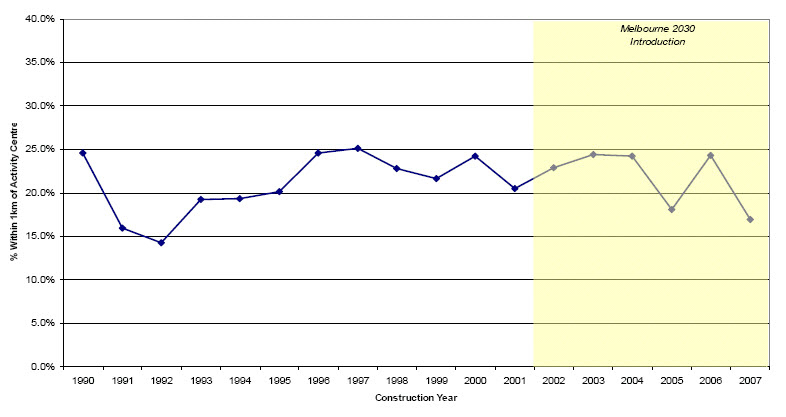
Percentage of new dwelling construction within 1km of a principal or major activity centre
A new research paper suggests that many of Melbourne 2030’s key ambitions in relation to housing have come to nought.
The paper, Planning and the characteristics of housing supply in Melbourne, was written by Dr Robin Goodman and a team of fellow academics from the RMIT Research Centre and published by the Australian Housing and Urban Research Institute (AHURI).
The first part of the project analysed a number of data bases on land transactions over the period from 1990 to 2007.
Contrary to the aspiration of Melbourne 2030, the researchers found that the proportion of new housing located within one kilometre of an activity centre did not increase following the promulgation of the Strategy.
In fact activity centres are not generally a favoured location for new housing. Of the 115 studied, just four account for almost a third of all housing built within one kilometre. Those four are all very close to the city centre – South Melbourne, Melbourne (CBD), Port Melbourne (Bay St) and Carlton (Lygon St). The ten with the highest proportion of new housing were either close to the CBD or in new parts of Growth Areas where developable land was still available close to activity centres.
When the radius is extended to two kilometres, the researchers found that the proportion of new housing actually declined since Melbourne 2030 was released.
They found a similar pattern with rail stations – the proportion of dwellings built within a one kilometre radius of a train station declined after Melbourne 2030 came into effect.
In addition, the delay between acquisition of property by a developer and completion of construction is more protracted on parcels that are closer to activity centres. Read the rest of this entry »
 The Melbourne Urbanist