Do firms want to be in suburban centres?
Posted: June 1, 2010 Filed under: Activity centres, Employment, Planning | Tags: activity centre, Edward Glaeser, Employment, Mathew Kahn, Melbourne 2030, Melbourne @ 5 Million, polycentricity, Silicon Valley, suburbs 3 CommentsWe know that most jobs in Melbourne are now in the suburbs. There’s also an increasing understanding that large metropolitan areas are now generally polycentric rather than monocentric in form i.e. there are significant activity centres outside the CBD with large numbers of jobs. The strategic planning update to Melbourne 2030, Melbourne @ 5 Million, released in October 2008, explicitly acknowledged this reality.
It is clear that firms can increasingly obtain the benefits of density, such as face-to-face contact, in both inner city and suburban centres where they don’t have to carry the extra costs in rent and congestion imposed by the very high density of the CBD. The CBD’s share of metropolitan jobs has consequently fallen significantly over the last 30-40 years (it has staged a small revival since 1996, showing significant jobs growth in absolute terms, but its share of metropolitan jobs has not increased).

Tysons Corner - the archetypal edge city
Yet many studies in many countries have found that while the number of suburban and inner city activity centres is increasing, the proportion of jobs located within them is falling. In fact, around a half to two thirds of employment in US cities is scattered across the metropolitan area at relatively low densities. Inter-city and cross-country comparisons are difficult, but the evidence suggests that suburban jobs are even more scattered in Melbourne.
It seems that firms can increasingly achieve the benefits of agglomeration at a larger geographical scale than that of the CBD or suburban activity centres. The advantages of physical proximity have apparently declined to such an extent that the costs of aggregation now exceed the benefits at ever lower levels of density.
But why are firms increasingly spurning density? Read the rest of this entry »
Should Parliament move to Werribee?
Posted: May 6, 2010 Filed under: Activity centres, Architecture & buildings, Decentralisation, Miscellaneous | Tags: bureaucrats, Decentralisation, Melbourne, Parliament House, politicians, public servants, regional development, relocation, Victoria, Werribee 3 CommentsContrary to what seems to be a widely held belief, it is not an easy matter to make jobs simply materialise in places that have a shortage of employment. It is a difficult and complex business that involves much more than merely rezoning land for business use.
However here’s an outrageous shortcut for developing Melbourne’s west. Why not shift the seat of Government in Victoria – politicians, bureaucrats, departments, the whole kit and caboodle – out of the CBD to somewhere like, say, Werribee?

Parliament House as it was intended...
Such an action would give an enormous boost to the development of the west and reinforce the Government’s new policy of developing significant suburban activity centres. A location like the west makes sense because the weight of future metropolitan growth will have to be north of the Yarra due to environmental constraints in the south and east.
This is a shocking idea but it’s not as far-fetched as it sounds (although I don’t mean to suggest that it would be costless or easy, much less politically tempting).
The standard argument for retaining the seat of Government in the CBD is that high level strategic operations obtain external economies of scale from co-location. Thus the efficiency of government in Victoria is greatly enhanced by face-to-face contact between politicians and bureaucrats on the one hand, and captains of business on the other. Further, the CBD maximises access to high human capital workers because of its excellent accessibility, particularly by rail, from all parts of the metropolitan area. Read the rest of this entry »
Are “urban villages” living in the past?
Posted: May 5, 2010 Filed under: Activity centres, Employment, Planning | Tags: CBD, employment balance, employment self sufficiency, road pricing, specialisation, urban villages, wasteful commuting 1 CommentThe Premier wants a Melbourne which encourages the transformation from a mono-centric to a multi-centred city, “so that people can work closer to where they live”. He goes on to laud Melbourne as “a city we’re all proud of – ‘a city of villages’, a whole that is greater than the sum of its parts.”
I’m not completely sure what he intends but I wonder if he’s thinking about “urban villages” where the great bulk of jobs are filled by local residents who live at density and walk to work. This is an old idea in planning and the Victorian planning department ran strongly with the idea in 1996.

Kogarah Town Centre
Whether or not “employment self-sufficiency” can be achieved in practice depends on the level of geography. If we look at Melbourne from a regional perspective, most people already work in the same region in which they live (other than for jobs in the CBD) – see this paper by Kevin O’Connor and Ernest Healy. The median journey to work time in Melbourne is consequently a reasonable 30 minutes by car (55 minutes by public transport, reflecting longer trips to the city centre).
However achieving something like “self-sufficiency” in employment at a smaller geographic level is hard. There are a number of reasons for this.
One is the increasing complexity of households. In two income households both parties frequently work in separate locations, so they either elect to live near one member’s workplace (and if so which one?) or they select a compromise location. Children who continue to live at home after they’ve entered the work force have no flexibility to live closer to where they work. If changing jobs involves a change in job location then that adds another layer of difficulty.
Another reason is that the journey to work has declined in importance as a determinant of where people live. It now accounts for only one fifth to one quarter of all trips, as people travel a lot more for other purposes than they used to. There is now less reason to live near work. Other factors like the level of local amenity seem to be an increasingly important determinant of the residential location decision. Read the rest of this entry »
Are all suburban centres the same?
Posted: April 20, 2010 Filed under: Activity centres, Employment | Tags: Activity centres, density, industries, location quotient, specialisation index, suburbs 2 CommentsLast week I looked at the geography of suburban jobs in Melbourne (Where are the suburban jobs?), finding there are 31 centres that account for just 20% of all suburban jobs. There is a large variation in the size of centres, with the largest four – Clayton, Tullamarine, Kew/Hawthorn and Box Hill – accounting for nearly half of the jobs in these centres.
Today I want to look at the economic functions of suburban centres, as indicated by their industry composition. If a centre is specialised by industry compared to jobs in the rest of the suburbs, it suggests it has a distinct economic role. It could also mean that the benefits of agglomeration may not be especially important.

Specialisation Index scores for suburban centres. 13 centres score 0.3 or higher. Dotted line shows score for suburban jobs located outside centres (click to enlarge)
Actually it’s a little more complex than that – specialisation implies that being in a large, diverse centre is not that important, but being spatially close to firms in the same or a related sector is. In other words, firms seek to minimise the costs of density by locating just with “their own kind” and avoid the overhead of firms from whom they obtain little benefit.
The data shows that the economic functions of suburban centres are many and varied and differ markedly from the 80% of suburban jobs that are not located in centres. Some centres are dominated by a single industry and accordingly have a distinct “personality”. There are thirteen such centres, mostly focussed on Retail or Manufacturing, although Latrobe is concentrated in Education and Heidelberg in Health.
Yet that only tells part of the story. With only one exception, all centres have a specialisation in at least one of 17 industries and some are specialised in multiple industries. For example, although Box Hill is not dominated by a single industry like Latrobe is, it nevertheless has specialisations in Health and Government (defined as having at least twice the share of jobs in each of these two industries as jobs located outside centres do). Health accounts for 27% of jobs in Box Hill and Government for 17% – the respective figures for suburban jobs outside of centres are just 11% and 4%.
Some centres like Burwood East, Sunshine and Broadmeadows are specialised in three industries. The only truly “diversified” centre is Kew/Hawthorne, whose sectoral composition is reasonably similar to that of the rest of the suburbs in all industries (note that larger centres tend to have fewer specialisations because there is less variability). Read the rest of this entry »
Where are the suburban jobs?
Posted: April 16, 2010 Filed under: Activity centres, Employment | Tags: Activity centres, Employment, Melbourne, suburbs 10 CommentsWhere are suburban jobs – are they located in activity centres or are they spread more or less uniformly across the suburbs?
Many people are surprised to learn that nearly three quarters of the jobs in Melbourne are located more than 5 km from the CBD i.e. in the suburbs (see The jobs are already in the suburbs). Here’s another surprise – only 20% of those suburban jobs are located in medium to large activity centres.
The other 80% aren’t sprinkled throughout residential areas in stand-alone developments (although some most definitely are). Rather, they’re mostly located in relatively small centres, for example in what Melbourne 2030 curiously calls Major Activity Centres.

Suburban employment centres - circles proportionate to job numbers. Click to enlarge
Defining an activity centre is not as straightforward as it might appear. There are a number of possible approaches, such as identifying higher density clusters of jobs, people or trip ends. Another way is to look for concentrations of particular land uses such as retail space. In practise, planning agencies don’t always seem to apply a lot of rigour to defining centres. Counting the area of retail space seems to suffice in many cases, or accepting historical hierarchies in others.
I defined centres as agglomerations of employment. This is in line with the customary approach in the literature on this topic and is appropriate because employment is a good indicator of economic activity. I broke Melbourne down into 1,950 zones and applied minimum thresholds for job numbers and gross job density to each zone using 1981- 2006 Census data. Zones that exceeded both thresholds constitute centres (contiguous qualifying zones are aggregated to a single centre).
Using 2006 Census job data, I found there are 31 suburban centres in Melbourne. These contain just one fifth of all suburban jobs. That low proportion is not because my thresholds are taxing – I used the mean values of employment and density for all zones across Melbourne. The suburban centres collectively are only around one eighth as dense as the CBD (defined to include Docklands and Southbank).
If I were to set the density threshold at the same level as the inner city (including the CBD) then only 7% of all suburban jobs would be in centres. If it were set at just over half the density of the CBD then just 2% of suburban jobs would be in centres (they would be Box Hill, Doncaster, Dandenong, Wantirna Sth and Heidelberg).
I also found that the proportion of suburban firms located in centres declined significantly over 1981-06, although the number of centres increased. This is a near-universal trend in US cities and is often interpreted as signifying that density is declining in importance as transport and communication costs have fallen.
That such a relatively small proportion of suburban jobs is located in centres is an enormously important finding. It indicates that the great bulk of firms in the suburbs (and hence most firms in Melbourne) either eschew anything but modest density or, alternatively, simply can’t get access to higher density locations. Read the rest of this entry »
No foundation for policy on centres
Posted: April 9, 2010 Filed under: Activity centres, Employment, Planning | Tags: Activity centres, Broadmeadows, CAD, Central Activities Districts, Melbourne @ 5 Million, suburban centres, The Age 2 CommentsThe six building blocks for a better Melbourne announced yesterday by the Premier are innocuous (the term mother’s milk springs to mind) except for the third one, in which he pledges to ensure the planning system “encourages the transformation of Melbourne from a mono-centric to a multi-centred city, so that people can work closer to where they live”.
The belated recognition that large modern cities tend to have multiple major employment centres was set out in the Victorian Government’s supplementary strategy plan, Melbourne @ 5 Million, released in late 2008. The original strategy, Melbourne 2030, implicitly conceived of Melbourne as a nineteenth century monocentric city – with jobs in the centre and with the suburbs acting as dormitories for workers. The multitude of small suburban centres identified in Melbourne 2030 were seen as largely providing retail and personal services for residents.
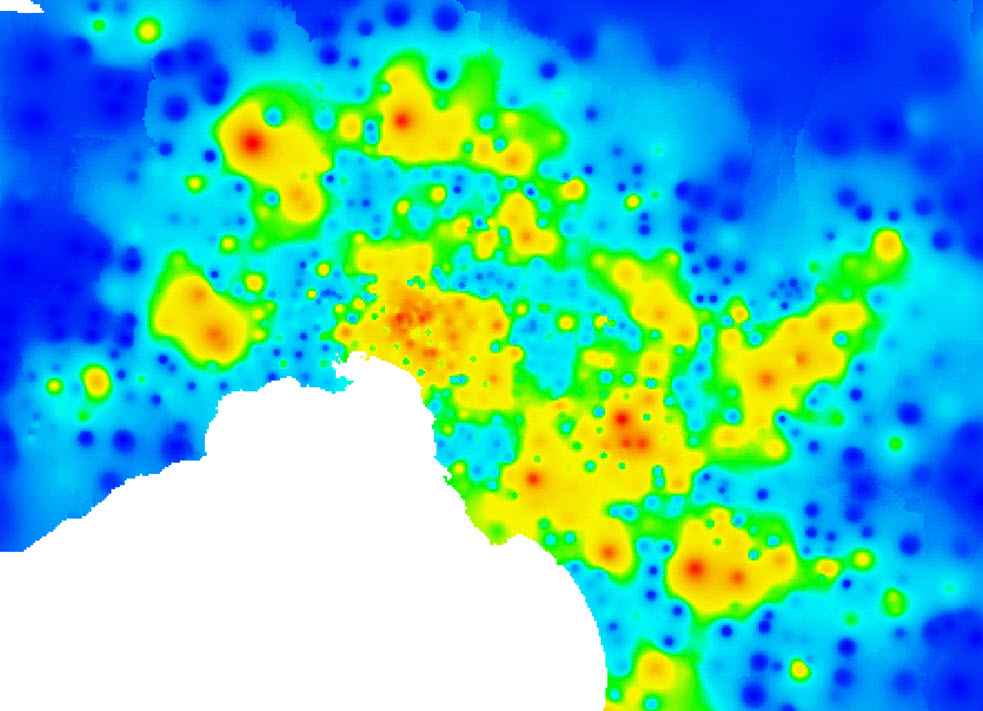
It seems the Premier knows that 72% of Melbourne’s jobs are now located more than 5 km from the CBD and 50% are more than 13 km out. But the Government doesn’t seem to know much about the geography of suburban jobs, particularly the number and role of major suburban activity centres.
Melbourne @ 5 Million designated six new Central Activities Districts (CADs) to provide “significant CBD-type jobs and services” in the suburbs. The Age described them as “mini-CBDs”. They are Broadmeadows, Box Hill, Dandenong, Footscray, Frankston and Ringwood.
I find it very hard to imagine that any of these CADs can seriously be thought of as having the potential to provide “significant CBD-type jobs and services”, at least in the foreseeable future. All the indications are that six of the existing Transit Cities were simply redesignated as CADs without much further thought.
Consider the case of Broadmeadows. On 24 March The Age ran a story headlined “Broadie all set for major revamp”, with the subtitle “Broadmeadows could become a major economic centre in the north”*. According to the story, the outstanding prospects for Broadmeadows come down to its designation as a CAD.
I don’t however see much evidence that Broadmeadows is acquiring a CBD-type character. The story lists a number of major investments that are either proceeding or planned, all of which are public sector driven.
There’re new Council premises, a Global Learning Centre, a leisure centre, a secondary school, a tree-lined extension of Main St, an upgrade of the railway station and a parking station. There’s a planned seven level office building but it is intended to accommodate public servants. All in all, there is little evidence that the private sector, which is the backbone of the CBD, has much interest in Broadmeadows beyond retailing and consumer services.
An examination of the composition of jobs is revealing. Whereas almost half of all jobs in the CBD are in Commercial Services (i.e. Finance, Insurance, Business and Property), the corresponding figure for the Broadmeadows CAD is just 4%. Where it excels however, as the projects listed above suggest, is in government – 44% of jobs are in the public sector.
Broadmeadows also has neither of the other two key characteristics of the CBD – size and density. It has only 1% as many jobs as the CBD and is only one eighth as dense. The idea that it could function like the CBD in the foreseeable future seems fanciful. Read the rest of this entry »
Watch the growth of Walmart stores from 1962 to 2010
Posted: April 8, 2010 Filed under: Activity centres, Miscellaneous | Tags: 1962, animation, growth, movie, Sam's Club, stores, US, Walmart Leave a commentJust released is an updated version of the now-famous ‘growth of Walmart’ animation which maps out the geography of store openings in the US since the first Walmart opened in 1962. The new version extends the timeline to 2010 and includes data on Walmart’s hardware store, Sam’s Club. Read the rest of this entry »
Fake shopfronts
Posted: March 11, 2010 Filed under: Activity centres | Tags: activity centre, high street, revitalise, strip shopping centre 2 CommentsAt last somebody’s found a way to revitalise ailing strip shopping centres – fake shops! My local high street is all restaurants, boutiques and real estate agents – this could be a way to bring back the hardware store we lost ten years ago. Read the rest of this entry »
 The Melbourne Urbanist