– Can social media make cities better?
Posted: May 18, 2011 Filed under: Public transport, Technology | Tags: buses, Bustration, cities, social media, transport, urban planing 3 Comments
Bus lane blockers! - photo by @bustration
When government agencies first started to put up web sites in the 1990s, management tended to treat them as little more than electronic brochures. Typically, no one in authority bothered to respond to e-mails. I hope that agencies today aren’t making the same mistakes with social media.
Social media is a rich source of ‘intelligence’ for consumers, business and, not least, policy-makers and implementers. There’s an extraordinarily valuable and growing pile of information out there in the ether. Public agencies and private providers should be mining it like robber barons!
I follow the tweets of bus driver, @bustration, who records the tribulations – and the occasional delights – of life on the road. She drives in Melbourne, but what she sees is bound to be true of most places. Here are some of her tweets from the driver’s seat for three days this week (16th – 18th) on the topic of cars in priority lanes:
XPZ372 THP041 SGM740 WHV378 blocking bus lanes George St
YBL657 WGT124 blocking clearway Clow St Dandy
Tow away job http://twitpic.com/4ychje
2 more bus lane parkers Dandenong http://twitpic.com/4ychw4
Catch 22 tow truck blocks clearway Clow http://twitpic.com/4ycqr4
Blocking Clow st http://twitpic.com/4yr9ea
Blocking Walker st http://twitpic.com/4yr9y2
CUD954 OCS367 WHB316 XHY707 RLY829 first 5 Blockers of dozens
Dandy BL Blockers http://twitpic.com/4z5p3t
Tow em Danno! http://twitpic.com/4z5pis
Hmmm, is @bustration simply unlucky? Perhaps she’s just a glass half-full sort of a person? Or are her observations highly suggestive evidence that there’s a very serious problem with enforcing the rules on priority lanes? It’s odd how as a society we’ll spend billions in capital but then skint on making sure it can deliver to specification.
@bustration’s frustrations are an example of how smartphones and Twitter have lowered the costs of monitoring and information collection. Perhaps right now someone is building a ‘name and shame’ web site where disgruntled travellers can share pics of priority lane parkers. Or maybe somewhere in government there’re Twitter Analysts who’re already on to it!
Here is a selection of more @bustration’s tweets from earlier in May (I’ve selected from those that relate to public transport – there’re other tweets on less gloomy topics): Read the rest of this entry »
Does higher density mean lower car use?
Posted: March 5, 2011 Filed under: Cars & traffic, Planning, Public transport | Tags: Centre for Transportation Studies, cities, Gary Barnes, land use, Public transport, transit, University of Minnesota, urban areas, weighted density Leave a comment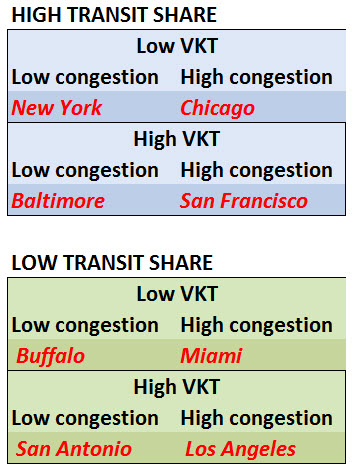
Travel outcomes (Barnes)
Not necessarily – in fact in the US, not even usually!
It’s a truism that denser, more concentrated cities tend to have higher public transport use. Various studies have confirmed this intuition but what is usually left unexamined is the implicit assumption that such cities consequently have lower car use.
This study of 31 of the largest cities in the US found that assumption is not correct. Higher public transport mode share does not translate on average to lower kilometres of travel by car, shorter commutes by car, or lower levels of traffic congestion.
The primary finding “is that land use, at least at the aggregate level studied here, is not a major leverage point in the determination of overall population travel choices”.
Undertaken by Gary Barnes from the Centre for Transportation Studies at the University of Minnesota, the research found that, if anything, “the higher densities that increase transit share tend to increase commute times and congestion levels”.
The main objective of the project was to identify the effect of land use on travel behaviour. Most studies concentrate on the effect of average density on one or two variables, usually transit share and sometimes total kilometres of car travel.
Barnes’ approach was much more extensive. For each urbanised area, he defined 15 descriptors of travel behaviour, 11 of land use and 15 other, mainly demographic, factors. Moreover, he employed the concept of ‘weighted density’ (he calls it ‘perceived density’) to more accurately describe the distribution of both population and employment in each city.
Barnes confirms that residential concentration increases transit’s share of travel, but he notes the effect is not large. Contrary to the underlying assumptions of much urban policy:
Even very large changes in land use have very little impact on travel behaviour, in good ways or in bad. Apparently the larger effects sometimes observed in neighborhood-scale studies are just that: neighbourhood-scale effects that do not extend their benefits to the larger urbanized area.
His analysis implies that increasing residential density by 100% would increase transit share by only 5-6%. To get a 1% increase in walking and cycling’s combined mode share would require an increase in residential density of 5,000 persons/mile2 (1,931/km2). Similarly, a 14% increase in density would only yield a 0.5% decrease in in-car travel time per person. Read the rest of this entry »
 The Melbourne Urbanist