– Can parking be managed better?
Posted: May 12, 2011 Filed under: Cars & traffic | Tags: Donald Shoup, Melbourne City Council, parking, pricing, San Francisco, SFpark 10 Comments
SFpark, San Francisco's experiment with dynamic pricing of parking spaces
I’m disappointed by the discussion of parking in Melbourne City Council’s draft Transport Strategy Update 2011-2030 (note – it’s a big download). There’s an opportunity to improve the efficiency of parking space allocation through using technology and pricing in combination, but Council seems content to pass on it.
The broad thrust of the discussion in the report is that the number of on-street parking spaces will decline over the next 20 years to enable public transport and amenity improvements to be implemented. Council is mindful of the impact this will have on its own revenues and those of local businesses, but is persuaded by the social and environmental benefits.
A key recommendation in relation to on-street parking is that Council “will implement new parking technology systems that allow payment without requiring parking machines or meters (and) will remotely sense and assess parking occupancy”. Surprisingly, this recommendation is entirely unsupported by any explanation or discussion. As far as it goes, it nevertheless sounds good – it’ll lower costs by eliminating the need for parking inspectors and it’ll give drivers more flexible payment options.
What seems to be missing, though, is the opportunity to provide drivers with real-time information about parking availability. More importantly, it squibs the opportunity to improve efficiency in allocating parking spaces by setting a price that’s responsive to demand.
The current pilot project just introduced in San Francisco, SFpark, gives a sense of what can be done. Like Melbourne City Council’s plan, it involves sensors that automatically sense if a parking space is empty. SFpark however will convey that information to drivers electronically via a smartphone app. That should reduce the time drivers spend cruising for parking. According to Donald Shoup, a Professor at UCLA and the author of The High Cost of Free Parking, several studies have found that cruising for curb parking generates about 30 percent of the traffic in CBDs in the US. He cites a study he did of a 15 block district in Los Angeles where cruising for on-street parking created 950,000 miles of excess vehicle travel per annum, in the process consuming 47,000 gallons of petrol and producing 730 tons of carbon dioxide.
But the real innovation of SFpark is that prices are adjusted in real time in response to rises and falls in demand. The objective is to ensure that, on average, there is at least one vacant space in each city block:
SFpark will adjust meter prices based on demand to encourage drivers to make trips in off-peak hours and to use parking lots and garages. While high-demand spaces will gradually go up in price, other spaces will decrease in cost……Once a space is found, longer time limits and new meters that accept credit and debit cards will make it easier to avoid parking tickets. Read the rest of this entry »
Is the Lord Mayor’s new parking charge a ‘money grab’?
Posted: May 19, 2010 Filed under: Cars & traffic | Tags: City of Melbourne, Donald Shoup, equity, George Costanza, Hoddle grid, Lord Mayor, Melbourne Business Council, parking, parking meter, Robert Doyle, VECCI 5 CommentsThe Lord Mayor of Melbourne, Robert Doyle, has bought himself a heap of trouble with Council’s decision to impose a flat $4 charge for parking in the CBD from 7.30 pm to midnight (see here, here, here and here).
The new fee will apply to 3,000 on-street metered parking spaces that are currently free at night. It will raise an estimated $1.9 million in revenue to be used for general Council purposes. Council is expecting to earn a similar amount from fines associated with the new policy.
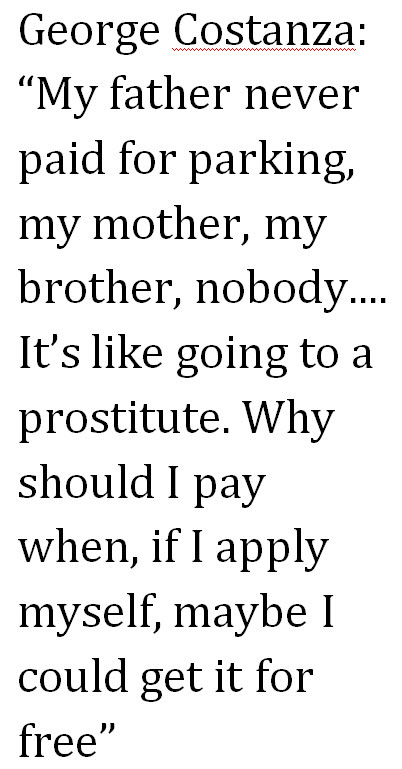
While some people think it will encourage greater use of public transport, others say it will have a severe impact on restaurants, movies and shows and is just a naked grab for money. Another criticism is that public transport is too unsafe at night and finishes too early to provide a satisfactory alternative to driving. Others vow they’ll stop visiting the CBD and go elsewhere.
I find the reaction extraordinary. In my view Council’s action is understandable – any time you have a scarce resource that is under-priced there are bound to be some perverse and inefficient outcomes. Melbourne is a 24/7 city – the streets of the CBD are frequently heavily congested at night, particularly on Friday and Saturday nights. Charging for parking at night makes sense.
The Melbourne Business Council however is concerned that people coming in to the CBD to see Fame or Sir Ian McKellen in Waiting for Godot will now have to pay for parking. VECCI is worried about the impact on restaurants, small bars and theatres. But who shells out $100 plus for tickets to a show or dinner and quibbles over $4 for parking? On the contrary, I expect patrons will feel they’re better off if it loosens up parking options a bit. Read the rest of this entry »
 The Melbourne Urbanist