Are young adults really dominating public transport use?
Posted: July 17, 2011 Filed under: Public transport | Tags: age, Australian Financial Review, Gen Y, passengers, patronage, Public transport 4 Comments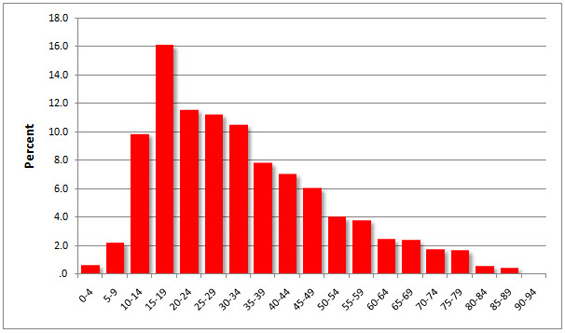
Actual use - age profile of public transport users in Melbourne (boardings) from VISTA
The world would be a much better place if transport operators would stop spinning patronage numbers to the media and public and start giving us the salient facts instead.
The Financial Review reported on Thursday that travellers in Melbourne aged 20-29 years comprise 38% of all public transport users in the city. This figure is in line with the claim of the WA Public Transport Authority that 18-25 year olds comprise 35% of all train users in Perth and 40% of all bus users.
As I’ve indicated before, I find these sorts of figures very hard to believe, given these two cohort’s each comprise around 15% of the population. In fact they’re extraordinary. It’s true young adults have always been over-represented on public transport because many are on relatively low incomes, but it’s the sheer scale of these figures I find too good to be true.
The reality is they’re not true, at least for Melbourne. The real situation is shown in the first exhibit. According to the Victorian Department of Transport’s VISTA database, travellers in the 20-29 age group account for only 22.3% of public transport users on an average day. If confined solely to the average weekday, the figure is a little lower, 21.9%. If instead we look at public transport boardings – to allow for the possibility that young adults make more multi-modal trips than others – the proportion in the 20-29 age group using public transport is a little higher, but still only 22.9%.
That’s a long, long way short of 38%. One explanation for this evident discrepancy could be that public transport operaters are measuring something else. VISTA is a snapshot of travel on a typical day, but it could be operators are counting the number of people who have ever used public transport – even if only once or twice – in some preceding period e.g. in the previous week, month or year. This will invariably give a much higher total patronage figure than VISTA or the Census because it picks up everybody who’s used train, tram, bus or ferry at least once during the (longer) period.
If this explanation is right, it would account for why claimed patronage levels for public transport are sometimes breathtakingly high compared to the customary, more rigorous ways of measuring travel. I’ve commented before on Metlink’s use of these sorts of inflated, self-serving numbers in its marketing material, but perhaps it’s a common practise in other states too. But by itself this explanation doesn’t fully account for why the young adult cohort’s share is apparently so high relative to others (see second exhibit). Read the rest of this entry »
Is the iPhone why Gen Y love public transport?
Posted: June 29, 2011 Filed under: Public transport | Tags: Gen Y, Generation X. baby boomers, iPhone, iPod, patronage, Peter Newman, Public transport, Public Transport Authority WA, smartphone, The West Australian 16 Comments
Most commonly used iPhone passwords
The “mystery factor” driving faster patronage growth on public transport may be Gen Y’s enthusiasm for staying connected through smartphones. Speaking to a reporter from The West Australian last week, Professor Peter Newman argued that previous generations found freedom and flexibility through the car, but generation Ys find freedom and flexibility by staying connected to friends, family and workplaces through information devices like laptops or iPhones (H/T Human Transit).
He went on to say: “They can stay connected on a bus or a train. They can bring the office with them. They can bring their study with them. They can’t if they’re driving”. The same news report also quotes a spokesperson from WA’s Public Transport Authority who says commuters aged between 18 and 25 years now make up 35% of all train users and 40% of all bus users, up from 30% and 38% respectively last year. As this same age group constitutes just 13% of all Australians aged over 17 years, that’s a phenomenal set of numbers.
Frankly, I’m a little sceptical about the claim that the patronage share of trains in Perth has risen five percentage points in just one year, but since I can’t find any other relevant information on the age profile of public transport users, I’ll (conditionally) go with it. However I’m in no way sceptical of the proposition that new technologies make public transport more attractive than it used to be. Like reading before it, the mobile phone was a big step forward in the 90s and now 3G means travellers can do even more things on the train or bus. Bring on free wi-fi – I hear even some stations on Sydney’s otherwise sad and sorry rail system have this facility.
I’m not convinced, though, that access to communication and entertainment technologies is the potent driver of young adult patronage that Professor Newman takes it to be. A much more likely driver, I think, is Gen Y’s falling interest in cars. It seems eminently plausible that if young adults aren’t driving as much as previous generations then they’re likely to be using public transport more. This is a topic I’ve discussed before in more detail, but in summary there is a range of reasons why members of Gen Y (born between 1982 and 2001) are driving less than previous generations. The key ones are: Read the rest of this entry »
Why are we driving less?
Posted: February 26, 2011 Filed under: Cars & traffic | Tags: Adam Millard-Bell, David Metz, distance driven, Gen Y, Lee Schipper, peak travel, saturation 6 Comments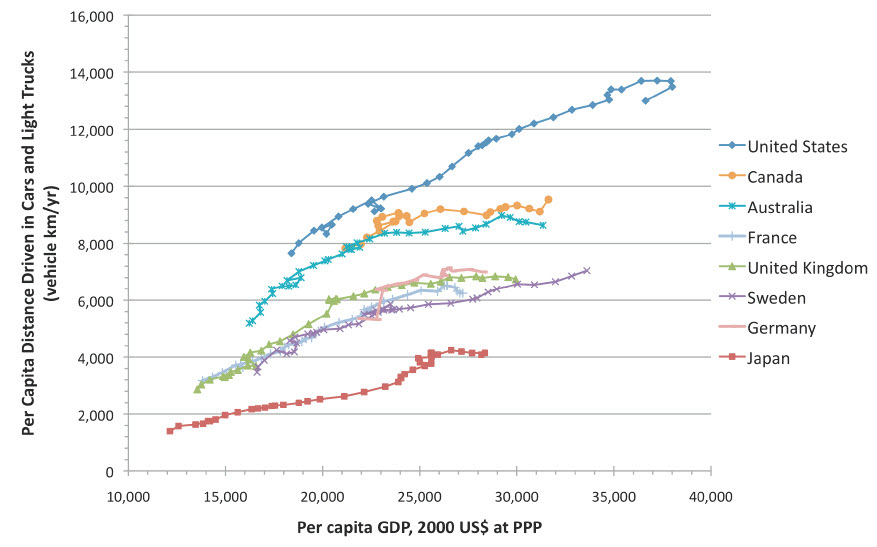
Per capita distance driven in cars and light trucks, 1970-2007/08 (click to enlarge)
I’ve mentioned before how travellers in developed countries like the United States, Britain and Australia are driving less.
The accompanying chart, from a new paper, Are we reaching peak travel? By Adam Millard-Ball and Lee Schipper of Stanford University, shows the change in per capita distance driven over the period from 1970 to 2007/08 (before the GFC in September 2008) in eight developed countries, including Australia.
It can be seen that the rate of growth in per capita car travel has been slowing for some time in Australia and has actually declined in recent years. As we’ve gotten richer we’ve driven less.
What explains this phenomenon? As with most things, it probably doesn’t come down to one dominant explanation. It’s more likely the coincidence of a number of factors (although some will be more important than others).
Higher petrol prices are one likely explanation because they started rising at a higher rate than the CPI about 10 years ago. However as I’ve discussed here, they didn’t rise any faster than average earnings over this period. Further, the flattening in car travel preceded the very large increase in the price of petrol from 2008.
Another likely explanation is increasing traffic congestion and greater restrictions on parking. Travellers may still drive for much the same time per day on average but lower speeds mean they can’t travel as far. Higher parking charges discourage car use and encourage use of alternative modes, at least for those like CBD workers who don’t have much choice about where they work.
While the declining rate of freeway construction in many cities contributes to traffic congestion, the converse is that greater investment in public transport has made it a more attractive alternative to driving for some types of trip.
This would be the case in the CBD where public transport is most competitive against cars. The rapid (absolute) growth in jobs in many central cities over the last 15 years would have helped shift more commuters onto public transport. Growth in population in the inner city could also have contributed somewhat to this phenomenon.
Vastly cheaper air travel has virtually wiped out the long distance drive. Thanks to Tiger Airways and their kind, there is now a generation of students that haven’t experienced the dubious delights of driving the Hume Highway. An increasing proportion of people don’t drive as much for the simple reason they spend a couple of weeks each year out of the country, either holidaying or on business. Their place is taken by incoming tourists who have a higher propensity to use public transport.
Also implicated in the decline is a range of what can loosely be termed ‘demographic’ factors. Read the rest of this entry »
Why is Gen Y driving less?
Posted: June 28, 2010 Filed under: Cars & traffic, Public transport | Tags: baby boomers, driving less, Gen Y, internet, Public transport 9 CommentsAfter growing consistently for many decades, car use is falling in developed countries (e.g. USA, Australia, Britain). A notable aspect of this decline is the fall-off in driving by young people.
New data from the US Federal Highway Administration (see here and here) shows that although they increased their share of the US population slightly over the period, those aged 21-30 accounted for only 14% of all miles driven in 2009, compared to 21% in 1995. Another study reports that in 2008 only 49% of 17 years olds had driver’s licenses compared to 75% in 1978.

There is now a sharp difference between Gen Y and baby boomers. A typical 58 year old in the US last year drove 11,607 miles, while the average 28 year old drove just 7,011 miles.
Neither the GFC nor the recent escalation of petrol prices fully account for these changes because the decline in driving preceded these events. So what is driving Gen Y to abandon what has traditionally been one of the great rewards of coming-of-age?
The explanation usually advanced is that the internet has enabled electronic communication to substitute for face-to-face contact. As I’ve pointed out before, however, reputable researchers conclude the exact opposite – electronic communication increases the demand for face-to-face contact more than it substitutes for it. Read the rest of this entry »
 The Melbourne Urbanist