Do more fast food restaurants make the locals fat?
Posted: December 13, 2010 Filed under: Education, justice, health | Tags: Anderson and Matsa, calories, fast food, fat tax, obesity, public health, restaurants 9 Comments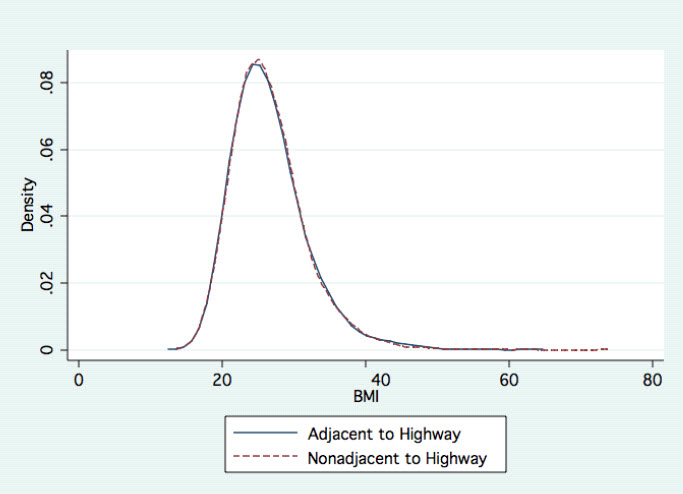
Distribution of BMI for people living in US towns adjacent and non adjacent to interstate highways (note there are 2 curves)
It’s commonly taken for granted that a disproportionately large number of fast food stores in an area is a key reason why the local population often has high rates of obesity.
The California Centre for Public Health Advocacy, for example, argues that “there is growing scientific evidence that what people eat—and their likelihood of being obese—is influenced by the food environment in which they live”.
More people are going to fast food restaurants where the food is high in calories and portions are large. Many respectable studies have shown a clear correlation between average body weight and eating out. According to one, growth in the number of restaurants accounts for as much as 65% of the rise in the percentage of Americans who are obese.
Various policies have been proposed to break the evident connection between fast food restaurants and obesity. These include proposals to limit the number of fast-food restaurants, ‘fat taxes’, limits on fast food advertising and mandatory calorie counts on menus.
But do fast food restaurants really cause obesity? As with many things, appearances may be deceiving. Correlation doesn’t mean causation.
This study, Are Restaurants Really Supersizing America?, by UC Berkeley researchers Michael Anderson and David Matsa, poses this question: “do more restaurants cause obesity or do preferences for greater food consumption lead to an increase in restaurant density?”. Read the rest of this entry »
 The Melbourne Urbanist