Will an airport rail link reduce GHGs?
Posted: July 5, 2010 Filed under: Airports & aviation, Energy & GHG, Public transport | Tags: Australian Greenhouse Office, Epping South Morang rail line, GHG, Melbourne airport, Public Transport Users Association, Skybus, Tullamarine freeway 7 CommentsGiven the evident public interest in the idea of a rail link from the CBD to the airport, I thought I’d look more closely at some of the key rationales for this project, starting with the claim that it would reduce greenhouse gas emissions.
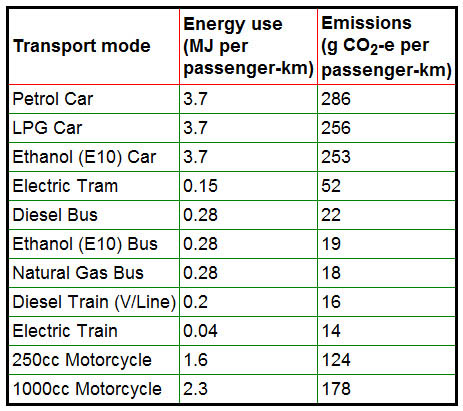
Energy use and emissions (PTUA)
I’ve looked at this issue and, on my admittedly simple calculations, I conclude that the value of greenhouse gas (GHG) savings from a rail line is likely to be minor compared to the probable cost. There are far cheaper ways to offset equivalent emissions than building a rail line.
I looked at this by making the following simplifying assumptions.
First, I assume that a new rail line captures 20% of airport passenger traffic or five million of the current 25 million annual passenger movements at Melbourne Airport. This is double the share captured at either Sydney or Brisbane (around 10%), and almost three times the 7% estimated in feasibility studies.
Second, I assume that all of the current two million passengers using Skybus transfer to the new train (i.e. Skybus ceases to operate) and three million passengers transfer from cars, including taxis.
Third, I assume an average distance of 22 km from the CBD to the airport for bus and train. I assume that the combined average distance travelled to the airport by the cars and taxis that are replaced by train is 35 km. Read the rest of this entry »
Forecasting patronage: it’s easy, isn’t it?
Posted: July 4, 2010 Filed under: HSR High Speed Rail, Infrastructure, Public transport | Tags: Clem 7 Brisbane, Cross City Tunnel Sydney, High Speed Rail, very fast train 2 CommentsWe’ve seen some high profile examples in recent years of how hard it is to forecast patronage on new transport infrastructure.
The Cross City tunnel in Sydney and the Clem 7 in Brisbane, for example, have both performed well below forecasts. Even when it was free, the Cross City tunnel did not approach the forecast volumes of 90,000 vehicles per day. Traffic volumes on the cross-river tunnel in Brisbane fell from almost 60,000 during the free period to around 20,000 in the first week of tolling.

Click to enlarge interactive map
California’s planned $42 billion High Speed Rail (HSR) project provides another example of the difficulties of forecasting demand. Although there are important differences between the design of the California HSR system and proposals for a Very Fast Train (VFT) between Sydney-Canberra-Melbourne, the former nevertheless has important lessons for us. I have previously discussed the VFT here, here, here and here.
A new analysis by the Institute of Transportation Studies, University of California Berkeley, found significant problems with the demand modelling and analysis undertaken for the California project by Cambridge Systematics (CS) “that render the key demand forecasting models unreliable for policy analysis”. Read the rest of this entry »
Cycling and walking on the rise in US
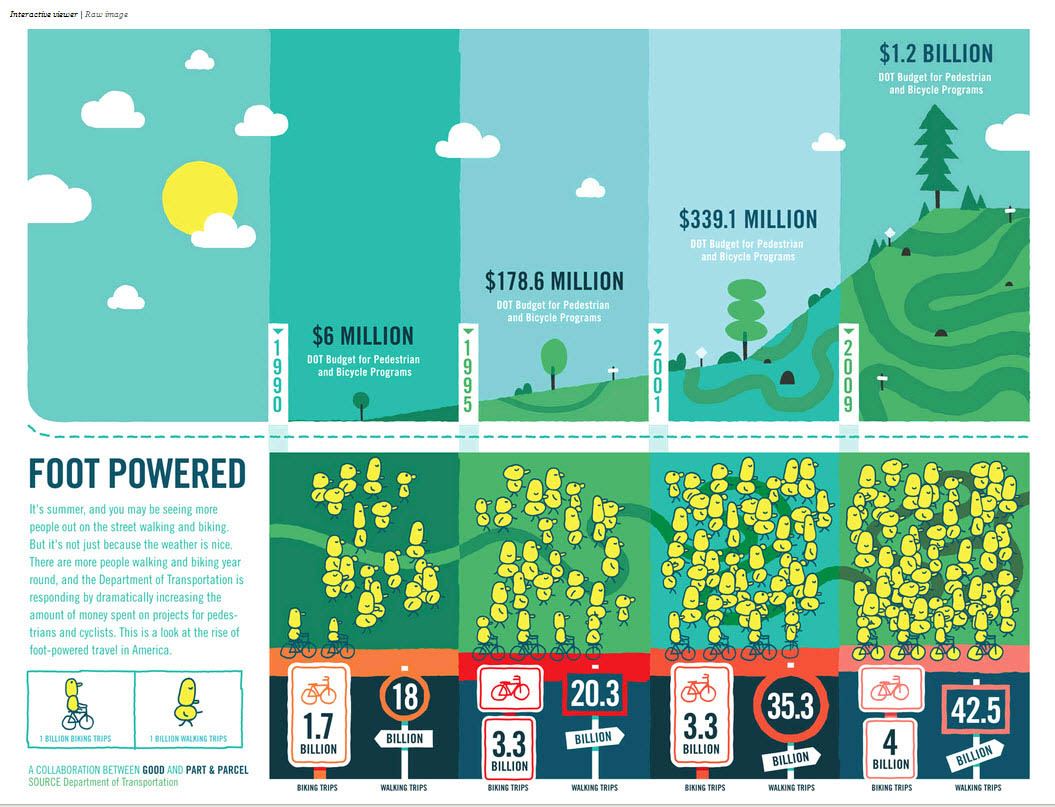
Posted: July 4, 2010 Filed under: Cycling | Tags: biking, Cycling, GOOD, Ray LaHood, US Department of Transportation, walking Leave a commentThis graphic is from GOOD and is titled The Rise of Walking and Biking (click to enlarge). The supporting text says “You may be seeing more people out on the street walking and biking. But it’s not just because the weather is nice. There are more people walking and biking year round, and the Department of Transportation is responding by dramatically increasing the amount of money spent on projects for pedestrians and cyclists”.
The increase in walking and cycling has comfortably out-paced population growth. Nevertheless, the ‘headline’ message is the increase in expenditure by the US Department of Transportation on sustainable forms of travel – it has risen much faster than either walking or cycling (from $6 million in 1990 to $1.2 billion in 2009), particularly since President Obama appointed former Republican House of Reps Member, Ray LaHood, to the position of Secretary of Transportation.
$1.2 billion looks good, but bear in mind that President Obama’s budget request for FY 2010 is over $3.5 trillion.
More on Melbourne Airport rail link
Posted: July 2, 2010 Filed under: Airports & aviation, Infrastructure, Public transport | Tags: Melbourne airport, rail link, Skybus, Tullarmarine freeway 19 CommentsThere’s been a strong reaction, predominantly negative, to my oped in The Age this morning where I argue that there are higher priorities for scarce transport funding at this time than the CBD-Airport rail link championed by the Lord Mayor and The Age.
I expected a hot reaction because The Age’s online poll is currently running 97% in favour of a rail link. Also, there were 208 comments, almost all strongly in favour of a rail link, on this piece run by The Age last Monday.
Some commenters seem to think my brief must be to defend the Minister for Transport and the Government. Others think I must be in the pocket of Skybus, the taxi industry, the Government, or all three. Someone’s even accused me of being anti public transport and of lamenting the decline in driving in my earlier post Why is Gen Y driving less? Lukas, who says he works in DPCD, reckons the consensus “around here” is we do need the link and the reason it’s not happening is “so many industries …have their hands in Brumby’s pockets”. Phew!!
Now that the flood of invective is slowing, let me say that not one of these personal insinuations is true. It is possible to raise serious questions about the desirability of this or any other transport project without being corrupt, incompetent or worse. No project, rail or otherwise, is automatically a “no brainer”.
My point remains that on the information publicly available, it does not seem to me that a rail link from the CBD to the airport is as high a priority at this time as some other pressing transport needs, such as improving outer suburban public transport services. Airport users generally have much better, if imperfect, options at present than those who live in the vast reaches of suburbia. Read the rest of this entry »
What makes you happy?
Posted: July 1, 2010 Filed under: Miscellaneous | Tags: Danny Dorling, Dimitri Ballas, happiness 2 CommentsThis question is important to everyone, including those most concerned with urban policy (believe it or not). One answer, which emphasises the dynamic over the static, is in this paper by Dimitri Ballas and Danny Dorling, Measuring the impact of major life events upon happiness, International Journal of Epidemiology, 2007, 36(6) 1244-1252. Here’s the authors’ summary:

Background
In recent years there have been numerous attempts to define and measure happiness in various contexts and pertaining to a wide range of disciplines, ranging from neuroscience and psychology to philosophy, economics and social policy. This article builds on recent work by economists who attempt to estimate happiness regressions using large random samples of individuals in order to calculate monetary ‘compensating amounts’ for different life ‘events’. We estimate happiness regressions using the ‘major life event’ and ‘happiness’data from the British Household Panel Survey.
Results
The data and methods used in this article suggest that in contrast to living states such as ‘being married’, it is more events such as ‘starting a new relationship’ that have the highest positive effect on happiness. This is closely followed by ‘employment-related gains’ (in contrast to employment status). Also, women who become pregnant on average report higher than average levels of subjective happiness (in contrast to ‘being a parent’). Other events that appear to be associated with happiness according to our analysis include ‘personal education-related events’ (e.g. starting a new course, graduating from University, passing exams) and ‘finance/house related events’ (e.g. buying a new house). On the other hand, the event that has the highest negative impact upon happiness according to our analysis is ‘the end of my relationship’ closely followed by ‘death of a parent’. Adverse health events pertaining to the parents of the respondents also have a high negative coefficient and so does an employment-related loss. Read the rest of this entry »
 The Melbourne Urbanist