Solar powered Melbourne
Posted: May 9, 2010 Filed under: Miscellaneous | Tags: music, planets, Solarbeat, Whitevinyl 1 Comment
Solarbeat (click to play)
There have to be a zillion opportunities to apply this idea to Melbourne. This movie by Whitevinyl, titled Solarbeat, shows the motion of the planets around the sun – a note is played each time a planet completes a year i.e. one orbit.
It could be applied to the motion of cars, trams, pedestrians, garbage trucks, ideas, footy, tourists, – in short anything that moves physically, metaphorically, etc. This really could be the sound of Melbourne.
Why did the NYC road pricing proposal fail?
Posted: May 8, 2010 Filed under: Cars & traffic, Infrastructure | Tags: Bruce Schaller, congestion charge, Mayor, Michael Bloomberg, New York, road pricing 2 CommentsThis paper is an object lesson in the pitfalls of attempting to introduce cordon pricing. Written by Bruce Schaller from the New York City Department of Transportation, it analyses Mayor Bloomberg’s failed 2007 congestion pricing proposal (it was ultimately blocked by the State legislature).
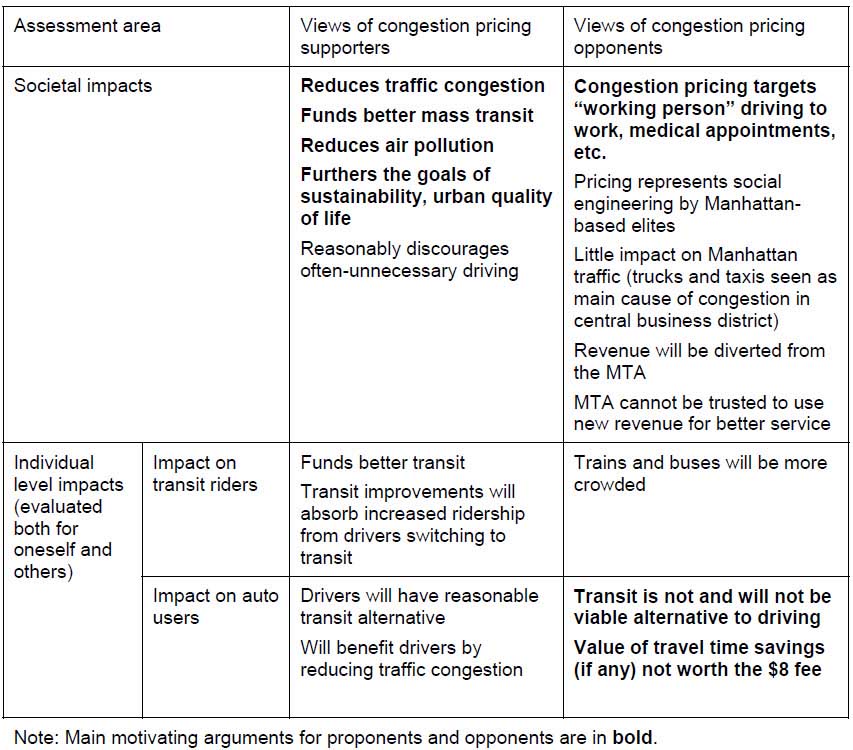
Opposing views on congestion charging (click to enlarge)
The key message is that gaining support for pricing proposals requires more than showing the social benefits – it is necessary to persuade individual motorists they will be better off. The New York experience shows small groups can have great influence – only 5% of workers would have paid the toll.
The author also argues that the best prospects for successfully implementing road pricing lie in initiatives like High Occupancy Toll lanes (see my previous post on this topic in relation to Melbourne) as motorists are less likely to feel they will be disadvantaged.
This table is a neat summary of the key views of proponents and opponents.
Should bicycle lanes be abolished?
Posted: May 7, 2010 Filed under: Cars & traffic, Cycling | Tags: arterial roads, Assen, bicycle lane, Copenhagen, Cycling, Netherlands, vehicular cycling 3 CommentsOver on the Bicycle Victoria Forums there’s a thread on something called “vehicular cycling”. This term is new to me and probably to most readers too.
As I read it, the key premise of vehicular cycling is that cyclists should “claim” the roads. Rather than being segregated in bicycle lanes that too often are narrow and impeded by parked cars – or worse, herded into off-road paths that are too indirect and are shared with unpredictable pedestrians – vehicular cyclists ride well away from the edge of a lane (although not in the middle) in order to be more visible to drivers and hence safer.

Cyclists in Copenhagen
They are concerned that construction of separate cycling infrastructure, such as Copenhagen-style lanes and on-road lanes, will reinforce the idea that cyclists are not legitimate road users.
There’re possibly some nuances here I’ve missed, but that seems to be the general idea. I think there’s a lot of logic to it. Even if a completely segregated network is feasible, it will be a long-term project, so there’s little choice other than to mix it with motorists in the meantime. And the meantime is likely to be a long time. Even in The Netherlands and Denmark, a significant proportion of cycling continues to be done on roads. So it seems sensible to find ways that cyclists and motorists can co-exist safely.
I can see that responsible cyclists, who ride defensively and maximise their visibility, could very well be safer if they adopt a more assertive approach. However I’m much less sanguine about how safe vehicular cycling is for irresponsible riders. Here I’m thinking mainly about children but there are also some adults who do irresponsible things like ride at night in dark clothing or without lights. Read the rest of this entry »
Should Parliament move to Werribee?
Posted: May 6, 2010 Filed under: Activity centres, Architecture & buildings, Decentralisation, Miscellaneous | Tags: bureaucrats, Decentralisation, Melbourne, Parliament House, politicians, public servants, regional development, relocation, Victoria, Werribee 3 CommentsContrary to what seems to be a widely held belief, it is not an easy matter to make jobs simply materialise in places that have a shortage of employment. It is a difficult and complex business that involves much more than merely rezoning land for business use.
However here’s an outrageous shortcut for developing Melbourne’s west. Why not shift the seat of Government in Victoria – politicians, bureaucrats, departments, the whole kit and caboodle – out of the CBD to somewhere like, say, Werribee?

Parliament House as it was intended...
Such an action would give an enormous boost to the development of the west and reinforce the Government’s new policy of developing significant suburban activity centres. A location like the west makes sense because the weight of future metropolitan growth will have to be north of the Yarra due to environmental constraints in the south and east.
This is a shocking idea but it’s not as far-fetched as it sounds (although I don’t mean to suggest that it would be costless or easy, much less politically tempting).
The standard argument for retaining the seat of Government in the CBD is that high level strategic operations obtain external economies of scale from co-location. Thus the efficiency of government in Victoria is greatly enhanced by face-to-face contact between politicians and bureaucrats on the one hand, and captains of business on the other. Further, the CBD maximises access to high human capital workers because of its excellent accessibility, particularly by rail, from all parts of the metropolitan area. Read the rest of this entry »
Are “urban villages” living in the past?
Posted: May 5, 2010 Filed under: Activity centres, Employment, Planning | Tags: CBD, employment balance, employment self sufficiency, road pricing, specialisation, urban villages, wasteful commuting 1 CommentThe Premier wants a Melbourne which encourages the transformation from a mono-centric to a multi-centred city, “so that people can work closer to where they live”. He goes on to laud Melbourne as “a city we’re all proud of – ‘a city of villages’, a whole that is greater than the sum of its parts.”
I’m not completely sure what he intends but I wonder if he’s thinking about “urban villages” where the great bulk of jobs are filled by local residents who live at density and walk to work. This is an old idea in planning and the Victorian planning department ran strongly with the idea in 1996.

Kogarah Town Centre
Whether or not “employment self-sufficiency” can be achieved in practice depends on the level of geography. If we look at Melbourne from a regional perspective, most people already work in the same region in which they live (other than for jobs in the CBD) – see this paper by Kevin O’Connor and Ernest Healy. The median journey to work time in Melbourne is consequently a reasonable 30 minutes by car (55 minutes by public transport, reflecting longer trips to the city centre).
However achieving something like “self-sufficiency” in employment at a smaller geographic level is hard. There are a number of reasons for this.
One is the increasing complexity of households. In two income households both parties frequently work in separate locations, so they either elect to live near one member’s workplace (and if so which one?) or they select a compromise location. Children who continue to live at home after they’ve entered the work force have no flexibility to live closer to where they work. If changing jobs involves a change in job location then that adds another layer of difficulty.
Another reason is that the journey to work has declined in importance as a determinant of where people live. It now accounts for only one fifth to one quarter of all trips, as people travel a lot more for other purposes than they used to. There is now less reason to live near work. Other factors like the level of local amenity seem to be an increasingly important determinant of the residential location decision. Read the rest of this entry »
Does My School have lessons for planners?
Posted: May 4, 2010 Filed under: Education, justice, health | Tags: ACARA, Barry McGaw, Camberwell High, Census, East Ivanhoe, Education, justice, health, ICSEA, Julia Gillard, My School, NAPLAN 6 CommentsThe brouhaha over My School is an important lesson for those of us interested in geography because it demonstrates how misleading a reliance on average values can be.
In a previous post, Limitations of My School, I pointed to some problems with the Index of Community Socio-educational Advantage (ICSEA) used on the My School web site. In particular, I was surprised to find that prestigious Melbourne Grammar scored much the same on ICSEA as nearby State school, Camberwell High.
This unlikely result was because each school’s ICSEA rating is calculated from the social and economic characteristics of the Census Collection Districts in which its students live.

Camberwell High School
The problem is that although the average socioeconomic status of Camberwell and surrounds is very high, there are nevertheless significant numbers of residents whose incomes don’t extend to finding upwards of $20,000 per annum in post tax income to fund a private school education for each of their children.
In other words, Camberwell High ranks highly on ICSEA because its students live in ritzy areas, not because the students themselves come from relatively well-off families (although some former students, like Kylie Minogue, have gone on to considerable financial success).
What this tells us is that not all households within a cluster of contiguous suburbs earn the average income – there’s considerable variability even though the suburbs might, on average, be quite affluent.
To throw further light on this issue, I looked at the incomes of families in Ivanhoe East at the 2006 Census to try and get a handle on the degree of variability in income within a small geographical area. Ivanhoe East is around the same distance from the CBD as Camberwell and has 984 families. It has about six times as many dwellings as a Census Collector’s District (Camberwell has 5,011 families). Read the rest of this entry »
Do the numbers support the Very Fast Train?
Posted: May 3, 2010 Filed under: Energy & GHG, HSR High Speed Rail, Infrastructure, Public transport | Tags: GHG, greenhouse gas, High Speed Rail, Melbourne airport, Sydney airport, very fast train 16 CommentsI’ve run some numbers on how a Very Fast Train in the Sydney-Melbourne corridor would stack up against planes in order to flesh out the questions I posed last week (Is the VFT all huff and no puff?). I used a simple “back of the envelope” methodology adapted from that used by Harvard’s Edward Glaeser to evaluate high speed rail projects in the US (here).
I estimate the economic and environmental benefits of carrying all current Sydney-Melbourne air traffic by VFT rather than plane at around $840 million p.a. (although this does not include the cost of GHG emissions from construction of a rail line – this would be large).
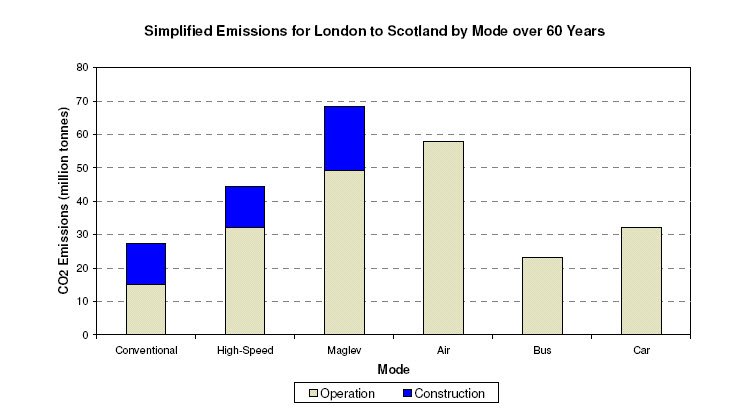
Table by Booz Allen
At first glance a VFT looks unpromising, since I estimate the capital cost of constructing and maintaining a VFT line from Sydney to Melbourne at about $1.5 billion per year. This is well in excess of the benefits.
However this assumes Sydney can accommodate passenger growth by using larger planes. It quite possibly can, but if it can’t and a second Sydney airport has to be built, a VFT starts to look viable if the cost of the airport were to come in at around $15 billion.
Let me emphasise that this is a simple analysis. I’ve left out many complications, including Canberra passengers and car traffic on the Hume.
The only environmental issue I’ve included is (operating) GHG. And of course I’ve made assumptions on things like construction costs and future interest rates.
Starting with capital costs, estimates of the cost to acquire land and construct a VFT line range from $14 to $82 million per km in Europe and the US (Japan is much higher because of earthquake risks). I assume a middling cost of $30 million per km, giving a total cost of $27 billion to build a 900 km line (the existing Sydney-Melbourne rail line is 950 km). I’ve assumed an interest rate of 5% p.a. and annual track maintenance cost of $124,000 per km. These assumptions give a total capital cost for the line of $1.5 billion per annum. Read the rest of this entry »
Is Melbourne really bigger than Los Angeles?
Posted: May 1, 2010 Filed under: Planning, Population | Tags: Los Angeles, Melbourne, Melbourne Zombie Shuffle, Population, Sydney, Zipf's Law, Zurich 19 CommentsDeirdre Macken makes the point in today’s AFR (gated) that a large proportion of Australia’s population is located in a very small number of primate cities, unlike the US where there are very many smaller cities.
She argues that if you want an urban lifestyle in Australia you either live in a large capital city or you camp out, whereas in the US you are spoilt for choice. Instead of making our capital cities larger, she asks, why don’t we build up our smaller cities?
Good question and if I weren’t about to go to the Zombie Shuffle I might well have something to say about it. Perhaps another day.

Not the Melbourne Zombie Shuffle but the footy! (The Age, today)
However for the moment let me just respond to her claim that “if Sydney were transported to the US, it would rank as the second-biggest city after New York. If Melbourne were transported to the US, it too would be the second biggest city, just pipping Los Angeles’s 3.8 million”.
A mere 3.8 million people in LA? I’ve got a lot of sympathy for journalists but this seems a bit too obvious. Perhaps Deirdre doesn’t do much travelling. She’s also got form when it comes to playing fast and loose with the numbers.
Sydney’s population is currently around 4.5 million and Melbourne’s is 4.0 million. Los Angeles had a population in 2009 of 12.9 million. In fact there are ten US cities that are larger than Sydney and fourteen larger than Melbourne (see here and here). Read the rest of this entry »
 The Melbourne Urbanist