Is the Flinders St Station design competition just about…..design?
Posted: November 16, 2011 Filed under: Public transport | Tags: architecture, competition, design, Flinders St Station, Geoffrey London, Ted Baillieu 5 Comments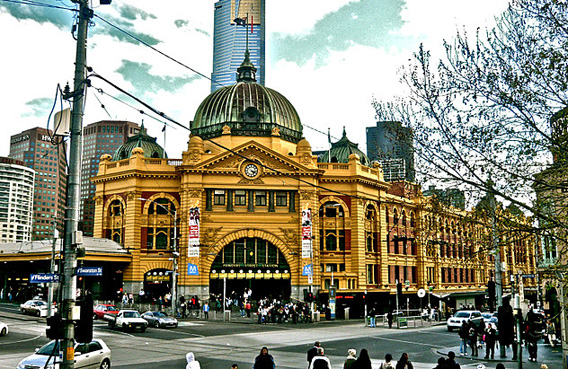
Melbourne's iconic Flinders St Station (this gorgeous photo by Gillian at Melbournecurious.blogspot.com)
The Premier gave the Flinders St Station International Design Competition another nudge this week, announcing entries will be formally invited from architects mid next year, with the winner to be announced mid 2013.
Mr Baillieu indicated the project for the 4.7 ha site has two basic components. One involves “restoring and renovating the building” and the other is about “releasing any opportunities for further development”. According to The Age:
Mr Baillieu said renovation of the heritage-listed station would be very expensive, and the government was looking for ways to ”release some value” to help bankroll the development, including the possibility of a public-private partnership. A property developer will sit on the competition judging panel, as well as Victoria’s government architect, Geoffrey London.
I’ve previously questioned the sense of running this project as a design competition, but there are a couple of other aspects that also worry me.
One is that this isn’t really first and foremost an “architectural design competition”. That’s a convenient way to market the project because it sounds innocuous – everyone knows architects are sensitive characters who care about design, heritage and place.
But all the signs suggests this is really a search for commercial uses that will generate revenue for the Government – at least enough to pay for the restoration and renovation, but hopefully more. The key players will be organisations with the wherewithal to “release some value” – i.e. to identify, develop and finance new uses that generate profits.
These sorts of players are traditionally called property developers or merchant bankers, not design professionals. Architects will still have a key role in the physical expression of the new Flinders St Station precinct but they won’t be the motive force determining what sort of activities take place there.
So-called competition entries will primarily be commercial bids, rather than primarily design submissions. The novelty is the bid consortia will presumably all have to be led by architects, at least nominally.
The project is likely to be as much about the redevelopment, as the restoration, of the precinct. Redevelopment can be positive provided it is handled in a way that’re sympathetic to the transport, heritage and civic importance of this precinct. And there’s certainly plenty that needs to be done – addressing that horrible concourse-cum-food court for a start.
However redevelopment can also mean some of the values that define the precinct might be put at risk. Mr Baillieu recognises there could be new buildings but says they will have a “common sense” height limit. Hmmm……I doubt we all have the same number in mind!
Another key issue is the “competition” shouldn’t be conceived as a fishing expedition. A potential danger with competitions is officials, politicians and the public could be seduced by a spectacular proposal – a one trick pony – that fails in other important respects. The brief is thus supremely important. Read the rest of this entry »
Is Avalon side-tracking Tullamarine rail?
Posted: August 15, 2011 Filed under: Airports & aviation | Tags: Avalon Airport, aviation, China, Gordon Rich-Phillips, High Speed Rail, investment, Lindsay Fox, Melbourne airport, rail, Robert Doyle, Ted Baillieu 5 Comments
Some famous faces spruiking Avalon Airport to Chinese investors
The Baillieu Government is determined to press on with its election commitment to start construction of the $250 million rail link to Avalon Airport in its first term. The Premier did this nice photo op last week waving-in planes at Avalon.
The Age reporter, Andrew Heasley, took a clever line, asking how the Government could commit to Avalon while spending just $6 million on a feasibility study for a rail line to Melbourne Airport. That produced this bizarre explanation from the State’s Aviation Minister, Gordon Rich-Phillips, who effectively said Avalon is going ahead because it’s easier:
There are challenges around an airport link for Melbourne ……Avalon is a clearer project than Melbourne in terms of the logistics associated with doing it. The reality is.…the lack of development around its [Avalon’s] immediate vicinity makes a lot of those logistics questions at Avalon easier than they are for Melbourne….. We have committed to work at Avalon and we’ve committed to feasibility at Melbourne. We don’t have a project for Melbourne [Airport], we have a feasibility study for Melbourne.
While I admire Mr Rich-Phillip’s unusual and possibly courageous frankness, I can’t see that ease matters more than need. Otherwise we’d build new schools where it’s cheapest rather than where the population is growing. Or the Government would be putting Protective Services Officers in retirement villages rather than on rail stations.
I won’t go into depth about what a silly idea the Avalon rail link is because I discussed it only a few weeks ago (Is the Avalon rail link Baillieu’s folly?). Suffice to say that Melbourne Airport is 22 km from the CBD, is the second busiest airport in the country, and has enormous scope for expansion; Avalon is 55 km away, has just six scheduled flights a day, and has enormous scope for expansion. Even if a rail line were built to Avalon, you’d have to wonder what the frequency, hours of operation and ongoing financial losses would be – it’s got to be sobering that Brisbane Airport’s train stops running at 8pm. I don’t have any problem with Avalon Airport per se, my worry is why taxpayers have to kick in when there are better uses our dollars could be put to.
This fascinating PR video produced to market Avalon to Chinese investors (see exhibit) shows what a cast of famous characters are backing Lindsay Fox’s Avalon venture, from the Prime Minister to the Lord Mayor. I know some gilding of the lily should be expected, but seriously Robert Doyle, how could you say “Avalon is the gateway to Melbourne” with a straight face? And as if, Lindsay Fox, travellers using Avalon could continue to get “on a plane in five minutes” if it really did grow to the size you imagine and hope it will?
What I didn’t know until I viewed the video is the Victorian Government, according to the Premier, has “committed to build a fuel pipeline for jets” to Avalon. This is all on the back of Avalon being “Melbourne’s second international airport”. As I’ve said before, it’s time we were given some explanation for what a second international airport actually means – is it something more than a place for motor racing teams and pop stars to land their cargos once a year? No one is going to seriously believe they’ll transport Ferraris to Albert Park or amplifiers to Rod Laver Arena by rail. What’s the logic behind it? We need a clear explanation – in terms of quantified benefits – of why governments are apparently prepared to spend hundreds of millions on infrastructure for Avalon.
Of course, construction of Avalon rail will have minimal practical effect on the need for a rail link to Melbourne Airport, although it could conceivably have a big effect on whether the Government feels obliged politically to proceed with the latter project. What they both have in common however is that no considered case has yet been made for either one. However The Age’s story – subsequently taken up as fact by these letter writers to the paper – implies that rail to Melbourne Airport is automatically a good idea. It’s certainly an infinitely better idea than rail to Avalon (what wouldn’t be?), but it’s by no means obvious that it’s needed now, as I’ve pointed out a number of times before (see Airports & Aviation in Categories list in the sidepane). Read the rest of this entry »
Is the Avalon rail link Baillieu’s folly?
Posted: August 1, 2011 Filed under: Airports & aviation | Tags: Avalon Airport, Barbara Tuchman, Freight Futures, rail, Ted Baillieu, The March of Folly, Tiger Airways, transport 7 Comments In her famous book, The march of folly: from Troy to Vietnam, multiple Pulitzer Prize winning author Barbara Tuchman describes how governments sometimes persist, despite overwhelming evidence to the contrary, with policies that are against their own interests.
Ted Baillieu’s folly might be his Government’s unconditional election commitment to build a rail line to Avalon Airport. Handed the perfect opportunity to begin stepping backwards from the project by reports of Tiger Airway’s imminent withdrawal of all services from Avalon in favour of Tullamarine, the Premier was steadfast in his support for the Avalon link.
Although Tiger accounts for half of all Avalon’s airline business, the Premier is reported as saying that he doesn’t think a pull-out by Tiger would have any longer term implications for the airport. In another report, the Premier told The Age planning for the rail line would continue irrespective of what Tiger does:
The rail link is part of the development of Avalon and if you look at the numbers around Melbourne airport, there is going to be a need for a second international airport
No doubt there’ll come a day when Melbourne does need a second major airport, but as I’ve explained before, we’re a long, long way from that now. In fact spare airport capacity is one of the city’s great competitive strengths compared to arch-rival Sydney. If the Federal Government’s current investigations conclude that High Speed Rail between Sydney and Melbourne is viable, the warrant for a second major airport in this city would recede even further into the future. In any event, given the majority of Melbourne’s population lives south of the Yarra and will be for many years yet, it’s not obvious that locating an airport near Geelong would be the most sensible course to pursue.
Now is the time to be planning long-term for a future airport, not to be building the associated infrastructure – yet the Government has committed to starting construction of the Avalon rail link in its first term. Read the rest of this entry »
Will Rowville be a Clayton(s) rail line?
Posted: December 11, 2010 Filed under: Activity centres, Employment, Public transport | Tags: airport, Avalon, CAD, Central Activities Districts, Doncaster, Huntingdale station, Monash Medical Centre, Monash University, rail line, Rowville, Ted Baillieu, Terry Mulder, Waverley Park 9 Comments
Size of Clayton/Monash precinct (jobs) relative to the six designated suburban CADs
Sooner rather than later, the Baillieu Government is going to have to prove its credibility on public transport by making substantial progress on one of the rail lines it has promised. And I have an idea for where it should start.
The easiest candidate is the promised Avalon rail line because its cost is estimated at only $250 million. But as some commentators have pointed out, including me, this would almost inevitably be a jumbo white elephant. It could be a real political liability too.
If good sense prevails, the Federal Government will refuse to contribute to the project and the Government will be off the hook. The private operator might also refuse to contribute to a properly designed financial model.
The other promised rail lines – to Rowville, Doncaster and Melbourne Airport – are all subject to studies. They will all be very costly to build to an acceptable standard but it’s unlikely the electorate will be bothered by the fine print or the cost. It’s likely that as far as they’re concerned, a ‘promise’ is a promise.
I’ve indicated before that none of these lines, on the face of it, seem ready for the green light just yet (here, here and here). Unless new information is introduced or the projects are redefined, it seems to me that any objective study would have to conclude they won’t be ready for funding for some time, probably not until after 2020 (it wouldn’t be politic for any government to come out and say ‘no’ outright).
But I think the Government will have to show serious progress on at least one of these lines by the time of the next election. In my view, the preferred candidate should be the Rowville line, but in an amended form. Read the rest of this entry »
Is Victoria’s new public transport authority just the beginning?
Posted: December 2, 2010 Filed under: Public transport | Tags: management arrangements, Minister for Public Transport and Roads, Ted Baillieu, Terry Mulder, Victoria, Victorian Public Transport Development Authority 10 CommentsEstablishing the Victorian Public Transport Development Authority before Christmas is a smart move by the new Government. Such early action signals its commitment to tackling the problems with public transport.
But the Premier and the Minister for Public Transport should not get too carried away – as so many others have – with the idea that changing management arrangements is the silver bullet we’ve been waiting for.

Setting up the new authority is neither a sufficient nor even a necessary condition for addressing the problems of public transport. What matters above all else is getting the right leadership, the right policies, the right resources and the right people.
The people aspect is by and large the least problematic area for improvement. Of course there are exceptions, but the great bulk of senior public servants across Australia at both Federal and State level are intelligent, committed, practical and hard working executives.
It should be no surprise to anyone that the weak link in the quality of public administration in Australia isn’t usually the public servants but rather the politicians. As clever as it was, I think the TV series, Yes Minister, did public administration a great disservice by portraying the public service as self interested and manipulative – and politicians as hapless and dim witted.
What’s a new rail line worth?
Posted: November 23, 2010 Filed under: Social and community | Tags: Avalon Airport, Carol Nader, disabilities, election, opportunity cost, rail, Ted Baillieu, Victoria 21 Comments
This is hilarious! (click) Men in Suits choir - Metro Trains Melbourne Regrets...
One way to answer this question is to consider what else the money could be spent on.
One possibility is the 1,235 people with disabilities in Victoria who, according to this article, are registered with the Department of Human Services for supported accommodation.
One of them is David Graham, a 44 year old who is legally blind, has an intellectual disability and suffers from epilepsy. Last month his 70 year old mother died of cancer. She had looked after him all his life since he was born premature at 24 weeks. Now Mr Graham is on the waiting list for supported accommodation.
Mr Graham’s plight illustrates the importance of opportunity cost, something I’ve banged on about here at length. In plain terms, when you spend money it refers to what else you could have spent the money on i.e. the opportunities you’re foregoing.
The writer of the article, Carol Nader, refers specifically to the $50 million that Ted Baillieu promised he would spend in his first term to commence building a rail line from the CBD to Avalon Airport. The full cost would be $250 million.
She implies that $50 million could instead be spent on something else, like supported accommodation for people with disabilities. It costs $1.5 million on average she says to provide a unit for five residents and an average annual cost of $125,000 to support each resident. Read the rest of this entry »
Are Melburnians mad about trains?
Posted: November 18, 2010 Filed under: Airports & aviation, Public transport | Tags: Avalon Airport, Martin Pakula, promises, rail, Ted Baillieu, Tullamarine, Victoria election 2010 19 Comments
Sir Ken Robinson - animation on changing paradigms in education (click)
Yesterday’s promise by the Victorian Opposition to build a $250 million rail line to Avalon Airport – with an unambiguous commitment to spend $50 million over the first term if elected – confirms how powerful the idea of rail is in this year’s election.
A new line is such a potent idea that Ted Baillieu didn’t even feel the need to lay out the warrant for the line. While the Greens are promising vapourware and the Government is close to mute on transport, the Coalition has put a real rail line on the table.
The Minister for Transport, Martin Pakula, made some lame criticisms of the accuracy of Mr Baillieu’s costing, but there are larger failings with this idea.
The most obvious one is it’s simply not warranted by patronage. Given that the numbers don’t make sense (yet) for a rail line from the CBD to Tullamarine, it’s highly unlikely they’re going to add up for a small operation like Avalon. Geelong’s population of 175,000 offers growth potential for Avalon, but Tullamarine is always going to overshadow it because it’s much closer to the centre of gravity of Melbourne’s 4 million population.
Today’s listed flights (18 November) show only 13 scheduled departures from Avalon between 6.45am and 9.55pm. Avalon’s owner, Linfox, claims 1.5 million passengers use Avalon each year. This compares with 26 million p.a. using Tullamarine. Read the rest of this entry »
Does the Opposition’s pitch on Doncaster rail stack up?
Posted: November 4, 2010 Filed under: Public transport | Tags: Banyule, City of Melbourne, Doncaster rail line, election, Liberal Party, Maroondah, Ted Baillieu, The Greens, Victoria, Whitehorse 24 Comments
San Francisco bans the Happy Meal!
So now the Victorian Opposition has jumped on the Green’s bandwagon and proposed a new rail line along the Eastern Freeway from Clifton Hill to Doncaster!
Ted Baillieu has made an art form of ‘vagueing’ the details, but this is essentially the same proposal as the Greens put forward last month for linking Doncaster with Victoria Park station.
I dealt with the shortcomings of this idea last week (here and here) so I’ll just look at a claim made in The Age that the City of Manningham has low public transport use.
This is attributed to the absence of both trains and trams in Manningham – the only municipality in Melbourne that doesn’t have at least one of these modes.
The reporter, Clay Lucas, says that only 7% of all trips made by residents of Manningham are by public transport compared to the metropolitan Melbourne average of 9% (actually he said 14% but the VISTA travel survey indicates the correct figure is 9%. Note also that this claim does not appear in the on-line version of The Age).
He is right – public transport does indeed have a lower share of trips in Manningham. In fact VISTA shows its share compares poorly with the neighbouring municipalities of Whitehorse, Banyule and Maroondah, which all have rail lines. In these municipalities, public transport carries 10%, 11% and 7%, respectively, of all trips. Still, there’s not all that much in it – the car dominates in all four.
The journey to work is probably a more pertinent measure of the warrant for a rail line to the CBD as peak period passenger volumes determine the need or otherwise for a mass transit system. Read the rest of this entry »
 The Melbourne Urbanist