London in the time of cholera
Posted: June 24, 2010 Filed under: Education, justice, health, Infrastructure | Tags: cholera, density, health, John Snow, London, Mathew Kneale, Steven Johnson, Sweet Thames, The Ghost Map 2 CommentsI’ve just read The Ghost Map by Steven Johnson. This extraordinary book, which nominally chronicles the campaign of physician Dr John Snow to persuade Victorian England that cholera was caused by contaminated water rather than noxious odours, also takes the reader on long and fascinating asides into topics like how living at density selected for alcohol-tolerant genes.
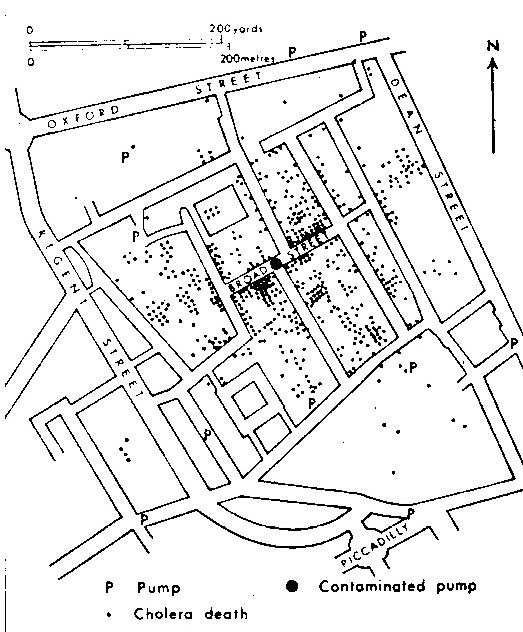
Deaths from cholera, Victorian London
As this article points out, large cities in all parts of the world used to be very dangerous places where the very proximity of humans directly led to disease and death.
I already knew the basics of John Snow’s battle with the established order and his famous map of Broad Street from TV programs and the odd book, like Mathew Kneale’s excellent novel about a Victorian hydraulic engineer, Sweet Thames.
But the particular value of Stevenson’s take on London’s cholera epidemic is the attention it gives to the broader circumstances of the times and the way he burrows deeply into the underlying social, medical and technological issues.
He talks, for example, about how humans living at close quarters historically addressed their vulnerability to polluted water by drinking alcohol instead (notwithstanding it is itself poisonous and addictive). Nothing new about that perhaps, but what is interesting is how the desire to live at higher density gradually selected for genes that could tolerate alcohol: Read the rest of this entry »
Is obesity really caused by suburban sprawl?
Posted: June 11, 2010 Filed under: Education, justice, health, Planning | Tags: CBD, diet, Inner city, Kelvin Thompson, obesity, Suburban sprawl 11 CommentsSuburban sprawl is often linked with rising obesity – for example, see this submission to last year’s Urban Growth Boundary Review from Kelvin Thompson, Labor Member for the Federal seat of Wills, or this article in the Sydney Morning Herald.
The customary argument is that because the incidence of obesity is lower in the inner city where densities are higher, it follows that low density outer suburban development is the cause, or at least a very significant contributor, to obesity.
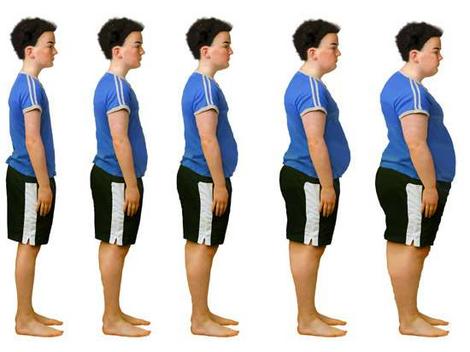
At first glance this seems to make some sense. For example, only 1.1% of workers in Melbourne’s outer suburbs walk to work, compared to 12.9% in the inner city.
But for all its faults, is it reasonable to put the blame for obesity on sprawl? No, it isn’t reasonable. We would we better off focusing our energies on the real issues associated with sprawl rather than being distracted by sideshows.
The key reason is that what goes in our mouths is more important than how much we exercise. You have to walk the dog for an hour and a half, or cycle for an hour, to burn off the calories in just one Big Mac.
The inner city has a lower incidence of obesity primarily because the residents eat better. And they don’t eat better because of higher density but because they have higher incomes than residents of the outer suburbs and, importantly, higher levels of education. They are more likely to know about the importance of good eating and they are more likely to be able to afford to eat better food. They also have smaller households on average so it’s easier to cook healthy food at home rather than go out for fast food. Read the rest of this entry »
What if you were the Premier?
Posted: May 27, 2010 Filed under: Cars & traffic, Education, justice, health, Public transport | Tags: Alcohol, Cars, Melbourne, Premier, prohibition, Public transport, road pricing, Victoria 3 CommentsImagine you’ve just been elected Premier. You carried the electorate on a simple but radical two-promise platform: (1) to prohibit alcohol and (2) to shift all travel out of cars and onto public transport.
The Party is solidly behind you. Members agree that both alcohol and cars are bad for the individual and bad for society. You’re lauded as a reformer.

But you’ve not long been in office before you discover just how entrenched car use is in your largest city. Just 10% of trips are made by public transport and 90% of households have at least one car. Less driving would make the community better off but you quickly discover how much people like doing things that are bad for them and bad for others. You have a stiff drink.
For all their talk about sustainability, your predecessors knew the electorate loved cars. The former Premier talked-the-talk about public transport and even threw a few paltry dollars its way, but at the end of the day she didn’t do anything that would come between voters and their cars.
Eager to get started, you begin your quest to reduce car use by investing massively in public transport. You mortgage the State budget for the next 50 years in an endeavour to provide high quality, metro-style public transport across the entire city. Travellers without access to a car, like school children and tourists, think you’re God. CBD workers think you’re Gary Ablett. But you fail to notice that most of them either don’t vote or don’t live in marginal electorates. Read the rest of this entry »
What makes people happier – money or status?
Posted: May 18, 2010 Filed under: Education, justice, health, Miscellaneous | Tags: Chris Boyce, happiness, Robert H Frank, social justice, social rank, status 6 CommentsA new study by researchers at the University of Warwick finds that money only makes people happier if it improves their social rank.
A well known example of this effect was documented by economist Robert H Frank. He asked people if they would prefer to live in a 4,000 ft2 house where all the neighbouring houses were 6,000 ft2, or in a 3,000 ft2 house where all the neighbours lived in houses that were 2,000 ft2. A majority of respondents chose the 3,000 ft2 house – smaller in absolute terms than the first option but larger in relative terms.

Where being brilliantly avaricious counts most? (Cut paper)
This is not a new insight but I think it is very important that planners and architects appreciate it – in fact it is very important for anyone who has clients or who is involved in policy development and implementation. Status matters. The trick is to direct it in ways that are as environmentally, economically and socially benign as possible. Bicycles rather than BMWs!
The researchers were seeking to explain why people in rich nations have not become any happier on average over the last 40 years even though economic growth has led to substantial increases in average incomes.
Lead researcher on the paper, Chris Boyce from the University of Warwick’s Department of Psychology said:
“Our study found that the ranked position of an individual’s income best predicted general life satisfaction, while the actual amount of income and the average income of others appear to have no significant effect. Earning a million pounds a year appears to be not enough to make you happy if you know your friends all earn 2 million a year”
The study, entitled “Money and Happiness: Rank of Income, Not Income, Affects Life Satisfaction”, will be published in the journal Psychological Science. The researchers looked at data on earnings and life satisfaction from seven years of the British Household Panel Survey (BHPS), which is a representative longitudinal sample of British households. Read the rest of this entry »
Spare infrastructure capacity – is it a tall story?
Posted: May 10, 2010 Filed under: Architecture & buildings, Education, justice, health, Infrastructure | Tags: Albert Park Primary School, Infrastructure, portable classroom, school, spare capacity, The Age 10 CommentsHere’s more evidence that claims of “spare” infrastructure capacity in inner city and inner suburban areas are a tall story. The Sunday Age reports that Port Melbourne Primary School, Malvern Primary and Middle Park Primary are the first schools to get double storey portable classrooms.
Two storey portables are a natural evolution – practically every State primary school in Melbourne within 10 km of the CBD already has single storey portables. However I’m not concerned with whether portables are better or worse than permanent buildings but rather with what additional classrooms say about spare capacity in schools.
As I argued previously in Why ‘spare infrastructure capacity’ is exaggerated, it is a mistake to think that there is necessarily spare infrastructure capacity just because an area historically had a higher population than it has at present. Read the rest of this entry »
Does My School have lessons for planners?
Posted: May 4, 2010 Filed under: Education, justice, health | Tags: ACARA, Barry McGaw, Camberwell High, Census, East Ivanhoe, Education, justice, health, ICSEA, Julia Gillard, My School, NAPLAN 6 CommentsThe brouhaha over My School is an important lesson for those of us interested in geography because it demonstrates how misleading a reliance on average values can be.
In a previous post, Limitations of My School, I pointed to some problems with the Index of Community Socio-educational Advantage (ICSEA) used on the My School web site. In particular, I was surprised to find that prestigious Melbourne Grammar scored much the same on ICSEA as nearby State school, Camberwell High.
This unlikely result was because each school’s ICSEA rating is calculated from the social and economic characteristics of the Census Collection Districts in which its students live.

Camberwell High School
The problem is that although the average socioeconomic status of Camberwell and surrounds is very high, there are nevertheless significant numbers of residents whose incomes don’t extend to finding upwards of $20,000 per annum in post tax income to fund a private school education for each of their children.
In other words, Camberwell High ranks highly on ICSEA because its students live in ritzy areas, not because the students themselves come from relatively well-off families (although some former students, like Kylie Minogue, have gone on to considerable financial success).
What this tells us is that not all households within a cluster of contiguous suburbs earn the average income – there’s considerable variability even though the suburbs might, on average, be quite affluent.
To throw further light on this issue, I looked at the incomes of families in Ivanhoe East at the 2006 Census to try and get a handle on the degree of variability in income within a small geographical area. Ivanhoe East is around the same distance from the CBD as Camberwell and has 984 families. It has about six times as many dwellings as a Census Collector’s District (Camberwell has 5,011 families). Read the rest of this entry »
Do cities cause divorce?
Posted: April 17, 2010 Filed under: Education, justice, health, Miscellaneous | Tags: city, country, Denmark, divorce rate, Scandanavia Leave a commentThe divorce rate is higher in cities (like Melbourne) than it is in the country. But is that because there’s something about cities that promotes marital discord? These Danish researchers say no – it’s because couples in relatively stable relationships are more likely to move to the country:
More on My School
Posted: March 18, 2010 Filed under: Education, justice, health | Tags: Education, justice, health, Gillard, ICSEA, My School, NAPLAN 1 CommentFollowing up on my comments about My School on 5 March, Limitations of My School, there is great post by Sam Wylie on Core Economics today, School performance data. While he doesn’t address my issue of concern (the accuracy of the social profiling methodology used for comparison purposes), he makes a number of other good points. In particular, I thought his closing, where he addresses the issue of league tables, was well put:
“In the matter of school testing there is always the presentation of an argument that parents and the press will not interpret the data correctly. The people can’t be trusted. How often does that idea come up in different spheres? We shouldn’t devolve power or information to individual households because they cannot be trusted not to abuse it. Those types of arguments are always based on the protection of private interest (teaching unions) or elitism”.
Does sprawl cause obesity?
Posted: March 15, 2010 Filed under: Education, justice, health, Planning | Tags: CBD, diet, Inner city, Melbourne, obesity, Public Transport Users Association, Suburban sprawl, Zhao 6 CommentsI’m unconvinced by the argument that suburban sprawl is obesity’s best friend. I’m equally suspicious that higher density living is justified as a sensible response to obesity, as this story in the Sydney Morning Herald, How City Living Fights the Waistband Sprawl, contends.
It’s not that I doubt there’s a correlation between obesity and distance from the city centre. The SMH story reports University of NSW researchers as finding that “those living in the outer suburbs were 30 to 50 per cent more at risk of being overweight and 40 to 60 per cent less likely to be physically active than their inner-city counterparts”.
Nor do I doubt that the physical environment might have some role. After all, 13% of inner city residents in Melbourne walk to work compared to just 1% in the outer suburbs.
But how much of this difference is due to low density living? Is the relationship causal?
Even at first glance, weight gain seems to me to be much more sensitive to what you eat than what you do (or don’t do). For example, you have to walk the dog for an hour and a half, or cycle for an hour, to burn off the calories in just one Big Mac. Isn’t it likely that all those suburban families eat more fast food than inner city latte sippers?
So differences in diet are probably a much more significant factor explaining obesity than low density living. Read the rest of this entry »
Limitations of My School
Posted: March 5, 2010 Filed under: Education, justice, health | Tags: Camberwell, ICSEA, Julia Gillard, Melbourne Grammar, My School, NAPLAN 7 CommentsThe My School web site launched by the Deputy Prime Minister earlier this year has some important lessons for any disciplines that rely heavily on spatial measures to capture social and economic information.
With two school age children, I’m sympathetic to Julia Gillard’s push for more information to be made available on schools’ performance. I think providing the NAPLAN information is a good start and I’m looking forward to seeing time-based data next year. Read the rest of this entry »
 The Melbourne Urbanist