Is the Lord Mayor’s new parking charge a ‘money grab’?
Posted: May 19, 2010 Filed under: Cars & traffic | Tags: City of Melbourne, Donald Shoup, equity, George Costanza, Hoddle grid, Lord Mayor, Melbourne Business Council, parking, parking meter, Robert Doyle, VECCI 5 CommentsThe Lord Mayor of Melbourne, Robert Doyle, has bought himself a heap of trouble with Council’s decision to impose a flat $4 charge for parking in the CBD from 7.30 pm to midnight (see here, here, here and here).
The new fee will apply to 3,000 on-street metered parking spaces that are currently free at night. It will raise an estimated $1.9 million in revenue to be used for general Council purposes. Council is expecting to earn a similar amount from fines associated with the new policy.

While some people think it will encourage greater use of public transport, others say it will have a severe impact on restaurants, movies and shows and is just a naked grab for money. Another criticism is that public transport is too unsafe at night and finishes too early to provide a satisfactory alternative to driving. Others vow they’ll stop visiting the CBD and go elsewhere.
I find the reaction extraordinary. In my view Council’s action is understandable – any time you have a scarce resource that is under-priced there are bound to be some perverse and inefficient outcomes. Melbourne is a 24/7 city – the streets of the CBD are frequently heavily congested at night, particularly on Friday and Saturday nights. Charging for parking at night makes sense.
The Melbourne Business Council however is concerned that people coming in to the CBD to see Fame or Sir Ian McKellen in Waiting for Godot will now have to pay for parking. VECCI is worried about the impact on restaurants, small bars and theatres. But who shells out $100 plus for tickets to a show or dinner and quibbles over $4 for parking? On the contrary, I expect patrons will feel they’re better off if it loosens up parking options a bit. Read the rest of this entry »
What makes people happier – money or status?
Posted: May 18, 2010 Filed under: Education, justice, health, Miscellaneous | Tags: Chris Boyce, happiness, Robert H Frank, social justice, social rank, status 6 CommentsA new study by researchers at the University of Warwick finds that money only makes people happier if it improves their social rank.
A well known example of this effect was documented by economist Robert H Frank. He asked people if they would prefer to live in a 4,000 ft2 house where all the neighbouring houses were 6,000 ft2, or in a 3,000 ft2 house where all the neighbours lived in houses that were 2,000 ft2. A majority of respondents chose the 3,000 ft2 house – smaller in absolute terms than the first option but larger in relative terms.

Where being brilliantly avaricious counts most? (Cut paper)
This is not a new insight but I think it is very important that planners and architects appreciate it – in fact it is very important for anyone who has clients or who is involved in policy development and implementation. Status matters. The trick is to direct it in ways that are as environmentally, economically and socially benign as possible. Bicycles rather than BMWs!
The researchers were seeking to explain why people in rich nations have not become any happier on average over the last 40 years even though economic growth has led to substantial increases in average incomes.
Lead researcher on the paper, Chris Boyce from the University of Warwick’s Department of Psychology said:
“Our study found that the ranked position of an individual’s income best predicted general life satisfaction, while the actual amount of income and the average income of others appear to have no significant effect. Earning a million pounds a year appears to be not enough to make you happy if you know your friends all earn 2 million a year”
The study, entitled “Money and Happiness: Rank of Income, Not Income, Affects Life Satisfaction”, will be published in the journal Psychological Science. The researchers looked at data on earnings and life satisfaction from seven years of the British Household Panel Survey (BHPS), which is a representative longitudinal sample of British households. Read the rest of this entry »
Are lots smaller in the outer suburbs than in the inner suburbs?
Posted: May 17, 2010 Filed under: Growth Areas, Housing, Planning | Tags: Craigieburn, Highlands, Inner city, inner suburbs, Oliver Hulme, outer suburbs, RP Data, small lot housing, Stockton 7 CommentsThe Financial Review (paywalled) reported on Saturday that the average house sold within 10 km of the CBD in Melbourne is located on a 511 m2 block, according to data collected by property information provider, RP Data.

Central Green, Highlands, Craigieburn - some lots are 213 sq m (click to enlarge)
Of course there is considerable variation in property types within that average. Houses in the inner city (0-5 km) are predominantly terraces on small lots whereas those in the inner suburbs (5-10 km) are predominantly detached houses on larger lots.
However what is especially interesting about this statistic is how it compares with the outer suburbs. The median size of lots sold in the Growth Areas is currently 513 m2, according to property consultants, Oliver Hume.
In other words, the average lot size is much the same in the two areas.
This is surprising, but a number of caveats are in order. First, some of the properties closer to the CBD would be destined for redevelopment whereas that seems unlikely in the Growth Areas. Read the rest of this entry »
Has local government gone to the dogs?
Posted: May 15, 2010 Filed under: Miscellaneous | Tags: boundaries, cartoon, cartozoology, dog, Local Government Area, map Leave a commentSeems that local government really has gone to the dogs in Melbourne although I’m not sure what breed this cartozoological canine is. Looks friendly enough considering the poor thing has had its tail docked and is getting on a bit. I think I’ll call him Maribyrnong ‘coz that’s where his head’s at (jeez, I hope he’s not about to do the dirty on Cardinia!).
And then there’s this ghostly character in eastern Victoria who’s amazed/terrified/awed by something – but what? Is that a sheep’s head or a wolf in…..?
I’ve created a few others as well that I’ll put up shortly. Contributions welcome.


Are cul de sacs a curse?
Posted: May 14, 2010 Filed under: Cars & traffic, Planning | Tags: Ballard, cul de sac, grid, growth areas, new urbanism, Seattle, Washington, Woodinville 5 CommentsOne of the tenets of new urbanism is that streets should be laid out in a rectilinear grid to maximise connectivity i.e. to minimise public transport and walking distances.
This research project in Seattle seems to confirm the wisdom of that principle. It compared the distance travelled by residents of two neighbourhoods and found that in Woodinville, where the dominant street form is the cul de sac, residents travel 26% more kilometres than residents of Ballard, where streets are laid out in a rectilinear grid.
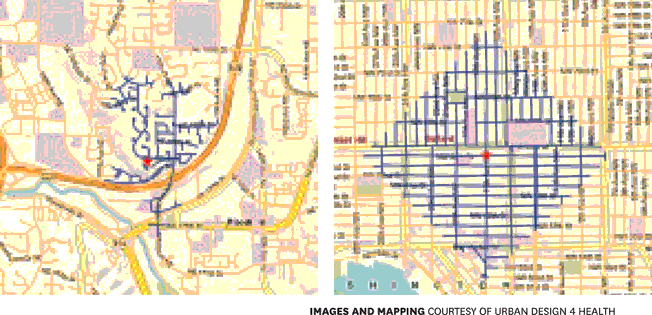
As it happens, I’ve spent a fair bit of my life living on a “no through road” or similar street form and I think the advantages of cul de sacs are too often neglected. I grew up in a closed street, lived for six years in a mews and currently live with my family in a short cul de sac created in the 1950s when a larger property was subdivided into seven lots.
The great advantage of the cul de sac is low traffic. When my children were very young my wife and I were relaxed about them playing in the street because the only cars that entered the street were residents or their visitors. And for that same reason we don’t have issues with traffic noise like we used to have in North Fitzroy. These are major advantages and should not be dismissed lightly.
But cul de sacs have another advantage. If they’re not too long, they can create a sense of a place that is shared or “owned” by a small number of residents. We got to know all our neighbours well, shared child supervision responsibilities and even had an annual lunch in the middle of the road. Read the rest of this entry »
Can inner city apartments save us from sprawl?
Posted: May 13, 2010 Filed under: Housing, Planning | Tags: apartments, dwelling size, Inner city, inner suburbs, Melbourne, prices, sprawl, suburban fringe 7 CommentsHere’s compelling evidence that inner city apartments are not substitutes for fringe development despite oft-repeated claims to the contrary.
The Age reported yesterday that the average size of new two-bedroom apartments under construction in Melbourne is just 73 m2, while the average size of one-bedroom apartments is 51 m2 and studio apartments 34 m2.

SEE apartments, Claremont St, South Yarra
More than three quarters of the 5,600 units currently being built are located in central areas, mostly in the Melbourne, Stonnington and Yarra municipalities. A spokesperson from property group Oliver Hulme says that the median size of apartments in the inner municipalities is no smaller than those in outer suburbs.
I must say I’m staggered by how little space you get for your money. According to the report, the entry-level median price for newly built two-bedroom apartments is around $530,000. Corresponding prices for one-bedroom and studio apartments are $379,000 and $302,500 respectively. It seems inner city buyers subscribe strongly to the “location, location, location” maxim.
In contrast, the median house and land package in Melbourne’s outer suburban growth areas costs around $383,500 and the median dwelling size is 219 m2. It’s even cheaper in Cardinia in Melbourne’s outer South East, where the median dwelling is 186 m2 and together with land costs $334,500 on average.
Clearly the inner city and the outer suburban growth areas are entirely different markets! The average size of apartments is probably reduced by the current high rate of social housing construction but I doubt that’s significant enough to explain the enormous difference between the two markets. Read the rest of this entry »
What caused inner city gentrification?
Posted: May 12, 2010 Filed under: Planning | Tags: gentrification, Inner city, Melbourne 5 CommentsPaul Krugman once said that while we can make a reasonable fist of unpicking how a city developed historically, it is virtually impossible to predict where it might go in the future.
Could anyone in the 1950s or 1960s have confidently predicted the extent of gentrification of Melbourne’s inner city? Looking back we can attempt to identify some of the key forces that produced the inner city revival and see just how difficult it would have been to predict.

Photo by ExTester
The starting point was the departure of manufacturing for the suburbs which began in earnest in the 1950s. This exodus was driven by a number of factors, including new ‘horizontal production’ methods, reductions in the cost of truck transport, increasing traffic congestion in the inner city and the suburbanisation of much of the blue collar workforce.
What it did was crucial – it made the inner city a much more pleasant place to live in.
The rapid expansion in higher education in the 60s and 70s introduced many staff and students to the lifestyle possibilities of the inner city. House prices were competitive with the fringe suburbs, at least in the early decades of gentrification, in part because many of the (former) migrant families who occupied inner city housing aspired to live in the suburbs.
Later, declining household size – itself the product of upstream changes in factors such as fertility – meant inner city dwellings provided more space per person, especially for the expanding cohort of professionals who worked in the CBD. They married later, had fewer children and hence required less space (although terraces could easily be renovated and extended). Read the rest of this entry »
Do “brownfields” sites matter?
Posted: May 11, 2010 Filed under: Housing, Planning | Tags: Brownfields, Challenge Melbourne, medium density housing, Melbourne 2030, Melbourne @ 5 Million 3 CommentsI was leafing through Challenge Melbourne, the discussion paper released in 2001 as part of the Melbourne 2030 process, the other day. This very interesting but apparently long-forgotten factoid caught my attention:
“Capacity for an estimated 65,000 dwellings on large sites such as old factories has been identified in the established suburbs”.
Given that the number of households in Melbourne is projected in Victoria in Future to grow by 825,000 between 2006 and 2036, it seems the potential contribution from “brownfields” sites – mainly large disused industrial and public sector sites – will be modest.

Melbourne @ 5 Million envisages that 53% of the required new dwellings will be located within the established suburbs. If the 65,000 figure is even broadly close to the mark, it seems that the great bulk of this new housing will have to come from redevelopment of small sites, most of which are presumably residential and likely to generate significant opposition from neighbours.
The key issue this raises is whether or not the anticipated level of redevelopment in established suburbs is achievable. Brownfields sites have made a significant contribution over the last 20 years to construction of multi unit housing but apparently will make a relatively small contribution in the future. Read the rest of this entry »
Spare infrastructure capacity – is it a tall story?
Posted: May 10, 2010 Filed under: Architecture & buildings, Education, justice, health, Infrastructure | Tags: Albert Park Primary School, Infrastructure, portable classroom, school, spare capacity, The Age 10 CommentsHere’s more evidence that claims of “spare” infrastructure capacity in inner city and inner suburban areas are a tall story. The Sunday Age reports that Port Melbourne Primary School, Malvern Primary and Middle Park Primary are the first schools to get double storey portable classrooms.
Two storey portables are a natural evolution – practically every State primary school in Melbourne within 10 km of the CBD already has single storey portables. However I’m not concerned with whether portables are better or worse than permanent buildings but rather with what additional classrooms say about spare capacity in schools.
As I argued previously in Why ‘spare infrastructure capacity’ is exaggerated, it is a mistake to think that there is necessarily spare infrastructure capacity just because an area historically had a higher population than it has at present. Read the rest of this entry »
Solar powered Melbourne
Posted: May 9, 2010 Filed under: Miscellaneous | Tags: music, planets, Solarbeat, Whitevinyl 1 Comment
Solarbeat (click to play)
There have to be a zillion opportunities to apply this idea to Melbourne. This movie by Whitevinyl, titled Solarbeat, shows the motion of the planets around the sun – a note is played each time a planet completes a year i.e. one orbit.
It could be applied to the motion of cars, trams, pedestrians, garbage trucks, ideas, footy, tourists, – in short anything that moves physically, metaphorically, etc. This really could be the sound of Melbourne.
Why did the NYC road pricing proposal fail?
Posted: May 8, 2010 Filed under: Cars & traffic, Infrastructure | Tags: Bruce Schaller, congestion charge, Mayor, Michael Bloomberg, New York, road pricing 2 CommentsThis paper is an object lesson in the pitfalls of attempting to introduce cordon pricing. Written by Bruce Schaller from the New York City Department of Transportation, it analyses Mayor Bloomberg’s failed 2007 congestion pricing proposal (it was ultimately blocked by the State legislature).
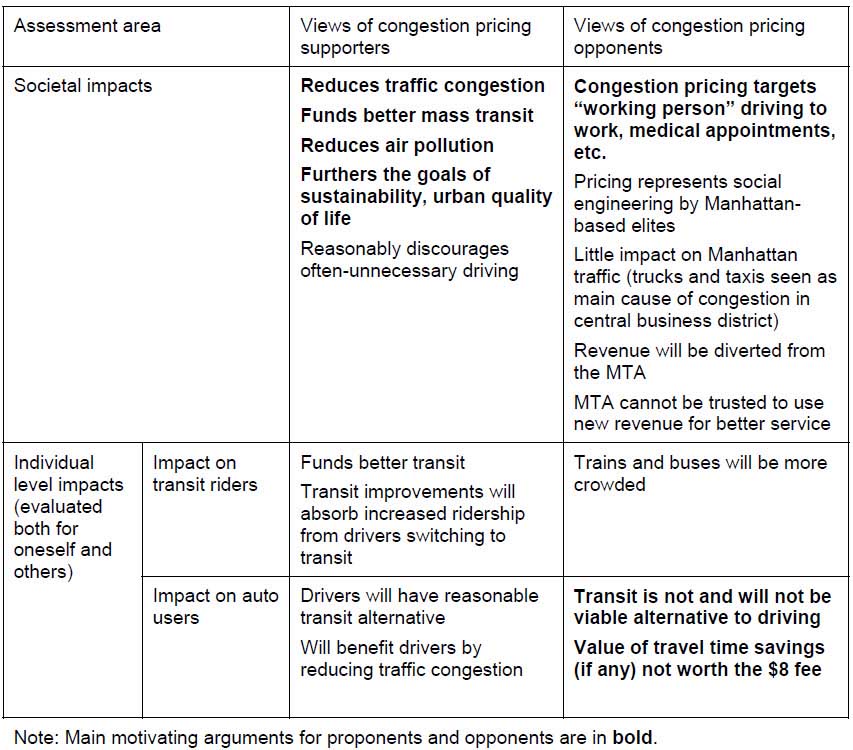
Opposing views on congestion charging (click to enlarge)
The key message is that gaining support for pricing proposals requires more than showing the social benefits – it is necessary to persuade individual motorists they will be better off. The New York experience shows small groups can have great influence – only 5% of workers would have paid the toll.
The author also argues that the best prospects for successfully implementing road pricing lie in initiatives like High Occupancy Toll lanes (see my previous post on this topic in relation to Melbourne) as motorists are less likely to feel they will be disadvantaged.
This table is a neat summary of the key views of proponents and opponents.
Should bicycle lanes be abolished?
Posted: May 7, 2010 Filed under: Cars & traffic, Cycling | Tags: arterial roads, Assen, bicycle lane, Copenhagen, Cycling, Netherlands, vehicular cycling 3 CommentsOver on the Bicycle Victoria Forums there’s a thread on something called “vehicular cycling”. This term is new to me and probably to most readers too.
As I read it, the key premise of vehicular cycling is that cyclists should “claim” the roads. Rather than being segregated in bicycle lanes that too often are narrow and impeded by parked cars – or worse, herded into off-road paths that are too indirect and are shared with unpredictable pedestrians – vehicular cyclists ride well away from the edge of a lane (although not in the middle) in order to be more visible to drivers and hence safer.

Cyclists in Copenhagen
They are concerned that construction of separate cycling infrastructure, such as Copenhagen-style lanes and on-road lanes, will reinforce the idea that cyclists are not legitimate road users.
There’re possibly some nuances here I’ve missed, but that seems to be the general idea. I think there’s a lot of logic to it. Even if a completely segregated network is feasible, it will be a long-term project, so there’s little choice other than to mix it with motorists in the meantime. And the meantime is likely to be a long time. Even in The Netherlands and Denmark, a significant proportion of cycling continues to be done on roads. So it seems sensible to find ways that cyclists and motorists can co-exist safely.
I can see that responsible cyclists, who ride defensively and maximise their visibility, could very well be safer if they adopt a more assertive approach. However I’m much less sanguine about how safe vehicular cycling is for irresponsible riders. Here I’m thinking mainly about children but there are also some adults who do irresponsible things like ride at night in dark clothing or without lights. Read the rest of this entry »
Should Parliament move to Werribee?
Posted: May 6, 2010 Filed under: Activity centres, Architecture & buildings, Decentralisation, Miscellaneous | Tags: bureaucrats, Decentralisation, Melbourne, Parliament House, politicians, public servants, regional development, relocation, Victoria, Werribee 3 CommentsContrary to what seems to be a widely held belief, it is not an easy matter to make jobs simply materialise in places that have a shortage of employment. It is a difficult and complex business that involves much more than merely rezoning land for business use.
However here’s an outrageous shortcut for developing Melbourne’s west. Why not shift the seat of Government in Victoria – politicians, bureaucrats, departments, the whole kit and caboodle – out of the CBD to somewhere like, say, Werribee?

Parliament House as it was intended...
Such an action would give an enormous boost to the development of the west and reinforce the Government’s new policy of developing significant suburban activity centres. A location like the west makes sense because the weight of future metropolitan growth will have to be north of the Yarra due to environmental constraints in the south and east.
This is a shocking idea but it’s not as far-fetched as it sounds (although I don’t mean to suggest that it would be costless or easy, much less politically tempting).
The standard argument for retaining the seat of Government in the CBD is that high level strategic operations obtain external economies of scale from co-location. Thus the efficiency of government in Victoria is greatly enhanced by face-to-face contact between politicians and bureaucrats on the one hand, and captains of business on the other. Further, the CBD maximises access to high human capital workers because of its excellent accessibility, particularly by rail, from all parts of the metropolitan area. Read the rest of this entry »
Are “urban villages” living in the past?
Posted: May 5, 2010 Filed under: Activity centres, Employment, Planning | Tags: CBD, employment balance, employment self sufficiency, road pricing, specialisation, urban villages, wasteful commuting 1 CommentThe Premier wants a Melbourne which encourages the transformation from a mono-centric to a multi-centred city, “so that people can work closer to where they live”. He goes on to laud Melbourne as “a city we’re all proud of – ‘a city of villages’, a whole that is greater than the sum of its parts.”
I’m not completely sure what he intends but I wonder if he’s thinking about “urban villages” where the great bulk of jobs are filled by local residents who live at density and walk to work. This is an old idea in planning and the Victorian planning department ran strongly with the idea in 1996.

Kogarah Town Centre
Whether or not “employment self-sufficiency” can be achieved in practice depends on the level of geography. If we look at Melbourne from a regional perspective, most people already work in the same region in which they live (other than for jobs in the CBD) – see this paper by Kevin O’Connor and Ernest Healy. The median journey to work time in Melbourne is consequently a reasonable 30 minutes by car (55 minutes by public transport, reflecting longer trips to the city centre).
However achieving something like “self-sufficiency” in employment at a smaller geographic level is hard. There are a number of reasons for this.
One is the increasing complexity of households. In two income households both parties frequently work in separate locations, so they either elect to live near one member’s workplace (and if so which one?) or they select a compromise location. Children who continue to live at home after they’ve entered the work force have no flexibility to live closer to where they work. If changing jobs involves a change in job location then that adds another layer of difficulty.
Another reason is that the journey to work has declined in importance as a determinant of where people live. It now accounts for only one fifth to one quarter of all trips, as people travel a lot more for other purposes than they used to. There is now less reason to live near work. Other factors like the level of local amenity seem to be an increasingly important determinant of the residential location decision. Read the rest of this entry »
Does My School have lessons for planners?
Posted: May 4, 2010 Filed under: Education, justice, health | Tags: ACARA, Barry McGaw, Camberwell High, Census, East Ivanhoe, Education, justice, health, ICSEA, Julia Gillard, My School, NAPLAN 6 CommentsThe brouhaha over My School is an important lesson for those of us interested in geography because it demonstrates how misleading a reliance on average values can be.
In a previous post, Limitations of My School, I pointed to some problems with the Index of Community Socio-educational Advantage (ICSEA) used on the My School web site. In particular, I was surprised to find that prestigious Melbourne Grammar scored much the same on ICSEA as nearby State school, Camberwell High.
This unlikely result was because each school’s ICSEA rating is calculated from the social and economic characteristics of the Census Collection Districts in which its students live.

Camberwell High School
The problem is that although the average socioeconomic status of Camberwell and surrounds is very high, there are nevertheless significant numbers of residents whose incomes don’t extend to finding upwards of $20,000 per annum in post tax income to fund a private school education for each of their children.
In other words, Camberwell High ranks highly on ICSEA because its students live in ritzy areas, not because the students themselves come from relatively well-off families (although some former students, like Kylie Minogue, have gone on to considerable financial success).
What this tells us is that not all households within a cluster of contiguous suburbs earn the average income – there’s considerable variability even though the suburbs might, on average, be quite affluent.
To throw further light on this issue, I looked at the incomes of families in Ivanhoe East at the 2006 Census to try and get a handle on the degree of variability in income within a small geographical area. Ivanhoe East is around the same distance from the CBD as Camberwell and has 984 families. It has about six times as many dwellings as a Census Collector’s District (Camberwell has 5,011 families). Read the rest of this entry »
Do the numbers support the Very Fast Train?
Posted: May 3, 2010 Filed under: Energy & GHG, HSR High Speed Rail, Infrastructure, Public transport | Tags: GHG, greenhouse gas, High Speed Rail, Melbourne airport, Sydney airport, very fast train 16 CommentsI’ve run some numbers on how a Very Fast Train in the Sydney-Melbourne corridor would stack up against planes in order to flesh out the questions I posed last week (Is the VFT all huff and no puff?). I used a simple “back of the envelope” methodology adapted from that used by Harvard’s Edward Glaeser to evaluate high speed rail projects in the US (here).
I estimate the economic and environmental benefits of carrying all current Sydney-Melbourne air traffic by VFT rather than plane at around $840 million p.a. (although this does not include the cost of GHG emissions from construction of a rail line – this would be large).
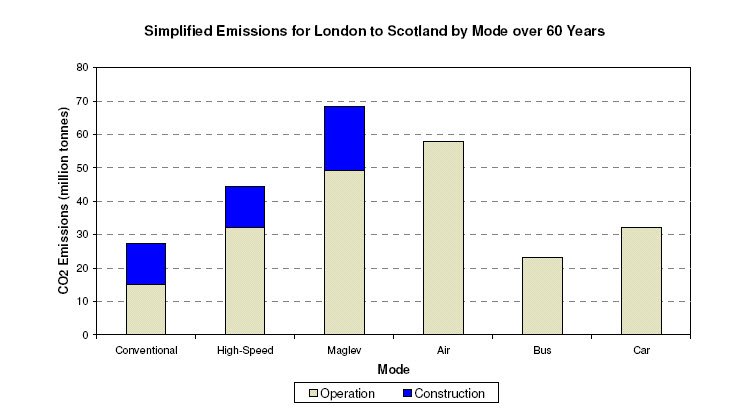
Table by Booz Allen
At first glance a VFT looks unpromising, since I estimate the capital cost of constructing and maintaining a VFT line from Sydney to Melbourne at about $1.5 billion per year. This is well in excess of the benefits.
However this assumes Sydney can accommodate passenger growth by using larger planes. It quite possibly can, but if it can’t and a second Sydney airport has to be built, a VFT starts to look viable if the cost of the airport were to come in at around $15 billion.
Let me emphasise that this is a simple analysis. I’ve left out many complications, including Canberra passengers and car traffic on the Hume.
The only environmental issue I’ve included is (operating) GHG. And of course I’ve made assumptions on things like construction costs and future interest rates.
Starting with capital costs, estimates of the cost to acquire land and construct a VFT line range from $14 to $82 million per km in Europe and the US (Japan is much higher because of earthquake risks). I assume a middling cost of $30 million per km, giving a total cost of $27 billion to build a 900 km line (the existing Sydney-Melbourne rail line is 950 km). I’ve assumed an interest rate of 5% p.a. and annual track maintenance cost of $124,000 per km. These assumptions give a total capital cost for the line of $1.5 billion per annum. Read the rest of this entry »
Is Melbourne really bigger than Los Angeles?
Posted: May 1, 2010 Filed under: Planning, Population | Tags: Los Angeles, Melbourne, Melbourne Zombie Shuffle, Population, Sydney, Zipf's Law, Zurich 19 CommentsDeirdre Macken makes the point in today’s AFR (gated) that a large proportion of Australia’s population is located in a very small number of primate cities, unlike the US where there are very many smaller cities.
She argues that if you want an urban lifestyle in Australia you either live in a large capital city or you camp out, whereas in the US you are spoilt for choice. Instead of making our capital cities larger, she asks, why don’t we build up our smaller cities?
Good question and if I weren’t about to go to the Zombie Shuffle I might well have something to say about it. Perhaps another day.

Not the Melbourne Zombie Shuffle but the footy! (The Age, today)
However for the moment let me just respond to her claim that “if Sydney were transported to the US, it would rank as the second-biggest city after New York. If Melbourne were transported to the US, it too would be the second biggest city, just pipping Los Angeles’s 3.8 million”.
A mere 3.8 million people in LA? I’ve got a lot of sympathy for journalists but this seems a bit too obvious. Perhaps Deirdre doesn’t do much travelling. She’s also got form when it comes to playing fast and loose with the numbers.
Sydney’s population is currently around 4.5 million and Melbourne’s is 4.0 million. Los Angeles had a population in 2009 of 12.9 million. In fact there are ten US cities that are larger than Sydney and fourteen larger than Melbourne (see here and here). Read the rest of this entry »
Is architectural criticism critical?
Posted: April 30, 2010 Filed under: Architecture & buildings | Tags: architecture, criticism, John Andrews, review, rowing shed, Sarah Goldhagen, The New Republic 2 CommentsReviews can sometimes be very scathing. Consider this reviewer’s reaction to a recently released philosophy book:
“Self-important, pompous, pretentious, solipsistic, often obscure, sometimes barely coherent, his book seems to address itself only to those in the know. The translation by Jane Marie Todd renders all these faults with exemplary accuracy”
Cutting! Architectural criticism however is customarily astonishingly polite. This review by Sarah Williams Goldhagen therefore caught my eye because it said something unusual in an architectural critique:
“This is a modest building, however, and it is not perfect. At 30,000 square feet, it cost $11.5 million, more than it should have to build. Owing to bad value-engineering rather than the architects’ miscalculations, some of the attempts at sustainability failed, including a green roof that was never installed (CRI is still raising the money), and a geothermal heating system that was cost-cut into irrelevance (only one well was dug, not enough to heat the building, so they use gas)”

This is only a minor part of her review – most of it is on the safe ground of aesthetic metaphor. But what’s striking is that Goldhagen is actually prepared to comment, in however limited a way, on topics that actually go directly to the interests of the owner and users of a building.
Think about any major new building. Right at the top of the client’s priorities is: does it meet its intended purpose? Has it delivered value for money? What is it completed on time? Did it come in on budget? Right at the top of the user’s priorities is: does it do what I expect it to? Read the rest of this entry »
Is medium density housing on tram routes sustainable?
Posted: April 29, 2010 Filed under: Cars & traffic, Planning, Public transport | Tags: apartments, Melbourne City Council, Residential intensification in tram corridors, Rob Adams, SGS, tram routes 20 CommentsI like Melbourne City Council’s proposal for higher dwelling densities along tram lines but I think the claim that it would increase sustainability is exaggerated. There’s a whole ‘second half’ missing from this proposal.
The idea, which seems to be largely the brainchild of Council’s Rob Adams, is essentially that multi unit developments of up to 8 storeys should be encouraged along tram routes, leaving the suburban “hinterland” undeveloped (Rob refers to it as a new green wedge). This would reduce the need for fringe development and increase the mode share of public transport.
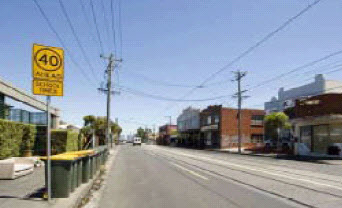
Nicholson Street - before
The major opportunities appear to be on tram routes in the inner suburbs, around 5-10 km from the CBD. While I think the assertion that 4-8 storey buildings can substitute for fringe development is fanciful and is based on a misinterpretation of other research, I accept that the proposal has the potential to increase the supply of dwellings of the type that are sought after by smaller households, especially those without dependents.
The key problem however is that nothing has been proposed to deal with car use by households occupying these new apartments. Without that, it won’t deliver. It just assumes that if households live cheek by jowl with good public transport they will necessarily use it. Read the rest of this entry »
Did good design make Federation Square a success?
Posted: April 28, 2010 Filed under: Architecture & buildings | Tags: ACMI, Australian Centre for the Moving Image, city square, Federation Square, Ian Potter gallery, LAB + Bates Smart, Major Projects, Melbourne City Council, Melbourne Visitor Centre, Princes Bridge, western shard 7 CommentsMelbourne has had a long and sorry history in its search for a successful city square, but it eventually all came good when Federation Square was opened to instant acclaim and popularity in 2002.
So why do some places like Fed Square have “buzz” but others, like the previous attempt at a city square, seem lacklustre? And why is Docklands, for example, unable to attract visitors in large numbers or create a sense of excitement and vibrancy like Fed Square?

A common explanation is design and Fed Square is indeed a wonderful building with a grand sense of occasion. Good design can certainly make things work better and poor design can subvert the best of intentions. But design rarely “makes” a project successful. Buildings like Bilbao and the Sydney Opera House are the exception rather than the rule.
Let me advance a handful of alternative hypotheses for why Fed Square has been so successful in attracting users and establishing itself as an iconic Melbourne landmark. None of these by themselves is sufficient but combined they provide a compelling explanation. Read the rest of this entry »
 The Melbourne Urbanist