Will an airport rail link reduce GHGs?
Posted: July 5, 2010 Filed under: Airports & aviation, Energy & GHG, Public transport | Tags: Australian Greenhouse Office, Epping South Morang rail line, GHG, Melbourne airport, Public Transport Users Association, Skybus, Tullamarine freeway 7 CommentsGiven the evident public interest in the idea of a rail link from the CBD to the airport, I thought I’d look more closely at some of the key rationales for this project, starting with the claim that it would reduce greenhouse gas emissions.
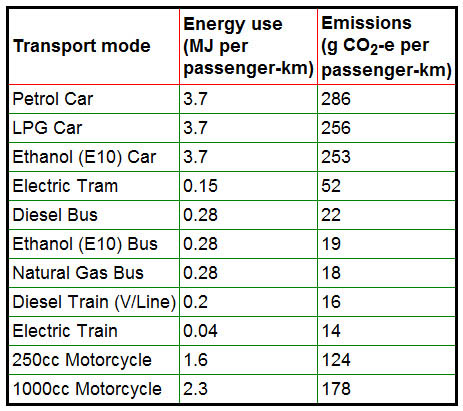
Energy use and emissions (PTUA)
I’ve looked at this issue and, on my admittedly simple calculations, I conclude that the value of greenhouse gas (GHG) savings from a rail line is likely to be minor compared to the probable cost. There are far cheaper ways to offset equivalent emissions than building a rail line.
I looked at this by making the following simplifying assumptions.
First, I assume that a new rail line captures 20% of airport passenger traffic or five million of the current 25 million annual passenger movements at Melbourne Airport. This is double the share captured at either Sydney or Brisbane (around 10%), and almost three times the 7% estimated in feasibility studies.
Second, I assume that all of the current two million passengers using Skybus transfer to the new train (i.e. Skybus ceases to operate) and three million passengers transfer from cars, including taxis.
Third, I assume an average distance of 22 km from the CBD to the airport for bus and train. I assume that the combined average distance travelled to the airport by the cars and taxis that are replaced by train is 35 km. Read the rest of this entry »
Minister for Sustainable Population: What’s in a name?
Posted: June 30, 2010 Filed under: Energy & GHG, Population | Tags: externalities, Julia Gillard, Minister for Sustainable Population, Prime Minister, Tony Burke Leave a commentThe new Prime Minister’s minor renaming of the Population portfolio to Sustainable Population suggests there’s a political agenda in play and a new way of thinking about “big Australia”. The terms sustainability and population have been conflated so the Government can walk a new path through the “big Australia” and “boat people” minefields.
But what it’s also saying is that you can’t have one without the other – population growth and environmental sustainability have to be traded off. The two concepts are necessarily in conflict, always and forever.

Population distribution, Australia (www.worldmapper.org)
While that’s perhaps true in a narrow sense, it doesn’t follow that Geelong is necessarily more environmentally sustainable than Melbourne (according to the ACF it isn’t!) or that both have a lower environmental “footprint” than New York.
In fact despite its considerably larger size, New York is substantially more environmentally sustainable than Melbourne. Large concentrations of people provide economies of scale in, for example, the consumption of energy by favouring travel by public transport and smaller, attached dwellings. Bigger is often more environmentally sustainable.
Of course bigger cities also tend to produce larger negative externalities. But the main reason that size is often accompanied by problems like traffic congestion and unaffordable housing is the failure of political and policy systems. Read the rest of this entry »
Simple but great piece on climate change
Posted: June 26, 2010 Filed under: Energy & GHG | Tags: Ian mcewan, Michael Beard, solar 1 CommentHere’s a simple but stylishly written and persuasive piece on climate change. It’s a short speech delivered to an audience of big business and investors in London in 2005 by Nobel Laureate and physicist, Professor Michael Beard, famous for devising the Beard-Einstein Conflation.

I can’t locate an on-line copy of the transcript of the entire speech so I’ve typed up just the first few paras:
“The planet is sick. Curing the patient is a matter of urgency and is going to be expensive – perhaps as much as two per cent of global GDP, and far more if we delay the treatment. I am convinced and I have come here to tell you, that anyone who wishes to help with the therapy, to be a part of the process and invest in it is going to make very large sums of money, staggering sums.
“What’s at issue is the creation of another industrial revolution. Here is your opportunity. Coal and then oil have made our civilisation, they have been superb resources, lifting hundreds of millions of us out of the mental prison of rural subsistence.
“Liberation from the daily grind coupled with our innate curiosity has produced in a mere two hundred years an exponential growth of our knowledge base. The process began in Europe and the United States, has spread in our lifetime to parts of Asia, and now to India and China and South America, with Africa yet to come. All our other problems and conflicts conceal this obvious fact: we barely understand how successful we have been. Read the rest of this entry »
Is Darwin really Australia’s most sustainable city?
Posted: June 16, 2010 Filed under: Energy & GHG, Planning | Tags: ACF, Australian Conservation Foundation, Darwin, Gold Coast, indicators, Melbourne, Perth, Sunshine Coast, sustainability, Sustainable Cities Index 2 CommentsSo, who knew intuitively that Darwin and the Sunshine Coast are Australia’s most sustainable cities? These startling revelations are from the Australian Conservation Foundation’s newly released Sustainable Cities Index, which examined the country’s 20 largest cities across 15 indicators. Our least sustainable city is Perth, closely followed by Geelong.
And contrary to The Age’s headline that “Melbourne trails in sustainable cities index” and “pales in comparison with Darwin and Brisbane”, Melbourne is the 7th most sustainable of the 20 cities studied (Brisbane is 3rd).
I’ve previously looked at the inappropriateness of the Mercer and Economist indexes as measures of a city’s liveability and I think the ACF’s index is less useful. It seems to be more about publicity than useful research – a feeling reinforced by an absence of technical information on the methodology. It’s actually not an environmental sustainability index per se, but rather a mish-mash of environmental, quality of life and resilience indicators.
It includes indicators like subjective well-being, the rate of volunteering, unemployment levels and the proportion of the population with type 2 diabetes.
I’m sympathetic to the argument that sustainability connects deeply to other facets of life – as the ACF puts it, it’s about learning to live within our environmental means while maintaining social cohesion and liveability. But the fact is most readers of the newspapers that reported on this study (see here and here) think of sustainability as a largely environmental concept. I agree with them – there’s a danger that stretching the term to include liveability measures will ultimately devalue its usefulness and render it virtually meaningless. It would be more sensible to have two or three separate indexes rather than one.
Notwithstanding the confusion about what it’s intended to measure, does the Sustainable Cities Index approach its task in a sensible way? Straight off there are some worrying methodological issues. Read the rest of this entry »
BP – bringing oil to American shores
Posted: June 12, 2010 Filed under: Energy & GHG, Miscellaneous | Tags: advertisement, BP, Gulf, oil 5 CommentsA sadly prophetic advertisement (not) run by BP in the US in nineties.

Should (some) Melbourne golf courses be turned into forest?
Posted: June 10, 2010 Filed under: Energy & GHG, Planning | Tags: Alphington, environment, forest, golf, Green Acres Gold Club, Ivanhoe, Kew Golf Club, Latrobe Golf Club, park, Yarra river 5 CommentsAs I noted yesterday, the Yarra River park system – that ribbon of green that runs north east from the vicinity of inner suburban Kew and Abbotsford to Warrandyte State Park – is one of Melbourne’s great assets. Few other cities have such a vast expanse of relatively undeveloped land threaded through residential areas so close to the city centre.
Like Melbourne’s green wedges it is used for all sorts of purposes, but rather than the sewage works, quarries and airports that sully the good name of the wedges, the Yarra River park system is mostly occupied by real “green” uses – primarily golf courses and sporting fields. At the time these facilities were established, this land was floodplain with few alternative uses.

Just looking at the Melways, I can see 10 golf courses along the Yarra, of which six are clustered at the southern end of the river around Fairfield-Ivanhoe. There’s a nine hole course in Yarra Bend Park, Yarra Bend Public Golf Course at Fairfield, Latrobe Golf Course at Alphington, Green Acres Golf Club at Kew, Kew Golf Club, Ivanhoe Public Golf Course, Freeway Public Golf Course at Bulleen, Yarra Valley Country Club at Bulleen, Rosanna Golf Club and Heidelberg Golf Club at Lower Plenty.
The Yarra River park system is a very special asset, but I’m not sure it’s used as well as it could be. In particular, there’s very little forest in the park. There’s a bushland area around Wilson Reserve in Ivanhoe that’s used by locals for walking, but its small and one of very few within the lower reaches of the park system.
Melbourne could however have one of the largest urban forests of any city in the world. Such an asset would provide enormous environmental, recreational and tourism benefits for the city.
If the three adjoining private golf courses at Alphington and Ivanhoe, say, were returned to native forest, it would produce a centrally located bushland region covering an area of around three square kilometres – more than eight times the area of the Royal Botanic Gardens. Read the rest of this entry »
Do the numbers support the Very Fast Train?
Posted: May 3, 2010 Filed under: Energy & GHG, HSR High Speed Rail, Infrastructure, Public transport | Tags: GHG, greenhouse gas, High Speed Rail, Melbourne airport, Sydney airport, very fast train 16 CommentsI’ve run some numbers on how a Very Fast Train in the Sydney-Melbourne corridor would stack up against planes in order to flesh out the questions I posed last week (Is the VFT all huff and no puff?). I used a simple “back of the envelope” methodology adapted from that used by Harvard’s Edward Glaeser to evaluate high speed rail projects in the US (here).
I estimate the economic and environmental benefits of carrying all current Sydney-Melbourne air traffic by VFT rather than plane at around $840 million p.a. (although this does not include the cost of GHG emissions from construction of a rail line – this would be large).
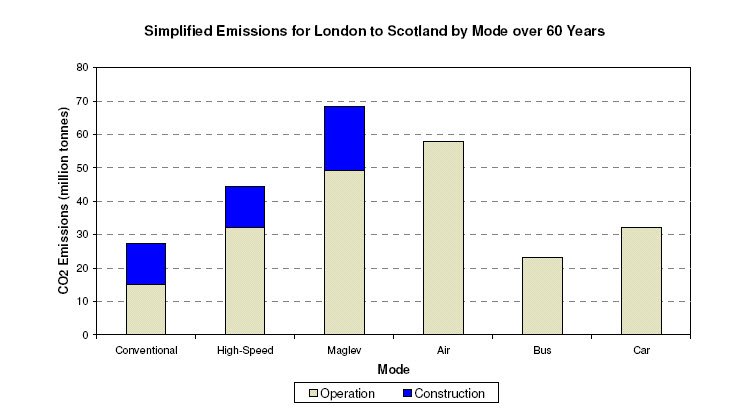
Table by Booz Allen
At first glance a VFT looks unpromising, since I estimate the capital cost of constructing and maintaining a VFT line from Sydney to Melbourne at about $1.5 billion per year. This is well in excess of the benefits.
However this assumes Sydney can accommodate passenger growth by using larger planes. It quite possibly can, but if it can’t and a second Sydney airport has to be built, a VFT starts to look viable if the cost of the airport were to come in at around $15 billion.
Let me emphasise that this is a simple analysis. I’ve left out many complications, including Canberra passengers and car traffic on the Hume.
The only environmental issue I’ve included is (operating) GHG. And of course I’ve made assumptions on things like construction costs and future interest rates.
Starting with capital costs, estimates of the cost to acquire land and construct a VFT line range from $14 to $82 million per km in Europe and the US (Japan is much higher because of earthquake risks). I assume a middling cost of $30 million per km, giving a total cost of $27 billion to build a 900 km line (the existing Sydney-Melbourne rail line is 950 km). I’ve assumed an interest rate of 5% p.a. and annual track maintenance cost of $124,000 per km. These assumptions give a total capital cost for the line of $1.5 billion per annum. Read the rest of this entry »
Is the Very Fast Train all huff and no puff?
Posted: April 27, 2010 Filed under: Decentralisation, Energy & GHG, HSR High Speed Rail, Infrastructure, Public transport | Tags: Canberra, CSIRO, Greens, Insiders, Melbourne, Sydney, very fast train, VFT 23 CommentsThe idea of a very fast train (VFT) connecting Sydney, Canberra and Melbourne is gaining momentum (again). The CRC for Rail Innovation launched a pre-feasibility study earlier this year; veteran journalist Brain Toohey expressed his enthusiasm for the idea on Insiders on 11 April; and now the Greens are calling on the Federal Government to fund a $10 million study into a new scheme they are proposing.

The idea of a VFT has a long history in Australia, dating back to the first serious proposal put forward by the CSIRO in 1984. The key drivers of the current proposal are environmental and resource efficiency and support for expanded regional centres.
I don’t have access to whatever technical analysis the Green’s are relying on, but this seems an unlikely idea. The fact no project has yet been shown to be viable should be a warning to tread warily. I have some doubts. Read the rest of this entry »
Are smart meters always a smart idea?
Posted: April 26, 2010 Filed under: Energy & GHG, Infrastructure | Tags: Dora Costa, electricity, energy, Matthew Kahn, NBER, nudges, smart meter 1 CommentYou need to be careful with incentive programs that aim to change behaviour by providing consumers with feedback on, for example, their level of electricity consumption.
Husband and wife academics at UCLA, Matthew Kahn and Dora Costa, gave households information about their own consumption of energy and that of their peers (the paper is here – may be gated for some). They found that providing feedback to green-minded households encourages them to reduce consumption, but it encourages conservative households to increase consumption. They conjecture that when conservatives see that their consumption is less than average, they respond by increasing it in order to be closer to the average.
How important is transport in addressing climate change?
Posted: April 19, 2010 Filed under: Energy & GHG | Tags: climate change, Climateworks Australia, GHG, Low Carbon Growth Plan, Monash University, Myer Foundation 3 CommentsThere are some salutary lessons in the Climateworks Australia report, Low Carbon Growth Plan for Australia, released publicly last month.
It reinforces the point I made on 10 March (We need to be more strategic about how we tackle GHGs) that it is important to think more deliberately about how to reduce carbon emissions. The estimated contribution that traditional “urban” policies in transport, buildings and land use planning can make to reducing emissions is relatively small, contributing together just 11% of potential savings, whereas the Climateworks report estimates power generation could contribute 31% and forestry 28%. Read the rest of this entry »
Building a green economy
Posted: April 12, 2010 Filed under: Energy & GHG | Tags: climate change, New York Times, paul krugman Leave a commentOutstanding feature on climate change in the New York Times Sunday magazine last weekend by Nobel prize winner Paul Krugman. This is a great primer on the key economic issues.
Energy efficiency in transport – some surprises!
Posted: April 1, 2010 Filed under: Cars & traffic, Energy & GHG, Public transport | Tags: autos, commuter rail, Department of Energy, energy intensity, light rail, load factor, Los Angeles, sprawl, transit, Transportation Energy Data Book 3 CommentsThe latest edition of the Transportation Energy Data Book: Edition 28 was released last year by the US Department of Energy (Office of Energy Efficiency and Renewable Energy).
I’ve derived the accompanying graph from Chapter 2 of the report. There are a couple of points of interest here.
In particular, the data shows that load factors are very important. Although public transport is more energy efficient than cars when it is fully loaded, it has to operate at off-peak times and on secondary routes, when patronage is low. Read the rest of this entry »
Electricity generation – renewables vs nuclear
Posted: March 14, 2010 Filed under: Energy & GHG | Tags: Melbourne Town Hall, Molly Olsen, nuclear power, renewables, Ziggy Switkowski Leave a commentIn my post on 10 March, We need to be more strategic about how we tackle greenhouse gas, I argued that we should give priority to making electricity carbon-free ahead of other actions like investing heavily in public transport. The post attracted a comment from Matt. For those who didn’t read it, he left an interesting link to beyond zero emissions on the potential for renewables to replace coal in generating electricity. Here’s more detail.
I attended the public debate in Melbourne Town Hall on 4 March where the proposition on the table was “that we should embrace nuclear power”. Here therefore in the interests of balance is a link to Brave New climate, which makes the case for nuclear.
The ABC and climate change
Posted: March 12, 2010 Filed under: Energy & GHG | Tags: ABC, balance, climate change, letters, Maurice Newman, Taegen Edwards, The Age Leave a commentTaegen Edwards has a superb letter in The Age today in response to Maurice Newman’s upbraiding of the ABC for supposed lack of balance on climate change.
She points out that unless it resorts to ideologues, opportunists, vested interests or nutters, where can the ABC possibly find someone who opposes climate change from a rational, evidence-based viewpoint?
The ABC’s obligation to ensure fundamental principles of science and logic are respected must come before any compulsion to provide ‘balance’ in ideology and political point-scoring.
 The Melbourne Urbanist