The Paul Krugman blues
Posted: August 6, 2010 Filed under: Miscellaneous | Tags: blues, Loudon Wainright, paul krugman Leave a comment Loudon Wainright 111 sings his homage to Nobel Laureate in economics and New York Times columnist, Paul Krugman.
Who does Google like the most – Julia or Tony?
Posted: August 4, 2010 Filed under: Miscellaneous | Tags: Google Search, Julia Gillard, Tony Abbott Leave a commentGoogle is being used for respectable academic research on issues like economic activity and health epidemics (for example, see this paper on how the recession in the US is impacting concern for the environment), so I thought I’d see how Julia Gillard is faring in terms of internet interest compared with Tony Abbott.
The first graph compares Google searches on ‘Gillard’ (red) and ‘Abbott’ (blue) over the last 30 days (up to August 1) within Australia.

Google says the numbers on the graph “reflect how many searches have been done for a particular term, relative to the total number of searches done on Google over time. They don’t represent absolute search volume numbers, because the data is normalized and presented on a scale from 0-100. Each point on the graph is divided by the highest point, or 100. When we don’t have enough data, 0 is shown”. Read the rest of this entry »
Jewel goes undercover
Posted: July 31, 2010 Filed under: Miscellaneous | Tags: happiness, Jewel, Karaoke, undercover 2 Comments
Click through to video
One of the most popular recent articles on The Melbourne Urbanist was one on happiness (What makes you happy?) that I put up back at the start of the month.
It was based on a research paper which looked at which events have the highest positive effect on happiness.
This video is more practical – it shows what unalloyed delight and elation look like. It covers the singer Jewel singing her own songs incognito at a karaoke bar.
The excitement of the patrons when they hear how good this apparently ordinary woman is at singing Jewel’s songs is a joy to behold.
Who else is Moving Forward?
Posted: July 20, 2010 Filed under: Miscellaneous | Tags: ALP, Connex, Julia Gillard, Moving Forward 2 Comments
Photo by Daniel Bowen (Flickr)
Connex wasn’t the only company to use Moving Forward as their logo before it was adopted by the ALP for the 2010 Federal election. A quick search on Google shows that many organisations like to show they’re on the move and, moreover, that when they move, they move forward. Not surprisingly there’re transport companies, but there are also libraries, psychologists, a farmer, singers and more. Here’s just a sample:
Clinical Psychological Services
Dairy Moving Forward Initiative
Why is there still a focus on Julia vs Kevin?
Posted: July 16, 2010 Filed under: Miscellaneous | Tags: Julia Gillard, Kevin Rudd, Personality and Social Psychology Bulletin, The Price of Power, Tyler Okimoto, Victoria Brescoll, Yale 2 Comments It might seem like yesterday’s news but there’s a reason the Prime Minister’s opponents are continually focussing on exactly how she took over from Kevin Rudd.
This newly published research examined the proposition that “the perception that a candidate is power-seeking will lead to social penalties for female politicians but not for male politicians and that these penalties may be reflected in voting preferences”.
The research was undertaken by Yale University School of Management researchers, Tyler Okimoto and Victoria Brescoll. It is published in the latest issue of Personality and Social Psychology Bulletin. Here’s the abstract: Read the rest of this entry »
Is suburban sprawl a threat to farming?
Posted: July 15, 2010 Filed under: Growth Areas, Miscellaneous | Tags: agriculture, Australian Collaborative Land Use Mapping Program, Australian Natural Resources Atlas, farming, food miles, Green Wedges, peri-urban, Peter Houston, Urban Growth Boundary 3 CommentsOne of the oldest processes in urban development is the conversion of peripheral land from farming to residential use. The standard argument is highest and best use: housing gives a bigger pay-off than farming. It’s the same basic logic underlying why natural bushland is cleared for agricultural use.
On Monday I looked at the idea of “food kilometres” but today I want to look at whether productive agricultural land should be converted to urban use.

Straight up, the evidence suggests urban development doesn’t pose much threat at all. The productivity of agriculture in Australia has increased 2.8% p.a. over the last 20 years, double the rate at which the wider market economy has grown.
Moreover, the Australian Natural Resources Atlas shows that the area of land used nationally for urban development amounts to just 0.5% of the area of land used for agriculture. Another estimate by the Australian Collaborative Land Use Mapping Program puts the ratio of urban land to agricultural land at 2.8%.
A more detailed study by Peter Houston published in 2005 found that agricultural land on Melbourne’s urban periphery comprised a little less than 6% of the total land base used for agriculture in Victoria. Melbourne seems to be an exception – the average figure for peri-urban areas across all mainland States is a mere 1%. Read the rest of this entry »
What makes you happy?
Posted: July 1, 2010 Filed under: Miscellaneous | Tags: Danny Dorling, Dimitri Ballas, happiness 2 CommentsThis question is important to everyone, including those most concerned with urban policy (believe it or not). One answer, which emphasises the dynamic over the static, is in this paper by Dimitri Ballas and Danny Dorling, Measuring the impact of major life events upon happiness, International Journal of Epidemiology, 2007, 36(6) 1244-1252. Here’s the authors’ summary:

Background
In recent years there have been numerous attempts to define and measure happiness in various contexts and pertaining to a wide range of disciplines, ranging from neuroscience and psychology to philosophy, economics and social policy. This article builds on recent work by economists who attempt to estimate happiness regressions using large random samples of individuals in order to calculate monetary ‘compensating amounts’ for different life ‘events’. We estimate happiness regressions using the ‘major life event’ and ‘happiness’data from the British Household Panel Survey.
Results
The data and methods used in this article suggest that in contrast to living states such as ‘being married’, it is more events such as ‘starting a new relationship’ that have the highest positive effect on happiness. This is closely followed by ‘employment-related gains’ (in contrast to employment status). Also, women who become pregnant on average report higher than average levels of subjective happiness (in contrast to ‘being a parent’). Other events that appear to be associated with happiness according to our analysis include ‘personal education-related events’ (e.g. starting a new course, graduating from University, passing exams) and ‘finance/house related events’ (e.g. buying a new house). On the other hand, the event that has the highest negative impact upon happiness according to our analysis is ‘the end of my relationship’ closely followed by ‘death of a parent’. Adverse health events pertaining to the parents of the respondents also have a high negative coefficient and so does an employment-related loss. Read the rest of this entry »
Winners of ‘App My State’ have an urban focus
Posted: June 22, 2010 Filed under: Miscellaneous, Public transport | Tags: App My State, application, iPhone app, mashup, Transportle, Which Bin? 5 Comments
Transportle: it's a long trip (purple line) from Preston to Ivanhoe station by public transport at 10.30 pm
The winners of the Victorian App My State competition announced last night by the Premier have a distinctly urban orientation. The objective of the competition is to inspire Victorians to create web and mobile applications for Victorians. Entrants compete for $100,000 in prizes.
First prize was won by Jason Smale for his iPhone app, Which Bin?, which helps people understand what items are able to be recycled. He says:
I’ve often seen my mother struggle to read which number is in the tiny recycling triangle on the bottom of yoghurt containers. After about 5 minutes she resorts to using a magnifying glass and finally the often undecipherable number defeats her.
The judging criteria are usefulness, design and development, innovation, useability and this delightful example of bureacratic cool, “The vibe” or overall appeal. Read the rest of this entry »
Is the online version of The Age still a paper?
Posted: June 15, 2010 Filed under: Miscellaneous | Tags: Committee for Melbourne, e-commerce, Fairfax, Financial Review, internet, online, review, Sydney Morning Herald, The Age, theage.com.au 4 CommentsI value having The Age delivered to my door each morning, but I’m disappointed with the online version, theage.com.au. I refer to it often, but my experience with the site suggests I’d have to think long and hard before I’d be prepared to pay to access it online.
Charging is of course Fairfax’s ultimate goal (the online version of The Financial Review, which is also Fairfax owned, is pay for use) and seen as a way of making up for the declining popularity of newspapers – sales of the Monday to Friday edition of The Age fell 4% in the March Quarter, 2010. Sales of the Saturday edition fell 5%.

Those video advertisements that automatically start when you click on the site are a real turn-off but I have some sympathy for Fairfax’s search for a financially viable online model (although since I pay for the hard copy, why should I have to endure such intrusive advertising?). No, my disappointment relates to management issues.
A key reason for my dissatisfaction is basic – it’s hard to find stuff on the site. I imagine that many people want to track down an article they recall seeing in yesterday’s paper or last week’s, yet you can’t search by date of publication. You have to know the title or author. That seems like a terribly basic omission to me. Why can’t I look up a simple table of contents for each day, showing the name and author of articles with the ability to jump straight to what I want? Read the rest of this entry »
BP – bringing oil to American shores
Posted: June 12, 2010 Filed under: Energy & GHG, Miscellaneous | Tags: advertisement, BP, Gulf, oil 5 CommentsA sadly prophetic advertisement (not) run by BP in the US in nineties.

Where are the special places in Melbourne?
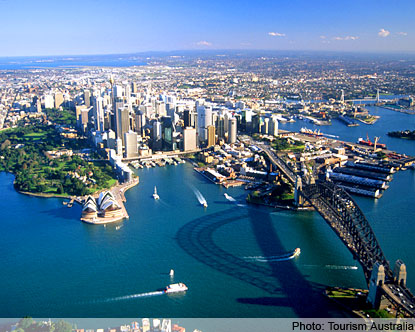
Posted: June 9, 2010 Filed under: Miscellaneous, Planning | Tags: Bicycle path, Liveability, special places, Warrandyte State Park, Westerfolds Park, Yarra Flats, Yarra river 4 Comments When I think of Sydney, where I lived for 10 years, I naturally think of the harbour. Not the familiar expanse around the bridge or opera house, but rather the myriad small inlets in places like Mosman that can only be fully appreciated from the water.
When I think of Brisbane, where I grew up, it’s those wonderful old latticed timber Queenslanders, laced with tropical vines and shaded by white and pink frangipani, stepping up and down the steep slopes of inner city Paddington.
But when I think of Perth, where I lived for four years, nothing truly special comes to mind. There’re plenty of interesting places, like Northbridge, Fremantle, Kings Park, Cottesloe and Rottnest Island, but they don’t seem different enough to really distinguish Perth from other cities.
So what about my favourite city – what are the special places in Melbourne? My rule is that these can’t simply be nice places to go to if you live in Melbourne. They have to be places that are special and not readily found in other cities – they are either unique or done so well they make a lasting impression on visitors. Here’s some I like. Read the rest of this entry »
Sydney or Melbourne – which is more liveable (part 2)?
Posted: May 31, 2010 Filed under: Miscellaneous, Planning | Tags: Liveability, Mercer, The Economist Intelligence Unit 5 CommentsI noted on Friday that the 2010 Mercer annual quality of living survey says Sydney is more liveable than Melbourne.
However neither of these surveys define what liveability is from the point of view of the residents of a city, begging the question: what makes one city more liveable than another? And in particular, which is more liveable, Sydney or Melbourne?
The strategic plan for Melbourne, Melbourne 2030, uses the term liveability liberally and even asserts that the plan’s “main purpose is to continue to protect the liveability of established areas” (page 1). It lists liveability as one of the city’s key strengths, but this is the closest it comes to a definition (page 23):
“liveability: metropolitan Melbourne overflows with sporting, cultural and recreational opportunity; the public transport system makes the city generally easy to traverse; health and safety standards are high, as is environmental quality; metropolitan Melbourne and the surrounding region has outstanding natural landscapes and coastlines”
At page 40, liveability is summarised as “quality of life, security, amenities, etc” and at page 50, in the context of activity centres, it is summarised again, this time as “safety, convenience, comfort and aesthetics”.
This is all a bit inexact. Whether the authors quite meant it or not, it seems implicitly to define the liveability of Melbourne as the quality of the public realm i.e. life outside the front door of residents’ houses and workplaces. The focus seems to be on ease of mobility, safety, leisure opportunities and the quality of the natural and human-constructed environments. Read the rest of this entry »
Is Sydney really more liveable than Melbourne (part 1)?
Posted: May 28, 2010 Filed under: Miscellaneous, Planning | Tags: Brisbane, expatriate, Liveability, Melbourne, Mercer, Sydney, The Economist Intelligence Unit 6 CommentsOn Wednesday the Sydney Morning Herald reported the release of the 2010 Mercer annual quality of living survey with the headline, “Sydney beats Melbourne in world’s top cities league”.
This is not news. Sydney beat Melbourne in the 2009 Mercer survey too. Sydney has stayed in 10th position and Melbourne has “slipped” from 17th to 18th out of 221 cities across the world.

Victorian politicians prefer to reference the annual survey done by The Economist Intelligence Unit. Its 2010 Global Liveability Report ranks Melbourne 3rd after Vancouver and Vienna. Sydney is ranked 7th.
Do these surveys really indicate that Sydney is more “liveable” than Melbourne, or vice versa? No, they don’t.
For one thing, the difference in scores is miniscule. In the Mercer survey, Sydney scored 106 points to Melbourne’s 105. In The Economist’s survey Melbourne scored 97 and Sydney 96.
Clearly rankings give a misleading impression of the two cities relative merits.
These sorts of surveys have been criticised on a number of grounds, including lack of transparency about their methodologies, definitions and quality of data. But that criticism misses the point that they are designed for a different purpose – to assist companies determine living allowances for staff posted to an overseas destination. The lower the city ranks, the higher the compensating allowance. Read the rest of this entry »
Is the Kobo cool?
Posted: May 24, 2010 Filed under: Miscellaneous | Tags: borders, ereader, Kindle, kobo, Nick Hornby, Phillip Meyer 4 CommentsMy household acquired the new Border’s e-reader, Kobo, on the weekend. The Kobo was released on Wednesday and with the dollar crashing to below 80c at one point on Friday I figured it might be now or never.
There’s no particular connection to Melbourne or to urbanism in this article but as this is the first time I’ve ever been a real early-adopter, I thought I’d share my experience. Perhaps my rationale can be that I’ve always had a page on this blog titled My Reading.

This’ll be a brief review because I haven’t really had much time to look at it, but based on my (limited) experience over the weekend and my wife’s slightly more extended experience, here are the pros and cons of the Kobo (which BTW I take to be an anagram of “book”?). Bear in mind that we only intend to use the Kobo for reading fiction.
On the pro side:
First, it’s very cheap – just A$199. It was released on Wednesday so I don’t know if there’re any left. Its closest rival, the Kindle, is US$249 and you have to wait for delivery.
Second, you can buy it over the counter. I got this one at Borders Carlton on Friday night. I’m a big user of e-commerce but having bricks and mortar to deal with is always preferable.
Third, it really is like reading paper. The screen isn’t lit by light like an LCD but uses a technology like the Etch A Sketch. It’s very easy on the eyes compared to a computer screen or an iPhone. There is a choice of two fonts and five type sizes – I expect the range will increase as the software is revised. Read the rest of this entry »
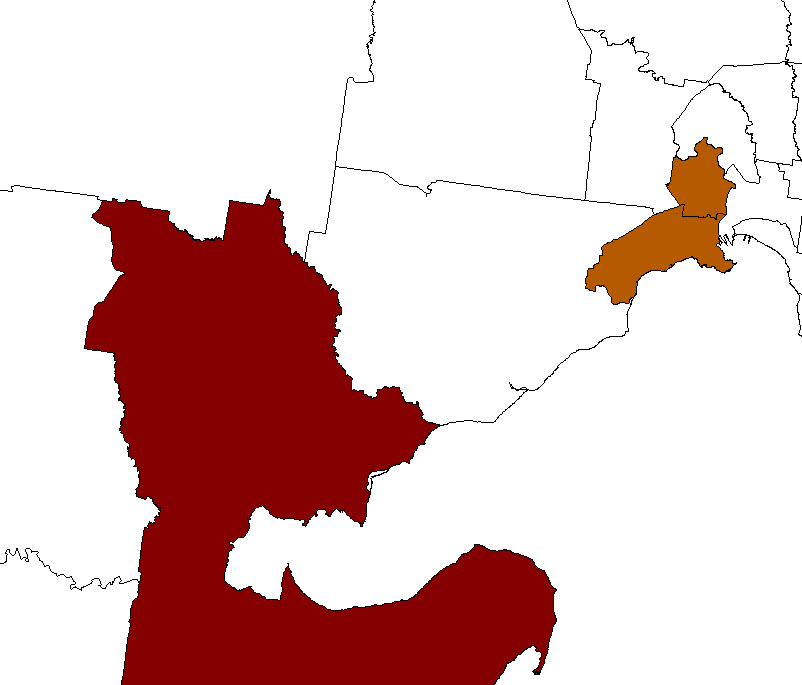
More cartozoology – two dogs
Posted: May 23, 2010 Filed under: Miscellaneous | Tags: cartozoology, dogs, Geelong, Hobsons Bay, Local Government boundaries, Maribyrnong, Melbourne 1 CommentAnd they say strategic planning is not about barking dogs (Local Government Boundaries, Melbourne)! This really needs a caption….
What makes people happier – money or status?
Posted: May 18, 2010 Filed under: Education, justice, health, Miscellaneous | Tags: Chris Boyce, happiness, Robert H Frank, social justice, social rank, status 6 CommentsA new study by researchers at the University of Warwick finds that money only makes people happier if it improves their social rank.
A well known example of this effect was documented by economist Robert H Frank. He asked people if they would prefer to live in a 4,000 ft2 house where all the neighbouring houses were 6,000 ft2, or in a 3,000 ft2 house where all the neighbours lived in houses that were 2,000 ft2. A majority of respondents chose the 3,000 ft2 house – smaller in absolute terms than the first option but larger in relative terms.

Where being brilliantly avaricious counts most? (Cut paper)
This is not a new insight but I think it is very important that planners and architects appreciate it – in fact it is very important for anyone who has clients or who is involved in policy development and implementation. Status matters. The trick is to direct it in ways that are as environmentally, economically and socially benign as possible. Bicycles rather than BMWs!
The researchers were seeking to explain why people in rich nations have not become any happier on average over the last 40 years even though economic growth has led to substantial increases in average incomes.
Lead researcher on the paper, Chris Boyce from the University of Warwick’s Department of Psychology said:
“Our study found that the ranked position of an individual’s income best predicted general life satisfaction, while the actual amount of income and the average income of others appear to have no significant effect. Earning a million pounds a year appears to be not enough to make you happy if you know your friends all earn 2 million a year”
The study, entitled “Money and Happiness: Rank of Income, Not Income, Affects Life Satisfaction”, will be published in the journal Psychological Science. The researchers looked at data on earnings and life satisfaction from seven years of the British Household Panel Survey (BHPS), which is a representative longitudinal sample of British households. Read the rest of this entry »
Has local government gone to the dogs?
Posted: May 15, 2010 Filed under: Miscellaneous | Tags: boundaries, cartoon, cartozoology, dog, Local Government Area, map Leave a commentSeems that local government really has gone to the dogs in Melbourne although I’m not sure what breed this cartozoological canine is. Looks friendly enough considering the poor thing has had its tail docked and is getting on a bit. I think I’ll call him Maribyrnong ‘coz that’s where his head’s at (jeez, I hope he’s not about to do the dirty on Cardinia!).
And then there’s this ghostly character in eastern Victoria who’s amazed/terrified/awed by something – but what? Is that a sheep’s head or a wolf in…..?
I’ve created a few others as well that I’ll put up shortly. Contributions welcome.


Solar powered Melbourne
Posted: May 9, 2010 Filed under: Miscellaneous | Tags: music, planets, Solarbeat, Whitevinyl 1 Comment
Solarbeat (click to play)
There have to be a zillion opportunities to apply this idea to Melbourne. This movie by Whitevinyl, titled Solarbeat, shows the motion of the planets around the sun – a note is played each time a planet completes a year i.e. one orbit.
It could be applied to the motion of cars, trams, pedestrians, garbage trucks, ideas, footy, tourists, – in short anything that moves physically, metaphorically, etc. This really could be the sound of Melbourne.
Should Parliament move to Werribee?
Posted: May 6, 2010 Filed under: Activity centres, Architecture & buildings, Decentralisation, Miscellaneous | Tags: bureaucrats, Decentralisation, Melbourne, Parliament House, politicians, public servants, regional development, relocation, Victoria, Werribee 3 CommentsContrary to what seems to be a widely held belief, it is not an easy matter to make jobs simply materialise in places that have a shortage of employment. It is a difficult and complex business that involves much more than merely rezoning land for business use.
However here’s an outrageous shortcut for developing Melbourne’s west. Why not shift the seat of Government in Victoria – politicians, bureaucrats, departments, the whole kit and caboodle – out of the CBD to somewhere like, say, Werribee?

Parliament House as it was intended...
Such an action would give an enormous boost to the development of the west and reinforce the Government’s new policy of developing significant suburban activity centres. A location like the west makes sense because the weight of future metropolitan growth will have to be north of the Yarra due to environmental constraints in the south and east.
This is a shocking idea but it’s not as far-fetched as it sounds (although I don’t mean to suggest that it would be costless or easy, much less politically tempting).
The standard argument for retaining the seat of Government in the CBD is that high level strategic operations obtain external economies of scale from co-location. Thus the efficiency of government in Victoria is greatly enhanced by face-to-face contact between politicians and bureaucrats on the one hand, and captains of business on the other. Further, the CBD maximises access to high human capital workers because of its excellent accessibility, particularly by rail, from all parts of the metropolitan area. Read the rest of this entry »
Do cities cause divorce?
Posted: April 17, 2010 Filed under: Education, justice, health, Miscellaneous | Tags: city, country, Denmark, divorce rate, Scandanavia Leave a commentThe divorce rate is higher in cities (like Melbourne) than it is in the country. But is that because there’s something about cities that promotes marital discord? These Danish researchers say no – it’s because couples in relatively stable relationships are more likely to move to the country:
 The Melbourne Urbanist