Is Melbourne pushing the boundary (too far)?
Posted: September 15, 2011 Filed under: Planning | Tags: CSIRO, density, Geosciences Australia, image, La Nina, satellte, sprawl, suburbs, urban growth Leave a comment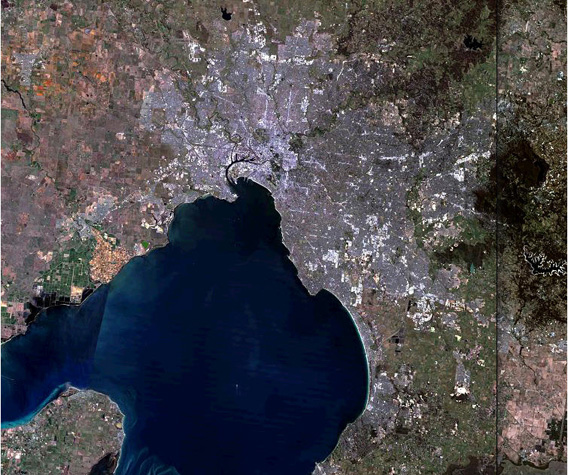
Melbourne in 1988 - a part of the 2010 image, showing the effects of the drought, is visible on the RHS
Geosciences Australia has released a new series of satellite images comparing the extent of development in Melbourne in 1988 with 2010. Click on the image above to go to Geosciences Australia’s web site where you can do a “swipe” comparison of the two images i.e. move the cursor across the image to progressively reveal the second image underneath.
According to a report in The Age, the images show a “massive” increase in urban sprawl, with Melbourne’s urban footprint surging to the north, west and south-east. Melbourne has “marched into surrounding rural landscapes” and its “unofficial boundary is now more than 150 km east to west”.
Melbourne has certainly expanded at the fringe over the last 22 years, there’s no doubt about that. However I’ve argued before that both the extent of sprawl and its downsides are routinely exaggerated, so I want to have a closer look at these images and at The Age’s interpretation.
One thing that struck me straight up is that any comparison of the two satellite images can be misleading unless the viewer appreciates Melbourne was still suffering the effects of a long drought in 2010 (compare the size of the dams in each year). So areas that appear to have gone from green to brown between 1988 and 2010 might reflect lack of rain, rather than an increase in development.
In fact 1988 was an unusual year. There was a La Nina event in 1988-89 – the first since 1973-76 – and hence there were wetter than normal conditions. Have a look at this older CSIRO comparison of satellite images of Melbourne in 1972 and 1988, and note the CSIRO cautions that 1972 was much drier than 1988.
It should also be borne in mind that 22 years is a reasonably long period in urban development terms. We shouldn’t be surprised to see substantial change when a metropolitan area is growing. Have a look at these images to see how spectacularly some other growing cities have changed in the course of 20 years.
The level of growth also needs to be considered. Melbourne’s population grew from circa 3.1 million to around 4 million between 1988 and 2010. That’s an increase of about 30%, which is considerably more than the apparent increase in the size of the urbanised area. That’s to be expected, as a large proportion of population growth – currently approaching half – is accommodated within the existing urban fabric via redevelopment.
And then there’s The Age’s claim that Melbourne’s urban footprint spreads “more than 150 km east to west”. It doesn’t. Using GIS, I measure at most 75 km from the western edge of Wyndham to Lilydale in the east and 85 km to Pakenham in the south-east. If I measure instead from Melton (putting aside that it’s separated by 9 km of green wedge from the continuously urbanised area), I still get less than 80 km to Lilydale and less than 100 km to Pakenham. Some might think that’s still too big, but it’s a lot less than 150 km plus. Read the rest of this entry »
What should be done with myki?
Posted: September 14, 2011 Filed under: Public transport | Tags: Bernie Carolan, MYKI, MykiLeaks, Public transport, Transport Ticketing Authority 23 Comments
Road pricing in London, 18th century
The Age reckons myki is “failing at maths”, but I wonder if the key failing is actually with the way it’s managed rather than with any technical shortcomings.
This report in Tuesday’s paper said “hundreds of travellers (who use myki) are paying too much”. It follows an earlier report by The Age, back in April, when it was claimed that “one third of myki bills are inaccurate”.
Both these stories refer to MykiLeaks, a web site set up by Monash University student Jonathan Mullins. It enables travellers to review (some aspects of) the accuracy of myki statements on-line.
The Age’s latest report indicates a big improvement since April – the proportion of inaccurate statements is down from 33% to 15%. But if valid, that’s still a very high error rate even if, as The Age’s reporter says, the total dollars involved aren’t significant (the combined overcharge across circa 300 faulty statements was $1700, with the biggest error being a traveller charged $18 instead of $6).
But there are reasons to be careful about how much weight to put on the MykiLeaks results. One is that we don’t know how accurate the MykiLeaks algorithm is. Another is that only 2,000 statements have been submitted to the site since it started last December. That’s a very small proportion of the million plus myki cards on issue.
Such a small sample might not be problematic if it were randomly selected, but it seems unlikely the kind of people who use MykiLeaks are representative of the whole body of myki users. They could have good reason to be wary if, for example, they are in the small group who make the kind of complex, multi modal trips where myki appears to be weakest.
I don’t know for sure how accurate myki actually is or even what most of the errors are, but I don’t put a lot of store by MykiLeak’s findings. But that doesn’t really matter all that much because the key issue in my view is the poor public perception of myki – it’s pretty clearly a tainted brand. I’m the first to be wary of on-line polls, but surely it’s not without significance that a staggering 91% of the 5,657 readers who voted in The Age’s poll answered ‘No’ to the question: “Do you trust myki to charge you the correct amount?”.
Moreover, read through the comments on the article and it’s evident there are other issues too. Quite a few people have difficulty understanding their account statements. Others are annoyed by the considerable delay between topping up their account on-line via credit card, and when the funds become available for use. Many resent having to identify errors themselves and then contact a call centre to have it fixed up.
If The Age’s report is a fair account, the Transport Ticketing Authority (TTA) seems to be taking a defensive posture. That’s not good for business and it’s not smart politics either.
The best counter the Chief Executive, Bernie Carolan, could manage was to warn “myki users against giving their personal information to the (MykiLeaks) website”. He also said he couldn’t confirm MykiLeak’s claims because the Government doesn’t have access to the site. Just as he did back in April, Mr Carolan again provided this reassuring, customer-friendly advice: “If a customer is concerned they have paid more for their fare than required, they should contact the myki call centre on 13 69 54”.
This sounds to me like an organisation that’s a little out of touch with its customers. People don’t want to hang on the phone to a call centre to correct a mistake they didn’t make. Moreover they expect the TTA will identify its own overcharging errors, not leave it up to customers and wait till they complain. Perhaps most of all, they want to be reassured – they want the TTA to tell them honestly and plainly if they’re being over-charged or not. Mr Carolan didn’t answer that question – he responded with bluster. Read the rest of this entry »
9/11: Should America move on?
Posted: September 13, 2011 Filed under: Miscellaneous | Tags: 9/11, Ground Zero, memorial, Overcoming Bias, Robin Hanson, World Trade Centre 11 Comments
South Pool, 9/11 memorial, Ground Zero
It’s a very brave or very insensitive American who would publicly question his nation’s entire 9/11 memorial project on the day of the tenth anniversary. Yet just a few days ago, on the morning of 11 September, US economist Robin Hanson began his internationally popular blog, Overcoming Bias, by complaining that half the comics in his Sunday paper “are not-funny 9/11 memorials”.
I did my own mawkish 9/11 ‘memorialising’ last time (the video On the transmigration of souls), so I too was guilty of dishing out largely uninformative and non-analytical content on this occasion. But Professor Hanson has a much bigger message (the links are his):
In the decade since 9/11 over half a billion people have died worldwide. A great many choices could have delayed such deaths, including personal choices to smoke less or exercise more, and collective choices like allowing more immigration….
Yet, to show solidarity with these three thousand victims, we have pissed away three trillion dollars ($1 billion per victim), and trashed long-standing legal principles. And now we’ll waste a day remembering them, instead of thinking seriously about how to save billions of others. I would rather we just forgot 9/11.
Do I sound insensitive? If so, good — 9/11 deaths were less than one part in a hundred thousand of deaths since then, and don’t deserve to be sensed much more than that fraction. If your feelings say otherwise, that just shows how full fricking far your mind has gone.
Just to really drive home his point, Professor Hanson updated his post with a link to news agency Aljazeera, which featured an article Let’s forget 9/11 by American Tom Engelhardt, author of The American way of war: how Bush’s wars became Obama’s and The end of victory culture.
Not surprisingly, given this was 11 September, some comments from readers were pretty direct:
This will, sadly, be the last time I read your blog.
You, Mr. Hanson, are an idiot. You have no conception of mythos or national dignity. Good bye, sir.
Robin, you’re “fricking” out of your mind.
A co-worker used to have a little sign in her office: Most people know how to remain silent. Few people know when.
Some other comments took issue with his basic argument:
Insensitivity will not stop people from being affected by some tragedies more than others.
Human nature is to attach greater significance to things that are close to us and have evoked personal feelings, rather than basing it on magnitude alone. And there is nothing wrong with that. Your moralizing is no better than the ridiculous moralizing that has gone on in the past ten years in reaction to 9/11. Everyone has their story to tell; yours involves looking down on the natural human reaction to a dramatic event. That is all.
Defence against terrorists, not solidarity with victims, explains the “pissing away” of three trillion dollars.
You cannot reasonably expect this sort of brazen and demented contrarianism to induce readers in search of a new moral framework to think, “hrm, maybe I’ll give this utilitarianism thing a whirl and see where it takes me!”
Might as well forget about the Holocaust too. In the bigger scheme of things, what were only 6M Jews?
But quite a few comments were supportive of Professor Hanson’s view:
I think what Robin is saying is that the response to 9/11 didn’t do any of the things that the “leaders” who pushed those responses said those responses were going to do. What those responses did do was piss away $3 Trillion (and counting), kill a bunch of US soldiers, and squander the “good will” of the rest of the world while committing great evils; the killing of many Iraqi civilians, the strengthening of al Qaeda and the bankrupting of the US economy.
If only one 1/100 of the social capital spent on 9/11 remembrance was spent on organ markets… I would expect more than 100x as many lives would have been saved compared to any anti-terrorist measures implemented because of 9/11. Read the rest of this entry »
Should scooters and motor cycles have a bigger role in cities?
Posted: September 12, 2011 Filed under: Cars & traffic | Tags: 2WMV, motor cycles, Paris, scooters, Two Wheel Motorised Vehicles, Velib 16 Comments
John Adams - On the transmigration of souls (Tribute for 9/11)
I’ve argued before that scooters and motorcycles should play a much bigger part in meeting our future transport needs if the cost of motoring increases dramatically in real terms (here and here). That’s because Two Wheel Motorised Vehicles (2WMVs) are cheap to buy, they’re economical to run and they offer many of the advantages of a car, including on-demand convenience and speed. Moreover they’re easy to park and can be threaded through traffic.
We know 2WMVs are very popular in countries like Vietnam where vehicle purchase and running costs are very high relative to incomes, yet they don’t have a high profile in discussions within Australia about how to deal with peak oil and climate change. Because of their low fuel use, small 2WMVs with efficient, clean engines should garner greater attention as a more sustainable transport option.
A new study published earlier this year, The unpredicted rise of motor cycles: a cost-benefit analysis, might help to give more prominence to the two wheel powered option. It shows use of 2WMVs grew strongly in Paris from the start of the new century, when real oil prices began to rise.
Pierre Kopp from the Pantheon-Sorbonne University (Paris-1) found the number of passenger kilometres travelled by 2WMVs increased 36% in Paris between 2000 and 2007*. This was much higher than other modes – rail grew 12% and bus and car fell 21% and 24% respectively. By 2007, 2WMVs accounted for 16% of all road passenger kms in Paris (up from circa 10% in 2000), more than double the share of buses.
The growth in 2WMV use was primarily at the expense of public transport. Of the 380 million additional passenger kms attributable to 2WMVs, a fifth were generated by existing riders travelling more and 27% by travellers transferring from cars. However more than half (53%) came at the expense of public transport.
This is not surprising given the evidence the author presents for the point-to-point time savings offered by 2WMVs over all other modes. Within Paris, they are 46% faster than cars and 50% faster than the Metro. Within the suburbs of the metropolis, they are 39% faster than cars and 34% faster than the RER.
The author calculates the switch from cars to 2WMVs generated an annual travel time saving worth €93 million. He subtracts higher accident, pollution and other costs, giving a net benefit of €102 million. The net benefit from those who switched to 2WMVs from public transport is €62 million. In contrast, the share of the additional 2WMV travel generated by existing riders has a net cost of €3.7 million (mostly reflecting the absence of the sort of dramatic time savings obtained by those who switched from relatively slow cars, trains and buses).
Parisians who switch to 2WMVs are motivated primarily by time savings rather than fuel costs. On the other hand, the main deterrent is safety (interestingly, the big cost component by far is minor accidents rather than serious ones or fatalities). The importance of safety is illustrated by the fact that all the value of the extra trips taken by existing riders was cancelled out by higher accident costs.
The total €160 million net benefit from increased 2WMV travel over the period was achieved with little official support, according to the author. For example, parking for 2WMVs is limited and the number of parking fines doubled over the last seven years. The author contrasts the relatively high level of expenditure on infrastructure aimed at making cycling safer with the paucity of expenditure on 2WMVs, even though, he says, cycling accounts for a mere 0.8% of all road travel (and 6 deaths p.a.) in Paris whereas 2WMVs account for 16% (and 21 deaths p.a.).
I think it’s unfortunate that bicycles and 2WMVs are cast in competing roles for funding, but it’s nevertheless puzzling why small capacity 2WMVs (I exclude big motor bikes) have such a low profile in public policy as a relatively sustainable transport option. This seems as true in Australia as it apparently is in Paris.
It’s puzzling because 2WMVs have many advantages. Compared to bicycles they can travel longer distances, are harder to steal, are more accessible to those who are infirm, can carry a passenger and goods, and riders don’t need to take a shower. Compared to public transport they’re faster point-to-point, they’re private, most of the financial cost is borne by the owner, and they offer on-demand availability. And compared to cars they use less fuel and can handle congested conditions better. Read the rest of this entry »
Flinders St Station: is a design competition a smart idea?
Posted: September 10, 2011 Filed under: Public transport | Tags: architecture, competition, Federation Square, Flinders Street station, Major Projects Unit, Melbourne Metro, Southbank 17 Comments
Fawcett and Ashworth's design for the Swanston Street facade (unbuilt)
It now seems clear the Government’s Flinders Street Station Design Competition is about much more than merely restoring the station to its former glory. This could be a redevelopment project, albeit one that respects heritage values. According to this statement from Major Projects Victoria, the Government will be looking for:
The best ideas from around the world to re-energise the station and its surrounds while making sure critical heritage values are maintained. Designs will be expected to address the station’s transport function, heritage requirements, urban design and integration with its surrounds as well as providing a value for money construction proposal.
At first glance a design competition seems like a good idea, but on further reflection I’m not so sure.
Architectural competitions have several advantages. If they’re open to all comers they allow for a range of interpretations of the brief and are more likely to draw in unusual, spectacular and ‘left field’ entries. It is unarguable that a radical conception like Utzon’s vision for Sydney’s Opera House would not have been selected in the absence of an international competition.
Competitions are a useful way to excite public interest in a project. They can also give up and coming architectural practices the chance to enter an otherwise exclusive club. Some of our most applauded buildings – like the Opera House and Federation Square – were the result of international competitions.
But they also have their risks. Designing a building to win a competition is not quite the same task as designing one strictly on the basis of fulfilling the brief. Competitions favour ideas that stand out from the crowd – they favour high impact visions. Sometimes the basic function, practicality and financial viability of the building can be compromised – the Sydney Opera House is one of the better known examples of this phenomenon.
There’s also a risk that entries will not be prepared with an appropriate level of diligence. Entrants don’t know they’re going to win, so rationally they’re going to make compromises to limit costs. That might not be so bad if the winner can correct the shortcomings, but once a proposal is selected the major parameters are often locked in, immediately limiting the scope for adaptation (I know short-listed entrants are often paid, but it’s usually not enough).
Some functional compromise might possibly be a price worth paying if the new Flinders Street Station were to became as iconic as the Opera House, Bilbao or the Guggenheim, but the odds on that are astronomical. No one really understands why a handful of buildings become international symbols, but the fact is millions don’t.
The key thing about this project is it will be extremely complex. Any use of the site is constrained by four key factors. First, there’s the need to protect perhaps the most iconic building in Melbourne, with high historic values. Second, it’s Melbourne’s busiest rail station – functional efficiency really, really matters and transit operations can’t be disturbed during construction. Three, if it proceeds, the proposed Melbourne Metro rail line also has to be incorporated within the complex. Four, the setting is a limiting factor – it includes the river, Princes Bridge, Fed Square, St Pauls, the view of the station across the river from Southbank, and more. Whatever’s built at the station has to take account and give due respect to the neighbours.
When it comes down to it, I doubt there’d be many projects more unsuitable for a design competition. There’s much more at stake here than a potentially functionally compromised opera house. This is the sort of extraordinarily complex project where a solution needs to be developed very, very carefully. There must be considerable research, testing and consultation with all the parties and interests involved. Theoretically this might be sorted out during the development of the brief but I think a much better outcome would be achieved if all parties, including the architects, were intimately involved from the outset.
In fact this just highlights that the key issue here isn’t “design” but “use”. What really matters is what sort of activities, commercial and public, could possibly work at Flinders Street Station without compromising the existing building, the entire metropolitan rail system and the integrity and value of the surrounding uses. A huge effort is needed to get the brief right. My expectation is that what will work here – given all the constraints – won’t be the kind of potentially spectacular stuff that in design terms would traditionally be put out to a competition. Read the rest of this entry »
Links for urbanists – No. 3
Posted: September 8, 2011 Filed under: Miscellaneous | Tags: Cat Poljski 3 Comments
Villa Verticale - Cat Poljski (Etching, aquatint)
Assorted links to some of the useful, the informative, the interesting, and sometimes even the slightly weird sources I stumble across from time-to-time:
- The wonderful world of Cat Poljski.
- A “brief, wondrous” history of brutalist architecture. Back in the olden days when I was a student, we were weaned on photos of this sort of stuff. Like religion, if they get you young enough you’re a goner – I still love the pile of Mars Bars Moshe Safdie confected for Habitat 67 (although this photograph is its least flattering angle).
- The Naipaul test – can you tell the sex of the authors of these novels just by reading a brief extract? V.S. Naipaul once famously claimed: “I read a piece of writing and within a paragraph or two I know whether it is by a woman or not”.
- Better pedestrian infrastructure is essential for safer roads and neighbourhoods – the tragic case of Raquel Nelson and her son AJ, in Atlanta.
- Have we already hit and passed ‘peak electricity’ in Australia?
- A simple economic model of fare evasion and non-compliance.
- Intercity buses are much cheaper than trains in the US (if you ignore the cost of building the roads).
- There’s lots of competition between PC makers but they’re all competing on price. Only one company makes the iMac but it has the freedom to make something really good.
- A lighter bicycle doesn’t make you any faster.
- Mark Twain on Taming the Bicycle (this is the real Mark Twain).
- The California Cycleway, opened in 1900, was an elevated tollway built specially for bicycle traffic through the Arroyo Seco, intended to connect the cities of Pasadena and Los Angeles.
- The Great Transition claims to provide the first comprehensive blueprint for building an economy based on stability, sustainability and equality.
- The parallel between climate change and teaching evolution in schools in Tennessee in 1925.
- Cost Overruns: How I Learned to Stop Worrying and Hate Bent Flyvbjerg.
- GPS and the end of the road – place and placelessness in America.
- 19th century cyclists paved the way for modern motorists’ roads.
- All aboard Tokyo’s last surviving streetcar.
- Melbourne is No. 8 in Askmen.com’s list of the 25 cities for blokes to visit in 2011.
- The top-10 least-polluting cities in the US – LA is No. 8 and Miami is No. 5. Having a temperate climate helps heaps.
- Video flythrough of Westfield’s new Stratford shopping centre in London.
- A new look at the industrial revolution – how it broke free from the shackles of land.
- Stockholm is the only city in the world where electors voted for congestion pricing.
Why don’t architects use colour more?
Posted: September 7, 2011 Filed under: Architecture & buildings | Tags: architect, architecture, buildings, colour, North Korea, Susy Freeman-Green 17 Comments
Not much power anymore in North Korea
About a month ago I was asked by a reporter for The Age, Susy Freeman-Green, why architects are so tentative with colour on the exteriors of buildings.
She’d observed many small apartment buildings going up in the inner city were made of grey slabs of concrete. On an overcast day, Melbourne could seem awfully leaden. “What is it with the colour grey?” she asked,”and why is it so popular with architects?”
My initial conjecture was it had a lot to do with the capital and maintenance costs of buildings. The common use of concrete is the obvious example. It’s a relatively economical material and maintenance costs are lower if it’s left unfinished (“off-form”) or with a stone aggregate finish.
However I added that this was likely to be only a partial explanation. If architects as a group were minded to dress their buildings in bigger, brighter and bolder colours, then over time they’d have convinced their clients accordingly. My best guess is they don’t for one or more of the following reasons:
Most architects see form, space and texture as the key elements of design; they think in 3D – strong colour could distract from the visual message (of course if used judiciously it could also reinforce the message!)
Strong colour used creatively can be dangerous – it can date easily and go out of fashion; clients might find it too confronting; and local government authorities and neighbours might find it too dominating
The modernist ideology stresses truth in materials – show them as they are. The contemporary stress on sustainability as a driving force of design reinforces this view
Many architects aren’t confident with colour – it seems to be a specialist talent (could that be why so many architects wear black?)
Strong and bold colours might be seen as too crass for the refined sensibilities of architects. The over-use of colour by advertisers and popular media has made it distinctly unfashionable.
I don’t know if there’s any objective data to support this contention, but it seems to me strong colour is used more extensively in warm climates where the light is brighter. Colour may look more vibrant on Mediterranean islands, but it surprises me there isn’t a greater demand for it in colder, overcast places like Melbourne where it might have a psychological bonus.
I also have a hypothesis (again, untested) that strong colours are more likely to be used in Melbourne if the building is cost-constrained to a simple form like a plain rectangular solid. Examples that spring to mind are the Macleod Netball Centre and the A’Beckett Tower. Even the NAB building in Docklands is a relatively simple form. This would be an interesting project for a student to test – if the hypothesis is true it suggests architects, on average, see colour as a residual medium.
While I think there’s room for architects to use colour more boldly than they seem to want to, I also think excessive colour is the last thing most of us want to see in our streetscapes. There could be visual cacophony if the great bulk of the urban landscape isn’t coloured in a relatively neutral way. There’s a straightforward analogy here with the look of the natural landscape, most of which tends to be in a limited, often muted, palette (I think it’s plausible we’ve evolved to prefer a subdued background).
So maybe architects are instinctively reflecting a human preference for what the outside world should look like. If so, good exterior colour design doesn’t have to be confined to the ubiquitous grey, but it needs to be relatively neutral – to form a background. Read the rest of this entry »
Do public transport and road pricing go together?
Posted: September 6, 2011 Filed under: Cars & traffic | Tags: congestion, pricing, PTUA, Public Transport Users Association, road, The Greens 20 Comments
Animation of US expansion from 1700-1900 - post office openings
It surprises me who’s still lukewarm about congestion pricing of roads. I’d have thought the focus on the carbon tax over the last year would’ve heightened understanding of the role of the price mechanism in managing resources better. Obviously governments find it too hard politically but even organisations like The Greens and the Public Transport Users Association (PTUA) offer only heavily qualified support for congestion pricing.
The PTUA doesn’t support congestion pricing in the absence of alternatives, arguing that it would be unlikely to win community support and would be socially inequitable. It’s position is public transport must first be improved to a competitive level. The Greens take a similar view. Senator Scott Ludlum says the party believes a congestion tax “would be an unfair impost unless significant improvements to public transport and other non-driving modes of commuting, such as walking and cycling facilities, are made at the same time”.
What this means in practice is neither organisation has much to say in favour of congestion pricing – neither could be regarded as a staunch advocate of this potential reform. I think that’s a real pity because congestion pricing and improvements in public transport go hand-in-hand. They are the veritable horse and carriage – you won’t get one without the other.
Cars are a very attractive transport option, especially in our dispersed cities. But even the streets of a dense city like Manhattan are full of cars. We could wait generations in the hope that land use changes will make Melbourne so dense that cars will necessarily become a minority mode. Or we could ignore the probability that motorists will shift to more fuel-efficient vehicles or to ones powered by alternative fuels and instead bet that higher fuel prices will drive cars off Melbourne’s roads.
But waiting and hoping aren’t a good basis for policy. Realistically, we can’t expect Australians will forego the private benefits of a car unless they’re forced to. The only reason most CBD workers don’t drive is because they can’t – traffic congestion and high parking charges rule driving out. Even so, around a quarter of CBD workers in Melbourne still drive and that proportion rises pretty rapidly to 50% and higher once you move even a few hundred metres away from the city rail loop. It would be a bit hard to argue they make this choice because public transport isn’t good enough.
Investing in public transport without simultaneously constraining the car will only achieve a modest increase in public transport’s existing 15% share of all motorised travel in Melbourne. Consider that Melbourne’s train, tram and bus system would cost an unthinkable amount if we had to build it from scratch today – hundreds of billions of dollars – yet 85% of motorised trips are still made by car. It should be obvious that simply providing the infrastructure isn’t enough.
Congestion pricing is the only way to reduce the considerable competitive advantage cars have over public transport (in most situations) within a reasonable time frame and at a reasonable cost. It’s therefore the only way to significantly increase public transport’s share of motorised trips. Of course good public transport has to be in place at the time congestion pricing is introduced. But what The Greens and the PTUA are missing is that you have to positively and enthusiastically embrace both.
The efficiency case for pricing is very strong and rejected by few. It’s the only practical way to manage traffic congestion. Its great virtue is that it prioritises travellers according to the value of their trip purpose. It also reduces accidents, as well as transport-related emissions and pollution.
The key concern of those with misgivings is the equity implications of congestion pricing. I don’t think it can be doubted that richer people will be better placed to buy road space. But I think there are a number of other issues that also need to be considered here. Read the rest of this entry »
Should public transport be free?
Posted: September 5, 2011 Filed under: Public transport | Tags: equity, free fares, Metlink, Public transport, Stanford University, trains, Victoria Ombudsman 19 Comments
This video has nothing to do with public transport, free or otherwise, it's just a great video
My post on fare evasion last week prompted a number of commenters to suggest that public transport should be made free. Roads are free, the argument goes, so the idea that public transport should also be free is obvious. It would eliminate fare evasion as an issue, increase patronage, reduce car use and benefit lower income travellers.
Proponents argue that once the costs of ticketing and inspection are allowed for, the net cost would not be that high – one estimate for Melbourne is less than $200 million p.a. That shortfall could be financed by taxing the beneficiaries of public transport infrastructure, like CBD property owners.
Interesting as it is, I don’t agree with this proposition – in my view making public transport free would be poor policy. It might appear at first glance to be a good idea, but it’s instructive that there are few places in the world where public transport isn’t charged for. All of those towns are very small and in some instances only certain services are unpriced e.g. Stanford University free bus shuttle.
Of course there’s no such thing as “free” public transport – it still has to be paid for. Being “free” would simply mean the cost is recovered from someone else, such as taxpayers generally, rather than from the 13% of travellers in Melbourne who currently use it on any given day. And it’s worth noting that while roads are cheap, they aren’t entirely free – other than cyclists, all vehicle owners pay an annual registration fee.
Reliable numbers are hard to come by, but my working estimate is net ticketing revenue in Melbourne, after deducting collection and inspection costs, is around $650 million per annum*. In a world of “no deficit” government, that’s a significant amount. It’s enough to operate more than thirty DART-type Bus Rapid Transit systems each year or more than sixty 1,000 pupil high schools.
But free public transport would cost significantly more than that because it would generate additional trips. This would increase costs – there’d be a need for more services, more maintenance, more cleaning, and so on (e.g. see Crowding on trams gets worse). If patronage were to increase by half (say), the extra cost could be many hundreds of millions per year. There might be economic benefits in lower negative externalities, but actual money would still have to be found to cover the added costs.
Those reductions in negative externalities – principally lower car use – would in any event very likely be much lower than proponents of free public transport assume. The key constraint on significantly increasing transit’s share of trips at the expense of cars isn’t fares, but the greater speed and convenience of cars. Abolishing fares won’t substantially change that equation. In fact I expect much of the additional patronage growth would be extra trips by transit-dependent users, as well as trips by car owners that wouldn’t otherwise have been made (and which therefore are of relatively low value).
And I’m not so sure about the equity benefits of abolishing fares either. The main beneficiaries would be CBD workers and high school students – many of them attending private schools – as well as residents of well-heeled inner suburbs served by trams. It would also confer a larger benefit on those who make long trips and thereby encourage people to live further away from the city centre.
There are assorted other issues too. Some people worry that removing the barrier of fares would see public transport colonised by “undesirables”. This could make it less attractive and consequently deter users. Another potential issue is public transport might struggle even more than it does now to get government funding for service improvements and expansions, given that any expenditure would generate zero return (at the moment public transport covers around a third of its operating costs). Read the rest of this entry »
New book giveaway: Black Glass by Meg Mundell
Posted: September 3, 2011 Filed under: Books | Tags: Black Glass, Chris Womersley, First Tuesday Book Club, Meg Mundell, Scribe Publications, The Slap 1 Comment I have two copies of another wonderful book about Melbourne to give away courtesy of Scribe Publications. This time it’s a novel set in a dystopian future Melbourne. Those inner city places you know and love (or hate), from Crown to the city loop to Footscray, have a new life in this dark and sinister world. It’s a compelling story in its own right, but as with The Slap, it’s fascinating to see familiar places and landmarks. There’s an added dimension here, though, because the writer re-imagines new and sometimes ominous purposes and populations for these places.
To be in the running to get one of the two copies of Black Glass, all you have to do is say which café, restaurant or bar in Melbourne you think has the most interesting ambience. Not so much food, more the design, setting and people who frequent it. Follow this link to enter, or go to the Pages menu in the sidebar (don’t enter on this page). Entries close in ten days at midday Thursday, 15 September 2011. One entry only per person. And the odds are much better than Crown!
As always, the quality of your nomination has absolutely no bearing whatsoever on whether or not you’ll win a copy of the book. The winner will be determined at random. However, explanation is encouraged. If you’re really at a loss and don’t care what the world thinks of you, “Pascoe Vale RSL Club” will do.
If you’re one of the winners, you’ll have to provide Scribe Publications with an Australian address they can post the book to (I won’t know who you are or where you live).
I probably live a sheltered life, but I must say I haven’t seen a ‘book trailer’ before (other than those execrable things on First Tuesday Book Club). There’s lots more info about the book at Scribe Publications and I’ve got more on the entry Page. But I think Chris Womersley sums it up well:
‘Black Glass is a superb debut novel. Meg Mundell has invented a compelling futuristic version of our urban world that is not only original but — like all great speculative fiction — frighteningly recognisable. In addition, she has populated it with a cast of charismatic characters, notably the resourceful sisters Tally and Grace — truly an endearing and heroic pair.’
Don’t enter here – follow this link.
Are these planners planning ahead?
Posted: September 1, 2011 Filed under: Activity centres | Tags: activity centre, City of Banyule, Ivanhoe Structure Plan, Planning, resident action group, Save Ivanhoe 10 Comments
Ivanhoe Activity Centre Framework Plan (proposed maximum building heights added by Save Ivanhoe RAG)
The familiar story of residents pushing back against higher density development hit the press again this week, this time in Ivanhoe, where Banyule Council is seeking feedback on its draft Structure Plan for the Ivanhoe Activity Centre. Council is proposing that some areas be zoned to permit development – largely residential – up to five and six storeys in height and, in two locations, up to eight storeys.
I have a personal interest in this issue because Ivanhoe is my nearest strip shopping centre. Unlike the members of the new Save Ivanhoe resident action group, I’m not personally concerned about potential impacts like loss of views, noise and traffic. I live far enough away from the proposed development areas that I don’t expect to be directly (adversely) affected.
In fact if done right, I see further development of the centre as a way of making me and my family much better off. Increased development has the potential to provide a wider and more diverse range of shops and services and make Ivanhoe a vibrant and exciting place to spend time in. The existing strip has its virtues, but at present it’s a bit dull and lacking in personality – it doesn’t give you enough reasons to stay local rather than drive somewhere more distant.
Higher housing density wouldn’t just benefit me personally, it would also increase the supply of dwellings in a highly accessible area and hence help moderate housing prices. If supported by improvements in supporting infrastructure, Ivanhoe is an obvious location for higher density housing – there are, for example, two closely spaced rail stations within the study area’s boundary and a large base of existing shops, restaurants and community facilities.
Having said that, I sympathise with residents concerned about issues like noise from apartments. It underlines the importance of giving attention to non-physical ways of managing the inevitable conflicts inherent in higher densities. As I’ve discussed before, the law around issues like noise simply hasn’t kept up with the shift to new housing forms.
Council has done itself no favours in the way it’s put together the draft Structure Plan. It’s poorly edited, outdated in places, and inconsistent (as Save Ivanhoe point out). It gives equal weight to the minor and the significant, it mixes physical strategies with process strategies, and it’s weak on the big picture. Unforgivably, consultation with residents has been patchy at best – while it’s hard to credit, it’s almost as if no one anticipated the reaction of residents.
A key failing in my view is that it does not explain and justify the very proposals, like building heights, that worry some residents. Why, for example, does medium density development extend west in that ‘finger’ along Livingstone Street (or perhaps it’s the barrel of a pistol!), rather than expanding on a broader front closer to the existing commercial area? Why is the maximum building height in the southern ‘finger’ around Darebin station six storeys rather than, say, two storeys (or, as I would prefer, eight or more)? And why are residential buildings in this finger required to have a zero setback along both sides of Heidelberg Rd?
I can make a guess at the logic Council is using, but a consultation document needs to be framed with its target audience in mind. It’s not enough to have a few high-level paras at the start of the document about sustainability and Melbourne 2030. Residents need to understand on their own terms why the proposals are a good idea. They need to understand what Council’s purpose and logic is otherwise there’s little chance they’ll be convinced the plan is in their interest.
This highlights another failing of the plan – it doesn’t paint an adequate picture of the benefits of growth and development. There’s no excitement, no tantalising suggestion of what a stimulating, even exhilarating, place the centre could be with more people, more shops, more mixing of land uses, and more density.
While I’m personally broadly happy with what’s proposed, I think the plan has some other deficiencies that, without getting too far into Ivanhoe-specific issues, have implications for activity centre structure planning in general.
One is it doesn’t seriously engage with how the centre is envisaged to function in the future as a retail, services and business node. There’s nothing on the emerging challenges to retailing or what sort of centre it will be. Will it be more of the same, will it have a specific character (e.g. restaurant strip), will it specialise? What sort of retail formats does Council see within the centre? What are developers’ requirements – if they favour some sort of mall, would there be a place for it? Are the areas set aside for retail suitable? Are they enough? Nor is there anything on how many, or what sort, of new businesses and jobs the centre might hope to host (although we’re told specialist medical will be restricted to Heidelberg).
In short, there’s not a lot of vision in this plan about the very essence of what an activity centre is. There’s plenty of ‘by the book’ stuff on physical planning and design (sometimes in ludicrous detail) but not much on the fundamentals. Read the rest of this entry »
Does being the most liveable city in the world mean anything?
Posted: August 31, 2011 Filed under: Miscellaneous, Planning | Tags: Adelaide, Auckland, Cities of Opportunity, Economist Intelligence Unit, livability, Liveability Ranking Report August 2011, Mercer Quality of Living Survey, Perth, Pricewaterhousecoopers, survey, Sydney 4 Comments
EIU's ten "most liveable" cities in the world (scores out of 100)
The good thing about ‘winning’ the World’s Most Liveable City gong is that it might help market Melbourne to overseas tourists, students, investors and maybe even buyers of our services. Unlike the Grand Prix, it costs us nothing. And while it won’t stop some Melburnians from pissing in trains (like this guy in case you missed him in yesterday’s post), it might give many others greater pride in their city. The thousands of Melburnians who travel overseas for business or pleasure each year can now be ambassadors for their city with this neat and handy marketing tool.
But of course league tables like The Economist Intelligence Unit’s (EIU) annual Liveability Survey are all bunkum and sensible people shouldn’t be sucked in. The EIU’s Survey purportedly provides an objective ranking of world cities based on 58 variables measuring dimensions like political stability, health care, environment, culture, education and infrastructure. However, as I’ve explained before (here, here and here), there are a number of reasons why liveability league tables are best left to the marketeers.
The EIU’s Survey is designed primarily to assist companies with formulating appropriate living allowances for staff posted to overseas cities. These people are transitory and well-heeled – they don’t experience the city like the average permanent resident. They usually rent somewhere convenient and salubrious, so they won’t care too much about high housing prices and inadequacies in outer suburban public transport.
There are also difficult methodological problems involved in arriving at a single summary ranking of a city’s “liveability”. These sorts of surveys typically have lots of variables – some are easy to measure, others are very subjective. The analysts often make the convenient but unrealistic assumption that they’re all of equal value (weight). Not all of them can be ‘added’ together in any meaningful sense, yet they have to be to arrive at a simple league table.
The differences between top cities in these sorts of surveys are in any event miniscule and hence of little consequence. For example, the top five ranked cities in the EIU’s survey all scored 97 points out of 100 (see exhibit) – this would be swamped by the margin of error in the estimates. The EIU acknowledges that “some 63 cities (down to Santiago in Chile) are considered to be in the very top tier of liveability, where few problems are encountered…. Melbourne in first place and Santiago in 63rd place (can) both lay claim to being on an equal footing in terms of presenting few, if any, challenges to residents’ lifestyles”.
Defining “liveability” is itself a difficult challenge (I’ve discussed this before in the context of the ‘Sydney vs Melbourne’ debate – see here and here). The EIU finds the concept so slippery it comes up with this tautology: “The concept of liveability is simple: it assesses which locations around the world provide the best or the worst living conditions”. Arriving at a consensus definition is extremely hard because it depends on a number of factors, like the characteristics of the observer – for example, their ethnicity, their income, their stage in the life cycle and so on. The vibrant centre of Melbourne might add nothing to the city’s liveability for someone who’s elderly, or on a low income, or a member of a cultural group that is under-represented in the city.
It’s not surprising the EIU’s top ten cities seem to be all of a one. They’re all medium sized cities (no megalopolises here), they’re practically all low to middling density, they’re all in first world countries and, with the possible exception of Sydney, they all have cool to cold climates. What seems obvious is that the ranking is shaped much more by the characteristics of the host country than anything else. Factors like political stability, health and education – which loom large in the selection calculus – are pretty much the same whether you’re in Melbourne, Sydney, Perth, Adelaide or Auckland.
I would be more inclined to focus on the attractiveness of a city and measure how sought after it is (perhaps by looking at the difference between wages and housing costs). It’s instructive, I think, that few of the cities in the EIU’s top ten are the sorts of places young people around the world seem to aspire to live in. Let’s be realistic, Australian cities don’t have quite the drawing power of places like London, New York, Los Angeles, San Francisco and Paris.
The slightly different methodology used by the rival Mercer Quality of Living Survey ranks Sydney 10th and Melbourne 18th. This is a big drop in ranking for Melbourne compared to the EIU Survey, but again the difference in ranking is far larger than the difference in absolute scores, which is small. Read the rest of this entry »
What to do about fare evasion?
Posted: August 30, 2011 Filed under: Public transport | Tags: fare evaders, Metlink, Metropolitan Fare Evasion Survey, rail, train 42 Comments
% journeys where fare is evaded (Metlink data)
Metlink released its Metropolitan Fare Evasion Survey on the weekend, which apparently shows 13.5% of trips on public transport in Melbourne in the first half of 2011 weren’t paid for.
The figure for trams, where it’s easier to avoid paying, was much higher – The Age’s headline was One in five evading fares on trams (see exhibit).
Metlink’s disappointed me before with its slipshod approach to customer focus and they’ve done it again this time. The survey was released to the media, but not to public transport users, so we can’t read it (in fact the most recent media release available on Metlink’s web site as of today is 17 August!).
However fortunately The Age has cited some of the findings in this indignant editorial, Fare dodgers owe us all big time. I also stumbled across Metlink’s Network revenue protection plan 2010 which was released under FOI and made available publicly by The Age (I do like it when media use the power of the digital world to supply supporting documentation online).
Metlink’s Network Revenue Protection report provides some interesting findings based on focus group research. I found it surprising only a small proportion of travellers actually always pay the fare – most people have not paid the fare at some time and some don’t pay frequently. The sorts of explanations offered are “because I didn’t have any change” or “because I could get away with it”.
Worryingly, the report argues that “fare evasion is seen as normative behaviour shared by the majority of the population”. Prevalent public attitudes are:
- Even people who admit to occasional fare evasion do not see themselves as ‘fare evaders’ i.e.they don’t see what they do as wrong
- Fare evasion is seen as socially acceptable i.e. it is perceived that everyone does it
- Opportunistic or inadvertent fare evasion leads to more systematic fare evasion as people learn how to ‘get away with it’
- Some customers are unwilling to pay for what they perceive as poor service delivery
- The existing ticketing system is perceived as letting passengers down – it’s too confusing, too hard to use, etc
- Poor value for money – despite the value provided by ‘bulk’ tickets, Melburnians are more likely than users in other Australian cities to consider public transport expensive
- Some customers like the idea of ‘playing the game’ and actively take on the system.
Many comments on The Age’s news report support this conclusion. Not paying fares is variously justified by difficulties with buying or validating tickets, inadequate information about ticketing requirements, poor quality of service, and expensive prices. Some suggest conductors should be restored to trams and some, with imaginative logic, say making public transport free would put paid to the problem of fare evasion (pun not intended).
Trams present a particular difficulty for protecting revenue because they’re relatively “open”. It isn’t practical to have barriers at city stops like there are at loop rail stations. Even with the best of intentions, ticket purchase and validation can be difficult on a crowded tram. Chronic evaders can “hover” near a validation point and only use it if an inspector comes aboard.
Whatever measures are adopted to increase fare compliance, there are limits. There’s always going to be a trade-off between minimising non-compliance, maintaining an attractive experience for bona fide travellers, and keeping costs within sensible bounds – this is public transport, so there’s a political constraint as well. Some lost revenue is inevitable: almost all retail businesses tolerate some degree of freeloading because beyond a certain point the cost relative to the saving in foregone revenue is too high. Read the rest of this entry »
Malls & strips: what’s the difference?
Posted: August 29, 2011 Filed under: Activity centres | Tags: activity centre, Chadstone, Chermside, mall, Myer, Northland, regional centre, strip shopping centre 9 Comments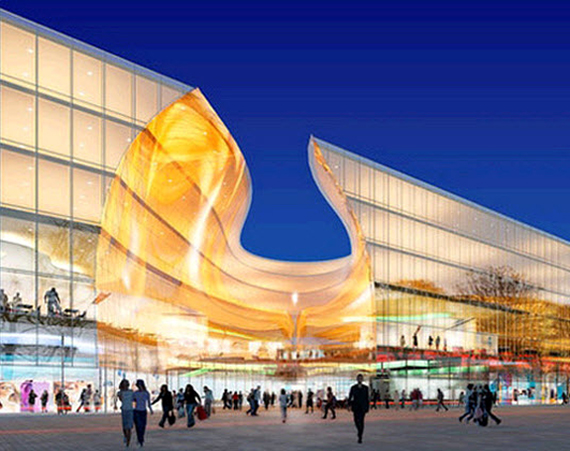
(Image from Fleskw - via The Conversation)
Whether you like them or not, malls have been pretty successful in capturing a sizeable share of the retail dollar in Australia since the first ones opened in 1957 at Chermside in Brisbane and Top Ryde in Sydney (Chadstone opened in Melbourne in 1960). Much of that success historically came at the expense of strip shopping centres, so it’s worth unpicking what it is about malls that attracts shoppers.
Both retail forms have their advantages and disadvantages from a consumer’s and an urbanist’s point of view. A week ago I took a general look at malls (What’s so bad about malls?) but what I want to look at here is a singular advantage that regional malls have over regional strip shopping centres: unified management. In one sense that’s a trite observation – it’s hard to imagine that a collection of small businesses could’ve gotten together in the 1950s to build collectively something as large as suburban Chadstone in Melbourne, currently Australia’s largest mall.
The Myer Emporium, however, had no such coordination problems. It was able to ignore the objective of the MMBW’s 1954 Melbourne and Metropolitan Planning Scheme to confine development to activity centres served by public transport. Ken Myer constructed instead a massive new retail centre on a Malvern orchard, well away from the nearest rail station.
Let me be clear that this is not a post about which is ‘better or ‘worse’ – it’s about understanding the differences between malls and strips and, in particular, why they’re different. I’ve chosen to look at management arrangements because I think that’s a key difference and space is limited, but it’s not the only one. I’ll try and look at other differences another time.
The real power of the management advantage enjoyed by malls is in operations. A stand-alone regional mall like Chadstone or Northland has a single landlord and manager who coordinates a wide range of key commercial variables, from infrastructure to the overall retail offer of the mall.
I think of malls as being a bit like clubs. The welfare of each retailer depends not only on his own performance but on that of all the others — they generate business for each other. That’s true of strips too, but in malls the tenants formally cede a considerable measure of independence to the centre manager in return for maximising the benefits of the mutual inter-dependency of the parties. The manager’s role is to maximise the benefit for all tenants and, consequently, for herself. If she doesn’t also satisfy shoppers then both she and the retailers will suffer.
One of the most important qualities of any regional centre for shoppers, whether it’s a mall or a large strip centre, is the range and choice of products and services on offer. The mall’s advantage is it is ‘designed’ or ‘engineered’ to maximise the retail experience. Managers are able to optimise a range of critical variables important to customers, like the mix of shops/tenants, the mix of merchandise value, and the mix of floorspace allocated to different retail segments. Considerable research effort is devoted to the subtleties and nuances of what sells and what doesn’t.
The centre manager can create a unified marketing image. She can also engineer a defined ‘experience’ or ‘atmosphere’ comprised of the retail offer, associated services like cinema, and the design of the physical environment. She can control the level and management of car parking, often providing it for ‘free’. Moreover she can provide simple things like clean, safe and working public toilets; tenant directories; staffed centre management offices; and security services.
The management advantage also extends to the quality of staff. Malls are largely populated by national franchises that can afford to put effort into choosing and training staff and supporting them with sophisticated management systems, inventory control and procedures manuals.
All of these activities are much more difficult for a strip shopping centre. Strips are composed of multiple landlords and multiple tenants. Individuals within each of these groups may have different priorities. Further, circulation and parking spaces are administered by a range of public agencies, such as local government and traffic authorities. In many centres there are residential and other non-retail occupants in the centre with agendas which might be inconsistent with the priorities of businesses and organisations that serve the public directly.
This diversity of purpose makes it more difficult to get any sort of sustained, unified action. Publicly funded programs like Mainstreet have endeavoured to create some semblance of joint action by retailers and other players but the results have been small scale, short-lived and largely confined to ‘beautification’ projects. Even where they work, they seldom go to the core commercial issues. Read the rest of this entry »
Are our trains going down the toilet?
Posted: August 28, 2011 Filed under: Public transport | Tags: Box Hill, Greg Barber, Jan Garrard, Rail station, The Greens, toilet 5 Comments There’s a theory that women are an “indicator species” of how bike-friendly a city is. According to Deakin University’s Jan Garrard, “if you want to know if an urban environment supports cycling, you can forget about all the detailed ‘bikeability indexes’ — just measure the proportion of cyclists who are female”.
I reckon you can say much the same thing about public toilets and public transport. Good public transport systems have good toilets because good managers focus on the welfare of users. Maybe users who are given a good system take better care of it.
The idea that a major urban node like a rail station doesn’t have toilets for its thousands of daily users is simply appalling. We wouldn’t tolerate their absence in other public places like a school, a stadium or a mall.
What’s more basic than a call of nature? If you’re travelling by train and you’ve got infants that need to be changed, or pre-teens that have difficulty planning ahead, or you’re pregnant, or you’ve been on the turps, or you’ve got an aging bladder, or you or someone in your care is feeling sick, then having access to a toilet is a fundamental human necessity.
Even in Manhattan, one of the world’s great public transport oriented cities, a busy interchange station like Union Square, with tens of thousands of people passing through each day, does not have toilets accessible to the public. Dense nodes of human activity are the very places that should have toilets!
Fortunately we have toilets at major CBD stations in Melbourne, but most suburban stations don’t. According to Greens MP, Greg Barber, two thirds of stations in Melbourne do not have toilets for public use. Even some premium stations don’t open the toilets at all times, even when staffed. Mr Barber says there are 40 stations with more than 5,000 patrons per day that don’t have public toilets.
For example, Box Hill is the tenth busiest rail station in Melbourne with circa 10,400 users per day on average, however according to Wiki:
Despite being a Premium station, there are no public toilets within the station complex. Toilets for station patrons were originally located out in Main Street Mall, however, they have been closed permanently due to vandalism. Station patrons must now use the toilets provided by the adjoining shopping centre, which are only open during trading hours.
Lack of privacy is a disadvantage of public transport relative to the car, so managers should be working hard to minimise passengers’ fear they might be put in an embarrassing position. Passengers shouldn’t have to plan their travel around the risk of needing unscheduled toilet stops.
Why are there so few public toilets at rail stations? The former Minister for Transport in the Brumby Government said toilets at stations weren’t open “for good reasons: first of all for issues of security, and for issues of cleanliness, and the like”. I acknowledge it costs money to clean graffiti and repair vandalised fittings. It probably costs much more to keep toilets clean (and were toilets opened at stations I expect users would demand a high and costly standard of maintenance). But I reckon that’s just one of those base line costs, like safety, that just have to be accepted – it’s the price of simply being in the business.
The excuse I find really odious is that toilets should be closed to prevent druggies using them. That’s really cutting off your nose to spite your face. There are other strategies for managing this problem – the Government’s promised PSOs should help – but even if toilets are used by junkies, they should nevertheless be kept open and kept in good order so ordinary passengers aren’t punished when in extremis. Travellers will doubtless avoid using toilets frequented by addicts, but they need to know they’re there when nature calls urgently and unexpectedly. Read the rest of this entry »
Are Melbourne’s trains really this bad?
Posted: August 26, 2011 Filed under: Public transport | Tags: Eltham, Hurstbridge, Monmorency, rail, trains 4 Comments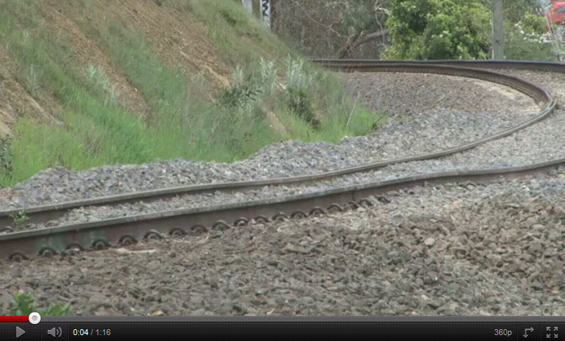
Hurstbridge line, yesterday
The amazing thing about this footage is that it was filmed only yesterday at Montmorency on the Hurstbridge rail line. The truly shocking thing is apparently this section of track was upgraded to concrete sleepers last year.
It was uploaded to Youtube by Rocketboy 1950, who says:
I shot this footage on the Hurstbridge line at Montmorency. It is testament to how safe trains are and how they will handle extraordinarily bad track without going arse over head. This is of course not to say that some of the passengers will be going to see a chiropractor or orthopedic surgeon to have their backs put right after riding the trains through here.
Expertly placed on a curve.
Update: Channel 7 now on to this and ran this story on Friday evening news.
New book giveaway: ‘When we think about Melbourne’ by Jenny Sinclair
Posted: August 25, 2011 Filed under: Books | Tags: Affirm Press, Anson Cameron, Chopper Read, Helen Garner, Jenny Sinclair, John Faine, Readings, Sonia Hartnett, When we think about Melbourne Leave a comment
Detail from cover of 'When we think about Melbourne'
Affirm Press has kindly supplied two copies of Jenny Sinclair’s beautiful book, When we think about Melbourne, to give away to readers of The Melbourne Urbanist.
To be in the running to get a copy, all you have to do is say which shopping/activity centre in Melbourne you think is the best. Follow this link to enter, or go to the Pages menu in the sidebar (don’t enter on this page). Entries close midday Saturday, 3 September 2011. One entry only per person.
As usual the quality of your nomination has absolutely no bearing whatsoever on whether or not you’ll win a copy of the book. The winner will be determined at random. However, a little explanation is encouraged. If you’re stuck, “the Bourke Street mall”, is acceptable.
If you’re one of the winners, you’ll have to provide Affirm Press with an Australian address they can post the book to (I won’t know who you are or where you live).
Here’s how Readings describes When we think about Melbourne:
Considering most Melburnians remain as steadfastly loyal to their city as they do their chosen AFL team, Jenny Sinclair is not alone in her love of Melbourne. When We Think About Melbourne charts the geography of Melbourne by exploring the historical and cultural significance of its landmarks and suburbs. Each section is accompanied with images and maps, which make for an interactive reading experience.
Sinclair’s interest lies in the way people make sense of their surroundings and come to call a particular area home. She does this through analysing the importance of maps, whether they are grand-scale drawings, something found on Google, or lines scrawled on notepaper. She also explores the potent effects of Melbourne on its artists – from Paul Kelly to Helen Garner – and how their works shape our own view of this ever-evolving city.
Here’re some images from this very visual book; here’s a review by Anson Cameron published in The Age; and here’s the author in conversation with John Faine (in company with Sonia Hartnett and Chopper Read!).
This extract from one of the chapters, City Stories, looks at how novelists have imagined Melbourne and here’s a small part of the rightly famous chapter on the Melway, a cartographic delight. Best of all though is this extract from a glowing review by The Melbourne Urbanist:
One of the observations made by Jenny Sinclair in When we think about Melbourne really strikes a chord with me – just how different the city is when you see it from the saddle of a bicycle. In this extract, she’s just cycled up the middle of St Georges Rd to Reservoir:
Perched on my bike on the track that runs through the park opposite these fine houses, I look down across Preston, Glenroy and to the city, and think: ‘it’s all downhill from here’. When I get home, I felt my sense of the world had expanded a little. Moments like this, of unexpected connection and revelation – I call them ‘surprised by joy’ moments after Wordsworth’s poem – come when we immerse ourselves, when we walk and ride; they are why we should get out of our cars for ourselves, not ‘just’ for the environment or for exercise Read the rest of this entry »
What can be learned from the English riots?
Posted: August 24, 2011 Filed under: Social and community | Tags: Architects Journal, Black Training & Enterprise Group, Chinese, education, Edward Glaeser, English riots, Jeremy Till, Jospeh Rykwert, Marianne Mueller, Yasman Shariff 2 Comments
"Remember, if you're arguing on the internet, you've already lost"
A lot of the commentary published in the wake of the English riots earlier this month marvelled at the wide range of views on the underlying causes. But few had much of substance to say themselves that might enhance broader understanding of the fundamental causes of the riots.
I’ve come across three sources that I think actually do have something interesting to say about the riots, or at least offer a different perspective. One is from the new issue of the UK Architect’s Journal; one is a new op ed by urban economist Edward Glaeser; and the third is a study by the Black Training & Enterprise Group in the UK on educational attainment in the British Chinese community.
What the Architect’s Journal says……
The UK Architect’s Journal asked a number of prominent Britons with an interest in design and cities for their views about the recent English riots. Those who responded include Joseph Rykwert, Richard Sennett, Jeremy Till, Alain de Botton and Robert Taverner.
Sennett says the riots were all too predictable – “a generation of poor, young people with no future becomes a tinder box for violence”. Taverner says the riots are a sobering reminder that people make cities – “cities rely on a precarious social balance that can be wrecked by the irresponsible”.
Some implicated the built environment more directly. Rykwert says cities incite riots – “herding people in high-rise reservoirs of social aggression doesn’t help”. Yasman Shariff says there are fundamental problems with urban regeneration schemes – “riots in new generation areas point to the schism where ordinary people cannot afford the new people’s palaces…..it can be little surprise that these regeneration areas are being torched”.
Marianne Mueller, whose practice is involved in assessing regeneration scheme designs, says “spaces for young people and public facilities in general (nurseries, libraries, green open spaces…..) are definitely not a focus in the schemes we have been reviewing over the last few years”.
The response that most struck a chord with me is from Jeremy Till who, perhaps surprisingly for an architect, emphasises the importance of underlying social processes relative to the built environment:
At least the architects are not blamed this time, as we were with Broadwater. Nor could we be, because (quoting Simmel) the city is not a spatial entity with sociological consequences, but a sociological entity that is formed spatially. Here the riots spatialise years of ramping up of social inequality. So when my Twitter feed calls for the reintroduction of Jane Jacobs, I blanch (because space is not the solution, just the symptom) and when the Tories say it is ‘pure’ criminality, I rage (because of the implicit disavowal of their political responsibility).
Very astute, Professor Till.
What Edward Glaeser says………
Harvard urban economist Edward Glaeser has published a short op ed on Bloomberg View in response to the English riots, titled How riots start and how they can be stopped. He reminds us that not all riots are overtly related to a political grievance (e.g. the ice hockey riot in Vancouver earlier this year). He argues there’s a tipping point where the cost of rioting – in terms of the risk of being arrested – gets lower as the number of people participating gets larger:
If I decided to start rioting tomorrow in Harvard Square to express my outrage at the closing of the beloved Curious George children’s bookstore, it’s a pretty good bet that I would be immediately arrested. But if thousands of others were involved, I’d probably get off scot free. The police would be overwhelmed, and my probability of incarceration would fall to zero. Thus, riots occur when the sheer mass of rioters overwhelms law enforcement.
Professor Glaeser also provides some insights on how riots might best be managed. He cites research which compares the Paris riots of 2005 with the Republican Convention in New York in 2004, where the threat of violence was averted. Police arrested only a handful of rioters in Paris, but sought serious criminal penalties. In contrast, the New York police arrested over 1,000 people but eventually let them go:
The New York strategy protected the city; the French strategy wasn’t as effective. The lesson: Light penalties widely applied and serious penalties applied to a few can both deter unlawful behaviour. This is a central conclusion of Gary Becker’s path-breaking economic analysis of crime and punishment. But in the case of riots, it is awfully hard to actually prove wrongdoing and extremely important to clear the streets. Arresting widely and temporarily can be far more effective.
What the Black Training & Enterprise Group says………
The Black Training & Enterprise Group’s study, titled What more can we takeaway from the Chinese community? (that just has to be an unintentional pun!), suggests that common explanations for poor educational performance, like ethnicity and poverty, don’t provide a complete answer. The study, which relied on official statistics from the UK Department of Education, found that 87.5 percent of British Chinese students pass the GCSE whilst their white counterparts manage only 69.6 percent. Further,
Black students from African and Caribbean descent attain a combined 67 percent respectively. Children of Indian heritage are the closest ethnic group in gaining similar levels of attainment but still only manage 82.2 percent exposing a gap of nearly 5.5 percentage points. Read the rest of this entry »
Are parking prices at the airport a rip-off?
Posted: August 23, 2011 Filed under: Airports & aviation | Tags: ACCC, access charges, Economic Regulation of Airport Services, Melbourne airport, parking, Productivity Commission, Skybus, Smartbus 10 Comments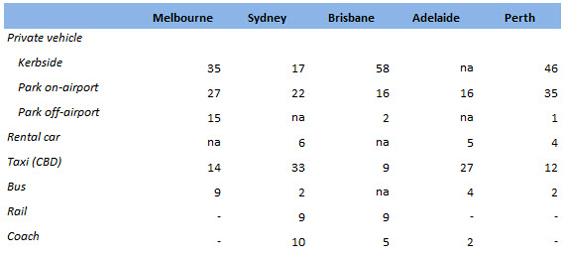
Mode share at five largest Australian airports - all users (%)
The new draft report by the Productivity Commission on Economic Regulation of Airport Services has sparked outrage among readers of The Age for its finding that parking fees at Tullamarine are “not a ripoff”. Last time I looked there were 110 comments on The Age Online, virtually every one of them dripping with vitriol.
Whether you’re happy with its conclusions or not, the thing about the Commission is that, relative to The Age’s readers, it’s put a lot of effort into this review, its assembled facts and figures, it’s made its assumptions transparent and its set down its line of reasoning. So far as I can see, none of that is true of the angry and furious readers who commented on The Age’s story.
The Commission examined lots more than parking but I’ve only had a chance to look at the chapter dealing with landside transport. It starts by acknowledging airports have the potential to raise parking prices above competitive levels and to control access to the airport by modes that compete with airport parking. It also notes the ACCC expressed concern the operator of Melbourne Airport seems to restrict entry by off-airport parking operators and private bus operators.
The Commission examined three sources of evidence for the possible existence of monopoly practices i.e. the ability of an airport to use its market power to restrict competition.
It looked first at whether there are effective substitutes for on-airport parking. The availability of alternative means of travel puts a ‘natural’ cap on what airport operators can charge. Hence all forms of transport must be taken into account. For example, at Melbourne Airport, travellers can use a private car (pick up and drop off; on-airport or off-airport parking), catch a taxi, take Skybus from the CBD, or use the 901 orbital SmartBus (which connects the Airport with Broadmeadows rail station) at standard Metlink fares (there are some other private bus operators too).
Off-airport parking is a particularly important substitute for those who drive. As the exhibit shows, this has a much larger role at Melbourne than at other airports. There are 14 private parking operators near the airport, providing 10,000 parking spaces in total. This is half the total number available on-airport. (The Airport operator is also examining a proposal for a new parking area where ‘meeters and greeters’ can wait until summoned by phone by the passenger they’re collecting).
The second issue the Commission addressed is the reasonableness of parking prices, noting that they are made up of a number of components. The obvious one is the cost of building and operating parking facilities (surface parking costs $2,000 per bay, multi-level parking stations $20,000 per bay). The total number needed is determined by peak demand (a few days at Christmas), meaning for most of the time some bays aren’t earning revenue.
Other components are the need to use price as a means of rationing demand (e.g. keeping long-term parkers out of scarcer and more valuable short-term spaces) and, finally, there’s the opportunity cost of the land used for parking – its value in an alternative use. The Commission cites a study of Sydney Airport’s international car park which found the parking charges were lower than the land could earn if developed commercially.
The third piece of evidence is more straightforward. Much as I did in this post 18 months ago, the Commission examined the claim that parking comprises a much larger proportion of Melbourne Airport’s total revenue than it does at other airports. This is taken by some as incontrovertible evidence that Melbourne Airport is engaging in monopolistic pricing.
Melbourne Airport has a lot of parking spaces (20,029). This is double the number of the next largest airport in terms of parking (Perth), so it’s not surprising it earns a lot more revenue from this source than other airports. However, Melbourne earns an average of $12.70 per bay, per day. This is the same as Adelaide ($12.20) but considerably lower than Brisbane ($16.60) and Sydney ($21.50). The importance of parking in Melbourne Airport’s revenue stream is also larger because it has the lowest aeronautical charges per passenger of any of the five airports examined. Read the rest of this entry »
What’s so bad about regional malls?
Posted: August 22, 2011 Filed under: Activity centres | Tags: activity centre, high street, internet, mall, Preston Market, retail, shopping centre, strip centre, Waterfront City Docklands 29 Comments
Waterfront City, Docklands, Melbourne - one of the newer breed of "topless" malls.
I’m always a little surprised by the ill-feeling many planners, architects and educated elites show toward regional managed shopping centres (a.k.a malls). The alternative isn’t always articulated but in most cases seems to be some notion of the traditional strip shopping centre, or ‘High Street’**.
The vast majority of Australians – the 90% plus who live in the suburbs – have pretty clearly voted with their feet for shopping in malls (see here, here, here, here and here). That seems like a rational and inevitable response to the prevailing cost of travel and, relative to strip centres, the considerable advantages of regional malls for a population that’s overwhelmingly car-based. The key advantages are:
One, malls provide complementary shopping – shoppers can buy a diverse range of goods and services from different retailers at a single destination. On one trip, a customer can buy electronics, clothes, furniture, kitchen gadgets, get a haircut, and more.
Two, they provide comparison shopping – buyers can compare the prices of similar products (say shoes) at multiple retailers within the same destination.
Three, economies of scale at the level of the store and the franchise network provide purchasers with lower prices and wider product choice than they could ever hope to get on the High Street.
Four, most regional malls offer a climate-controlled shopping experience irrespective of whether it’s hot, cold or raining outdoors (although enclosure might possibly be of declining importance – newer malls like Waterfront City at Docklands are largely open-air with car-free pedestrian “streets”).
Five, they’re safe. There are no cars within malls, so parents of small children don’t have to worry about road safety. In most, there’s a permanent security guard and centre management presence. Most don’t have pubs or licensed restaurants so there’re fewer drunks.
Six, malls are very sociable. They have indoor ‘streets’ and large food courts. They have cinemas and play areas for small children. They’re meeting places that offer plenty of “buzz” for little cost. Few traditional strip shopping centres have a direct equivalent to the food court because they’re not centrally managed.
Seven, they’re equitable. Prices are competitive – that’s one reason those on average to low incomes like them. Maybe they also like the fact their “relative poverty” isn’t highlighted by the sorts of expensive restaurants and designer shops often found in fashionable strip shopping centres.
Of course there’s no such thing as a perfect solution and malls also have downsides. The most common criticisms I hear are as follows:
One, malls are dull and franchising means “they’re all the same” no matter where you are in Australia. Personally, I don’t find regional malls particularly appealing (although some are better than others), but there’s no getting away from the fact that most people, on balance, prefer them to the High Street. Either it’s a price most people are prepared to pay for the benefits, or most simply don’t see many other malls, or more likely there’re many, many people who actually don’t find them dull.
Two, they turn their back on the street. This criticism misses the essential point of malls – they have their streets within the building and these indoor promenades are often safer, quieter and more congenial that outside streets. Shops blend with the ‘street’ – mall designers have understood the importance of “activation” since the days of Victor Gruen.
It’s true that malls often have blank, windowless facades and are separated from the street network by parking, but this is true of many suburban building types. Suburban universities, schools, hospitals and sports stadia, for example, are commonly set well back from the street and only occasionally directly ‘address’ it. This is a wider urban design issue and there are ways to handle it – it’s by no means peculiar to malls.
Three, malls are blatantly commercial – they’re designed around getting people “to buy”. That’s probably true, but almost every proposal I see to “activate” civic spaces is based on uses like cafes and bars that are, well, commercial operations. Remove the commercial operators from Southbank and see how much life is left. Strip shopping centres too, are places of commerce. Read the rest of this entry »
 The Melbourne Urbanist