Should (some) Melbourne golf courses be turned into forest?
Posted: June 10, 2010 Filed under: Energy & GHG, Planning | Tags: Alphington, environment, forest, golf, Green Acres Gold Club, Ivanhoe, Kew Golf Club, Latrobe Golf Club, park, Yarra river 5 CommentsAs I noted yesterday, the Yarra River park system – that ribbon of green that runs north east from the vicinity of inner suburban Kew and Abbotsford to Warrandyte State Park – is one of Melbourne’s great assets. Few other cities have such a vast expanse of relatively undeveloped land threaded through residential areas so close to the city centre.
Like Melbourne’s green wedges it is used for all sorts of purposes, but rather than the sewage works, quarries and airports that sully the good name of the wedges, the Yarra River park system is mostly occupied by real “green” uses – primarily golf courses and sporting fields. At the time these facilities were established, this land was floodplain with few alternative uses.

Just looking at the Melways, I can see 10 golf courses along the Yarra, of which six are clustered at the southern end of the river around Fairfield-Ivanhoe. There’s a nine hole course in Yarra Bend Park, Yarra Bend Public Golf Course at Fairfield, Latrobe Golf Course at Alphington, Green Acres Golf Club at Kew, Kew Golf Club, Ivanhoe Public Golf Course, Freeway Public Golf Course at Bulleen, Yarra Valley Country Club at Bulleen, Rosanna Golf Club and Heidelberg Golf Club at Lower Plenty.
The Yarra River park system is a very special asset, but I’m not sure it’s used as well as it could be. In particular, there’s very little forest in the park. There’s a bushland area around Wilson Reserve in Ivanhoe that’s used by locals for walking, but its small and one of very few within the lower reaches of the park system.
Melbourne could however have one of the largest urban forests of any city in the world. Such an asset would provide enormous environmental, recreational and tourism benefits for the city.
If the three adjoining private golf courses at Alphington and Ivanhoe, say, were returned to native forest, it would produce a centrally located bushland region covering an area of around three square kilometres – more than eight times the area of the Royal Botanic Gardens. Read the rest of this entry »
Where are the special places in Melbourne?
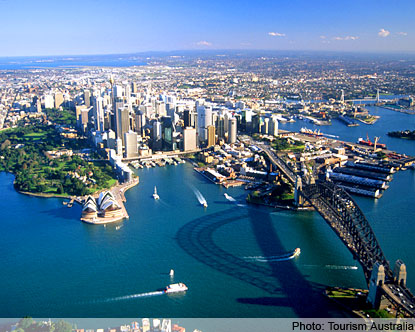
Posted: June 9, 2010 Filed under: Miscellaneous, Planning | Tags: Bicycle path, Liveability, special places, Warrandyte State Park, Westerfolds Park, Yarra Flats, Yarra river 4 Comments When I think of Sydney, where I lived for 10 years, I naturally think of the harbour. Not the familiar expanse around the bridge or opera house, but rather the myriad small inlets in places like Mosman that can only be fully appreciated from the water.
When I think of Brisbane, where I grew up, it’s those wonderful old latticed timber Queenslanders, laced with tropical vines and shaded by white and pink frangipani, stepping up and down the steep slopes of inner city Paddington.
But when I think of Perth, where I lived for four years, nothing truly special comes to mind. There’re plenty of interesting places, like Northbridge, Fremantle, Kings Park, Cottesloe and Rottnest Island, but they don’t seem different enough to really distinguish Perth from other cities.
So what about my favourite city – what are the special places in Melbourne? My rule is that these can’t simply be nice places to go to if you live in Melbourne. They have to be places that are special and not readily found in other cities – they are either unique or done so well they make a lasting impression on visitors. Here’s some I like. Read the rest of this entry »
Melbourne Bike Share – how can the Government save face?
Posted: June 8, 2010 Filed under: Cycling, Public transport | Tags: Bixi, helmet, Melbourne Bicycle Share, RACV, tourism 10 CommentsThere is a near universal consensus that Melbourne Bicycle Share is misconceived and almost certain to fail. Most attention has focussed on the compulsory helmet requirement but as I noted last week, this is a program that addresses a need that doesn’t exist and is designed in a way that will almost guarantee failure.
But no one wants a fiasco. The Government wants to save face, the RACV wants to keep its management contract and no one wants to see Melbourne’s reputation damaged by the failure of the blue Bixis.

So, I propose some radical surgery for Melbourne Bicycle Share.
First, forget about targeting the scheme at CBD workers running short errands. Reposition it instead as a service to promote tourism. The tariff should be turned around completely to support longer hire periods. For example, something more tourist-friendly, like $20 for the first two hours and $5/hr thereafter – hence $30 for 4 hours – would be close to the mark, although the tariff should be set with the goal of operating on a commercial basis.
Second, the Government should change the law to give anyone who can produce a valid out-of-State ID the right to ride a blue bike without a helmet. The exemption would not apply to any other bicycles and would be justified on the basis of supporting tourism. Tourism has been used to support Sunday trading in the dark and distant past when shopping on the Sabbath was a sin, so it’s an old and much used workhorse. Read the rest of this entry »
Will Lygon Street’s spruikers have the last shout?
Posted: June 7, 2010 Filed under: Activity centres | Tags: cartel, Lygon Street, spruikers, Victoria Market 1 CommentI imagine economics teachers have abandoned school trips to Victoria Market and are now heading with their charges to the more exciting restaurant strip of Lygon Street. Why show them something as delicate and ephemeral as “perfect” competition when just up the road they can see how markets really work in the messy and dirty real world?
The Age reported last week that a number of restaurateurs in Lygon Street have come to the belated recognition that spruiking was bad for business. In essence they have been fighting over how big their slice of the pizza is while all the time the pizza is getting smaller and smaller because of public distaste for spruiking.

As one reviewer puts it: “If there is one thing I hate, loathe, detest with every fibre of my being, it’s restaurant spruikers. I just can’t stand them…. But if a restaurant spruiker comes and tries to get me to go inside, well…. I’m sorry. For me, that’s an automatic Permanent Rejection.”.
Last Tuesday afternoon, according to The Age, “the owners of eight Italian restaurants on the eastern side of Lygon Street between Grattan and Pelham met to discuss what to do about a practice that is both tradition and millstone. The informal gathering decided unanimously to put an end to spruiking”.
This sort of agreement is usually seen as inherently unstable because there’s an incentive to cheat (I’m refraining from labelling it a cartel because there’s presumably no damage to the public interest from abandoning spruiking, so such a pejorative term seems out of order). An individual owner would do better by breaking the agreement than by abiding by it because the short term returns from cheating are greater than the long term losses from the collapse of the cartel. Read the rest of this entry »
Free download!!: transport model of NYC
Posted: June 5, 2010 Filed under: Cars & traffic, Public transport | Tags: Balanced Transport Analyzer, Charles Komanoff, New York 1 Comment According to the New York Time’s Freakonomics Blog, the Balanced Transport Analyser “is a spreadsheet that models in intricate detail the daily flow of all transit – public, private, wheeled and bipedal – in New York City”. According to Wired, “over the course of about 50 worksheets, the BTA breaks down every aspect of New York City transportation—subway revenues, traffic jams, noise pollution—in an attempt to discover which mix of tolls and surcharges would create the greatest benefit for the largest number of people”.
It calculates “how new fees and changes to existing tolls affect traffic at different times of day and calculates which costs are borne by city dwellers and which by suburbanites. It calculates how long it takes passengers to dig for change and board buses. And it allows any user to adjust dozens of different variables—from taxi surcharges to truck tolls—and measure their impact. The result is a kind of statistical SimCity, an opportunity to play God and devise the perfect traffic policy”.
The Balanced Transport Analyzer was created by Charles Komanoff. The complete model can be downloaded here.
Will cars destroy Preston Market?
Posted: June 4, 2010 Filed under: Activity centres, Cars & traffic, Planning | Tags: gentrification, parking, Public transport, retail, Victoria Market 4 CommentsThe biggest threat to Preston Market is cars.
I got thinking about this after I had lunch there last Friday. As always, I was taken in by the mad rush and vitality of the place and the sense that much of it is still essentially the same as it was when it started. I was surprised to learn that it’s a relatively young institution, having only been established in 1970 (although Preston proper is considerably older – it was connected to Flinders Street by rail in the 1920s and experienced a major population boom in the 1950s).

Initially, I was wondering if the Market is vulnerable to the increasing gentrification in the area, but then I realised Victoria Market has withstood demographic changes in the inner city reasonably well. Sure, it’s pretty middle class now but the deli and meat sections at Vic Market are unsurpassed in Melbourne. So while gentrification of Preston Market will undoubtedly diminish its authenticity – and that is the vital ingredient for some customers – it will not necessarily undermine its viability.
Which brings me to the threat to the Market posed by cars – not too many cars, but too few!
I saw a flyer issued by the Market parking manager to stall holders advising of a new parking scheme. I don’t know when it commences, but rather than fine parkers who stay beyond the initial free two hour period (one hour near Aldi), the new arrangement will charge them $1 for each additional hour. How that will work financially for the parking operator is a puzzle (how will they administer it cost-effectively?), but it’s their money. Read the rest of this entry »
Why do inner city residents walk and tram to work?
Posted: June 3, 2010 Filed under: Planning, Public transport | Tags: CBD, Cycling, density, Inner city, new urbanism, Orenco, Public transport, socioeconomic status, sustainable transport, symbolic analyst, traffic congestion, walkability 4 CommentsMore than half of all trips to work by residents of the inner city are made by walking, cycling or public transport. In fact three quarters as many residents walk and cycle as use public transport for their commute.
Why? Is it because of the higher density of the inner city?

Inner city Melbourne (photo by ExTester)
The view that density predicts more sustainable transport use is a common one. While it has some role, it is not the key force at play here. In fact there’s evidence that the population density of some parts of the inner city is not that much higher than that of the suburbs – this is because the average size of households in the inner city is relatively small compared to suburban locations.
There are also examples of higher density developments where use of public transport is quite low, for example edge cities in the US and suburban New Urbanism developments like Orenco in Portland, Oregon.
So if density isn’t the primary force driving more sustainable transport use in the inner city, what is?
Here are four plausible explanations.
The first is proximity. Inner city residents live cheek by jowl with the largest concentration of jobs in the metropolitan area – the inner city has 28% of all metropolitan Melbourne’s jobs and the CBD, despite its diminutive geographical size, has 14.5%. There is no other location in Melbourne that comes within cooee of the job density of the CBD. Read the rest of this entry »
Is Melbourne Bicycle Share all spin?
Posted: June 2, 2010 Filed under: Cycling, Public transport | Tags: fares, Melbourne, Melbourne Bicycle Share, RACV, taxis, tourism, trains, trams 21 CommentsI hope I’m proven wrong but I can’t help feeling Melbourne Bicycle Share is much more about political spin than about transport.
The PR material indicates the scheme is pitched at short-distance and short-duration travellers “running an errand at lunch or going across town for a meeting or lecture”. It extends “your public transport options and makes the CBD more accessible than ever before”.

The big question to my mind is what exactly is the need that this scheme is filling? Or more precisely, what is the justification for the Government subsidy it requires?
The very idea of a CBD is that it is walkable and if the trip’s too far then travellers take public transport. In fact public transport in Melbourne’s CBD, where we have the choice of the city rail loop and a dense tram system, is pretty good by world standards. Quite simply, the CBD doesn’t need share bicycles for transport.
I can’t see a lot of sense, either, in spending public money to take off-peak passengers away from public transport – that’s the very time when the system has spare capacity and should earn extra revenue with minimal extra cost. And why subsidise walkers to ride instead?
I’m not in any event confident that Melbourne Bicycle Share is even going to work. Read the rest of this entry »
Do firms want to be in suburban centres?
Posted: June 1, 2010 Filed under: Activity centres, Employment, Planning | Tags: activity centre, Edward Glaeser, Employment, Mathew Kahn, Melbourne 2030, Melbourne @ 5 Million, polycentricity, Silicon Valley, suburbs 3 CommentsWe know that most jobs in Melbourne are now in the suburbs. There’s also an increasing understanding that large metropolitan areas are now generally polycentric rather than monocentric in form i.e. there are significant activity centres outside the CBD with large numbers of jobs. The strategic planning update to Melbourne 2030, Melbourne @ 5 Million, released in October 2008, explicitly acknowledged this reality.
It is clear that firms can increasingly obtain the benefits of density, such as face-to-face contact, in both inner city and suburban centres where they don’t have to carry the extra costs in rent and congestion imposed by the very high density of the CBD. The CBD’s share of metropolitan jobs has consequently fallen significantly over the last 30-40 years (it has staged a small revival since 1996, showing significant jobs growth in absolute terms, but its share of metropolitan jobs has not increased).

Tysons Corner - the archetypal edge city
Yet many studies in many countries have found that while the number of suburban and inner city activity centres is increasing, the proportion of jobs located within them is falling. In fact, around a half to two thirds of employment in US cities is scattered across the metropolitan area at relatively low densities. Inter-city and cross-country comparisons are difficult, but the evidence suggests that suburban jobs are even more scattered in Melbourne.
It seems that firms can increasingly achieve the benefits of agglomeration at a larger geographical scale than that of the CBD or suburban activity centres. The advantages of physical proximity have apparently declined to such an extent that the costs of aggregation now exceed the benefits at ever lower levels of density.
But why are firms increasingly spurning density? Read the rest of this entry »
Sydney or Melbourne – which is more liveable (part 2)?
Posted: May 31, 2010 Filed under: Miscellaneous, Planning | Tags: Liveability, Mercer, The Economist Intelligence Unit 5 CommentsI noted on Friday that the 2010 Mercer annual quality of living survey says Sydney is more liveable than Melbourne.
However neither of these surveys define what liveability is from the point of view of the residents of a city, begging the question: what makes one city more liveable than another? And in particular, which is more liveable, Sydney or Melbourne?
The strategic plan for Melbourne, Melbourne 2030, uses the term liveability liberally and even asserts that the plan’s “main purpose is to continue to protect the liveability of established areas” (page 1). It lists liveability as one of the city’s key strengths, but this is the closest it comes to a definition (page 23):
“liveability: metropolitan Melbourne overflows with sporting, cultural and recreational opportunity; the public transport system makes the city generally easy to traverse; health and safety standards are high, as is environmental quality; metropolitan Melbourne and the surrounding region has outstanding natural landscapes and coastlines”
At page 40, liveability is summarised as “quality of life, security, amenities, etc” and at page 50, in the context of activity centres, it is summarised again, this time as “safety, convenience, comfort and aesthetics”.
This is all a bit inexact. Whether the authors quite meant it or not, it seems implicitly to define the liveability of Melbourne as the quality of the public realm i.e. life outside the front door of residents’ houses and workplaces. The focus seems to be on ease of mobility, safety, leisure opportunities and the quality of the natural and human-constructed environments. Read the rest of this entry »
Why I don’t warm to public art
Posted: May 29, 2010 Filed under: Public transport | Tags: community art, Dostoevsky, public art, Rail station, Russia 4 Comments I love Russian railway stations. The TimesOnline reports “the opening of a Moscow Metro station named after Fyodor Dostoevsky has been postponed after complaints that murals decorating the platform walls are too depressing. The images, drawn from the 19th-century novelist’s works, could prompt depressed commuters to kill themselves, critics say.
“One scene, right, depicts a man preparing to hit a woman with an axe while another lays dying at his feet — inspired by Rodion Raskolnikov in Crime and Punishment”.
I’ve never been very keen on public art and this reinforces my prejudice.
Hat tip to Tyler Cowen.
Is Sydney really more liveable than Melbourne (part 1)?
Posted: May 28, 2010 Filed under: Miscellaneous, Planning | Tags: Brisbane, expatriate, Liveability, Melbourne, Mercer, Sydney, The Economist Intelligence Unit 6 CommentsOn Wednesday the Sydney Morning Herald reported the release of the 2010 Mercer annual quality of living survey with the headline, “Sydney beats Melbourne in world’s top cities league”.
This is not news. Sydney beat Melbourne in the 2009 Mercer survey too. Sydney has stayed in 10th position and Melbourne has “slipped” from 17th to 18th out of 221 cities across the world.

Victorian politicians prefer to reference the annual survey done by The Economist Intelligence Unit. Its 2010 Global Liveability Report ranks Melbourne 3rd after Vancouver and Vienna. Sydney is ranked 7th.
Do these surveys really indicate that Sydney is more “liveable” than Melbourne, or vice versa? No, they don’t.
For one thing, the difference in scores is miniscule. In the Mercer survey, Sydney scored 106 points to Melbourne’s 105. In The Economist’s survey Melbourne scored 97 and Sydney 96.
Clearly rankings give a misleading impression of the two cities relative merits.
These sorts of surveys have been criticised on a number of grounds, including lack of transparency about their methodologies, definitions and quality of data. But that criticism misses the point that they are designed for a different purpose – to assist companies determine living allowances for staff posted to an overseas destination. The lower the city ranks, the higher the compensating allowance. Read the rest of this entry »
What if you were the Premier?
Posted: May 27, 2010 Filed under: Cars & traffic, Education, justice, health, Public transport | Tags: Alcohol, Cars, Melbourne, Premier, prohibition, Public transport, road pricing, Victoria 3 CommentsImagine you’ve just been elected Premier. You carried the electorate on a simple but radical two-promise platform: (1) to prohibit alcohol and (2) to shift all travel out of cars and onto public transport.
The Party is solidly behind you. Members agree that both alcohol and cars are bad for the individual and bad for society. You’re lauded as a reformer.

But you’ve not long been in office before you discover just how entrenched car use is in your largest city. Just 10% of trips are made by public transport and 90% of households have at least one car. Less driving would make the community better off but you quickly discover how much people like doing things that are bad for them and bad for others. You have a stiff drink.
For all their talk about sustainability, your predecessors knew the electorate loved cars. The former Premier talked-the-talk about public transport and even threw a few paltry dollars its way, but at the end of the day she didn’t do anything that would come between voters and their cars.
Eager to get started, you begin your quest to reduce car use by investing massively in public transport. You mortgage the State budget for the next 50 years in an endeavour to provide high quality, metro-style public transport across the entire city. Travellers without access to a car, like school children and tourists, think you’re God. CBD workers think you’re Gary Ablett. But you fail to notice that most of them either don’t vote or don’t live in marginal electorates. Read the rest of this entry »
Has the very fast train run out of steam?
Posted: May 26, 2010 Filed under: HSR High Speed Rail, Infrastructure, Public transport | Tags: Canberra, High Speed Rail, Sydney-Melbourne corridor, very fast train 9 CommentsThe idea of very fast trains on the Sydney-Canberra-Melbourne corridor seems to have run out of steam after an initial flurry earlier this year when the CRC for Rail Innovation and the Greens both called on the Federal Government to fund a major concept study.
There has been very little in the popular media since that opening blast. Hence it was interesting to see author, educator and consultant, John Legge, arguing in The Age on Saturday that the figures on very fast rail add up.

Note the extensive green areas near Canberra
He asserts that: (a) high speed rail works in Europe, China and Japan, (b) the US is now building high speed rail projects, (c) rail is faster, more comfortable and more convenient than flying, and (d) it can be built for a mere $15 billion. Ergo, it will be an unqualified success on the Sydney-Canberra-Melbourne corridor. But he provides little in the way of evidence or argument to support these claims.
Surprisingly, Legge makes no mention of what I think is the best argument for the project – constraints on Sydney Airport’s ability to expand capacity. Even more surprisingly, he doesn’t mention the environmental benefits of rail over air until the very last line and then just in passing. His key argument is that rail would out-compete air simply because a very fast train is a more attractive product.
I don’t want to deal with everything Legge says because I’ve covered most of the arguments for and against high speed rail here and here. But I do want to take issue with a couple of the points he makes.
First, what works in other countries won’t necessarily work in Australia. Most of the routes in Europe and Japan where high speed rail is strong are relatively short e.g. London-Paris is 340 km; London-Brussels is 198 km. London, with a population of 8 million and Paris (10 million) are very big cities compared to Sydney and Melbourne. They are world cities that have huge numbers of business travellers and tourists compared to Australia (London is an ‘Alpha’ world city). Congestion in the air and on the ground makes air less competitive in those cities, particularly for short trips. Read the rest of this entry »
Does the housing dollar buy more in Melbourne?
Posted: May 25, 2010 Filed under: Housing, Planning | Tags: affordability, capital cities, Financial Review, house prices, Melbourne, RP Data, Sydney 3 CommentsYes! Compared to Sydney, you get 11 km closer to the city centre in Melbourne and pay $70,000 less!
The Financial Review ran an interesting article on Saturday titled Only units deliver median inner glow. It’s paywalled, but I’ve made two graphs (click to enlarge) based on information it presents in a table on house and unit prices. The data was compiled by RP Data.
The Financial Review’s emphasis was on affordability however the sophisticated readers of this blog will appreciate that there’s a more interesting story here (although with a caveat – I haven’t seen RP Data’s full set of numbers as they’re subscription only).

Figure 1 (based on numbers prepared by RP Data)
Figure 1 shows that a buyer has to travel 23 km from the CBD in Sydney in order to obtain a house at the median price of $500,000. However in Melbourne the median house costs considerably less – $430,000 – and, more importantly, you only have to go 12 km out to find it. All this even though the population difference is only around 500,000 people – 4 million in Melbourne vs 4.5 million in Sydney.
Thus the bundle of locational services available in Melbourne for the dollar is significantly better than in our older sister up the Hume. Those services relate to the special attractions of proximity to the city centre – high level corporate and government jobs, recreational and cultural facilities, private schools, entertainment, etc.
The value of the city centre is brought home by that quintessential icon of Melbourne, the footy. The only place you can attend an AFL game within Melbourne nowadays is in the centre. And being 12 km from the CBD will usually be a better location than points further out for accessing Melbourne’s wealth of suburban jobs and for being closer to family. No wonder migrants are beating a path to Melbourne rather than Sydney. Read the rest of this entry »
Is the Kobo cool?
Posted: May 24, 2010 Filed under: Miscellaneous | Tags: borders, ereader, Kindle, kobo, Nick Hornby, Phillip Meyer 4 CommentsMy household acquired the new Border’s e-reader, Kobo, on the weekend. The Kobo was released on Wednesday and with the dollar crashing to below 80c at one point on Friday I figured it might be now or never.
There’s no particular connection to Melbourne or to urbanism in this article but as this is the first time I’ve ever been a real early-adopter, I thought I’d share my experience. Perhaps my rationale can be that I’ve always had a page on this blog titled My Reading.

This’ll be a brief review because I haven’t really had much time to look at it, but based on my (limited) experience over the weekend and my wife’s slightly more extended experience, here are the pros and cons of the Kobo (which BTW I take to be an anagram of “book”?). Bear in mind that we only intend to use the Kobo for reading fiction.
On the pro side:
First, it’s very cheap – just A$199. It was released on Wednesday so I don’t know if there’re any left. Its closest rival, the Kindle, is US$249 and you have to wait for delivery.
Second, you can buy it over the counter. I got this one at Borders Carlton on Friday night. I’m a big user of e-commerce but having bricks and mortar to deal with is always preferable.
Third, it really is like reading paper. The screen isn’t lit by light like an LCD but uses a technology like the Etch A Sketch. It’s very easy on the eyes compared to a computer screen or an iPhone. There is a choice of two fonts and five type sizes – I expect the range will increase as the software is revised. Read the rest of this entry »
More cartozoology – two dogs
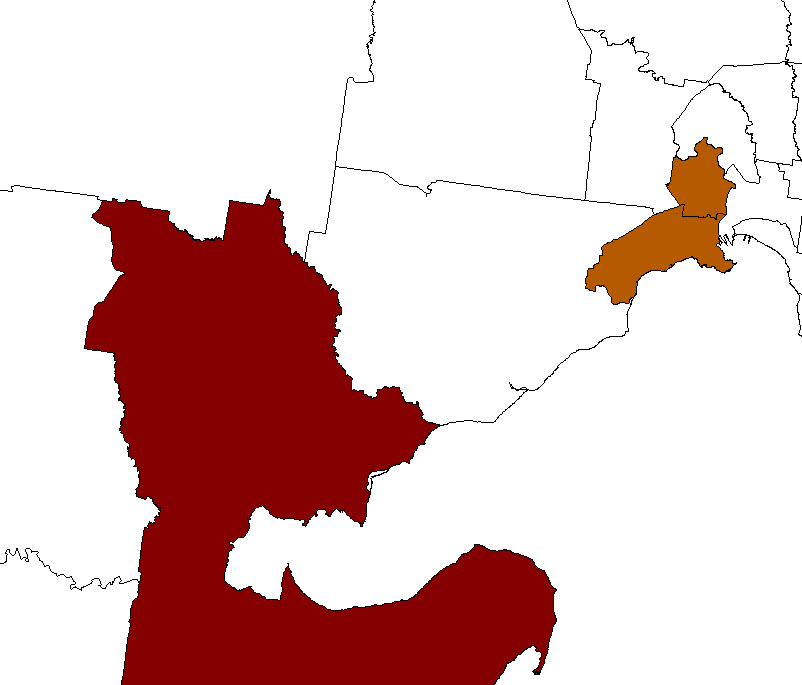
Posted: May 23, 2010 Filed under: Miscellaneous | Tags: cartozoology, dogs, Geelong, Hobsons Bay, Local Government boundaries, Maribyrnong, Melbourne 1 CommentAnd they say strategic planning is not about barking dogs (Local Government Boundaries, Melbourne)! This really needs a caption….
Stop making sense!
Posted: May 22, 2010 Filed under: Planning | Tags: Atlanta, Bicycle Diaries, bicycles, David Byrne, new urbanism, Talking Heads Leave a comment David Byrne on bicycles, Atlanta’s sprawl and burying highways.
On New York: “If I had a magic wand — ahhh, that’s easy — I’d bury the highways, as they’ve done in some other cities. The West Side Highway and the FDR would both go underground, with parks on top that link the city and its people to their waterfront. Cafes, clubs and recreational stuff too. It would be glorious”.
David Byrne at Atlanta new urbanism conference (too late, it finishes today)
David Byrne’s book, Bicycle Diaries. He’s been riding his bike in New York since the 80s.
David Byrne on Paris’s bike sharing scheme
And David Byrne on Houston – land of the free
Is the urban fringe getting bigger?
Posted: May 21, 2010 Filed under: Growth Areas, Housing, Planning | Tags: First Home Owners Grant, growth areas, Melbourne 2030, Melbourne @ 5 Million, Steve Keen, suburbs, urban fringe 4 CommentsThe proportion of new dwelling commencements planned for the outer suburban growth areas increased sharply between the release of Melbourne 2030 in 2003 and the release of the revised strategy, Melbourne @ 5 Million, in October 2008.
Melbourne 2030 envisaged 31% of dwelling starts would be located in the growth areas over the period to 2030 (page 30). It expected virtually all the rest would be located within the established suburbs, either clustered around major activity centres or dispersed across the suburbs.

Residential forecasts by region, Melbourne 2030 (click to enlarge)
The subsequent update, Melbourne @ 5 Million, made a dramatic change. It increased the proportion of dwellings expected to be constructed in outer suburban growth areas to 47% – half as much again as envisaged by Melbourne 2030 (page 3).
This change was consistent with the reality of what was happening in the market.
The authors of Melbourne 2030 probably felt at the time that 31% was a reasonable “stretch” target. Over the four years from 96/97 to 00/01, only 38% of new commencements were in the growth areas.
However four years is a short period to use as a basis for policy. As it happened this was a relatively quiet period compared to the boom that followed. Read the rest of this entry »
Why are home prices rising when lending is down?
Posted: May 20, 2010 Filed under: Housing | Tags: Australian Financial Review, home prices, Housing, loan approvals, RBA, Reserve Bank Australia Leave a commentOne of the puzzles in the current housing market is why loans for housing have fallen but prices nevertheless have continued to increase.
According to a speech given earlier this week by Dr Luci Ellis from the Reserve Bank, the number of new loan approvals in March was 16% lower than their peak late last year. In a feature last Saturday titled “The Great Property Puzzle”, the Financial Review reported that loan approvals are now at a nine year low.

Figure 1
Yet as Figure 1 shows, prices continued to rise well into 2010. In its May 2010 Statement on Monetary Policy, the RBA said “Overall, the divergence between aggregate nationwide loan approvals and housing prices remains something of a puzzle”. The Financial Review continued this theme: “Home loan approvals are falling, but property prices just keep rising. The fundamentals are all out of whack and nobody seems to know why”.
There seem to be a number of factors at play. First, immigration is strong and some migrants bring capital with them from assets they’ve sold in their former country. Second, some temporary residents are buying properties using funds raised overseas – although that’s arguable, because according to the Financial Review, the FIRB says they only account for 2% of purchases.
However what seems to be the most important factor is shown in Figure 2 – lower income buyers are dropping out of the market as home prices and interest rates rise and as assistance to first home buyers is wound back. Read the rest of this entry »
 The Melbourne Urbanist