Do fringe dwellers want density?
Posted: November 11, 2010 Filed under: Growth Areas, Housing | Tags: density, Docklands, growth areas, Henley, Housing, mcmansion, Stockland, urban fringe 8 Comments
150 m2 house on 294 m2 lot at Craigieburn
The benefits of residential density are more complex than they appear. The attractions of living cheek by jowl in places like Surfers Paradise or the CBD may not apply everywhere, especially on the fringes of our major cities.
Almost everyone knows, it seems, that density has enormous benefits. It is correlated with lower levels of car ownership, fewer kilometres driven and higher public transport use. It lowers infrastructure costs and is also associated with lower consumption of energy and water. According to some, it’s even connected with higher levels of social capital and lower rates of obesity.
However most of the benefits – both private and social – do not derive from density per se but rather from location. Lots of people want to live in high amenity places like the beachfront or in proximity to the jobs, entertainment opportunities and transport infrastructure of somewhere like the city centre. These sorts of places are in short supply so demand can only be met by increasing density.
Higher density necessarily means less land per dwelling but it doesn’t inevitably mean smaller dwellings. However unless you’re filthy rich, one of the compromises you will have to make to capitalise on a sought-after location is a smaller dwelling. The 350 m2 McMansion on the fringe might at best be a 140 m2 three bedroom unit on the top of Doncaster Hill or an 80 m2 two bedroom unit in Docklands.
The point is that many of the social benefits associated with density – like higher public transport use and lower car ownership – are a function of the location, not the dwelling type. In turn, lower energy and water use is not primarily a direct function of density but rather a result of their smaller size.
This might seem self-evident or even a distinction of no more than academic interest. But as I’ve argued before, the failure to fully understand what density is, can lead to bad policy. It is also a particularly pertinent point in the context of advocating higher densities in places like fringe Growth Areas.
Why are outer suburban houses so damn big?
Posted: October 28, 2010 Filed under: Growth Areas, Housing | Tags: Burbank, dwelling size, floor space, Housing, McMansions 15 Comments
The economics of Seinfeld (click)
Everyone knows that Australians build the largest new houses in the world. According to the Deputy Governor of the Reserve Bank, real expenditure on each new dwelling is now 60% higher than it was 15 years ago.
Just why we need 85 m2 per person, on average, in our new suburban houses is an interesting question, especially given that the average household size in Australia has fallen.
As with most things, it’s the coincidence of a number of factors that provide the most plausible explanation, but in my view the key reason is that Australians increasingly see the purchase of a dwelling as an investment decision.
There was a time when buying a house was solely about consumption – i.e. shelter – but now it’s received wisdom that houses inexorably increase in price. They provide growing equity to borrow against in the future and capital to draw against if the unthinkable should happen.
Recent history has convinced home buyers that residential property is a good, even spectacular, investment. This reflects factors such as its tax-sheltered status, restrictions on supply, low interest rates and Federal and State home buyer assistance schemes.
From the perspective of many home buyers, a bigger house not only provides more consumption value but is seen as a sound long-term investment decision. Unlike a car, which depreciates in value, buyers assume every dollar spent on a house ultimately increases in value. A bigger house might even appreciate in value faster than a smaller house. Read the rest of this entry »
Do higher travel costs make the fringe unaffordable?
Posted: October 27, 2010 Filed under: Cars & traffic, Growth Areas, Housing | Tags: affordability, Cardinia, Casey, fuel economy, growth areas, Monash, transport cost 5 Comments
The new art of Cartosimpsonology
A common argument is that households who settle on the fringe because housing is more affordable end up worse off because of higher transport costs. They are forced to buy a second or third car and they use more petrol because they have to travel further.
Of course there’s an assumption here – that ordinary families actually could find a suitable dwelling, at an affordable price, in an area where transport costs are significantly lower than they would be on the fringe.
Consider the municipalities of Casey and Cardinia, which together comprise the largest Growth Area in Melbourne. At around 45 km and 55 km respectively from the CBD they are also the most distant fringe growth areas.
The median price of an established house and garden in Casey (Narre Warren) is $350,000. Now compare that with the City of Monash, which stretches between 13 km and 24 km from the CBD. The median price for a house in this municipality is $780,000 (although in Clayton it’s $618,000).
A more likely alternative for a settler in Monash who’s primary concern is affordability would be a unit. However the median price for a unit is $464,000 ($401,000 in Clayton).
Thus the Growth Area has a considerable advantage in price and size – it’s much cheaper and offers a three to four bedroom house with a garden compared to a two bedroom unit. Clearly a Monash location would need to offer a considerable saving in transport costs to offset Casey/Cardinia’s advantages. Read the rest of this entry »
Are the new suburban ‘supercentres’ attracting residents?
Posted: October 6, 2010 Filed under: Employment, Growth Areas, Housing | Tags: CAD, Central Activities Districts, DPCD, Principal Activity Centres, UDP, Urban Development Program 4 Comments
Number of new dwellings by major suburban activity centre, Melbourne
The credibility of the six new suburban ‘supercentres’ announced by the Victorian Government in October 2008 has been undermined by a recent Government report on land supply.
The Government announced in October 2008 that it was upgrading six existing suburban Principal Activity Centres (PAC) to Central Activities District (CAD) status. The CADs are a new top-level category of centre intended to provide “significant CBD-type jobs and services” in the suburbs.
Described as “mini CBDs” by The Age and envisaged to have a mix of business, residential and civic uses, the six designated CADs are Broadmeadows, Box Hill, Dandenong, Footscray, Frankston and Ringwood.
I’ve previously pointed out there’s little evidence that any “science” was applied to the selection of the CADs. It seems the Government picked six centres under the existing Transit Cities Program and designated them as CADs.
They do not appear to be natural centres of commerce or industry. Only one of the six CADs (Box Hill) ranks among the nine largest suburban centres in terms of job numbers.
Now the 2009 Annual Report on the Urban Development Program issued earlier this year by the planning department shows that the CADs aren’t the preferred location of residents or developers, either. The accompanying graph indicates the number of dwellings recently built, under construction, or planned, in major suburban activity centres. Read the rest of this entry »
Are apartments cheaper than houses?
Posted: October 3, 2010 Filed under: Housing | Tags: 2nd State of Supply Report, infill development, National Housing Supply Council 5 Comments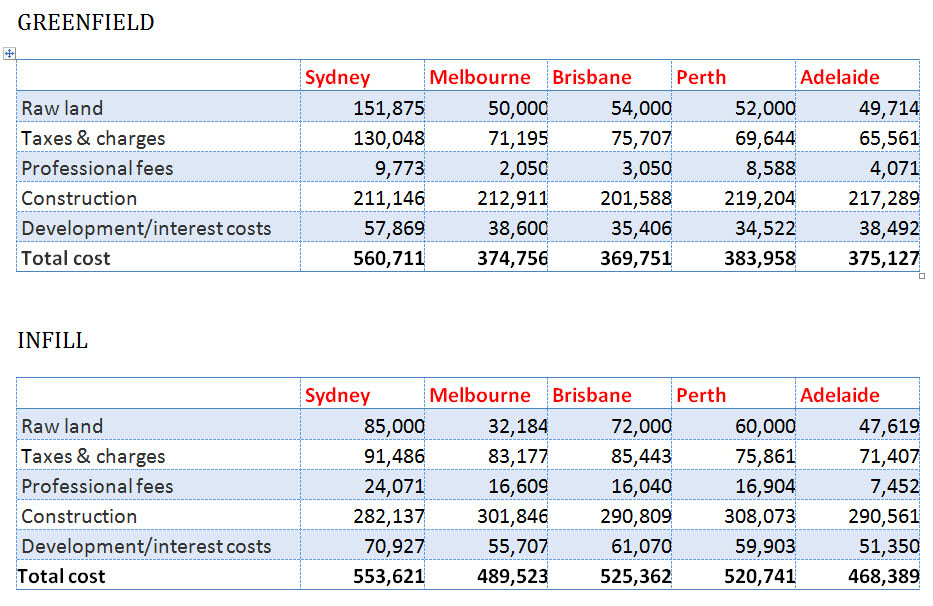
Costs of development, greenfield and infill sites
Australia’s five largest capital cities all have targets to increase the proportion of new housing constructed within established areas rather than on the fringe. The vast bulk of these dwellings will be constructed at medium to high densities i.e. apartments and townhouses.
Brisbane, Perth and Melbourne are each aiming for around 50% of commencements within established areas by 2030 while Sydney and Adelaide are aiming for 60 to 70%. In Melbourne’s case the target of 53% of commencements within established suburbs is a major step-back from the more ambitious target of around 70% set down in 2002 in Melbourne 2030 (also see here).
Yet in four out of five cities, it costs more to build an apartment within established areas than it does to build a detached house with a garden on the suburban periphery.
It costs $156,000 more to build a two bedroom infill apartment in Brisbane than a three bedroom outer suburban house. In Adelaide it costs $93,000 more, in Melbourne $115,000 more and in Perth $137,000 more. Read the rest of this entry »
Is there a housing bubble?
Posted: September 9, 2010 Filed under: Housing | Tags: Christopher Joye, hedge funds, home prices, Rismark International 9 Comments
Rismark International
In an excellent post, finance whiz Christopher Joye explains that all those foreign hedge funds who are actively shorting Australian bank shares are themselves taking a bath.
He deflates the claim of “US investment legend” Jeremy Grantham that Australia’s housing market is a time bomb with house prices 7.5 times family incomes. The hedge funds believe the housing bubble will burst and threaten the balance sheets of Australian banks.
Mr Joye, who is the MD of Rismark International, points out that the home price to disposable income ratio in Australia was actually only 4.6 in the June quarter 2010, a figure generally in line with the average since 2003. Read the rest of this entry »
Can we make living together better?
Posted: September 7, 2010 Filed under: Education, justice, health, Housing, Planning | Tags: election, Liveability, neighbours, noise, NSW, nuisance, Queensland, Victoria 12 Comments OK so now it’s time to turn to State politics.
I have a modest idea for making our major cities more liveable that I’d like to offer to the Premiers and Opposition Leaders of Victoria, NSW and Queensland in the run up to their forthcoming State elections.
The idea could be named something like the Better Neighbours Initiative or it could as easily be titled Considerate Cities or Liveable Cities or something of that ilk. The idea starts with the recognition that living in close proximity within cities imposes stresses on human relations and demands strong remedial action.
Some of the risks associated with cities, like disease, respond to investment in physical infrastructure. But some don’t – they require behavioural approaches.
The main objective is to limit the stress that inconsiderate behaviour, like noise from “hot” cars or audio amplifiers, imposes on residents and neighbours. I’ll focus on noise here, but the ambit of the liveable cities idea could extend to other problems such as taming the speed and behaviour of cars in local streets and activity centres. Read the rest of this entry »
Are new outer suburban homes getting smaller?
Posted: June 29, 2010 Filed under: Growth Areas, Housing | Tags: floor area, growth areas, home size, Housing, lot size, Oliver Hume, sprawl 3 CommentsThere was a flurry of almost salacious excitement in the media at the end of last year when an ABS study found that Australians have the largest homes in the world. Worse, it found Victorians have the biggest homes in the country.
The Age reported that houses and apartments in Australia are bigger than those in the United States, which has traditionally had the most spacious homes:
“While Australian home sizes have risen 10 per cent over the past decade, research shows sizes of new American homes have fallen from a peak of 212 square metres to 201.5 square metres”.
 Now property group Oliver Hume has thrown some new light on home sizes in Melbourne. They say that excluding Melbourne’s west, the median size of homes in the other five growth areas actually fell slightly over the last three years.
The largest absolute fall was in Cardinia, where the median home size fell from 267 sq m to 209 sq m, or by 57 sq m. Home sizes also fell in Casey, Hume and Whittlesea but increased in Wyndham and Melton. This does not, however, indicate an across-the-board change in preferences toward smaller houses.
According to Oliver Hume’s research manager, Mr Andrew Perkins, much of the drop in house size can be attributed to the increase in the number of first home buyers in the 2007-2008 period, when they accounted for an unprecedented 70% of all sales across the growth areas. Read the rest of this entry »
Does the housing dollar buy more in Melbourne?
Posted: May 25, 2010 Filed under: Housing, Planning | Tags: affordability, capital cities, Financial Review, house prices, Melbourne, RP Data, Sydney 3 CommentsYes! Compared to Sydney, you get 11 km closer to the city centre in Melbourne and pay $70,000 less!
The Financial Review ran an interesting article on Saturday titled Only units deliver median inner glow. It’s paywalled, but I’ve made two graphs (click to enlarge) based on information it presents in a table on house and unit prices. The data was compiled by RP Data.
The Financial Review’s emphasis was on affordability however the sophisticated readers of this blog will appreciate that there’s a more interesting story here (although with a caveat – I haven’t seen RP Data’s full set of numbers as they’re subscription only).

Figure 1 (based on numbers prepared by RP Data)
Figure 1 shows that a buyer has to travel 23 km from the CBD in Sydney in order to obtain a house at the median price of $500,000. However in Melbourne the median house costs considerably less – $430,000 – and, more importantly, you only have to go 12 km out to find it. All this even though the population difference is only around 500,000 people – 4 million in Melbourne vs 4.5 million in Sydney.
Thus the bundle of locational services available in Melbourne for the dollar is significantly better than in our older sister up the Hume. Those services relate to the special attractions of proximity to the city centre – high level corporate and government jobs, recreational and cultural facilities, private schools, entertainment, etc.
The value of the city centre is brought home by that quintessential icon of Melbourne, the footy. The only place you can attend an AFL game within Melbourne nowadays is in the centre. And being 12 km from the CBD will usually be a better location than points further out for accessing Melbourne’s wealth of suburban jobs and for being closer to family. No wonder migrants are beating a path to Melbourne rather than Sydney. Read the rest of this entry »
Is the urban fringe getting bigger?
Posted: May 21, 2010 Filed under: Growth Areas, Housing, Planning | Tags: First Home Owners Grant, growth areas, Melbourne 2030, Melbourne @ 5 Million, Steve Keen, suburbs, urban fringe 4 CommentsThe proportion of new dwelling commencements planned for the outer suburban growth areas increased sharply between the release of Melbourne 2030 in 2003 and the release of the revised strategy, Melbourne @ 5 Million, in October 2008.
Melbourne 2030 envisaged 31% of dwelling starts would be located in the growth areas over the period to 2030 (page 30). It expected virtually all the rest would be located within the established suburbs, either clustered around major activity centres or dispersed across the suburbs.

Residential forecasts by region, Melbourne 2030 (click to enlarge)
The subsequent update, Melbourne @ 5 Million, made a dramatic change. It increased the proportion of dwellings expected to be constructed in outer suburban growth areas to 47% – half as much again as envisaged by Melbourne 2030 (page 3).
This change was consistent with the reality of what was happening in the market.
The authors of Melbourne 2030 probably felt at the time that 31% was a reasonable “stretch” target. Over the four years from 96/97 to 00/01, only 38% of new commencements were in the growth areas.
However four years is a short period to use as a basis for policy. As it happened this was a relatively quiet period compared to the boom that followed. Read the rest of this entry »
Why are home prices rising when lending is down?
Posted: May 20, 2010 Filed under: Housing | Tags: Australian Financial Review, home prices, Housing, loan approvals, RBA, Reserve Bank Australia Leave a commentOne of the puzzles in the current housing market is why loans for housing have fallen but prices nevertheless have continued to increase.
According to a speech given earlier this week by Dr Luci Ellis from the Reserve Bank, the number of new loan approvals in March was 16% lower than their peak late last year. In a feature last Saturday titled “The Great Property Puzzle”, the Financial Review reported that loan approvals are now at a nine year low.

Figure 1
Yet as Figure 1 shows, prices continued to rise well into 2010. In its May 2010 Statement on Monetary Policy, the RBA said “Overall, the divergence between aggregate nationwide loan approvals and housing prices remains something of a puzzle”. The Financial Review continued this theme: “Home loan approvals are falling, but property prices just keep rising. The fundamentals are all out of whack and nobody seems to know why”.
There seem to be a number of factors at play. First, immigration is strong and some migrants bring capital with them from assets they’ve sold in their former country. Second, some temporary residents are buying properties using funds raised overseas – although that’s arguable, because according to the Financial Review, the FIRB says they only account for 2% of purchases.
However what seems to be the most important factor is shown in Figure 2 – lower income buyers are dropping out of the market as home prices and interest rates rise and as assistance to first home buyers is wound back. Read the rest of this entry »
Are lots smaller in the outer suburbs than in the inner suburbs?
Posted: May 17, 2010 Filed under: Growth Areas, Housing, Planning | Tags: Craigieburn, Highlands, Inner city, inner suburbs, Oliver Hulme, outer suburbs, RP Data, small lot housing, Stockton 7 CommentsThe Financial Review (paywalled) reported on Saturday that the average house sold within 10 km of the CBD in Melbourne is located on a 511 m2 block, according to data collected by property information provider, RP Data.

Central Green, Highlands, Craigieburn - some lots are 213 sq m (click to enlarge)
Of course there is considerable variation in property types within that average. Houses in the inner city (0-5 km) are predominantly terraces on small lots whereas those in the inner suburbs (5-10 km) are predominantly detached houses on larger lots.
However what is especially interesting about this statistic is how it compares with the outer suburbs. The median size of lots sold in the Growth Areas is currently 513 m2, according to property consultants, Oliver Hume.
In other words, the average lot size is much the same in the two areas.
This is surprising, but a number of caveats are in order. First, some of the properties closer to the CBD would be destined for redevelopment whereas that seems unlikely in the Growth Areas. Read the rest of this entry »
Can inner city apartments save us from sprawl?
Posted: May 13, 2010 Filed under: Housing, Planning | Tags: apartments, dwelling size, Inner city, inner suburbs, Melbourne, prices, sprawl, suburban fringe 7 CommentsHere’s compelling evidence that inner city apartments are not substitutes for fringe development despite oft-repeated claims to the contrary.
The Age reported yesterday that the average size of new two-bedroom apartments under construction in Melbourne is just 73 m2, while the average size of one-bedroom apartments is 51 m2 and studio apartments 34 m2.

SEE apartments, Claremont St, South Yarra
More than three quarters of the 5,600 units currently being built are located in central areas, mostly in the Melbourne, Stonnington and Yarra municipalities. A spokesperson from property group Oliver Hulme says that the median size of apartments in the inner municipalities is no smaller than those in outer suburbs.
I must say I’m staggered by how little space you get for your money. According to the report, the entry-level median price for newly built two-bedroom apartments is around $530,000. Corresponding prices for one-bedroom and studio apartments are $379,000 and $302,500 respectively. It seems inner city buyers subscribe strongly to the “location, location, location” maxim.
In contrast, the median house and land package in Melbourne’s outer suburban growth areas costs around $383,500 and the median dwelling size is 219 m2. It’s even cheaper in Cardinia in Melbourne’s outer South East, where the median dwelling is 186 m2 and together with land costs $334,500 on average.
Clearly the inner city and the outer suburban growth areas are entirely different markets! The average size of apartments is probably reduced by the current high rate of social housing construction but I doubt that’s significant enough to explain the enormous difference between the two markets. Read the rest of this entry »
Do “brownfields” sites matter?
Posted: May 11, 2010 Filed under: Housing, Planning | Tags: Brownfields, Challenge Melbourne, medium density housing, Melbourne 2030, Melbourne @ 5 Million 3 CommentsI was leafing through Challenge Melbourne, the discussion paper released in 2001 as part of the Melbourne 2030 process, the other day. This very interesting but apparently long-forgotten factoid caught my attention:
“Capacity for an estimated 65,000 dwellings on large sites such as old factories has been identified in the established suburbs”.
Given that the number of households in Melbourne is projected in Victoria in Future to grow by 825,000 between 2006 and 2036, it seems the potential contribution from “brownfields” sites – mainly large disused industrial and public sector sites – will be modest.

Melbourne @ 5 Million envisages that 53% of the required new dwellings will be located within the established suburbs. If the 65,000 figure is even broadly close to the mark, it seems that the great bulk of this new housing will have to come from redevelopment of small sites, most of which are presumably residential and likely to generate significant opposition from neighbours.
The key issue this raises is whether or not the anticipated level of redevelopment in established suburbs is achievable. Brownfields sites have made a significant contribution over the last 20 years to construction of multi unit housing but apparently will make a relatively small contribution in the future. Read the rest of this entry »
Why is there a housing shortage?
Posted: April 13, 2010 Filed under: Housing | Tags: Battelino, Housing, immigration, Reserve Bank, Ross Gittins, shortage 4 CommentsA curious aspect of the Australian housing market is that we have a shortage of housing even though dwelling investment has been at record levels in the last decade. It’s now 6% of GDP.
A key reason is that a large part of that investment has not been directed at building new houses, as this address by Ric Battelino of the Reserve Bank indicates. Instead we’ve been investing in:
- Dwellings that are bigger and of higher quality – real expenditure on each new dwelling is now 60% higher than it was 15 years ago
- Additions and alterations, which now attract almost half of all dwelling investment
- Replacement dwellings – around 15% of new dwellings built between 2001 and 2006 replaced dwellings that were demolished. The figure was 10% a decade ago
- Holiday homes and second homes – there are now 8% more dwellings in Australia than households
Does this shortage of supply mean we’re spending more on housing than we can afford? On the face of it, yes – the ratio of dwelling prices to incomes is higher in Australia than in the US. However what doesn’t gel here is that there’s little evidence of housing stress in Australia – for example, our arrears rates on loans are lower than in the US. Read the rest of this entry »
What role for high-rise towers in Melbourne?
Posted: March 25, 2010 Filed under: Housing | Tags: East Perth, high rise, Housing, medium density, Melbourne, Peter Newman, Rob Adams, sprawl, sustainability, tower, VECCI 1 CommentDo high-rise towers have a role in Melbourne’s future? Peter Newman thinks they do!
This report by VECCI, Up or out? dealing with Melbourne’s population boom, nicely summarises two alternative approaches set out in The Age for planning Melbourne’s future growth. Read the rest of this entry »
Why ‘spare infrastructure capacity’ is exaggerated
Posted: March 23, 2010 Filed under: Housing, Infrastructure | Tags: ACF, Coburg, Infrastructure, inner suburbs, Pascoe Vale, spare capacity, sprawl, sustainability 5 CommentsAre claims of spare infrastructure capacity in the inner suburbs real?
The Age reports that there were almost 30,000 more people living in Coburg and Pascoe Vale in 1976 than there are now (The Outer Limits). The paper quotes the former Mayor of the City of Moreland, who says that increasing the population density in many areas “is simply returning suburbs to previous population levels”.
The editorialist in The Age of 20 March stated that “some ‘traditional’ inner Melbourne suburbs – such as Coburg, Pascoe Vale and Fitzroy – have fewer residents than they did 50 years ago. Current ‘in-fill’ housing is thus regrowth” (emphasis added).
The idea of course is that there is spare capacity in infrastructure and amenities that can accommodate ‘restoration’ of the historic population level. This would be a good thing because any underutilisation of infrastructure is economically wasteful. It might also minimise further ‘sprawl’ at the urban fringe. Read the rest of this entry »
Home affordability in Australia
Posted: March 5, 2010 Filed under: Housing | Tags: affordability, Christopher Joye, home prices, mortgage, price to income ratio Leave a commentClaims that home affordability is at disastrous levels appear to be exaggerated. The always interesting Christopher Joye points out today that the average Australian home price is $428,000 on Dec Qtr figures (median is $400,000). Read the rest of this entry »
Infrastructure costs on the urban fringe
Posted: March 3, 2010 Filed under: Housing, Infrastructure | Tags: Infrastructure, Inner city, Melbourne, Suburban sprawl, The Age 8 CommentsIt is amazing how quickly supposed facts become accepted wisdom. A feature article in The Age last week, Fringe Benefits, repeated the highly questionable claim that “for every 1,000 dwellings, the cost for infill development (in existing suburbs) is $309 million and the cost of fringe development is $653 million”. Read the rest of this entry »
 The Melbourne Urbanist