Are cul de sacs a curse?
Posted: May 14, 2010 Filed under: Cars & traffic, Planning | Tags: Ballard, cul de sac, grid, growth areas, new urbanism, Seattle, Washington, Woodinville 5 CommentsOne of the tenets of new urbanism is that streets should be laid out in a rectilinear grid to maximise connectivity i.e. to minimise public transport and walking distances.
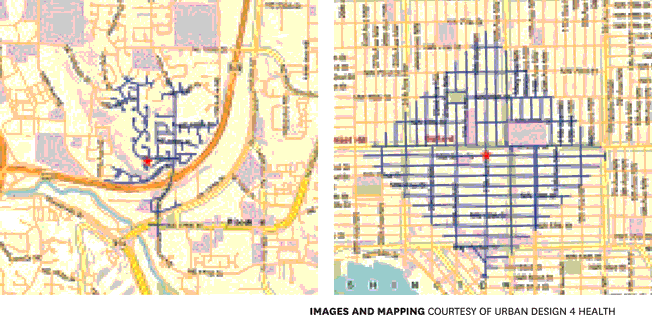
This research project in Seattle seems to confirm the wisdom of that principle. It compared the distance travelled by residents of two neighbourhoods and found that in Woodinville, where the dominant street form is the cul de sac, residents travel 26% more kilometres than residents of Ballard, where streets are laid out in a rectilinear grid.
As it happens, I’ve spent a fair bit of my life living on a “no through road” or similar street form and I think the advantages of cul de sacs are too often neglected. I grew up in a closed street, lived for six years in a mews and currently live with my family in a short cul de sac created in the 1950s when a larger property was subdivided into seven lots.
The great advantage of the cul de sac is low traffic. When my children were very young my wife and I were relaxed about them playing in the street because the only cars that entered the street were residents or their visitors. And for that same reason we don’t have issues with traffic noise like we used to have in North Fitzroy. These are major advantages and should not be dismissed lightly.
But cul de sacs have another advantage. If they’re not too long, they can create a sense of a place that is shared or “owned” by a small number of residents. We got to know all our neighbours well, shared child supervision responsibilities and even had an annual lunch in the middle of the road. Read the rest of this entry »
Why did the NYC road pricing proposal fail?
Posted: May 8, 2010 Filed under: Cars & traffic, Infrastructure | Tags: Bruce Schaller, congestion charge, Mayor, Michael Bloomberg, New York, road pricing 2 CommentsThis paper is an object lesson in the pitfalls of attempting to introduce cordon pricing. Written by Bruce Schaller from the New York City Department of Transportation, it analyses Mayor Bloomberg’s failed 2007 congestion pricing proposal (it was ultimately blocked by the State legislature).
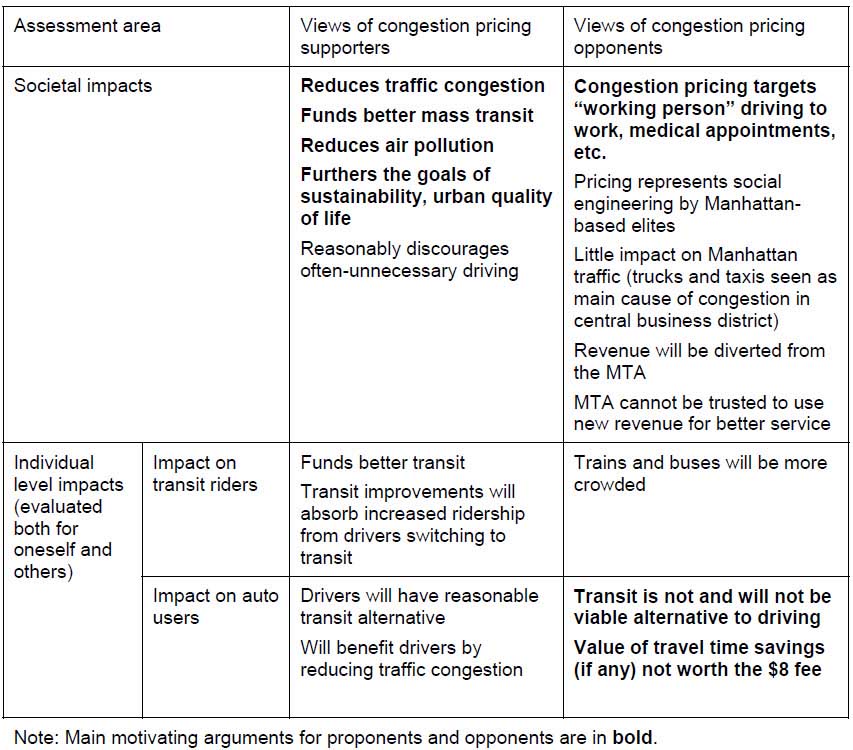
Opposing views on congestion charging (click to enlarge)
The key message is that gaining support for pricing proposals requires more than showing the social benefits – it is necessary to persuade individual motorists they will be better off. The New York experience shows small groups can have great influence – only 5% of workers would have paid the toll.
The author also argues that the best prospects for successfully implementing road pricing lie in initiatives like High Occupancy Toll lanes (see my previous post on this topic in relation to Melbourne) as motorists are less likely to feel they will be disadvantaged.
This table is a neat summary of the key views of proponents and opponents.
Should bicycle lanes be abolished?
Posted: May 7, 2010 Filed under: Cars & traffic, Cycling | Tags: arterial roads, Assen, bicycle lane, Copenhagen, Cycling, Netherlands, vehicular cycling 3 CommentsOver on the Bicycle Victoria Forums there’s a thread on something called “vehicular cycling”. This term is new to me and probably to most readers too.
As I read it, the key premise of vehicular cycling is that cyclists should “claim” the roads. Rather than being segregated in bicycle lanes that too often are narrow and impeded by parked cars – or worse, herded into off-road paths that are too indirect and are shared with unpredictable pedestrians – vehicular cyclists ride well away from the edge of a lane (although not in the middle) in order to be more visible to drivers and hence safer.

Cyclists in Copenhagen
They are concerned that construction of separate cycling infrastructure, such as Copenhagen-style lanes and on-road lanes, will reinforce the idea that cyclists are not legitimate road users.
There’re possibly some nuances here I’ve missed, but that seems to be the general idea. I think there’s a lot of logic to it. Even if a completely segregated network is feasible, it will be a long-term project, so there’s little choice other than to mix it with motorists in the meantime. And the meantime is likely to be a long time. Even in The Netherlands and Denmark, a significant proportion of cycling continues to be done on roads. So it seems sensible to find ways that cyclists and motorists can co-exist safely.
I can see that responsible cyclists, who ride defensively and maximise their visibility, could very well be safer if they adopt a more assertive approach. However I’m much less sanguine about how safe vehicular cycling is for irresponsible riders. Here I’m thinking mainly about children but there are also some adults who do irresponsible things like ride at night in dark clothing or without lights. Read the rest of this entry »
Is medium density housing on tram routes sustainable?
Posted: April 29, 2010 Filed under: Cars & traffic, Planning, Public transport | Tags: apartments, Melbourne City Council, Residential intensification in tram corridors, Rob Adams, SGS, tram routes 20 CommentsI like Melbourne City Council’s proposal for higher dwelling densities along tram lines but I think the claim that it would increase sustainability is exaggerated. There’s a whole ‘second half’ missing from this proposal.
The idea, which seems to be largely the brainchild of Council’s Rob Adams, is essentially that multi unit developments of up to 8 storeys should be encouraged along tram routes, leaving the suburban “hinterland” undeveloped (Rob refers to it as a new green wedge). This would reduce the need for fringe development and increase the mode share of public transport.
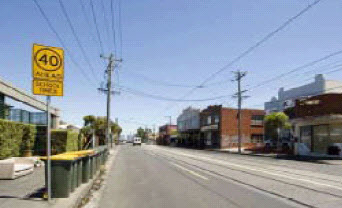
Nicholson Street - before
The major opportunities appear to be on tram routes in the inner suburbs, around 5-10 km from the CBD. While I think the assertion that 4-8 storey buildings can substitute for fringe development is fanciful and is based on a misinterpretation of other research, I accept that the proposal has the potential to increase the supply of dwellings of the type that are sought after by smaller households, especially those without dependents.
The key problem however is that nothing has been proposed to deal with car use by households occupying these new apartments. Without that, it won’t deliver. It just assumes that if households live cheek by jowl with good public transport they will necessarily use it. Read the rest of this entry »
Is commuting harder on women?
Posted: April 25, 2010 Filed under: Cars & traffic | Tags: commuting, It's driving her mad, University of Sheffield, women Leave a commentThis study by three University of Sheffield researchers finds that commuting has a detrimental effect on the well-being of women, but not men. The authors explore possible explanations for this gender difference and find no evidence that it is due to women´s shorter working hours or weaker occupational position. Rather, the greater sensitivity of women to commuting time is a result of their greater responsibility for day-to-day household tasks, including childcare.
Roberts J, Hodgson R, Dolan P, It’s driving her mad: gender differences in the effects of commuting on psychological well-being, Department of Economics, University of Sheffield
Are older drivers a danger to others?
Posted: April 24, 2010 Filed under: Cars & traffic | Tags: accidents, cataracts, dementia, drivers, elderly 4 CommentsRadio National had a fascinating talk-back session yesterday on older drivers (audio download here; no transcript). This is a pressing issue because of the ageing of the Australian population – by around 2040 a quarter of the population is projected to be aged over 65 years.
However the good news is that elderly drivers, including those over 85, are just as safe as other age cohorts. In fact in Victoria there is no compulsory age-related retesting of drivers for this reason. It seems older drivers actively self-regulate as they feel their capability diminish – they drive less, drive shorter trips, driver slower and in particular avoid driving at night or in wet conditions. Read the rest of this entry »
More on scooters
Posted: April 23, 2010 Filed under: Cars & traffic, Public transport | Tags: fast rail, Hanoi, motor scooter 1 CommentWordPress wouldn’t let me upload my planned post last night or early this morning about Melbourne City Councils’ proposals for apartments along tram routes, so I’m trying something more modest. Fortuitously, hot on the heels (top box?) of my post earlier this week about motor scooters, The Age has some related stories today. The first is Surge in motor cycle deaths hits move to slash tolls. The second relates to my invocation of Hanoi as what Melbourne might look like in the future (although as one reader points out, whether Hanoi will look anything like it does now is a good question): A (top gear) trip through Vietnam by scooter .
And there’s also a story on yet another proposal for a fast Melbourne-Canberra-Sydney rail link: Green dream: fast-rail link to Sydney. I’ll definitely want to take a closer look at this one.
Will the streets of Melbourne look more like Hanoi than Manhattan in the future?
Posted: April 21, 2010 Filed under: Cars & traffic, Cycling, Public transport | Tags: bicycle, Hanoi, MIT, motor scooter, motorcycle, noise, petrol price, Roboscooter, transport 14 CommentsI’ve believed for some years that motor scooters and motorcycles are likely to become a much more important component of Melbourne’s transport system if the cost of fuel increases dramatically.
Scooters and small motorcycles are extremely popular in cities like Hanoi where, like the probable Melbourne of the future, the cost of transport is very high relative to incomes.
Like cars, scooters offer a very high degree of personal mobility. They also have the advantage that they can ‘thread’ their way through congested traffic, are easy to park and are light on fuel. Read the rest of this entry »
Ring Road (M80) – an opportunity for road pricing?
Posted: April 8, 2010 Filed under: Cars & traffic, Infrastructure | Tags: congestion charging, equity, HOT lane, M80, Melbourne, ring road, road pricing, toll lane 8 CommentsThe current upgrade of Melbourne’s Ring Road (the M80) provides an unprecedented opportunity to implement a form of peak period congestion charging in Melbourne.
Designation of one lane as a toll lane during congested periods would offer a higher speed for vehicles paying a fee. They would not necessarily enjoy the maximum permitted speed – a time saving of around 15% seems sufficient.
A toll lane would offer clear economic benefits. In particular, it would enable high value trips, which currently suffer the same delays as comparatively low value trips, to be made faster. In the US these sorts of lanes are called High Occupancy Toll (HOT) lanes but I prefer something like High Value Trip (HVT) lanes to emphasise the underlying efficiency rationale. The ‘price’ or toll varies with how many vehicles use the toll lane to ensure it provides an advantage while optimising the level of use. Read the rest of this entry »
Get a ‘ticket’ for not speeding
Posted: April 3, 2010 Filed under: Cars & traffic | Tags: Fun Theory Award Winner, Kevin Richardson, lottery, speeding, Volkswagen 2 CommentsThis is a humorous but subtly brilliant idea – drivers get rewarded for driving responsibly. Not sure how this specific example would work in practice, but the principle is great and could also be used to reward drivers who buy more fuel-efficient cars, who car pool, etc. There have to be other ideas around for ‘inducements’ in the same vein e.g. incentive to buy Metro tickets. Why hasn’t Australian’s love of gambling been exploited before for ‘a good cause’? Read the rest of this entry »
Energy efficiency in transport – some surprises!
Posted: April 1, 2010 Filed under: Cars & traffic, Energy & GHG, Public transport | Tags: autos, commuter rail, Department of Energy, energy intensity, light rail, load factor, Los Angeles, sprawl, transit, Transportation Energy Data Book 3 CommentsThe latest edition of the Transportation Energy Data Book: Edition 28 was released last year by the US Department of Energy (Office of Energy Efficiency and Renewable Energy).
I’ve derived the accompanying graph from Chapter 2 of the report. There are a couple of points of interest here.
In particular, the data shows that load factors are very important. Although public transport is more energy efficient than cars when it is fully loaded, it has to operate at off-peak times and on secondary routes, when patronage is low. Read the rest of this entry »
20 years of TAC campaigns
Posted: March 30, 2010 Filed under: Cars & traffic | Tags: 20 years, advertising campaign, road safety, TAC, Traffic Accident Commission, Victoria Leave a commentThe Victorian Traffic Accident Commission’s montage of 20 years of road safety advertisements. This is very harrowing. Read the rest of this entry »
How to ‘green’ the Grand Prix
Posted: March 27, 2010 Filed under: Cars & traffic | Tags: Australian Grand Prix, F1, FIA, Formula One, fuel economy, KERS, Melbourne, Prius 1 CommentHow could the QANTAS Australian Grand Prix be made greener?
This is a pretext to post on Formula One because the Australian GP is being held in Melbourne this weekend, but it’s nevertheless an interesting question (almost as interesting as this morning’s news that Lewis Hamilton was caught doing donuts in St Kilda last night!). Read the rest of this entry »
Signage ‘distorted’ at Eureka carpark
Posted: March 24, 2010 Filed under: Cars & traffic | Tags: Axel Peemoeller, Emery Studio, Eureka Tower, signage Leave a commentThis brilliant signage was designed by Emery Studio (Axel Peemoeller) for the carpark of Melbourne’s own Eureka Tower. The letters are distorted until the viewer is in exactly the right position, whereupon they can be read perfectly. Read the rest of this entry »
How to clean a Ferrari
Posted: March 23, 2010 Filed under: Cars & traffic | Tags: clean, F1, Ferrari, Melbourne Grand Prix, youtube Leave a commentI’d like to post something on F1 because the Australian Grand Prix is held in Melbourne and starts in a few days. This’ll do just fine for the moment because it’s about Ferrari. Read the rest of this entry »
Electric cars could have 10-20% of the market in 10 years
Posted: March 22, 2010 Filed under: Cars & traffic | Tags: Better Place Australia, electric vehicles, Evan Thornley, plug in, RACV Leave a commentEvan Thornley, the CEO of Better Place Australia, predicted on Inside Business yesterday that plug-in vehicles will have 10-20% of the Australian vehicle market by 2020 and the entire national vehicle fleet will have transitioned from petrol to electricity in 20-25 years. Better Place Australia, which is in the business of providing the support infrastructure for plug-in vehicles,will start in Canberra in late 2011 and will then roll out throughout the country starting late 2012. RACV has taken a $2 million stake in the company.
Where cars might be heading
Posted: March 17, 2010 Filed under: Cars & traffic | Tags: electric vehicles, MIT Media Lab, Ryan Chin, shared use vehicle Leave a commentI’ve previously written in The Age (Efficiency the key to car culture) about the need to speed up the shift to smaller, lighter more environmentally friendly vehicles. This electric two passenger shared use vehicle designed at the MIT Media Lab gives an idea of where cars might be going in the immediate future. Read the rest of this entry »
Toyota’s ‘sudden acceleration’ problem may be driver error
Posted: March 13, 2010 Filed under: Cars & traffic | Tags: Megan McArdle, sudden acceleration, The Atlantic, toyota 1 CommentThere are lots of Toyotas in Melbourne and we even have a factory that builds them. It is therefore of great interest to note that Toyota’s mysterious problems in the US with sudden acceleration, wonky electronics and floor mats, may actually be the result of driver error. Megan McArdle writes today in The Atlantic, How Real are the Defects in Toyota’s Cars?, that it may be older, shorter and immigrant drivers that made the errors, not Toyota’s engineers. Read the rest of this entry »
Attention: Drunks!
Posted: March 11, 2010 Filed under: Cars & traffic | Tags: drunk, Hungary, Melbourne, pedestrians, road sign 2 CommentsWe have ‘Koalas next 10km’ road signs in Australia but in Romania they have road signs warning motorists about drunk pedestrians. Perhaps in Melbourne we should erect similar road signs in King St, like ‘Glassing – next 400 metres’. Read the rest of this entry »
Melbourne will be a car city for a long time yet
Posted: March 9, 2010 Filed under: Cars & traffic | Tags: compressed natural gas, electric car, environment, Melbourne, Public transport, sprawl, suburbs 14 CommentsIt seems likely that many more Melbourne travellers will drive cars in the foreseeable future than take public transport.
This is not necessarily the disaster that it might at first appear – improvements to the environmental and fuel efficiency of cars will make them much more environmentally friendly and offer a fair trade-off for their many advantages. Read the rest of this entry »
 The Melbourne Urbanist