-Are there really limits to what planning can do?
Posted: March 7, 2011 Filed under: Management, Planning | Tags: development assessment, diversity, obesity, Planning, Productivity Commission, States and Territories, Victoria, zoning 7 Comments
States' and Territories responses to 23 land use planning 'challenges'
There are, but in Victoria those limits appear to be very elastic.
Because it controls the use of land, the whole complex edifice of planning regulation touches to a greater or lesser extent a lot of the things we do.
In a newly released report commissioned by COAG, the Productivity Commission gives us an insight into how the nation’s planning agencies think the land use control system influences our lives.
The report, Performance Benchmarking of Australian Business Regulation: Planning, Zoning and Development Assessments, examines the regulatory frameworks of each jurisdiction, the processes for supply of land, the bases for assessing developer contributions, compliance costs for business, and competition issues arising from planning decision-making.
As part of its investigations, the Commission asked each State and Territory to answer this question: “To what extent can government use the planning, zoning and DA system to positively influence the following challenges”?
The answers each jurisdiction provided to 23 “challenges”, graded from “no effect” through to “major effect”, are shown in the accompanying chart (copied from the report). The survey was completed between October and November 2010, prior to the Victorian State election.
Bear in mind that the survey relates specifically to the powers of land use planning agencies i.e. not transport or other agencies. Also, the planners were specifically asked about the scope to positively influence each of the challenges. There are some interesting claims here and some equally interesting comparisons between States and Territories.
There’s a consensus that, given (presumably) the right policies, land use planning can have a major positive influence on managing greenfield development, accommodating population growth, managing the transition to higher population densities, providing diverse/appropriate housing, and protecting biodiversity.
By and large I’d agree with that. My only caveat would be the understanding that some of the benefits will come from reducing rather than increasing the degree of planning intervention. A prime example is the many restrictions on constructing higher density housing within established urban areas.
Where the survey gets really interesting is outside these five key areas. Victoria in particular stands out from its peers. Read the rest of this entry »
Does higher density mean lower car use?
Posted: March 5, 2011 Filed under: Cars & traffic, Planning, Public transport | Tags: Centre for Transportation Studies, cities, Gary Barnes, land use, Public transport, transit, University of Minnesota, urban areas, weighted density Leave a comment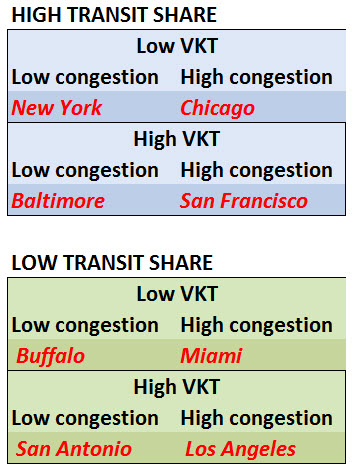
Travel outcomes (Barnes)
Not necessarily – in fact in the US, not even usually!
It’s a truism that denser, more concentrated cities tend to have higher public transport use. Various studies have confirmed this intuition but what is usually left unexamined is the implicit assumption that such cities consequently have lower car use.
This study of 31 of the largest cities in the US found that assumption is not correct. Higher public transport mode share does not translate on average to lower kilometres of travel by car, shorter commutes by car, or lower levels of traffic congestion.
The primary finding “is that land use, at least at the aggregate level studied here, is not a major leverage point in the determination of overall population travel choices”.
Undertaken by Gary Barnes from the Centre for Transportation Studies at the University of Minnesota, the research found that, if anything, “the higher densities that increase transit share tend to increase commute times and congestion levels”.
The main objective of the project was to identify the effect of land use on travel behaviour. Most studies concentrate on the effect of average density on one or two variables, usually transit share and sometimes total kilometres of car travel.
Barnes’ approach was much more extensive. For each urbanised area, he defined 15 descriptors of travel behaviour, 11 of land use and 15 other, mainly demographic, factors. Moreover, he employed the concept of ‘weighted density’ (he calls it ‘perceived density’) to more accurately describe the distribution of both population and employment in each city.
Barnes confirms that residential concentration increases transit’s share of travel, but he notes the effect is not large. Contrary to the underlying assumptions of much urban policy:
Even very large changes in land use have very little impact on travel behaviour, in good ways or in bad. Apparently the larger effects sometimes observed in neighborhood-scale studies are just that: neighbourhood-scale effects that do not extend their benefits to the larger urbanized area.
His analysis implies that increasing residential density by 100% would increase transit share by only 5-6%. To get a 1% increase in walking and cycling’s combined mode share would require an increase in residential density of 5,000 persons/mile2 (1,931/km2). Similarly, a 14% increase in density would only yield a 0.5% decrease in in-car travel time per person. Read the rest of this entry »
Will redevelopment of Fishermans Bend really be ‘revolutionary’?
Posted: February 19, 2011 Filed under: Planning | Tags: affordability, density, Docklands, Fishermans Bend, growth area, Housing, Inner city, Jennifer Cunich, Matthew Guy, Property Council Australia, UCB, Urban Growth Boundary 13 Comments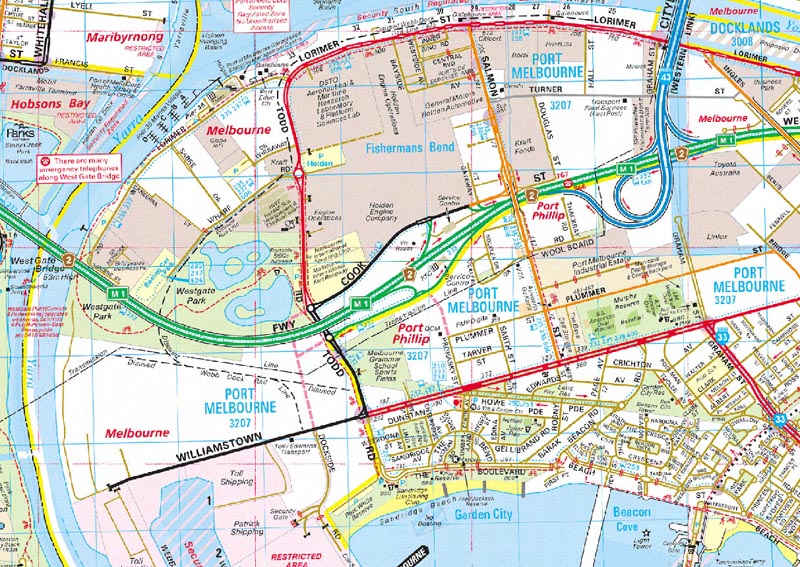 The Age breathlessly headlines the Government’s proposals for the redevelopment of Fishermans Bend as Premier Ted Baillieu’s “inner city housing revolution”. Planning Minister Matthew Guy says the area will evolve as ”Australia’s first inner-city growth corridor”.
Whoa there! I think it might be time for a relaxing cup of tea and a lie down. Let’s put these claims in perspective.
According to Mr Guy, the area under consideration is 200 Ha. That’s quite a bit smaller than the 41,000 Ha expansion of the Urban Growth Boundary approved last year.
Mr Guy also says the area is going to be developed over a 20-30 year time frame. If its total capacity is the 10,000 to 15,000 dwellings estimated by the Chief Executive of the Property Council, Jennifer Cunich, that’s at most 750 additional dwellings per year on average, and as few as 333 per year.
Just to put that in context, 42,509 dwellings were approved in the metropolitan area in the 12 months ending on 30 September 2010. Ms Cunich is quoted as saying even that’s less than we need – she says there’s a shortfall of 6,000 homes per year across the State.
While the redevelopment of Fishermans Bend is important, the claim that it’s a ‘revolution’ is hyperbole.
Likewise, the Minister’s claim that Fishermans Bend will be a ‘growth area’ – a term usually used to refer to massive outer suburban release areas – is more than a trifle exaggerated. Consider that 17,000 new dwellings were approved in Melbourne’s (outer) Growth Area municipalities in the year ending September Qtr 2010.
The Minister’s claim that the project will focus on “more affordable” housing also seems ambitious. Read the rest of this entry »
What’s good (and bad) about greater diversity?
Posted: February 13, 2011 Filed under: Planning, Social and community | Tags: Beyond 5 Million, Committee for Melbourne, Disconnected, diversity, Dr Andrew Leigh, ethnicity, Melbourne 2030, The cities we need, The Grattan Institute, Tiger Mother 6 Comments
High-level city objectives in The Grattan Institute's 'The cities we need'
A standard objective these days in high-level city strategic plans is greater diversity. It’s mentioned, for example, in Melbourne 2030, in the Committee for Melbourne’s Beyond 5 Million and in The Grattan Institute’s The Cities We Need (see graphic).
The Grattan Institute says diversity is important because “many economists think that mixing of ethnicity, age, culture and education is important for a modern knowledge economy, in order to stimulate and disperse ideas”.
But according to Dr Andrew Leigh, it’s not necessarily all mother’s milk, at least in relation to ethnic diversity (which is what most discussion of diversity in Australia is about). In his new book on social capital, Disconnected (which I’ve discussed before), he points out that there is a negative correlation between trust and ethnic diversity:
Residents of multi-racial neighbourhoods are more likely to agree that ‘you can’t be too careful in dealing with most Australians’. In particular, neighbourhoods where many languages are spoken tend have lower levels of trust…
This accords with the findings of a succession of studies of ethnic diversity in the US and other countries. We will have to work harder, Dr Leigh suggests, if we are to make Australia both diverse and high trust.
Let me emphasise that Dr Leigh, who is the new ALP member for Fraser in the ACT and until the last election was a Professor of economics at ANU, is a supporter of immigration:
A spate of studies suggest that continued high levels of immigration will most likely bring a raft of economic and social benefits to Australia. But we should not gild the lily. Most likely, higher diversity will lead to lower levels of interpersonal trust…..the challenge for policymakers is how to maintain the current levels of immigration while mitigating the impact on our social and political fabric.
But how do you mitigate that impact? Most city policy documents don’t even acknowledge that there might be potential downsides to ethnic diversity. Nor do they usually specify what the spatial dimension is, much less what specific policies ought to be pursued. Read the rest of this entry »
Does density matter for mode share?
Posted: February 5, 2011 Filed under: Employment, Planning | Tags: average density, concentration, Employment, Jobs, Paul Mees, Population, Public transport, transit, weighted density 8 Comments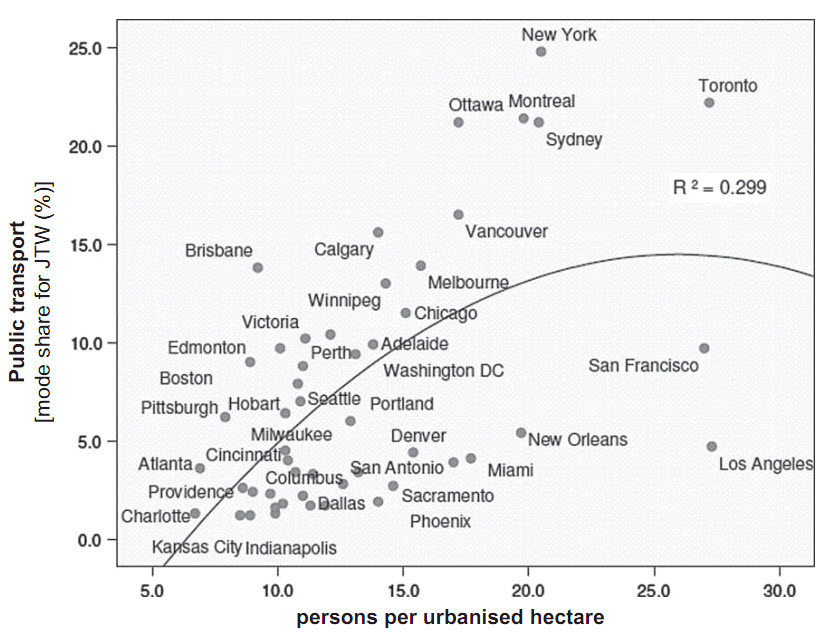
Mode share vs density (click to enlarge)
The accompanying chart shows how public transport’s share of the journey to work varies with population density across 41 US and Australian cities.
It is taken from the same article that I mentioned in my last post. The authors, Dr John Stone and Dr Paul Mees, find there is only a modest relationship between population density and transit share (R2 = 0.229). They conclude that “higher density across the whole urban region is not the explanatory variable that many might expect”.
Los Angeles, for example, is the densest metropolitan area in the US – denser ever than New York – yet the chart shows public transport’s share of work travel in LA is much smaller than in NY.
If that seems counter-intuitive, your intuition could be right. The chart uses average population density calculated across the entire urbanised area of each city.
While that’s perfectly alright in some contexts, it doesn’t allow for the possibility that public transport’s ability to win travel away from cars is related to the morphology of density – the ‘peaks and troughs’ in the way the population is spatially distributed. It’s possible that the relative proportion of population in high density areas vs low density areas has a greater impact on mode share.
Using average density probably won’t present a serious problem with cities like Atlanta, Austin, Dallas, Phoenix and Portland where the population is overwhelmingly suburbanised at relatively uniform (low) densities. But it could have a big impact on places like New York which have an extensive ring of low density suburbs as well as a high density central region e.g. Manhattan and Brooklyn.
A way of dealing with this issue is to use weighted density rather than average density. This involves weighting the density of each suburb (or other convenient geographical unit e.g. traffic zone) by its share of the city’s total population. So a one km2 suburb with 5,000 residents (say) carries a lot more weight than another suburb of the same area that has only 1,000 residents. Read the rest of this entry »
How liveable are our major cities?
Posted: January 30, 2011 Filed under: Miscellaneous, Planning | Tags: Adelaide, Brisbane, Liveability, Melbourne, Perth, Property Council Australia, Public transport, safety, security, Sydney, traffic congestion 15 Comments
How residents of our five largest cities (combined) see liveability
Adelaide is the most liveable capital city in Australia and Sydney is the least, according to a study released earlier this month by the Property Council of Australia.
The Australian reports that Sydney might have the harbour, Opera House and Bondi, but most Sydneysiders live a long way from these attractions in less salubrious places like Liverpool, Strathfield and Penrith.
The Property Council’s study is based on a national sample of 4,072 respondents in the nation’s eight capital cities (with around 600 in each of the four largest cities). They were given 17 attributes of liveability and asked, firstly, to rate them by importance and, secondly, to rate how well their cities perform on each of them. These two dimensions were then combined to produce a ‘liveability score’ for each city.
I’ve taken quite an interest in “liveability” in the past, especially as it relates to Sydney/Melbourne rivalry (e.g. here, here and here), so naturally I had a look at the study.
These sorts of surveys are often problematic and this one is no exception. For example, information on the representativeness of those who actually responded to the survey is scant and some of the attributes are sloppily conceptualised and poorly worded.
So with that caveat, let’s look at what the study found. The aggregate liveability scores of the eight capitals are probably the least useful aspect because the differences are small – Adelaide does best with 63.4 and Sydney does worst with 55.1. Third ranking Melbourne scores 60.9 but sixth ranking Brisbane scores 60.2. Put Sydney aside and there’s not enough in it to be useful.
What’s more interesting is how respondents define liveability. I’ve put the accompanying chart together to show how the five largest capital cities perform in aggregate i.e. Sydney, Melbourne, Brisbane, Perth, Adelaide (you won’t see this table in the Property Council’s report because I had to correct the figures in the Appendix to the report. Also, make sure to have a look at the full text of the questions).
The first column shows how important respondents think each attribute is for liveability (smaller is better). The second shows what proportion of respondents agree that their city exhibits this attribute. Read the rest of this entry »
What’s the angle with Fishermans Bend?
Posted: December 14, 2010 Filed under: Housing, Planning | Tags: city centre, e-Gate, Fishermans Bend, high density housing, Kenneth Davidson, LA Live, Matthew Guy, Melbourne City Council, urban renewal 7 Comments
LA Live entertainment complex
The Minister for Planning, Matthew Guy, is reported as saying that rather than “sprinkle high density housing across Melbourne”, the new Government will give priority to strategic developments on specific sites close to the CBD.
Mr Guy has already moved to water down the former government’s planning laws encouraging higher density residential developments (i.e. over three storeys) along public transport corridors.
He says the focus of urban renewal in future will be on locations like Fishermans Bend, the 20 hectare E-Gate site just off Footscray Road, and the area around Richmond station.
This is surprisingly reminiscent of Kenneth Davidson’s prescription for Melbourne. However unlike the Minister, who is moving to increase land supply in the Growth Areas as well, Mr Davidson sees major urban renewal projects as providing enough land to obviate the need for further fringe development.
Facilitating urban renewal in areas close to the city centre is a good thing. But it’s a big call to put all your higher density eggs in one basket when Melbourne’s population is projected to grow by 1.8 million between 2006 and 2036. According to The Age, Mr Guy doesn’t want higher density development in that part of the city that lies beyond the city centre i.e. virtually all of Melbourne*.
I’m not sure the potential of the brownfields basket is as great as Messrs Guy and Davidson imagine. Here are some constraints that individually might be a mere difficulty but collectively amount to a major impediment. Read the rest of this entry »
Are there multiple ‘Melbournes’?
Posted: December 9, 2010 Filed under: Cars & traffic, Planning, Public transport | Tags: Brimbank, Cardinia, Casey, home range, municipalities, regions, travel time, trip distance 5 Comments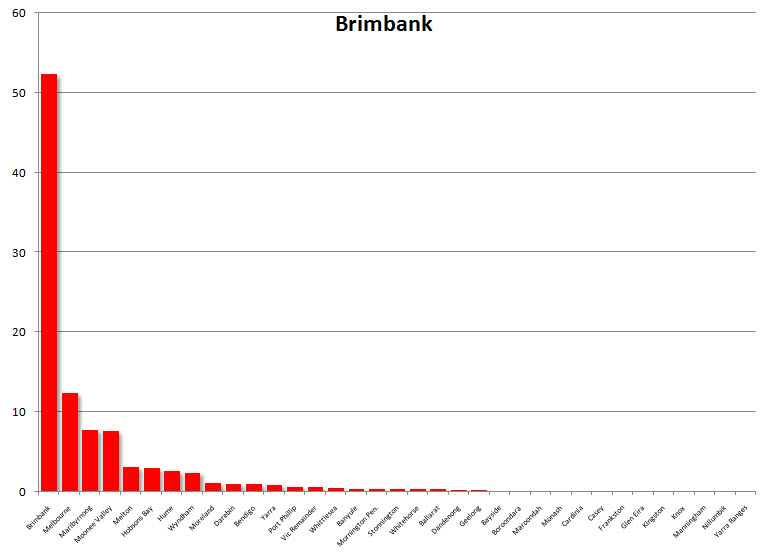
Where residents of Brimbank travel to (%)
The stereotype of people travelling long distances in Australian cities is wrong but persistent. The reality is that most trips are relatively close to home.
For example, the accompanying chart and map show that 52% of all weekday trips (all purposes, all modes) by residents of the middle suburban municipality of Brimbank in Melbourne’s west are made within the municipality. Further, 79% of trips are made either within Brimbank or to contiguous municipalities.
In fact more than 90% of trips by Brimbank residents can be accounted for if just one more destination – the city centre – is added to the list above.
This pattern also holds for the other parts of Melbourne.
More than 80% of trips by residents of Monash, Cardinia and Casey, for example, are likewise made within their home municipality or to neighbouring ones.
While another 8% of trips by Monash residents are to the city centre, the corresponding figure is less for far-flung municipalities – just 4% for Casey and less than 1% for Cardinia (see more charts below).
 It thus makes sense to think of a city like Melbourne as a number of regions rather than as a very big, singular entity. In terms of what people physically do within the urban area, there are multiple ‘Melbournes’.
Each little ‘Melbourne’ or region is centred on a home LGA and has a limited ‘home range’. The median weekday trip distance (all purposes, all modes) for residents of Cardinia is 3.7 km. Monash is 4.9 km and Brimbank is 6.3 km.
For the great bulk of residents, metropolitan Melbourne is more of a construct – an idea – than something that has a real presence in their day-to-day lives. With the exception of the city centre, few people venture much beyond their own region.
This limited ‘home range’ is a product of many forces. In the case of the inner city municipalities – Melbourne, Yarra and Port Phillip – the predominance of professional jobs and social attractions in the city centre is an obvious and powerful factor. The median weekday trip distance for residents of Yarra is 2.8 km.
For the great bulk of the population who live in the suburbs, the factors explaining this limited geography would include the suburbanisation of jobs (more than 80% of jobs in metropolitan Melbourne are outside the CBD), slower travel speeds on roads due to increasing traffic and the desire to live close to family and friends.
It’s natural therefore to emphasise the importance of regions and devise typologies like The Age uses in its real estate pages e.g. inner east, outer east. But that assumes a community of interest at the regional level. And it assumes it can be defined within fixed boundaries. Read the rest of this entry »
Is Melbourne 2030 achieving its objectives on housing?
Posted: December 7, 2010 Filed under: Activity centres, Growth Areas, Planning | Tags: Activity centres, AHURI, construction, Housing, Melbourne 2030, RMIT Research Centre, Robin Goodman 8 Comments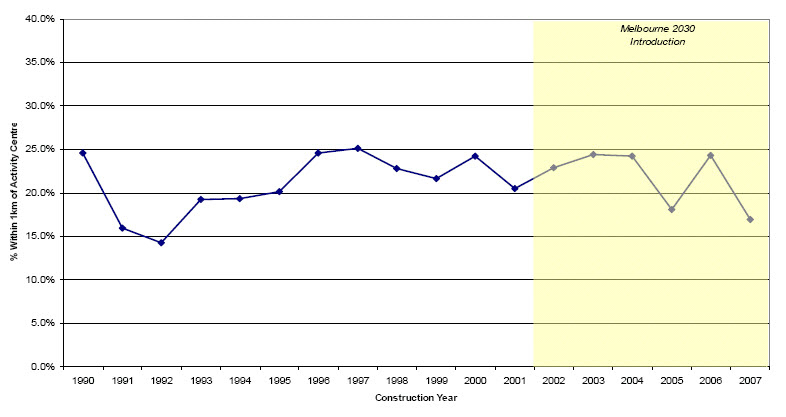
Percentage of new dwelling construction within 1km of a principal or major activity centre
A new research paper suggests that many of Melbourne 2030’s key ambitions in relation to housing have come to nought.
The paper, Planning and the characteristics of housing supply in Melbourne, was written by Dr Robin Goodman and a team of fellow academics from the RMIT Research Centre and published by the Australian Housing and Urban Research Institute (AHURI).
The first part of the project analysed a number of data bases on land transactions over the period from 1990 to 2007.
Contrary to the aspiration of Melbourne 2030, the researchers found that the proportion of new housing located within one kilometre of an activity centre did not increase following the promulgation of the Strategy.
In fact activity centres are not generally a favoured location for new housing. Of the 115 studied, just four account for almost a third of all housing built within one kilometre. Those four are all very close to the city centre – South Melbourne, Melbourne (CBD), Port Melbourne (Bay St) and Carlton (Lygon St). The ten with the highest proportion of new housing were either close to the CBD or in new parts of Growth Areas where developable land was still available close to activity centres.
When the radius is extended to two kilometres, the researchers found that the proportion of new housing actually declined since Melbourne 2030 was released.
They found a similar pattern with rail stations – the proportion of dwellings built within a one kilometre radius of a train station declined after Melbourne 2030 came into effect.
In addition, the delay between acquisition of property by a developer and completion of construction is more protracted on parcels that are closer to activity centres. Read the rest of this entry »
Will Melbourne be like Watts (L.A.) in 1965?
Posted: December 6, 2010 Filed under: Planning | Tags: Activity centres, developers, Kenneth Davidson, urban fringe, Urban Growth Boundary, Watts riots 1965 6 Comments
What if the geographically most extensive countries had the biggest populations?
Journalist Kenneth Davidson is often quite sensible so I’m astonished to see him arguing that Melbourne’s planning system is creating a potentially explosive situation like the 1965 riots in Watts, Los Angeles.
In fact there are a number of contentious propositions and assumptions in his column in The Age (6/12/10), Planning must be for people not developers.
He argues that Victoria’s planning system is dominated by developers and is effectively creating two cities in Melbourne – the inner city and the fringe suburbs – with citizens divided by geography as well as class.
Now there’s no doubt there are clear geographical differences by social class across Melbourne – there’s nothing new about that – but invoking the spectre of the Watts riots of 1965 seems a bit excessive. They were a reaction by the black community to racial injustices, including severe police brutality and entrenched job and housing discrimination. More than a thousand people were injured and 34 died. The Watts riots were different by orders of magnitude to Sydney’s 2005 Macquarie Fields riots or the 2004 Redfern riots.
Mr Davidson seems intent on sheeting home almost every planning issue in Melbourne to greedy developers. I accept the argument that speculation and lack of competition are issues in the Growth Areas, but there’s much more to the “two cities” phenomenon than that. Read the rest of this entry »
Does being a locavore add up?
Posted: November 30, 2010 Filed under: Education, justice, health, Energy & GHG, Planning | Tags: agriculture, food miles, locavore 7 Comments
"It gets better" - Pixar shows why it would be a great place to work (click)
As I’ve argued before (here) there are a number of reasons why buying food locally is probably the least sustainable basis on which to base your food buying preferences.
First, transport is only a small component of the total carbon emissions from agriculture.
Second, most food can’t be grown locally without resorting to potentially environmentally damaging practices like excessive application of fertiliser, irrigation or artificial heating of greenhouses.
Third, even where the local area is suitable for growing certain foods, it might not be the most environmentally efficient location for a particular food.
Fourth, producers in more distant locations might have superior farming practices to local growers. Fifth, the environmental and economic cost of moving people is higher than the cost of transporting their food.
Now Stephen Budiansky has assembled an array of interesting factoids in this NY Times oped, Math lessons for locavores, to show the folly of being a locavore. He’s a stylish writer so you might want to read the full article; otherwise here are a few key quotes:
- “Whether it’s grown in California or Maine, or whether it’s organic or conventional, about 5,000 calories of energy go into one pound of lettuce. Given how efficient trains and tractor-trailers are, shipping a head of lettuce across the country actually adds next to nothing to the total energy bill. Read the rest of this entry »
What is the inner city?
Posted: November 28, 2010 Filed under: Planning | Tags: Brisbane, definition, density, Employment, history, Inner city, Jobs 7 Comments We all use the term “inner city” but I doubt we’re all talking about the same geographical area.
For some people, the inner city means the area where cafe society thrives – probably a 10 km circle around the CBD in cities like Sydney and Melbourne. Or it might mean the extent of medium density historic terrace housing.
Some Brisbanites think of the inner city as the large area covered by the Brisbane City Council (1,367 km2) while some Melburnians think of it as the area serviced by tram lines.
Planners have addressed this problem by adopting simple measures. For example, in Melbourne the inner city is customarily defined as the area covered by the central municipalities of Melbourne, Yarra and Port Phillip (77 km2). Sometimes the Prahran portion (SLA) of the City of Stonnington is also included.
In my work on Melbourne I define the inner city as the area (79 km2) within a 5 km radius of the City Hall . This approximates closely to the three inner municipalities, but I use it because it’s consistent with what’s done elsewhere. US researchers typically use a 3 mile radius to define the inner city – an area approximating the size of the central Counties of the larger metros.
There are a number of problems with this sort of ‘administrative’ approach. A key one is that there is no underlying rationale for where the boundary is drawn – why not 2 km or 10 km? Another is that it doesn’t really connect with people because it has no obvious reference like, say, the tram network. Read the rest of this entry »
Why did Melbourne 2030 fail?
Posted: November 22, 2010 Filed under: Planning | Tags: Brownfields, Challenge Melbourne, Decentralisation, empty nesters, growth areas, Infrastructure, Melbourne 2030, Oliver Hulme, peri-urban 6 Comments
(click) Heaps of parking in central Paris in 1976!
The Age editorialises (21/11/10) that Melbourne 2030 is effectively dead and I agree. The latest nail in the coffin in The Age’s opinion is the apparently burgeoning growth of housing in townships and hamlets located in the peri urban area outside the Urban Growth Boundary (UGB).
I’ve argued before that this sort of “decentralisation” is poor policy (e.g. here and here). But I also think The Age has tended to ‘catastrophise’ the scale of the problem, especially with its highly misleading contention that Melbourne has “sprawled 50% beyond the official growth boundary, spanning 150 kilometres from east to west”.
However what interests me at the moment is why Melbourne 2030 failed. The key reason in my view is that it blithely assumed that enough affordable dwellings – mostly town houses and apartments – could be provided within the established urban areas to avoid the need for the UGB to be extended.
This objective was never realistic for a number of reasons. Read the rest of this entry »
What’s good about the Coalition’s planning policy?
Posted: November 21, 2010 Filed under: Growth Areas, Planning | Tags: code based assessment, election, Melbourne 2030, Melbourne @ 5Million, Metropolitan Liveability Audit, population projection, spare infrastructure capacity, Urban Growth Boundary, Victoria, Victorian Liberals Nationals Coalition Plan for Planning 2 Comments
What Americans think 'family' means
I think some aspects of the Victorian Opposition’s clumsily titled Plan for Planning are doubtful, especially their proposal for ensuring 25 years land supply within Growth Areas and their intention of levying the Growth Areas Infrastructure Charge at the time of development.
But there are also some good ideas that I want to discuss, notably the proposal for a new strategic plan for Melbourne and another for an audit of the infrastructure capacity of the entire metropolitan area.
A new plan for Melbourne would be timely because Melbourne 2030 is misguided, old and tired. It’s been more than ten years since the process of preparing the metropolitan strategy began and eight years since it was published.
A key problem with Melbourne 2030 is that it was misconceived from the get-go. It never worked properly and simply hasn’t delivered on its lofty ambitions.
Its relevance took a serious hit when the projections of future population growth that underpinned its policies were revised upwards. Further, one of its main directions – the primacy of the CBD – was weakened in 2008 when the Government decided to establish six new CBD-type Central Activities Districts in the suburbs.
The objective of locating nearly 70% of all dwelling commencements out to 2030 within the existing suburbs – rising to almost 80% by 2030 – was also abandoned in 2008 and replaced with the much less challenging target of just 53%.
And of course the much vaunted Urban Growth Boundary lasted only a few years before it was breached. The supply of well-located affordable housing that the plan was intended to foster dried up and neither jobs nor housing gravitated to suburban centres on anything like the scale originally envisaged.
The problem with Melbourne 2030 is that it was driven from the outset by ideological posturing rather than logic. Too many of its key directions weren’t supported by data or analysis and the consultation process was largely a sham. Read the rest of this entry »
Will changing management arrangements give us better cities?
Posted: November 7, 2010 Filed under: Management, Planning, Public transport | Tags: Grattan Institute, Hunter District Water Board, John Paterson, management arrangements, MMBW, organisation, Paul Landa, structure, Vicroads, water pricing 7 Comments
Counting votes - Federal election 2010
Almost everybody, it seems, from political parties to academics, think tanks and planning experts, reckons the key priority for improving planning and public transport in Melbourne is to reform the way they’re managed.
The clamour for revised governance arrangements in order to effect reform has been increasing in Melbourne, with groups like the Committee for Melbourne, the Greens, the Public Transport Users Association and the Committee for Economic Development of Australia agitating for change.
It’s therefore sobering to see the Grattan Institute pointing out that reformed governance arrangements are not a silver bullet. The Director of the Institute’s Cities program, Jane-Frances Kelly, makes the point that:
the evidence from successful overseas cities does not support the idea that changing governance structures will help. In the successful cities we examined, no one type of governance was dominant. Unnecessary changes to governance structures can also be a distraction from the things that are vital. In short, changing structures is no cure-all. Read the rest of this entry »
Zombie planning ideas
Posted: November 1, 2010 Filed under: Planning | Tags: ideas, Planning, zombie 15 Comments
Not a real zombie...
This is a day late, but I wouldn’t want to let Halloween pass without joining in the spirit of the walking dead.
So here’s my starter list of urban policy ideas and misconceptions that should be dead but are still staggering, walking or, in most cases, still running full pelt:
- Freeways solve traffic congestion
- Public transport solves traffic congestion
- Drivers would willingly change to public transport if only it were better
- Cars are irredeemably bad – they have no role in making transport more sustainable
- The suburbs are dormitories – most jobs are in the city centre
- There’s heaps of spare infrastructure capacity in the inner city and suburbs
- Buses aren’t real public transport – real transit runs on tracks Read the rest of this entry »
What should we do about Melbourne?
Posted: October 20, 2010 Filed under: Planning | Tags: Melbourne 2030, strategic planning 21 Comments
Bike-O-Meter. Real time usage of bike hire schemes across world cities
I’ve been thinking for some time that I should set down what I see as the key high-level actions that need to be taken to ensure Melbourne can remain liveable well into the future. Given that the State election is about six weeks away, this seems like a good time.
I’m only going to look at the supply side. I’ll leave the topic of demand for another day. For the moment, I’ll assume that Melbourne really will grow to 7 million around 2050.
The actions I propose are not confined to the predominantly physical measures we’re used to seeing in traditional strategic plans like Melbourne 2030 and Melbourne @ 5 Million. Cities can’t be managed effectively without taking a holistic view – that’s because many of the apparent “planning” problems have deeper causes.
I start with the same overall goals as plans like Melbourne 2030 espouse – greater environment sustainability, equity and economic efficiency – but the route I propose for getting there is very different and, I think, much more likely to work.
I’m more concerned here with getting the policy right than I am with short-term political feasibility, so I don’t expect either side is going to pick up these ideas and run with them in the election. That’ll take time.
So, the key high-level actions I propose are: Read the rest of this entry »
Should most redevelopment be in activity centres?
Posted: October 19, 2010 Filed under: Growth Areas, Planning | Tags: Activity centres, growth areas, Housing, Melbourne 2030, Melbourne @ 5 Million, residential intensification, Residential Land Bulletin, Transforming Melbourne, urban consolidation, Urban Development Program, urban renewal 5 Comments
Maribyrnong Rd, before redevelopment and after (from Transforming Melbourne)
I noted yesterday that Melbourne @ 5 Million envisages just over half of all new dwellings constructed between now and 2030 – about 16,000 per year – will be located within the built-up area. The rest will be built in the fringe Growth Areas.
This is a significant reduction compared to the 69% share Melbourne 2030 envisaged would be built within established areas over 2001 to 2030.
My view is that the disadvantages of sprawl are routinely exaggerated and the fringe will necessarily be an important location for some of the expected future growth.
But I think home buyers’ preference for the outer suburbs is also commonly exaggerated. I expect many fringe settlers would prefer a location closer to the centre if only the market could deliver a better space/price compromise.
I think one of the reasons they can’t find that compromise could be the Government’s policy of prioritising redevelopment to strategic locations, like activity centres and along main transport routes. Read the rest of this entry »
How much growth is going to the fringe?
Posted: October 18, 2010 Filed under: Growth Areas, Planning | Tags: growth areas, Melbourne 2030, Melbourne @ 5 Million, Residential Land Bulletin, Toolern, Transforming Melbourne 7 Comments
Flight & Expulsion - Shows where refugees to Australia came from in 2008. Click map to see all countries, by year, back to 1988.
The Victorian Government set a target in its 2002 strategic plan, Melbourne 2030, that only 31% of new dwellings constructed between 2001 and 2030 would be located on outer suburban greenfield sites.
In fact, it envisaged that by 2030, the proportion would have fallen to just 22%.
This ambitious target reflected the conviction at the time that continued outward growth was unsustainable. The firm view was that a much higher proportion of growth would need to be accommodated within the existing built-up area.
The subsequent update released in 2008, Melbourne @ 5 Million, significantly downgraded the target.
Melbourne @ 5 Million “anticipated” that 47% of all new dwellings constructed over the next 20 years would be located in the fringe Growth Areas.
The new target simply reflected what the market was actually doing. There would be little danger now of getting caught out by a politically ambitious “stretch target”.
The most recent edition of the Government’s Residential Land Bulletin (March Qtr, 2010) indicates how prescient the authors of Melbourne @ 5 Million were. It shows that exactly 47% of dwelling approvals in the preceding twelve months were located in the Growth Areas.
But if you think we need less development in the outer suburbs and more in the inner and middle ring suburbs, it gets worse. Read the rest of this entry »
Can public transport “solve” the obesity epidemic?
Posted: October 14, 2010 Filed under: Education, justice, health, Planning | Tags: AFR, Bailleau, Charlotte, Deirdre Macken, density, John MacDonald, obesity, transit 7 Comments
My entry in Ted Baillieu's (proposed) competition. Flinders St Station - originally planned Swanston St elevation
A new US study has found that there is a significant association between public transport use and reductions in Body Mass Index over time.
This study has excited a lot of attention because it used a before-and-after “natural experiment” (see here, here, and here).
The researchers did an initial “before” telephone survey of residents living within one mile of a proposed new light rail line in Charlotte NC. They followed up with an “after” telephone survey 6-8 months after the new line opened.
There are some major methodological limitations with the study. Respondents self-reported their weight. The initial sample of 839 fell to 498 respondents in the follow-up phase. Only 26 respondents used the new line to commute on a daily basis.
Nevertheless, I have no difficulty with the proposition that those who choose to commute by transit are likely to be thinner than those who choose to drive to work. After all, transit requires the expenditure of more calories on walking and standing than driving does.
But in my view, the key issue is to what extent better health outcomes – and in this context specifically weight reduction – should shape transport policy. In order to look at that issue it is essential to understand what’s driving the “obesity epidemic” in Australia. Read the rest of this entry »
 The Melbourne Urbanist