Is High Speed Rail the new NBN?
Posted: November 3, 2010 Filed under: HSR High Speed Rail, Public transport | Tags: Anthony Albanese, Department of Infrastructure and Transport, High Speed Rail Study, Terms of Reference, very fast train 8 Comments
The National Public Toilet Map - East Melbourne
The Federal Minister for Transport, Anthony Albanese, released the Terms of Reference on the weekend for the High Speed Rail (HSR) study promised during the election campaign.
I’m very disappointed with Mr Albanese’s approach. He says the first phase of the study, which will be completed by July 2011, will:
focus on identifying possible routes, corridor preservation and station options, including city-centre, city-periphery and airport stations. This will provide a basis for route development, indicative transit times and high-level construction costs.
That reads to me like a straight up and down business plan. The key questions it seeks to answer are nothing more than: is there a feasible route? is it affordable? and, where will the money come from?
This is most definitely not a cost-benefit analysis. We already know that HSR will never work without a heap of taxpayer’s money. Yet there’s no suggestion here that it should first be established whether or not it’s a good idea – do we need to do it? Why would we want to do it? What will the consequences be for other industries?
Since when did it become accepted wisdom that HSR is such ‘a good thing’ that it’s not necessary to make a case for it? Read the rest of this entry »
Is a busway right for Mernda?
Posted: October 30, 2010 Filed under: Public transport | Tags: BRT, Brumby, bus, busway, Epping, Mernda, Parkula, Planning Institute Australia, Public Transport Users Association, rail, South Morang, train, transit, Whittlesea 18 Comments If I lived in Mernda I’d be pretty unhappy that the Brumby Government (here and here) is only going to give me a bus service rather than extend the Epping rail line beyond the new station at South Morang.
Sure, it’s Bus Rapid Transit with its own dedicated 7.5 km busway (here and here). And buses will be coordinated with arrivals and departures when trains start operating from the new South Morang station.
But it means I would have to change mode at South Morang. That will inevitably lose me some minutes. Moreover, a bus is simply not as comfortable as a train.
This seems like a politically fraught decision. The President of the Victorian Planning Institute says it’s bad planning and that buses are a “dinky service”. The President of the Public Transport Users Association (PTUA) says buses are “not as good as a train and are certainly not what residents are looking for”.
However I don’t live in Mernda. And I pay taxes, so I’m quite interested in public money being spent efficiently and equitably. I also understand that there are many demands on available funds, not just from other transport projects but from other portfolios like education, health and housing.
So when I stand back and take a look at this initiative I can see some positives. In fact I think this is the right decision. It’s how governments should be approaching this sort of issue. These are my reasons: Read the rest of this entry »
A Doncaster rail line – is this really what the Greens stand for?
Posted: October 25, 2010 Filed under: Public transport | Tags: City of Manningham, DART, Doncaster, Greens, rail line, Victoria Park 13 Comments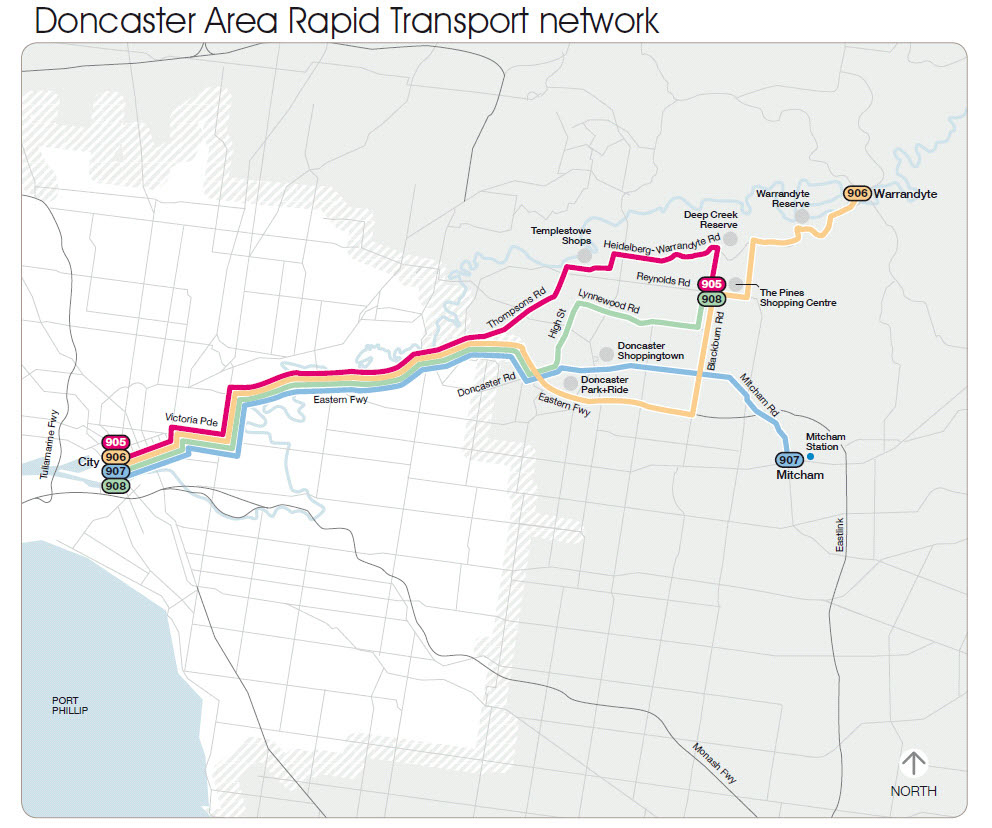 In my last post about the Green’s election manifesto, a Public transport plan for Melbourne’s east, I indicated I would take a closer look at the two new rail lines the party is proposing to finance – a line to Rowville and a line to Doncaster – with its nonexistent $6 billion.
I discussed the shortcomings of the Rowville line a few months ago when the Liberals also came out in favour of it (is there a winnable seat in the vicinity perhaps?), so here I’ll just concern myself with the proposed Doncaster line.
The Greens say a line is needed because Manningham is the only municipality in Melbourne without either a train line or a tram line. And they say a rail line was promised before – plans were drawn up in 1969 but never acted on.
I’m not impressed by this logic. Do we spend billions of dollars on infrastructure because some area is “entitled” to a track even if it’s not the best solution? Should we get the 1969 freeway plan because it’s a “broken” promise too?
I’d be more impressed if the Greens had provided some justification, but they haven’t. There’s no attempt to measure expected patronage and no indication of the possible economic benefits compared to other potential investments. Nor is there any indication of the annual operating cost and the ongoing subsidy that the line would require.
The proposal is that the line would run from the CBD via a tunnel under Carlton and Fitzroy to Victoria Park station on the Hurstbridge-Epping line. It would then run along the median of the Eastern Freeway (which was designed from the outset to take a rail line) until 1.5 km east of Bulleen Rd. At that point it would run underground to a new station at Doncaster.
There are some very serious questions that need to be asked about this proposal. Read the rest of this entry »
Victorian election – why have the Greens dug a black hole?
Posted: October 24, 2010 Filed under: Public transport | Tags: City of Knox, Doncaster, election, North East Link, Public Transport Plan for Melbourne's East, rail, Rowville, The Greens, Victoria, Victoria Transport Plan 22 Comments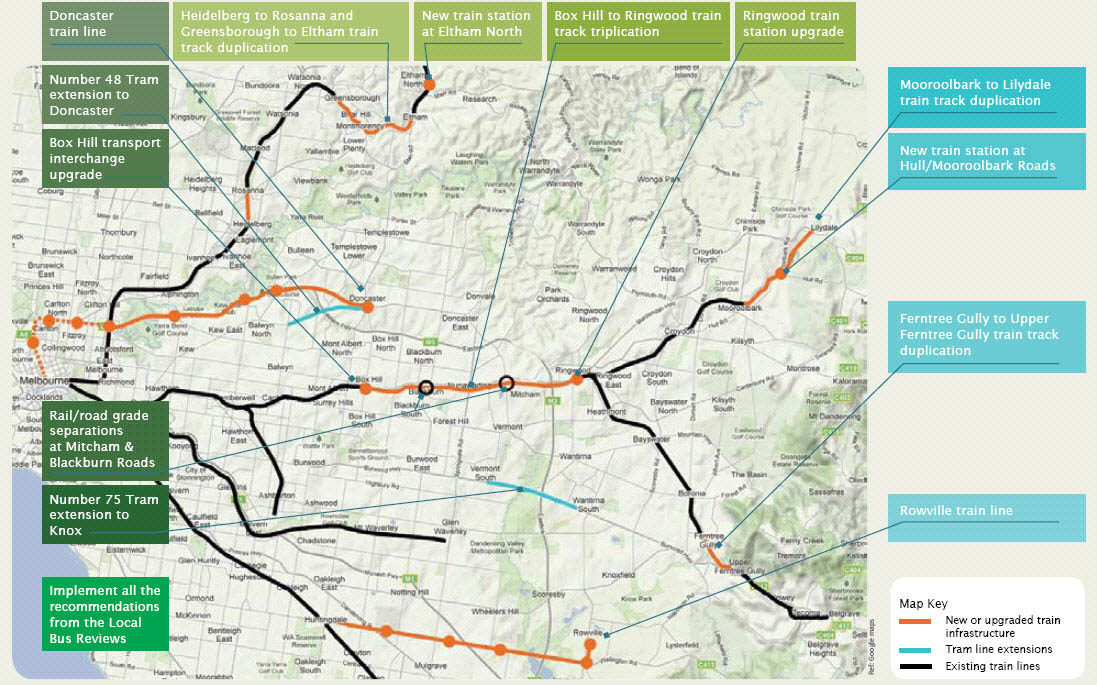
The Green's transport plan for Melbourne's east
If you think the Greens provide a real alternative to the tired, cynical politics of Labor and the Liberals, then you might be very disappointed in the transport initiative the Green’s are promoting for the forthcoming Victorian election.
The Green’s Public transport plan for Melbourne’s east proposes a massive $6 billion program of public transport works, including a new rail line to Rowville and another along the Eastern Freeway to Doncaster. It also proposes rail duplications and triplications, new train stations, level crossing upgrades, tram line extensions, transport interchange upgrades and improvements to bus services.
The Greens clearly and loudly proclaim that the $6 billion will be found by scrapping the Government’s proposed North East Link, the so-called ‘missing link’ between the metropolitan ring road at Greensborough and the Eastern Freeway at Bulleen.
It almost sounds too good to be true. No additional funding, no new freeway and heaps of new public transport infrastructure! Trouble is, as the Greens well know, it isn’t true – there is no $6 billion to reallocate. Read the rest of this entry »
Are the suburbs like the inner city?
Posted: October 5, 2010 Filed under: Public transport | Tags: 10^100 project, Auckland, bicycle, definition, Google, Inner city, monorail, New Zealand, Shweeb, suburbs 4 Comments
Shweeb human-powered monorail - winner of Google's $1 million 10^100 environment project. Google chose Shweeb because of its transit potential, but there seem to be a few obvious questions they didn't ask!
Australian suburbs are commonly thought of as low density, single-use dormitories offering residents spacious lots, detached houses, quiet streets and a good measure of “leafy” amenity. Since it is assumed residents commute to the city centre, the suburbs are unsullied by the noise and grind of daily commerce.
It’s also commonly implied that the suburbs are homogeneous, alienating and unauthentic. As Graeme Davison says, suburbanites have variously been accused of conformity, philistinism, apathy and wowserism.
But it seems this stereotype is outdated. Housing densities are rising in the suburbs, whether through large developments like this 13 storey, 520 unit development on a redundant government site at Coburg in Melbourne (10 km from the CBD), or via numerous dual occupancy and small-scale infill town house developments in middle ring suburbs and the older parts of outer suburbs. Read the rest of this entry »
Should public transport users pay their way?
Posted: September 27, 2010 Filed under: Public transport | Tags: congestion pricing, cost recovery, fares, Funding, LEK, Meeting the Funding Challenges of Public Transport, Public transport, Tourism & Transport Forum, transit 9 Comments
The peak industry body, Tourism and Transport Forum Australia, got itself into hot water with the media last week. The Forum suggested in a new report, Meeting the funding challenges of public transport, that eligibility for concession fares should be drastically restricted.
The brouhaha was unfortunate because the Forum’s underlying contention – that public transport in Australia should be operated on a full cost-recovery basis – is worthy of closer examination. Closer examination, that is, provided we’re talking about recovering full costs from those who can afford it!
At present, fares only account for approximately 36% of public transport operating costs across Australia’s five largest cities according to the Forum’s consultant’s, LEK. They say the rest comes from Government subsidies and is low compared to an international average of 60%.
The challenge facing governments in Australia is simple enough. Public transport capacity has to increase enormously to deal with expected higher demand driven by issues like peak oil, climate change and unprecedented population growth. For example, patronage has already grown 5% p.a. over the past five years in Brisbane and Melbourne. Read the rest of this entry »
Do we spend too much time commuting?
Posted: September 23, 2010 Filed under: Cars & traffic, Public transport | Tags: commuting, Jenny Sinclair, Richard Florida, Trip times 10 Comments
Time spent commuting to work, Melbourne
I’m currently reading a new book by writer and journalist Jenny Sinclair, When we think about Melbourne: the imagination of a city. This fascinating book sets out to discover what makes Melbourne unique and, according to the cover blurb, ultimately concludes that it’s all in our collective imagination.
I’m only a little way into the book but a comment she makes – just an aside really – caught my attention and sent me scurrying to the spreadsheet. She’s strolling through Victorian era parts of Melbourne when she’s:
reminded that there’s another (Melbourne), in which workers with affordable houses in Sunbury or Hoppers Crossing have no choice but to drive for hours every day to get to their jobs
This passage reminded me of Richard Florida’s recent claim that commutes in the US are so long they’re injurious to health. I made the point in this post that Florida’s methodology is flawed and time spent commuting in the US is actually relatively short.
But what about Melbourne – is Sinclair’s understanding that many Melburnites “drive for hours” to get to work correct? Read the rest of this entry »
HSR feasibility study: what should it address?
Posted: September 18, 2010 Filed under: HSR High Speed Rail, Public transport | Tags: AECOM, greenhouse gas, High Speed Rail, Infrastructure, Infrastructure Australia, Infrastructure Partnerships Australia, very fast train 5 Comments
What is the What?!!! Wau, Southern Sudan
There’s a long history of rent-seeking in Australia over major projects. Business puts a lot of effort into lobbying government and the media to subsidise projects the private sector wouldn’t otherwise touch with a bargepole.
So when IPA (Infrastructure Partnerships Australia) – the nation’s peak infrastructure lobby group – releases a new study calling for land to be reserved for a High Speed Rail (HSR) service from Brisbane to Melbourne, I don’t immediately assume it’s an impartial assessment.
However that didn’t bother The Age, which ran the story as the lead on the front page of Saturday’s issue. The paper reports that AECOM, who prepared the study jointly with IPA, was involved in France’s TGV and Britain’s HS2 HSR projects.
The Chairman of IPA, Mark Birrell, is also on the board of Infrastructure Australia, the body established under legislation to advise the Federal Minister on infrastructure needs and priorities.
No, rather than assume the report is impartial, I thank the angel of small mercies that the only promise on the table from the Greens and Labor is for a $20 million feasibility study of HSR. There may be a thousand more welfare-enhancing ways that $20 million could be spent, but it will well and truly have earned its keep if it leads to the right decision on what could be a $40 – $80 billion investment in HSR.
I’m not going to reiterate the many and varied problems I see with HSR, since I’ve covered them before (see here, here, and here, ). What I do want to address however is the way the planned feasibility study will be conducted. Read the rest of this entry »
Public transport: time for a new paradigm?
Posted: September 12, 2010 Filed under: Cars & traffic, Planning, Public transport | Tags: Cars, energy efficiency, Public transport, sustainability 22 Comments Sorry for the hoary cliché but I really do think it’s time for a new way of thinking about public transport.
Much of the debate on transport in cities is too simplistic. All too frequently it’s reduced to a simple nostrum: “replace all car travel with public transport”. I think it’s more complex than that and, to use another cliché, requires a more nuanced approach.
Let me be clear from the outset that there are compelling reasons why we need to invest more in public transport – for example, to provide mobility for those without access to a car. Another reason is to provide an alternative to roads that are becoming increasingly congested.
But I’m not convinced that the reason most commonly advanced – to overcome the environmental disadvantages of cars – is all that persuasive. Here’s why. Read the rest of this entry »
Will providing better transit be enough to cope with city growth?
Posted: September 6, 2010 Filed under: Cars & traffic, Public transport | Tags: congestion pricing, private transport, Public transport, road pricing, transit 9 Comments
Policies on Public Transport and Private Transport - you can't have one without the other
It might seem counter-intuitive, but you can’t increase public transport’s share of travel significantly unless you simultaneously do something about cars. Yet this simple relationship is usually ignored by governments and lobbyists alike.
Back on 23 August I looked at the question of how our cities could grow larger but still be liveable. Public transport has a vital role in meeting this challenge, but the task is daunting. Notwithstanding current overcrowding on the train system, public transport’s share of all motorised travel is only around 11% in Melbourne and a little higher in Sydney.
The standard recipe for increasing transit’s share of travel is to offer a better product. This is popularly thought of as more trains and more light rail (only occasionally more buses).
It usually involves providing some combination of greater route coverage, higher frequencies, longer operating hours, faster speeds, better connections, more information and higher levels of comfort and security.
Improving quality seems a self-evident solution. After all, the area of the city with the best public transport offering – the CBD – is also the area where public transport scores best against the car. For example, 43% of all motorised work trips to the inner city in Melbourne are made by public transport and this study suggests the figure for the CBD is probably upwards of 65%.
This strategy works – but only up to a point. Consider, for example, the Melbourne inner city municipality of Yarra. It has a pretty high standard of train and tram services, yet 86% of all motorised weekday travel by residents of Yarra is still made by car (or 74% when walking and cycling are also included). Read the rest of this entry »
Why do major infrastructure projects fail?
Posted: September 2, 2010 Filed under: Cars & traffic, Infrastructure, Public transport | Tags: Clem 7, Clem Jones Tunnel, infrastructure failures, Infrastructure financing, Matt O'Sullivan, Midtown Tunnel, Peninsula Link, Public transport, Rivercity Motorway, roads 15 Comments
Selected road and rail infrastructure projects (data from The Australian)
It was reported this week that the new Clem Jones Tunnel in Brisbane (known as the Clem7) is in diabolical financial trouble due to traffic levels that are well below those forecast.
Fewer than 30,000 vehicles a day are using the tunnel even though tolls were halved from 1 July (now $2 for a car). This compares with a forecast of 60,000 on opening, rising to 100,000 after 18 months. The operator of the tunnel, Rivercity Motorway, posted a $1.67 billion loss for the year to 30th June.
Clem7 joins a growing list of infrastructure projects funded on the basis of overly optimistic forecasts of initial usage. These include Sydney’s Lane Cove and Cross City tunnels, the Brisbane and Sydney airport trains, Melbourne’s Eastlink, and the 2,250 km Freightlink rail line connecting Adelaide and Darwin.
The Age’s Matt O’Sullivan is gob-smacked that Clem7’s transport consultants could have forecast traffic levels higher than those on New Yorks Midtown Tunnel, given that Brisbane’s population is a quarter of the City of New York’s:
“Yet traffic forecasters predicted that thousands more motorists would use the new Clem7 tunnel under the Brisbane River every day than another four-lane artery in New York linking Queens with central Manhattan.
“Running under the East River, the two-kilometre Midtown Tunnel has had about 80,000 vehicles passing through it each day. And it has been that way for much of the 70-year-old tunnel’s life. Half a world away in the Sunshine State, well-paid traffic forecasters had predicted that 91,000 vehicles daily would use the Clem7 by now and, by late next year, more than 100,000”.
What strikes me immediately is that this is not a sensible comparison. It’s highly likely the Midtown Tunnel is at capacity and probably has been for a very long time. Read the rest of this entry »
How to pay for public transport?
Posted: September 1, 2010 Filed under: Public transport | Tags: congestion pricing, Funding, Independent Public Inquiry into a Long Term Public Transport Plan for Sydney, Public transport, rail, Regional Rail Link, road pricing 8 Comments
Additional revenue from fare increase, Sydney - three scenarios (Independent Inquiry)
I was pleased to see the call earlier this week by The Age’s city editor, Jason Dowling, for tolling of roads to be introduced in Melbourne (Losing our way on roads).
He sees it as a way to reduce congestion and generate revenue for public transport improvements. Road pricing is something I’ve advocated on a number of occasions (here and here), but what particularly caught my eye in Mr Dowling’s article was his opening line:
“Everyone pays for public transport, first through taxes and then through fares, and it is time everyone had access to it, just as they do to roads”.
Few would disagree that Melbourne would be a more attractive place if it were as easy to access a train, tram or bus as it is a car. Somewhere along the line, however, the issue of cost has to be considered. Transport projects are very expensive. The State Government is spending about $2.5 billion on increasing the capacity of Victoria’s rail and road systems this year.
At that rate it will take many decades to improve the capacity of Melbourne’s public transport system. Just one project, the Regional Rail Link, is costing $4.3 billion in total and is only proceeding because the Federal Government is contributing $3.2 billion. Read the rest of this entry »
Does the proposed Rowville rail line make sense?
Posted: August 31, 2010 Filed under: Public transport | Tags: CAD, Central Activities District, City of Knox, Clayton, Huntingdale, Monash University, Peter Newman, Rowville rail line, Transit Cities 10 Comments At first glance, the Victorian Opposition’s enthusiasm for a new rail link between the existing Huntingdale station and Rowville seems like simple opportunistic politics. And it undoubtedly is. But as we shall see later, a variation on this idea might be worth a second glance.
The idea of a Rowville rail line goes back to 1969. The most recent substantive development was a pre feasibility study commissioned by Knox City Council in 2004 and undertaken by Professors Bill Russell and Peter Newman.
The study endorses the rail line, arguing that it could reduce the travel time from Rowville to the CBD by 30 minutes, improve the mobility of students using rail to access Monash University, remove cars from freeways and reduce the need for households to own second cars.
The pre feasiblity study is very “preliminary”, but nevertheless there’s enough there to see that there are some formidable obstacles to this proposal. Read the rest of this entry »
W Class trams – is this a great opportunity?
Posted: August 17, 2010 Filed under: Public transport | Tags: Grand Circle, history, Market Street Railway, National Trust, San Francisco, streetcar, trams, W Class tram 3 Comments
Melbourne’s W Class trams have serious limitations when it comes to doing what urban transit systems are supposed to do – move people around efficiently and quickly.
But they might potentially provide enormous benefits – particularly in relation to tourism and city “branding” – that could make their continued operation (and expansion!) more than worthwhile.
Twenty five W Class trams currently operate on the 78/79 route (Chapel St) but the Minister for Transport says they will be phased out by 2012. Another twelve operate the free City Circle route. There are possibly another 200 W Class trams in storage.
While they exude history, they are old and more like museum pieces than components of a modern public transport system. The youngest models were built in the 1950s, but the design dates from the 1920s. So there is no denying that the W Class has many shortcomings for use on a contemporary transit network.
They are slow. They are not air conditioned. They don’t have low-floor access. They are extremely noisy. They are bumpy. They do not offer adequate protection to the driver in the event of a collision with another vehicle unless they run at speeds lower than 40 Km/hr. On mixed routes they would hold up faster and more efficient trams like those operating on the 109 route, preventing them from being used to their potential. Read the rest of this entry »
Are Melbourne’s trains really getting safer?
Posted: August 15, 2010 Filed under: Public transport | Tags: Auditor General, crime, safety, trains 2 Comments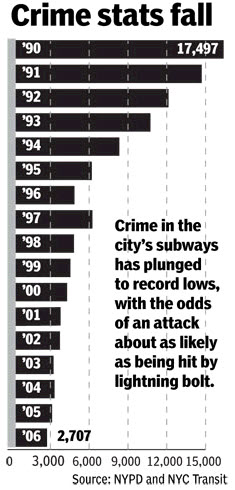
Offences on NYC's subway have fallen
A new report on the safety of Melbourne’s trains says they are getting safer. Reported offences fell from 45 per million passenger boardings in 2005-06 to 33 in 2008-09. That’s a phenomenal 27% reduction.
The report, titled Personal Safety and Security on the Metropolitan Train System, was prepared by the Victorian Auditor General and released publicly on 9 June 2010, shortly after a mob attacked a train at McKinnon station.
While the statistics look good, the report also says that passenger’s perceptions of safety on trains nevertheless got worse over the same period and are significantly lower than for trams and buses. Passengers feel reasonably safe during daylight hours but markedly less safe at night, not only in trains but also on stations and in car parks.
An initial observation is that 33 offences per million boardings is actually not that good. For example, crime is much lower on the New York City subway (see chart -shows absolute numbers), which carries ten million passengers on an average work day. The Boston rail system carries 350 million passengers per year with only 2.2 crimes per million boardings.
But what I want to look at is the puzzling matter of why passengers feel less safe on Melbourne’s trains even though crime is apparently falling.
Disappointingly, the Auditor General’s report doesn’t seek to explain why they are out of kilter. The implication seems to be that passenger’s perceptions are irrational and shaped by the media. Read the rest of this entry »
Should public transport fares to the airport be subsidised?
Posted: August 10, 2010 Filed under: Airports & aviation, Public transport | Tags: Every 10 Minutes to Everywhere, Melbourne airport, Metlink, Public transport, Public Transport Users Association, rail link, Skybus, Smartbus 13 Comments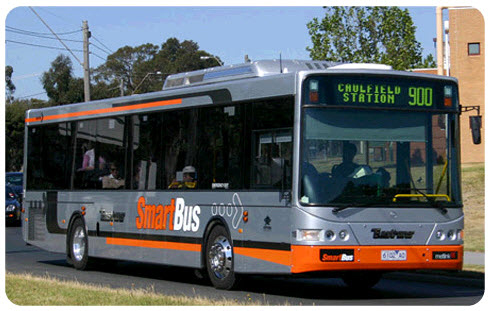 Yesterday’s discussion of an airport-CBD rail link prompts me to look further at the idea that airport users have a “right” to public transport priced at the standard Metlink tariff.
My first reaction is that the idea makes sense. After all, everywhere else in Melbourne is provided with public transport subsidised by the Government (no matter how inadequate it might be). Melbourne Airport is also one of the largest suburban activity centres in the metropolitan area, with around 12,000 workers.
If travel to and from the Airport were charged in accordance with the Metlink tariff, the fare to the CBD would be the standard Zone 1-2 fare of $5.80 one-way. But while it might be the equitable solution it doesn’t follow that it’s the sensible one, the necessary one, or the one that’s in the best interests of all Melburnians. Read the rest of this entry »
Would an airport rail link take us for a ride?
Posted: August 9, 2010 Filed under: Airports & aviation, Infrastructure, Public transport | Tags: Essential Economics, Melbourne airport, rail link, Skybus 15 Comments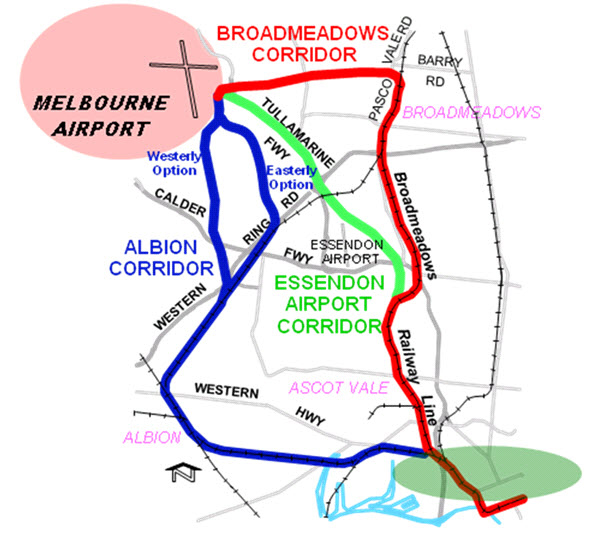
Possible corridors for an airport rail link identified by DoT
A senior economist at Essential Economics, Sean Stephens, has joined the debate about a rail link from the CBD to Melbourne Airport, arguing in The Age last week that “a rail link would help Melbourne maintain its world-class status, where visitors and locals could access Melbourne Airport, our gateway to the world, with ease and convenience”.
There are some misconceptions in the article and an evident misunderstanding of existing public transport services between the airport and the CBD.
The main supplier is Skybus, a privately operated and profitable operation that carries two million passengers per annum, or about 8% of airport passenger traffic. Skybus operates a 24 hour service (with 10-15 minute frequencies between 4am and 11.45pm). Because Skybus makes use of the emergency lane on the freeway, it takes 20 minutes from the airport to the CBD in the off-peak and up to 40 minutes in the peak.
Also, from next year, the Government will extend operation of the existing Frankston to Ringwood Yellow Smartbus service to connect with Melbourne Airport via Broadmeadows station. Buses will operate every 15 minutes with ticket prices based on the standard Metlink fare structure.
Mr Stephen’s only concrete criticism of Skybus is that the fares are too expensive and “well above those of comparable cities that provide a rail link”. In fact Skybus tickets cost $16 one way, much the same as those on the Sydney ($15) and Brisbane ($15) airport rail systems, notwithstanding Melbourne airport’s greater distance from the CBD. Skybus offers airport workers a discounted fare. Read the rest of this entry »
Does Labor’s Sydney-Newcastle High Speed train make sense?
Posted: August 5, 2010 Filed under: HSR High Speed Rail, Infrastructure, Public transport | Tags: Albanese, High Speed Rail, HSR, Newcastle, Sydney, VFT 9 Comments
The car-eating "straddle" train
I watched Anthony Albanese foreshadow on Lateline on Wednesday night that the Government, if re-elected, would fund a $20 million feasibility study of a high speed rail connection between Sydney and Newcastle as part of a Sydney-Brisbane route.
The Minister’s subseqent announcement on Thursday puts more emphasis on an east coast Brisbane-Sydney-Melbourne HSR but it seems clear the Central Coast is a key target of the initiative (Robertson is a marginal seat).
The announcement was greeted with some scepticism – an HSR link between Sydney and Newcastle was announced by Bob Carr twelve years ago. Crikey’s Canberra correspondent, Bernard Keane, reckons Labor isn’t serious about HSR and is only pretending.
Provided the focus is on Sydney-Newcastle, I think there are some reasonable aspects to this initiative notwithstanding its apparent political motivation. Read the rest of this entry »
What will high speed rail do for regional development?
Posted: August 2, 2010 Filed under: Decentralisation, HSR High Speed Rail, Infrastructure, Public transport | Tags: albury, Decentralisation, High Speed Rail, regional centres, very fast train, wodonga 12 Comments
Albury-Wodonga
Yesterday I looked at the carbon reduction justification for high speed rail between Sydney and Melbourne. Today I want to discuss another argument – that high speed rail will promote the development of regional centres. It is argued that this could in turn relieve capital cities of much of the burden of projected population growth.
I have no doubt that improving connection times between regional centres like Albury-Wodonga and Melbourne will benefit both.
But if regional centres are to be a serious alternative for growth, they will need to provide new arrivals with jobs. The question I ask is: where are those jobs going to come from?
One way could be that regional centres provide a “dormitory” for workers who can live in the country but commute to work in capital cities like Melbourne by high speed rail. Read the rest of this entry »
High speed rail – are the Greens as shallow as the rest?
Posted: August 1, 2010 Filed under: Energy & GHG, HSR High Speed Rail, Infrastructure, Public transport | Tags: Bob Brown, High Speed Rail, Julia Gillard, The Greens, Tony Abbott, very fast train 12 Comments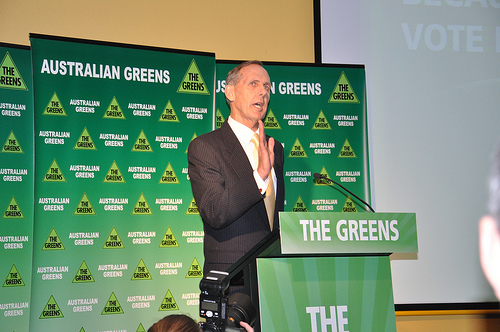 Bob Brown let us know yesterday with his call for a high speed rail link from Brisbane to Melbourne that the Greens are just as susceptible to populism as Julia Gillard and Tony Abbott.
In April he costed a Sydney-Canberra-Melbourne link at more than $40 billion. Yesterday he pointed to a survey commissioned by the Greens showing 74% of Australians support high speed rail. That’s not surprising because it is an attractive and beguiling idea – 94% of readers of The Age support it. After all, China and Europe can’t seem to build enough high speed rail and President Obama has grand plans for an extensive network in the US.
The idea of some form of very fast train service connecting Sydney-Canberra-Melbourne has been around at least since the 1980s. A number of feasibility studies have been undertaken, all of which concluded that it wouldn’t be feasible without massive Government assistance. So it’s worth asking a few questions:
- why would we want to commit billions in Government subsidies to replace one form of public transport (planes) with another (trains)?
- why would we want to replace the four airlines that currently compete vigorously on price and service on this route with a single monopoly rail operator? Read the rest of this entry »
 The Melbourne Urbanist