Are the suburbs dormitories?
Posted: September 21, 2010 Filed under: Activity centres, Employment | Tags: activity centre, centre of mass, Employment 4 Comments
"Centre of gravity" of jobs, 1981 and 2006
There are many misconceptions about the suburbs. A common one is that they are dormitories for workers who commute to the CBD. Another is that jobs in the suburbs are mostly low skill and low pay.
The reality is most economic activity in our capital cities takes place in the suburbs. In Melbourne, for example, 72% of jobs are more than 5 km from the CBD, 50% are more than 13 km away and 25% more than 22 km away.
Jobs have been moving away from the centre for a long time. The “centre of gravity” of jobs in Melbourne is now 7.9 km south east of the CBD, in the vicinity of Tooronga station, East Malvern. That’s up from 5.9 km in 1981. The “average” job is 15.6 km from the CBD (12.4 km in 1981).
This decentralised pattern holds for most industry sectors. More than 70% of jobs in the Community sector and more than 80% of jobs in the Retail, Wholesale and Manufacturing sectors are in the suburbs (defined as more than 5km from the CBD). Even in the Commercial Services sector, which is the inner city’s great strength, 49% of metropolitan jobs are in the suburbs.
Over 90% of Melburnites live in the suburbs and the great bulk work there too. Less than 10% of workers who live in outer suburbs like Casey, Cardinia, Dandenong, Knox, Maroondah, Mornington work in the centre (City of Melbourne). Even in older suburbs like Hobsons Bay, Brimbank, Maribyrnong and Moonee Valley, less than 25% of the workforce works in the centre. Read the rest of this entry »
Does the built environment determine our lives?
Posted: September 20, 2010 Filed under: Architecture & buildings | Tags: Physical determinism, psychological, Richard Neutra, social, urban design 14 Comments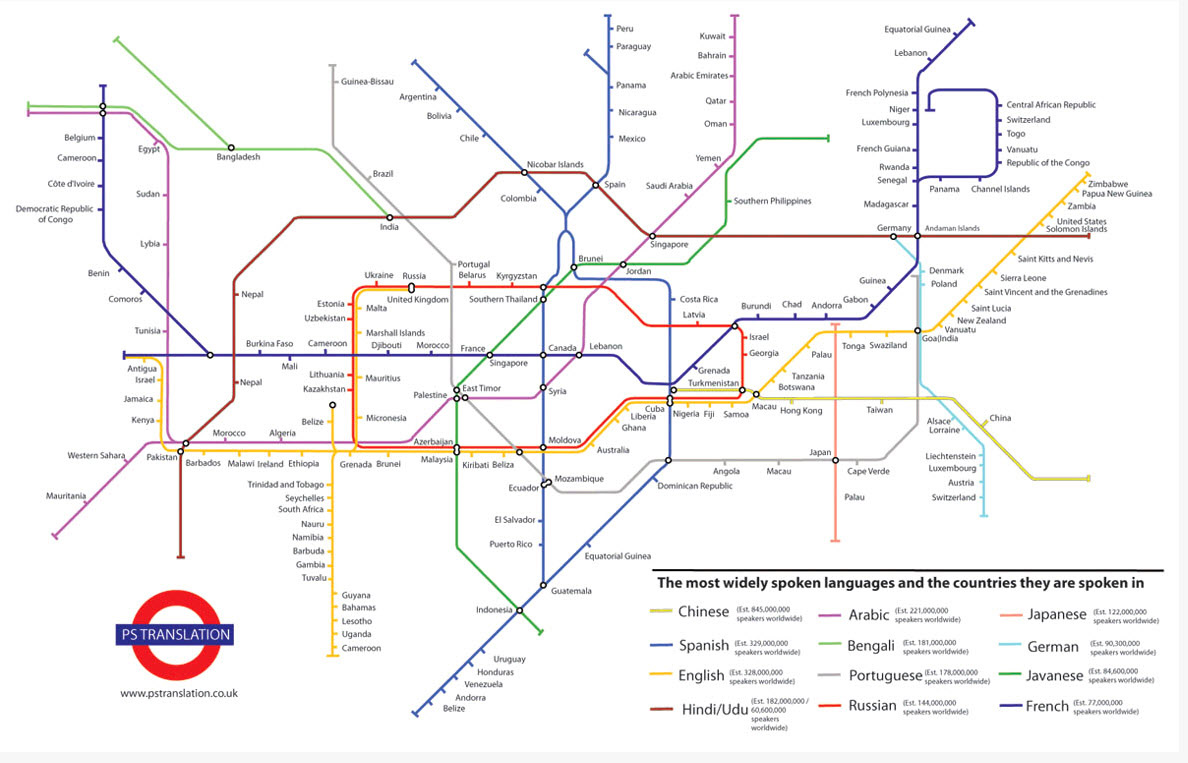
Where the most common languages are spoken
The American modernist architect, Richard Neutra, is supposed to have once claimed that if he were so minded, he could design a house for a happily married couple that would assure their divorce within six months. Or something like that.
While it’s possibly apocryphal, the story illustrates what many architects and urban designers think – design profoundly affects our behaviour and wellbeing.
It’s clear the built environment matters. It keeps out the rain, cold and unwanted visitors. And it’s equally obvious that some buildings, like churches, can move us in the same way a natural landscape can impress itself on us.
We know that some colours can affect our perceptions and possibly, in some circumstances, even our emotional state. And we know that all other things being equal, public spaces where there are “many eyes on the street” tend to have less crime and the “dark end of the street” can be a dangerous place. And you’re less likely to know your neighbours across the street if you live on a busy road.
We also know it’s a simple enough matter for designers to channel where people walk through urban places and where they are most likely to pause in the sunlight and take in the view or a latte.
But designers have a tendency to over-state the behavioural and social effects of the built environment. I don’t know what design strategies Neutra had in mind but it seems to me he would have failed miserably. Humans are remarkably resilient when it comes to adapting to different environments. Read the rest of this entry »
HSR feasibility study: what should it address?
Posted: September 18, 2010 Filed under: HSR High Speed Rail, Public transport | Tags: AECOM, greenhouse gas, High Speed Rail, Infrastructure, Infrastructure Australia, Infrastructure Partnerships Australia, very fast train 5 Comments
What is the What?!!! Wau, Southern Sudan
There’s a long history of rent-seeking in Australia over major projects. Business puts a lot of effort into lobbying government and the media to subsidise projects the private sector wouldn’t otherwise touch with a bargepole.
So when IPA (Infrastructure Partnerships Australia) – the nation’s peak infrastructure lobby group – releases a new study calling for land to be reserved for a High Speed Rail (HSR) service from Brisbane to Melbourne, I don’t immediately assume it’s an impartial assessment.
However that didn’t bother The Age, which ran the story as the lead on the front page of Saturday’s issue. The paper reports that AECOM, who prepared the study jointly with IPA, was involved in France’s TGV and Britain’s HS2 HSR projects.
The Chairman of IPA, Mark Birrell, is also on the board of Infrastructure Australia, the body established under legislation to advise the Federal Minister on infrastructure needs and priorities.
No, rather than assume the report is impartial, I thank the angel of small mercies that the only promise on the table from the Greens and Labor is for a $20 million feasibility study of HSR. There may be a thousand more welfare-enhancing ways that $20 million could be spent, but it will well and truly have earned its keep if it leads to the right decision on what could be a $40 – $80 billion investment in HSR.
I’m not going to reiterate the many and varied problems I see with HSR, since I’ve covered them before (see here, here, and here, ). What I do want to address however is the way the planned feasibility study will be conducted. Read the rest of this entry »
What’s VECCI’s vision for Melbourne?
Posted: September 16, 2010 Filed under: Planning | Tags: bicycle licensing, Infrastructure, Liveability, VECCI 22 Comments
I've always said street art is rubbish (video)
The Victorian Employer’s Chamber of Commerce and Industry (VECCI) released five policy papers on Monday aimed at guiding the pre-election decision-making of the major parties.
The paper on Infrastructure and Liveability is of particular interest to the Melbourne Urbanist. Apart from a short introduction emphasising the economic importance of infrastructure, it’s essentially a list of actions, some very specific, which looks like it was cobbled together by the proverbial committee.
It includes some current projects such as the planned Melbourne Metro, but there are some other ideas that are very interesting, to say the least. Read the rest of this entry »
What’s wrong with (green) cars?
Posted: September 15, 2010 Filed under: Cars & traffic, Energy & GHG | Tags: congestion, electricity, embodied energy, green cars, traffic 13 Comments
Optical illusion slows traffic in Vancouver
Earlier in the week I argued that public policy needs to recognise that climate change and peak oil are the least compelling reasons for investing in public transport (Public transport: time for a new paradigm?). There are far more convincing reasons, I argued, such as providing universal mobility and an alternative in congested conditions.
One of my key points was that cars will almost certainly be the dominant mode for many decades to come. There are many reasons for this, including the fact that there are potential substitutes for oil and that travellers will not easily give up the advantages of on-demand mobility.
It will also take considerable time to move our cities to a more transit-friendly urban form and improving public transport to the point where it can “take over” from the car will be enormously expensive. Of course there are also alternative uses competing for investment and attention, like education and health.
I argued that we should therefore give high priority to making cars green i.e. work toward vehicles powered by renewable energy sources with low carbon and pollution. Some people say that even cars powered by zero carbon electricity will nevertheless have enormous negative impacts. Whether that’s right or not, we don’t realistically have a choice – at least in the medium term – because the transformation from car-dependent cities to transit-dependent cities will be long and arduous.
However it is true that green cars will still present serious challenges. Read the rest of this entry »
Should you look askance at climate skeptics?
Posted: September 14, 2010 Filed under: Energy & GHG | Tags: climate change, insight, Legal Eagle, SBS, skeptic, SkeptiClawyer, Stephen Schneider 22 Comments There’s been a massive shitstorm in the blogosphere since a left-leaning Melbourne lawyer, Legal Eagle, outed herself as a climate change skeptic on the SkeptiClawyer blog last week (Climate change, scepticism and elitism).
Legal Eagle also appeared on SBS’s Insight program a week ago when eminent climate change scientist, Stanford University’s Professor Stephen Schneider, was confronted with an audience of non-believers (sadly, Professor Schneider died a few weeks after the show was recorded).
Legal Eagle explained on her blog why she’s skeptical:
I am a lay person, not a scientist. I can’t make any effective judgments about the science behind Professor Schneider’s figures and projections.
I don’t have the scientific or the statistical capacity to judge the various accounts as to what is going to happen with our climate. I don’t know who is right or wrong about the ‘hockey stick graph‘ Read the rest of this entry »
Local vs central delivery – what’s the difference?
Posted: September 13, 2010 Filed under: Activity centres | Tags: Banyule Netball Centre, Coburg High School, economies of scale, suburban centres 6 Comments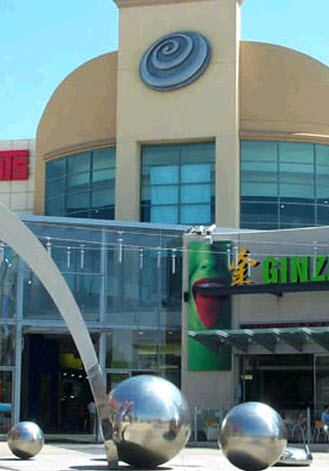 One of the ever-present tensions in planning is the desire for accessibility on the one hand and the advantages of economies of scale on the other. This is an age-old debate about localised delivery versus centralised delivery.
Here’s an example from everyday life. For years, I took my son on Saturday mornings to play basketball in the “local” comp – local in this case meaning the North East sector of Melbourne. Every second Saturday he played a home game about 3 km away. On alternate Saturdays we travelled to away games, from Collingwood out to relatively “remote” places like Park Orchards, Templestowe and Eltham.
When my daughter started playing netball last year I encountered a very different model. There’s a single netball centre in Macleod with multiple indoor and outdoor courts serving the region. All games in her age competition are played at the centre each Saturday at the same time.
There are real advantages in the Macleod approach compared with the decentralised model that my son experienced. He sometimes had to play in sub standard venues and on more than one occasion there was no volunteer there to open up the court. Just navigating to some of the more far-flung venues seemed like a substantial achievement! Read the rest of this entry »
Public transport: time for a new paradigm?
Posted: September 12, 2010 Filed under: Cars & traffic, Planning, Public transport | Tags: Cars, energy efficiency, Public transport, sustainability 22 Comments Sorry for the hoary cliché but I really do think it’s time for a new way of thinking about public transport.
Much of the debate on transport in cities is too simplistic. All too frequently it’s reduced to a simple nostrum: “replace all car travel with public transport”. I think it’s more complex than that and, to use another cliché, requires a more nuanced approach.
Let me be clear from the outset that there are compelling reasons why we need to invest more in public transport – for example, to provide mobility for those without access to a car. Another reason is to provide an alternative to roads that are becoming increasingly congested.
But I’m not convinced that the reason most commonly advanced – to overcome the environmental disadvantages of cars – is all that persuasive. Here’s why. Read the rest of this entry »
Is there a housing bubble?
Posted: September 9, 2010 Filed under: Housing | Tags: Christopher Joye, hedge funds, home prices, Rismark International 9 Comments
Rismark International
In an excellent post, finance whiz Christopher Joye explains that all those foreign hedge funds who are actively shorting Australian bank shares are themselves taking a bath.
He deflates the claim of “US investment legend” Jeremy Grantham that Australia’s housing market is a time bomb with house prices 7.5 times family incomes. The hedge funds believe the housing bubble will burst and threaten the balance sheets of Australian banks.
Mr Joye, who is the MD of Rismark International, points out that the home price to disposable income ratio in Australia was actually only 4.6 in the June quarter 2010, a figure generally in line with the average since 2003. Read the rest of this entry »
Is commuting (very) bad for you?
Posted: September 8, 2010 Filed under: Cars & traffic | Tags: commuting, creative class, Edward Glaeser, health, Richard Florida 6 Comments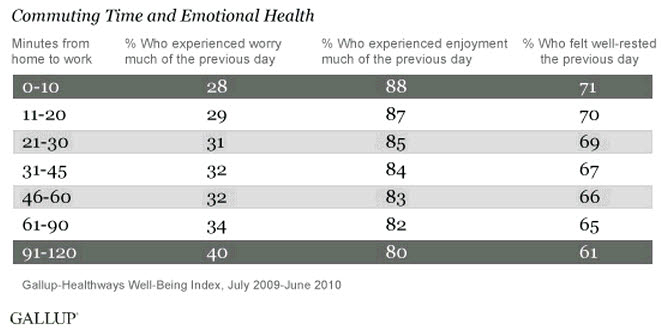 Let me say from the outset that I’ve long been sceptical about some of the methods used by Richard Florida, celebrated author of The Rise of the Creative Class. And I’m not the only one – this review of his book by Edward Glaeser is written with a velvet glove but packs an iron fist.
So it’s not surprising I’m unimpressed by Commuting is very bad for you, written by Florida for last month’s issue of The Atlantic. He gets it completely wrong and provides a lesson in the dangers of only seeing what you want to see.
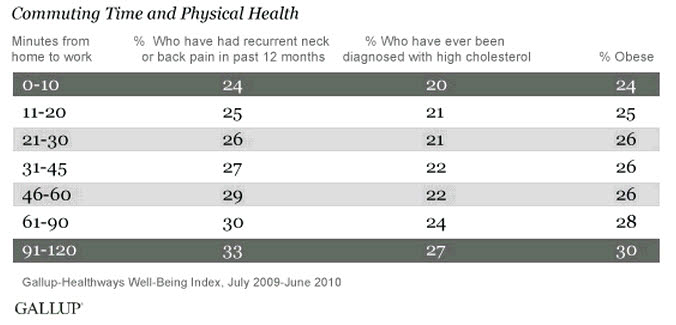 Florida seizes on a survey of 173,581 working Americans which he claims shows that those with longer commutes suffer higher levels of back pain, higher cholesterol and higher obesity. It also shows, he says, that commuting takes a toll on emotional health and happiness – those who commute more worry more, experience less enjoyment and feel less well-rested.
Commuting by car is so bad it’s up there with smoking:
“commuting is a health and psychological hazard, not to mention the carnage and wasted time on our over-clogged roads. It’s time to put commuting right beside smoking and obesity on the list of priorities for improving the health and well-being of Americans”.
The trouble is the data he cites doesn’t support these conclusions. A proper reading of the two tables from his article (I’ve reproduced them above) indicates there’s very little relationship between commute time and health. Read the rest of this entry »
Can we make living together better?
Posted: September 7, 2010 Filed under: Education, justice, health, Housing, Planning | Tags: election, Liveability, neighbours, noise, NSW, nuisance, Queensland, Victoria 12 Comments OK so now it’s time to turn to State politics.
I have a modest idea for making our major cities more liveable that I’d like to offer to the Premiers and Opposition Leaders of Victoria, NSW and Queensland in the run up to their forthcoming State elections.
The idea could be named something like the Better Neighbours Initiative or it could as easily be titled Considerate Cities or Liveable Cities or something of that ilk. The idea starts with the recognition that living in close proximity within cities imposes stresses on human relations and demands strong remedial action.
Some of the risks associated with cities, like disease, respond to investment in physical infrastructure. But some don’t – they require behavioural approaches.
The main objective is to limit the stress that inconsiderate behaviour, like noise from “hot” cars or audio amplifiers, imposes on residents and neighbours. I’ll focus on noise here, but the ambit of the liveable cities idea could extend to other problems such as taming the speed and behaviour of cars in local streets and activity centres. Read the rest of this entry »
Will providing better transit be enough to cope with city growth?
Posted: September 6, 2010 Filed under: Cars & traffic, Public transport | Tags: congestion pricing, private transport, Public transport, road pricing, transit 9 Comments
Policies on Public Transport and Private Transport - you can't have one without the other
It might seem counter-intuitive, but you can’t increase public transport’s share of travel significantly unless you simultaneously do something about cars. Yet this simple relationship is usually ignored by governments and lobbyists alike.
Back on 23 August I looked at the question of how our cities could grow larger but still be liveable. Public transport has a vital role in meeting this challenge, but the task is daunting. Notwithstanding current overcrowding on the train system, public transport’s share of all motorised travel is only around 11% in Melbourne and a little higher in Sydney.
The standard recipe for increasing transit’s share of travel is to offer a better product. This is popularly thought of as more trains and more light rail (only occasionally more buses).
It usually involves providing some combination of greater route coverage, higher frequencies, longer operating hours, faster speeds, better connections, more information and higher levels of comfort and security.
Improving quality seems a self-evident solution. After all, the area of the city with the best public transport offering – the CBD – is also the area where public transport scores best against the car. For example, 43% of all motorised work trips to the inner city in Melbourne are made by public transport and this study suggests the figure for the CBD is probably upwards of 65%.
This strategy works – but only up to a point. Consider, for example, the Melbourne inner city municipality of Yarra. It has a pretty high standard of train and tram services, yet 86% of all motorised weekday travel by residents of Yarra is still made by car (or 74% when walking and cycling are also included). Read the rest of this entry »
Historic short films of early Melbourne, 1910-1947
Posted: September 5, 2010 Filed under: Miscellaneous | Tags: Beautiful Melbourne, film, history, Marvellous Melbourne, Melbourne Today, Screen Australia, traffic Leave a comment
Melbourne Today 1931
There’s a wonderful video of Melbourne in 1931, Melbourne Today, put up by Gillian over at Melbourne Curious. This inspired me to track its original source to the Screen Australia web site where there are literally hundreds of films on diverse aspects of Australian life dating from the end of the nineteenth century.
I went looking for films with a specifically Melbourne urban perspective and picked out these four:
Marvellous Melbourne, circa 1910
City traffic in variable moods, circa 1920
Melbourne Today was made by F.W. Thring, renowned Melbourne film maker and father of Aussie film legend Frank Thring (who memorably appeared as Pontius Pilate in the 50s sword and sandals epic, Ben Hur). More over the leaf….. Read the rest of this entry »
Why do major infrastructure projects fail?
Posted: September 2, 2010 Filed under: Cars & traffic, Infrastructure, Public transport | Tags: Clem 7, Clem Jones Tunnel, infrastructure failures, Infrastructure financing, Matt O'Sullivan, Midtown Tunnel, Peninsula Link, Public transport, Rivercity Motorway, roads 15 Comments
Selected road and rail infrastructure projects (data from The Australian)
It was reported this week that the new Clem Jones Tunnel in Brisbane (known as the Clem7) is in diabolical financial trouble due to traffic levels that are well below those forecast.
Fewer than 30,000 vehicles a day are using the tunnel even though tolls were halved from 1 July (now $2 for a car). This compares with a forecast of 60,000 on opening, rising to 100,000 after 18 months. The operator of the tunnel, Rivercity Motorway, posted a $1.67 billion loss for the year to 30th June.
Clem7 joins a growing list of infrastructure projects funded on the basis of overly optimistic forecasts of initial usage. These include Sydney’s Lane Cove and Cross City tunnels, the Brisbane and Sydney airport trains, Melbourne’s Eastlink, and the 2,250 km Freightlink rail line connecting Adelaide and Darwin.
The Age’s Matt O’Sullivan is gob-smacked that Clem7’s transport consultants could have forecast traffic levels higher than those on New Yorks Midtown Tunnel, given that Brisbane’s population is a quarter of the City of New York’s:
“Yet traffic forecasters predicted that thousands more motorists would use the new Clem7 tunnel under the Brisbane River every day than another four-lane artery in New York linking Queens with central Manhattan.
“Running under the East River, the two-kilometre Midtown Tunnel has had about 80,000 vehicles passing through it each day. And it has been that way for much of the 70-year-old tunnel’s life. Half a world away in the Sunshine State, well-paid traffic forecasters had predicted that 91,000 vehicles daily would use the Clem7 by now and, by late next year, more than 100,000”.
What strikes me immediately is that this is not a sensible comparison. It’s highly likely the Midtown Tunnel is at capacity and probably has been for a very long time. Read the rest of this entry »
How to pay for public transport?
Posted: September 1, 2010 Filed under: Public transport | Tags: congestion pricing, Funding, Independent Public Inquiry into a Long Term Public Transport Plan for Sydney, Public transport, rail, Regional Rail Link, road pricing 8 Comments
Additional revenue from fare increase, Sydney - three scenarios (Independent Inquiry)
I was pleased to see the call earlier this week by The Age’s city editor, Jason Dowling, for tolling of roads to be introduced in Melbourne (Losing our way on roads).
He sees it as a way to reduce congestion and generate revenue for public transport improvements. Road pricing is something I’ve advocated on a number of occasions (here and here), but what particularly caught my eye in Mr Dowling’s article was his opening line:
“Everyone pays for public transport, first through taxes and then through fares, and it is time everyone had access to it, just as they do to roads”.
Few would disagree that Melbourne would be a more attractive place if it were as easy to access a train, tram or bus as it is a car. Somewhere along the line, however, the issue of cost has to be considered. Transport projects are very expensive. The State Government is spending about $2.5 billion on increasing the capacity of Victoria’s rail and road systems this year.
At that rate it will take many decades to improve the capacity of Melbourne’s public transport system. Just one project, the Regional Rail Link, is costing $4.3 billion in total and is only proceeding because the Federal Government is contributing $3.2 billion. Read the rest of this entry »
Does the proposed Rowville rail line make sense?
Posted: August 31, 2010 Filed under: Public transport | Tags: CAD, Central Activities District, City of Knox, Clayton, Huntingdale, Monash University, Peter Newman, Rowville rail line, Transit Cities 10 Comments At first glance, the Victorian Opposition’s enthusiasm for a new rail link between the existing Huntingdale station and Rowville seems like simple opportunistic politics. And it undoubtedly is. But as we shall see later, a variation on this idea might be worth a second glance.
The idea of a Rowville rail line goes back to 1969. The most recent substantive development was a pre feasibility study commissioned by Knox City Council in 2004 and undertaken by Professors Bill Russell and Peter Newman.
The study endorses the rail line, arguing that it could reduce the travel time from Rowville to the CBD by 30 minutes, improve the mobility of students using rail to access Monash University, remove cars from freeways and reduce the need for households to own second cars.
The pre feasiblity study is very “preliminary”, but nevertheless there’s enough there to see that there are some formidable obstacles to this proposal. Read the rest of this entry »
Which portfolio should the Greens take?
Posted: August 30, 2010 Filed under: Cars & traffic, Energy & GHG | Tags: Climatechange Summit, Climateworks, electricity, The Greens, Victorian Transport Plan 5 Comments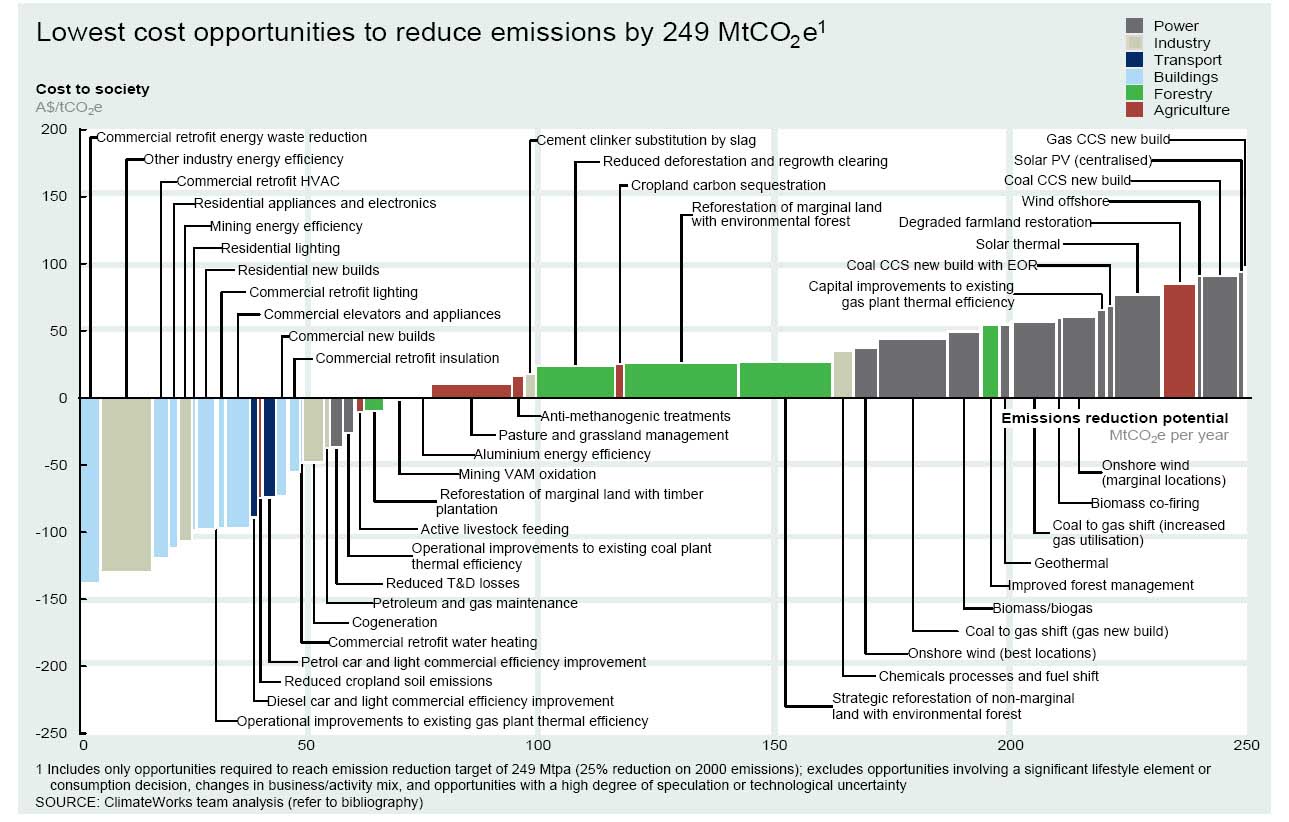
Climateworks - click to enlarge
It’s a commonplace in politics, as it is in most things, that it’s better to focus limited resources on a few objectives than to spread them thin over a broad front.
So I’m therefore more than a little surprised that the Greens in Victoria, fresh from winning the Federal seat of Melbourne, are reportedly going to demand the Transport portfolio if they control the balance of power at the next State election (here and here).
If true that strikes me as a curious demand. There are doubtless complex political issues around why the Greens would even want a Ministry, but in terms of the scope for improving the environment it seems to me that Energy would be a more logical choice than the Transport portfolio.
There are a number of reasons for this view.
First, as this report prepared for the 2008 Victorian Climatechange Summit shows, electricity is a far larger generator of CO2 emissions than the transport sector. In Victoria, 64% of all carbon emissions are generated by the residential, commercial and manufacturing sectors. Almost all of this carbon is emitted from coal-fired power stations.
In comparison, all passenger transport in the State – by both car and public transport – generates 14% of Victoria’s total carbon emissions. The transport of freight is responsible for another 5%. Comparable figures are also published in The Victorian Transport Plan.
So on the face of it there’re potentially much bigger gains for the environment from clean energy production than there are from clean transport. Read the rest of this entry »
Is water priced to encourage conservation?
Posted: August 30, 2010 Filed under: Miscellaneous | Tags: conservation, sewage, water prices 6 Comments There have been some quite spectacular reductions in Melbourne’s water consumption in recent years. The latest invoice from my water company proclaims that total water consumed by customers has fallen 36% since 1997.
Most of this gain is undoubtedly due to water restrictions and jaw boning. Pricing doesn’t seem to have been a big influence, even though most economists would suggest that it is one of the most efficient ways to moderate demand.
I just got my water bill for the last three months. Average daily use by my household is 495 litres, or 124 litres per person. That’s not bad compared to the Government’s daily target of 155 litres per person (although admittedly it’s been a pretty wet winter).
What surprises me however is the relatively low profile given to pricing as a mechanism for dampening demand (pun intended). My Consumption Charges only amount to 24.4% of my total bill. The other key items are Parks Charges, Drainage Charges, Service Charges and Sewage Charges. Read the rest of this entry »
A new high school for Coburg – what are the lessons?
Posted: August 26, 2010 Filed under: Education, justice, health, Infrastructure | Tags: Coburg High School, Education Department 7 Comments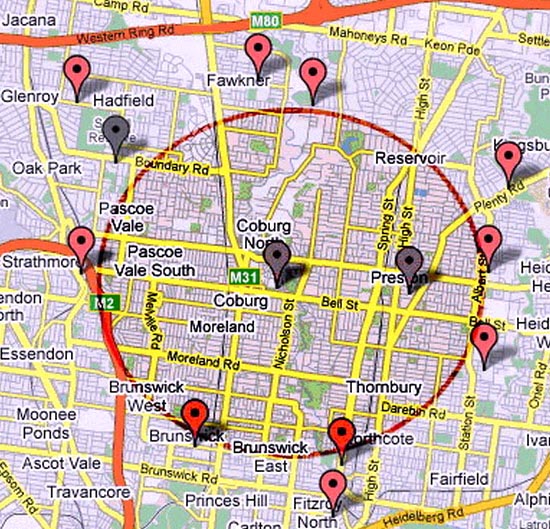
Coburg's "Black Hole" - no high school for year 7 students (existing high schools in red - grey schools don't offer full service)
There’s a fascinating struggle going on between the Education Department and residents of Coburg about the need for a new junior high school in the area (see here and here).
The map shows what residents call the “black hole” and this story in The Age gives the history of high school closures in the area:
“The troubled Moreland City College closed in 2004. Coburg High School shut its doors in 1993 and is now the site for a planned 510 apartments. Newlands High School, now part of the Pentridge Prison development, folded in 1993. Moreland High School taught its final class in 1991 and is now Kangan Batman TAFE”.
The Education Department says there isn’t sufficient demand to meet the minimum size requirements for a junior high school and that there are others nearby with adequate capacity to take Coburg children from year seven. The residents argue that these schools are either too far away or unsuitable.
There are two existing high schools within the circle, shown in grey on the map, but they are not full-service schools. One is Coburg Senior High (co-ed, year 10 upwards) and the other is Preston Girls College (girls 7-12 only). The obvious “new junior school” solution is to expand Coburg Senior High.
I’m not concerned with the reasonableness of either side’s case, but I am interested in the issue of how far teenagers should reasonably be expected to travel to school. I also think there’s some insight to be had here into the issue of whether or not there is spare infrastructure capacity in inner suburbs. Read the rest of this entry »
Where are the (infrastructure) white elephants?
Posted: August 25, 2010 Filed under: Decentralisation, Infrastructure | Tags: Clem 7, Docklands, Eastlink, Federation Square, Infrastructure, MYKI, National Wine Centre, Southern Star Observation Wheel, white elephant 7 Comments With the renewed political focus on regional development, it’s timely to think about white elephants – in this instance specifically about Infrastructure White Elephants.
Anytime politicians are excited by regional development, herds of white elephants can’t be far away. I touched on this important matter in a previous post on “visionary” projects, but now I’m interested to know which projects, if any, qualify as Infrastructure White Elephants.
To begin with I’ll use a simple definition – according to Wiki, a white elephant is a valuable possession whose level of use is low relative to its cost to build and maintain.
On that definition I’d be tempted to include Sydney’s Cross City tunnel and Brisbane’s Clem 7 under-river tunnel on my list of provisional white elephants, as initial traffic levels were much lower than forecast. Then going back a bit, other potential candidates might include the Ord River Scheme and more recently the Alice Springs to Darwin rail line. Read the rest of this entry »
 The Melbourne Urbanist