The distribution of wealth: perception vs reality
Posted: February 24, 2011 Filed under: Miscellaneous, Social and community | Tags: Dan Ariely, equity, Michael Norton, wealth distribution 4 Comments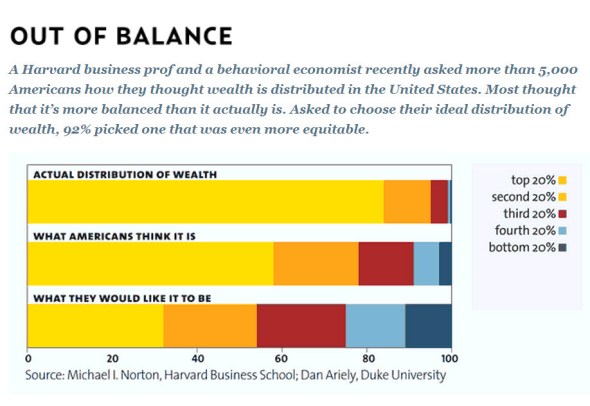
Chart from Mother Jones. And here’s a link to the paper this chart came from, Building a Better America – One Wealth Quintile at a Time (it’s quite short).
Is this a sensible comparison of cars and public transport?
Posted: February 23, 2011 Filed under: Cars & traffic, Public transport | Tags: accessibility, auto, Bendigo, car, Employment, Jobs, Melbourne 2030, Public transport, rail, Sunbury Leave a comment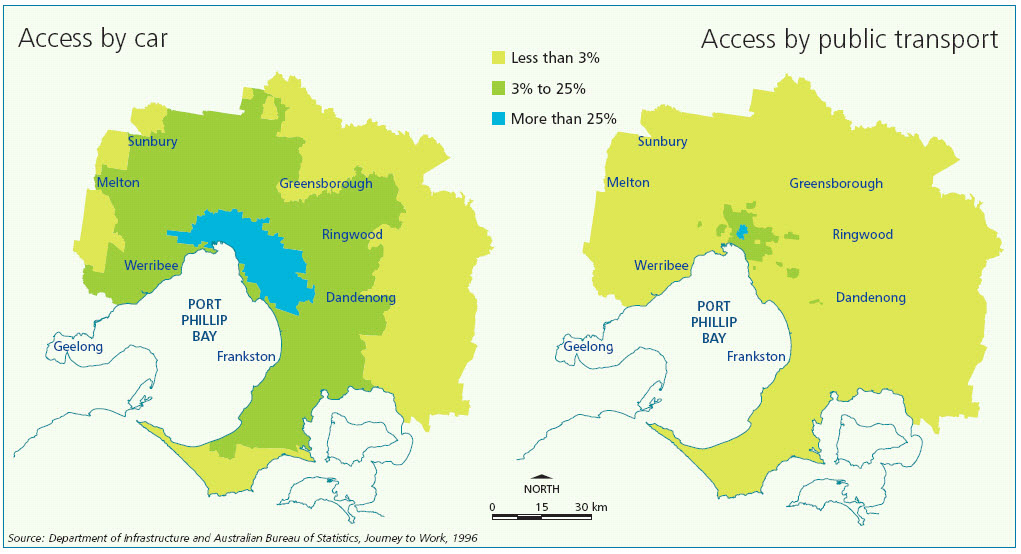
Many readers will have seen this now-ubiquitous chart before – it’s from Melbourne 2030 and has been republished countless times. It shows the proportion of metropolitan jobs accessible within 40 minutes travelling time from different parts of Melbourne by car and by public transport.
I’ve never been happy with this chart because its simplicity is deceptive – I don’t accept the implicit premise that public transport should be judged on the same basis as cars. I’ll come to that shortly, but first there are some technical shortcomings that need to be addressed.
One is that the chart doesn’t say how the data range intervals are determined – are they equal counts? Are they based on a ‘natural break’ in the way the data is distributed? It’s not possible to be confident that they portray the situation with either public transport or cars in as objective a way as possible.
Another shortcoming is that a mere three categories is very limiting. If you live in Sunbury (say), the chart says you can drive to between 3% and 25% of metropolitan jobs within 40 minutes. That’s an enormous range – a factor of more than eight between the lowest and highest values. It’s essentially a useless piece of information. And the maps give a misleading impression of how many Melburnians live in areas with the poorest accessibility. There are very large areas on the fringe that have a tiny population e.g. there is a 9 km wide greenbelt between Melton and Caroline Springs. Much of the outer north east is a catchment area.
Yet even with these technical flaws, there is some intriguing information. For example, the majority of the population can access no more than 2% of metropolitan jobs within 40 minutes travel by public transport. Read the rest of this entry »
Are our local shopping centres doomed by technology?
Posted: February 22, 2011 Filed under: Activity centres, Technology | Tags: borders, Crikey, e-commerce, Guy Rundle, shopping, supermarket 9 Comments
The geography of surnames in the US (click)
In an interesting article on Crikey, Guy Rundle riffs off the Borders bankruptcy to ask if technological change will inevitably destroy local strip shopping centres:
The whole centrality of the shop is changing. It is no longer a necessary place, and so the high street no longer acts as the spatial core of a community. At some point a whole series of mainstream shops will succumb to insufficient, intermittent demand. Everyone will want to know they are there, but no-one will use them enough.
Whether Borders succumbed to poor management, competition from e-commerce, the dead hand of the parallel importing restrictions, or the fall-off in consumer spending, there’s no question that the nature of shopping is changing profoundly.
For example, I bought my first lot of ten novels from Amazon back in 1994 and have purchased many more books from various on-line retailers since. Whenever I have the option, I now download e-books to read on my e-reader in preference to hard copies.
I started home-banking in 1994 and now visit the bank maybe four times a year max (I hate being paid by cheque!). My wife and I have bought so much stuff on eBay we have Turquoise Star status. The household increasingly downloads movies via T-Box rather than hire DVDs and all our music is purchased through iTunes. We book our travel on-line and even negotiated the purchase of a car over the net.
Guy Rundle foresees that these sorts of changes will extend to the local supermarket and beyond, driven by improvements in on-line ordering and home delivery. I expect that once the public has confidence the problems with e-commerce – like affordable and secure home delivery and safe payment systems – have been overcome, many people will surely choose to use their time for higher value activities than routine consumer shopping.
Mr Rundle fears that if the boring but essential services like supermarkets are lost to the high street, then specialist stores like bookshops that rely on passing trade from ‘anchor tenants’ will also go under. He says:
The wider question, in terms of future life, is how we will sustain any form of public spatial life at all – as the last shared, necessary space dissolves
I don’t think the high street is in any imminent danger. It’s likely to change but I doubt it will die. Not all the changes will necessarily be bad. Read the rest of this entry »
Is Melbourne the 2nd most liveable city in the world?
Posted: February 21, 2011 Filed under: Miscellaneous, Social and community | Tags: Economist Intelligence Unit, EIU, Global Liveability Report, Mercer, Property Council Australia 4 Comments
The Economist Intelligence Unit’s (EIU) 2011 Global Liveability Report says Melbourne is the 2nd most liveable city in the world, just behind Vancouver and up one place from 3rd last year. Sydney ranks 7th.
But any elation is likely to be short-lived. The Mercer Annual Quality of Living survey for 2011, due in late May, will very probably put Melbourne much further down the list. In Mercer’s 2009 and 2010 surveys, Melbourne slipped from 17th place to 18th place. Sydney ranked 10th in both years.
As I’ve pointed out before, these sorts of surveys shouldn’t be taken seriously as a guide to how liveable our cities really are. They have a number of shortcomings. Read the rest of this entry »
Will redevelopment of Fishermans Bend really be ‘revolutionary’?
Posted: February 19, 2011 Filed under: Planning | Tags: affordability, density, Docklands, Fishermans Bend, growth area, Housing, Inner city, Jennifer Cunich, Matthew Guy, Property Council Australia, UCB, Urban Growth Boundary 13 Comments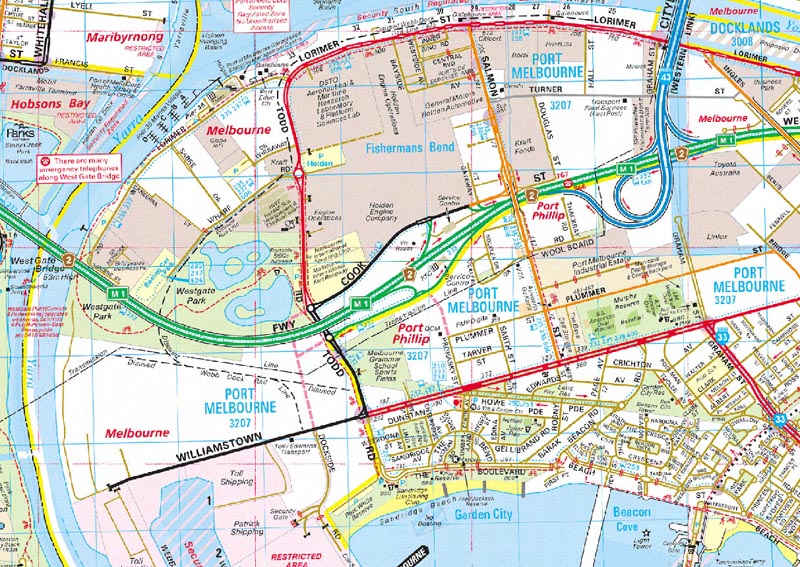 The Age breathlessly headlines the Government’s proposals for the redevelopment of Fishermans Bend as Premier Ted Baillieu’s “inner city housing revolution”. Planning Minister Matthew Guy says the area will evolve as ”Australia’s first inner-city growth corridor”.
Whoa there! I think it might be time for a relaxing cup of tea and a lie down. Let’s put these claims in perspective.
According to Mr Guy, the area under consideration is 200 Ha. That’s quite a bit smaller than the 41,000 Ha expansion of the Urban Growth Boundary approved last year.
Mr Guy also says the area is going to be developed over a 20-30 year time frame. If its total capacity is the 10,000 to 15,000 dwellings estimated by the Chief Executive of the Property Council, Jennifer Cunich, that’s at most 750 additional dwellings per year on average, and as few as 333 per year.
Just to put that in context, 42,509 dwellings were approved in the metropolitan area in the 12 months ending on 30 September 2010. Ms Cunich is quoted as saying even that’s less than we need – she says there’s a shortfall of 6,000 homes per year across the State.
While the redevelopment of Fishermans Bend is important, the claim that it’s a ‘revolution’ is hyperbole.
Likewise, the Minister’s claim that Fishermans Bend will be a ‘growth area’ – a term usually used to refer to massive outer suburban release areas – is more than a trifle exaggerated. Consider that 17,000 new dwellings were approved in Melbourne’s (outer) Growth Area municipalities in the year ending September Qtr 2010.
The Minister’s claim that the project will focus on “more affordable” housing also seems ambitious. Read the rest of this entry »
What can Sydney teach us about airport rail lines?
Posted: February 16, 2011 Filed under: Airports & aviation, Infrastructure, Public transport | Tags: ACCC, aviation, Melbourne airport, Public transport, rail, Sydney airport, train 30 Comments
Mode share (prepared by ACCC)
There is little doubt that Melbourne Airport needs action to improve land-side access for passengers arriving and departing from the airport.
Many observers argue the solution is a rail line from the CBD to the airport. I think there’s a much bigger picture they’re missing. They would be well advised to look at the Airport Monitoring Report 2009-10, just released by the ACCC (see chart).
It shows that only 39% of trips to Sydney Airport are made by private car (on-airport parking, rentals and kerbside drop-off), compared to 69% for Melbourne Airport. Since Sydney has a train and Melbourne doesn’t, it’s tempting to conclude that a train is the answer to Melbourne’s woes.
However the ACCC’s report says that more people travel to Melbourne Airport by public transport (14% – all by bus) than is the case for Sydney Airport (12% – train and bus).
A key difference between the two airports is that taxis (incl ‘mini buses’) are far more popular in Sydney, where they account for 49% of all airport trips. The comparable figure for Melbourne is just 17%.
Part of the reason for this difference is taxis are more competitive in Sydney against cars and against the train – Kingsford Smith is 8 km from the CBD and hence is relatively central. In contrast, Melbourne is 22 km from the CBD so taxis are not as competitive with either buses or cars (other reasons for the difference include more tourists at Sydney, as well as higher parking charges).
As I discussed last week, Brisbane’s airport – like Melbourne’s – is also located a considerable distance from the city centre. It might be that the location of both airports on the edge of their respective metropolitan areas – well away from the centre of gravity of population in both cities – is a key reason for their high private car use (and low taxi use).
Yet distance can’t be the whole explanation. The Brisbane airport train only captures 5% of trips and all up, public transport carries 8% of airport journeys. That’s considerably less than either Sydney or train-free Melbourne.
Given the experience of Sydney and Brisbane, it cannot simply be assumed that constructing a rail line from the CBD to Melbourne Airport will inevitably lead to a significant increase in public transport use – at the expense of cars – over and above the already substantial mode share enjoyed by buses. Read the rest of this entry »
Is this the way we’ll live next?
Posted: February 15, 2011 Filed under: Infrastructure, Public transport | Tags: aerotropolis, aircraft, airport, freight, Greg Lindsay, Lawrence D Kasarda, logistics, Tullamarine 6 Comments
Wivenhoe Dam, Qld, at 197% capacity, Jan 2011
The centre of the city of the future will be the airport, according to a book by John D Kasarda of the University of Carolina and journalist Greg Lindsay to be published next month.
They say in Aerotropolis (subtitled, to emphasise its inevitability, The Way We’ll Live Next), that “not so long ago, airports were built near cities, and roads connected the one to the other. This pattern—the city in the center, the airport on the periphery— shaped life in the twentieth century, from the central city to exurban sprawl”. But things, they say, have changed:
Today, the ubiquity of jet travel, round-the-clock workdays, overnight shipping, and global business networks has turned the pattern inside out. Soon the airport will be at the center and the city will be built around it, the better to keep workers, suppliers, executives, and goods in touch with the global market.
Soon the airport will be the centre of the city?!!! I am, to put it mildly, sceptical about this view of the future.
Yes, cities have almost always developed around transport infrastructure – first ports and rivers and more recently railheads and freeway nodes. Yes, local concentrations of economic activity have sprung up in various places to provide logistics services in close proximity to major airports, some of which are very large. And of course, as this preview of the book states, the share of high value freight carried by air is increasing at a much faster rate than trade generally.
Now if some marketer wants to start calling Melbourne airport and the surrounding area ‘Tullamarine Aerotropolis’ or something similar (‘Tullatropolis’?) that’s OK by me. It is after all one of the biggest concentrations of jobs in the suburbs of Melbourne and a fair number of those jobs are doubtless related in some way to aviation.
But arguing that the city of the future will “be built around the airport” is silly. Read the rest of this entry »
An animated map of Auckland’s public transport network
Posted: February 14, 2011 Filed under: Public transport | Tags: animation, Auckland, Chris McDowell, Flink Labs, Google Transit Feed McDowell, Public transport 2 Comments
Last year I linked to an animation of Melbourne’s trains system developed by Flink Labs. This one (click on map) shows a day in the life of public transport in Auckland and was developed by Chris McDowell. He says:
The animation begins at 3am on a typical Monday morning. A pair of blue squiggles depict the Airport buses shuttling late night travellers between the Downtown Ferry Terminal and Auckland International. From 5am, a skeleton service of local buses begins making trips from the outer suburbs to the inner city and the first ferry departs for Waiheke Island. Over the next few hours the volume and frequency of vehicles steadily increases until we reach peak morning rush hour. By 8am the city’s major transportation corridors are clearly delineated by a stream of buses filled with commuters. After 9am the volume of vehicles drops a little and stays steady until the schools get out and the evening commute begins. The animation ends at midnight with just a few night buses moving passengers away from the central city. Read the rest of this entry »
What’s good (and bad) about greater diversity?
Posted: February 13, 2011 Filed under: Planning, Social and community | Tags: Beyond 5 Million, Committee for Melbourne, Disconnected, diversity, Dr Andrew Leigh, ethnicity, Melbourne 2030, The cities we need, The Grattan Institute, Tiger Mother 6 Comments
High-level city objectives in The Grattan Institute's 'The cities we need'
A standard objective these days in high-level city strategic plans is greater diversity. It’s mentioned, for example, in Melbourne 2030, in the Committee for Melbourne’s Beyond 5 Million and in The Grattan Institute’s The Cities We Need (see graphic).
The Grattan Institute says diversity is important because “many economists think that mixing of ethnicity, age, culture and education is important for a modern knowledge economy, in order to stimulate and disperse ideas”.
But according to Dr Andrew Leigh, it’s not necessarily all mother’s milk, at least in relation to ethnic diversity (which is what most discussion of diversity in Australia is about). In his new book on social capital, Disconnected (which I’ve discussed before), he points out that there is a negative correlation between trust and ethnic diversity:
Residents of multi-racial neighbourhoods are more likely to agree that ‘you can’t be too careful in dealing with most Australians’. In particular, neighbourhoods where many languages are spoken tend have lower levels of trust…
This accords with the findings of a succession of studies of ethnic diversity in the US and other countries. We will have to work harder, Dr Leigh suggests, if we are to make Australia both diverse and high trust.
Let me emphasise that Dr Leigh, who is the new ALP member for Fraser in the ACT and until the last election was a Professor of economics at ANU, is a supporter of immigration:
A spate of studies suggest that continued high levels of immigration will most likely bring a raft of economic and social benefits to Australia. But we should not gild the lily. Most likely, higher diversity will lead to lower levels of interpersonal trust…..the challenge for policymakers is how to maintain the current levels of immigration while mitigating the impact on our social and political fabric.
But how do you mitigate that impact? Most city policy documents don’t even acknowledge that there might be potential downsides to ethnic diversity. Nor do they usually specify what the spatial dimension is, much less what specific policies ought to be pursued. Read the rest of this entry »
Is this one of the coolest things you’ve ever seen?
Posted: February 11, 2011 Filed under: Miscellaneous | Tags: Theo Jansen 2 Comments YES!!! This astounding video comes via The Atlantic. Coolest thing I’ve seen in a long time.
There’s more on Theo Jansen’s work here. He doesn’t seem to be an adherant of Charles Darwin, but his stuff is brilliant anyway.
H/T Nick Bastow
Does it pay to be the first-born if you’re a girl?
Posted: February 10, 2011 Filed under: Miscellaneous, Social and community | Tags: Donald Appleyard, Enrico Moretti, first-born, girls, Gordon Dahl, The Demand for Sons Leave a comment
Revisiting Donald Appleyard's liveable streets project in San Francisco in the early 70s
I’m gob-smacked by the findings of this paper, The Demand for Sons. No, it doesn’t pay to be the first-born in the family if you’re a girl, at least not in the US. Preference for sons is not limited to China and India.
The paper is by Gordon Dahl and Enrico Moretti from the University of California and was published in 2008 in The Review of Economic Studies.
They find that “first-born girls and their siblings are more likely to live in families where income is lower, the poverty rate is higher, welfare participation is higher, home ownership is lower, and child support payments following a divorce are lower”.
The authors ask this question: do parents in the US have preferences regarding the gender of their children and, if so, does this have negative consequences for daughters versus sons? Read the rest of this entry »
Is this story a beat-up?
Posted: February 9, 2011 Filed under: Public transport | Tags: East West Link Needs Assessment, Edward Dotson, Investing in Transport, Kenneth Davidson, Regional Rail Link, Sir Rod Eddington, Tarneit Link 3 Comments
A great song that really is about public transport (click to play)
Kenneth Davidson reckons the Regional Rail Link (RRL) is a “wasteful infrastructure investment” that hopefully will be cancelled in its entirety as a result of the Federal Government’s flood reconstruction cutbacks.
He bases this argument largely on a review prepared for the Government in 2008 by consultant transport planner Edward Dotson, who formerly worked for Melbourne’s public transport authority from 1983 to 1991.
Mr Dotson was commissioned to review four of the recommendations of the East West Link Needs Assessment study undertaken by Sir Rod Eddington. One of those recommendations relates directly to the RRL, a planned new rail line from West Werribee via Tarneit to Southern Cross Station (a.k.a the Tarneit Link).
Referring to Mr Dotson’s report, Mr Davidson says “his report was scathing. He described (the Eddington report) as a ‘pre-feasibility study’ whereas what was required was a full study that included engineering analysis, service planning (including timetabling), costing and public consultation”.
He says Dotson also recommended the examination of alternatives to the RRL, including using the existing Bunbury Street tunnel and running a new set of tracks alongside the existing line to Werribee rather than a new route through Tarneit. He goes on:
The RRL proposal looked as if it was set up to fail in the first place. On the basis of what the transport expert Dotson said, the Eddington report was a pre-feasibility study that hadn’t done the engineering studies in sufficient detail to come with cost estimates in the first place.
I hadn’t heard of the Dotson report so I tracked it down and had a look – you can read it too, here (It would also be a good idea to have a look at the Eddington report, here). There’re three things that struck me about this report. Read the rest of this entry »
Will a rail line stop high airport parking prices?
Posted: February 8, 2011 Filed under: Airports & aviation, Public transport | Tags: ACCC, Airport Monitoring Report, Australian Pacific Airports Corporation, Brisbane Airport, Melbourne airport, parking, Skybus, Skytrain 21 Comments
Passenger mode share for access to Brisbane and Melbourne airports (ACCC)
The ACCC has fingered Melbourne Airport for its monopolistic approach to parking. In its latest Airport Monitoring report, it accuses the operator of imposing excessive levies on private buses and limiting the service offering of off-airport parking establishments:
Excessive access levies could have the effect of shifting demand to on-airport parking and, consequently, allow the airport to increase car parking prices. These factors point to Melbourne Airport earning monopoly profits from its car parking operations.
The comments section of The Age’s story about the report is bubbling over with calls from outraged punters calling for a rail line to be built from the CBD in order to bust the monopoly power of the airport operator, Australia Pacific Airports Corporation.
Irrespective of the overall merits of building an airport rail link, I can’t see that it would have any more than a marginal impact on the airport’s parking policies. It might (or might not) be justified on other grounds, but a train is not really a substitute for parking.
Travellers who park at the airport are by definition residents of Melbourne and have access to a car. A rail line from the CBD is not going to be attractive when most trips made by residents – including business trips – either originate or terminate at home (or both). When you’re catching a 7:00 am flight you don’t usually catch the train into the office first. Likewise if your flight gets you back into town at 7:00 pm or later, most travellers go straight home.
Rail is not going to be an attractive alternative for the great bulk of the 99% of residents who live outside the CBD or the 92% who live outside the inner city. Rather than walk to their local station, take a train and then change onto the airport line, they’ll drive.
In many cases their employer (or the taxpayer!) is in any event paying for their airport parking. Read the rest of this entry »
Who’s buying homes on the fringe?
Posted: February 7, 2011 Filed under: Growth Areas, Housing | Tags: Cardinia, Casey, first home buyers, growth areas, Hume, investors, mcmansion, Melton, Oliver Hulme, renters, Whittlesea, Wyndham 1 Comment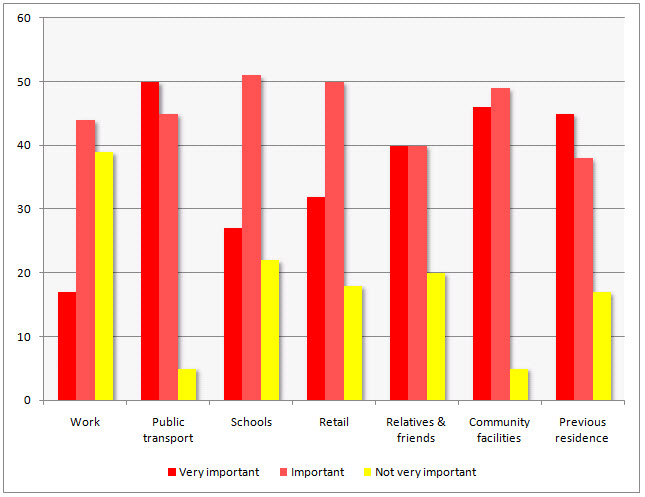
Importance of proximity to......(%)
If you think that home buyers in the fringe Growth Area LGAs are predominantly young renters buying their first McMansion, then think again.
A survey released today by property consultants Oliver Hulme profiles home buyers in the Growth Areas LGAs i.e. Wyndham, Melton, Hume, Whittlesea, Casey and Cardinia.
Given the brouhaha in The Age today over foreign investment on the fringe, the media might give attention to the finding that 23% of purchasers in these areas are investors. However it is not possible to deduce from the report how many of them live overseas.
But there are plenty of other interesting nuggets of information.
Rather than moving out of rental accommodation and into their first home, most fringe purchasers already own a house. Only 36% are first home buyers. Of the 64% who are ‘upgrading’ from an existing owner-occupied dwelling, a third are buying their third or fourth home.
It is therefore no surprise that the average buyer is not ‘starting out’ on the great suburban journey. Nearly half (48%) of adult buyers are aged 35 years or more. In fact 14% are aged 50 or more.
And while some bought large houses, almost three quarters (74%) purchased a single level dwelling. Moreover, 70% of homes are less than 30 squares and 47% are less than 26 squares. That suggests the great bulk of dwellings are roomy but they’re hardly McMansions. However, small dwellings don’t cut it – even though 12% of buyers are single, only 1% of dwellings are smaller than 15 squares.
Does density matter for mode share?
Posted: February 5, 2011 Filed under: Employment, Planning | Tags: average density, concentration, Employment, Jobs, Paul Mees, Population, Public transport, transit, weighted density 8 Comments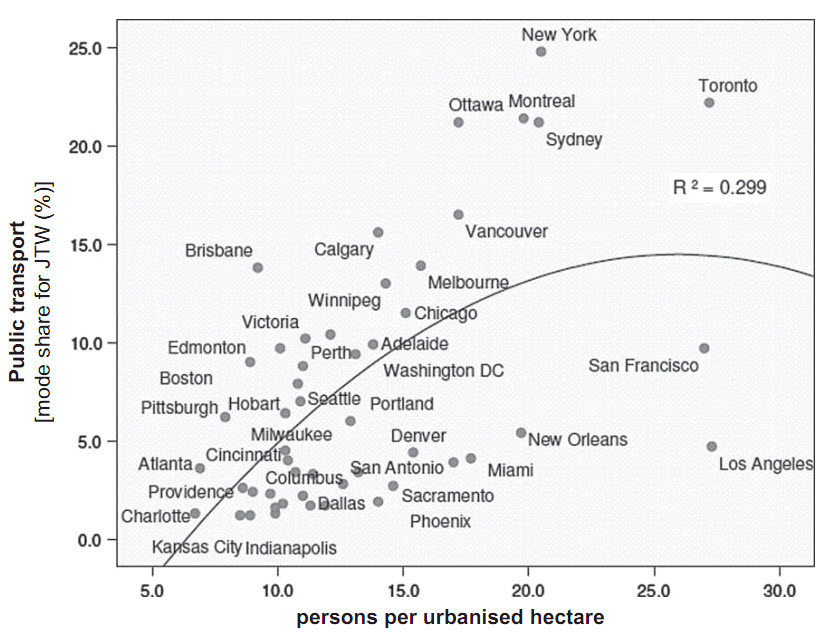
Mode share vs density (click to enlarge)
The accompanying chart shows how public transport’s share of the journey to work varies with population density across 41 US and Australian cities.
It is taken from the same article that I mentioned in my last post. The authors, Dr John Stone and Dr Paul Mees, find there is only a modest relationship between population density and transit share (R2 = 0.229). They conclude that “higher density across the whole urban region is not the explanatory variable that many might expect”.
Los Angeles, for example, is the densest metropolitan area in the US – denser ever than New York – yet the chart shows public transport’s share of work travel in LA is much smaller than in NY.
If that seems counter-intuitive, your intuition could be right. The chart uses average population density calculated across the entire urbanised area of each city.
While that’s perfectly alright in some contexts, it doesn’t allow for the possibility that public transport’s ability to win travel away from cars is related to the morphology of density – the ‘peaks and troughs’ in the way the population is spatially distributed. It’s possible that the relative proportion of population in high density areas vs low density areas has a greater impact on mode share.
Using average density probably won’t present a serious problem with cities like Atlanta, Austin, Dallas, Phoenix and Portland where the population is overwhelmingly suburbanised at relatively uniform (low) densities. But it could have a big impact on places like New York which have an extensive ring of low density suburbs as well as a high density central region e.g. Manhattan and Brooklyn.
A way of dealing with this issue is to use weighted density rather than average density. This involves weighting the density of each suburb (or other convenient geographical unit e.g. traffic zone) by its share of the city’s total population. So a one km2 suburb with 5,000 residents (say) carries a lot more weight than another suburb of the same area that has only 1,000 residents. Read the rest of this entry »
Will networking make public transport the mode of choice?
Posted: February 1, 2011 Filed under: Employment, Public transport | Tags: auto, car, CBD, density, John Stone, network, Paul Mees, Public transport, road pricing, suburbs, traffic congestion 9 Comments
What's the biggest danger?
According to a report in The Age last month, new research published in the latest issue of Australian Planner shows that higher suburban densities are not a precondition for vastly better public transport. Reporter Andrew West says:
City dwellers have been presented with a false choice – live in apartments and enjoy good public transport or retain the house and land and rely on cars
The research by Dr John Stone and Dr Paul Mees contends that it is not necessary to intensify land-use across the whole city before significant improvement in both patronage and economic efficiency of public transport becomes possible.
They say the contribution made by urban consolidation “to recent public transport patronage growth is modest and makes little impact on the density of the whole urban region”. Most residents of Australian cities will continue to live in houses and suburban subdivisions that are already built so “alternatives to the car will need to be effective at existing urban residential densities”.
They argue instead for a ‘networked’ model of public transport. Improving the way existing public transport resources are managed – especially by providing higher frequencies and improving coordination between services and between modes – will yield significantly higher transit patronage in the suburbs without the need for broadbrush increases in density.
I’ve argued before that increasing residential density, by itself, will not necessarily increase public transport patronage significantly, much less shift travellers out of their cars in large numbers.
I’ve also argued that there are generally better gains to be had from using existing resources more efficiently rather than relying on strategies based around huge new infrastructure investments or massive land use changes.
And I think the idea of networking public transport is absolutely critical. By embracing transfers, networking provides faster travel paths to all parts of the metropolitan area than is possible by radial routing.
However it’s not obvious to me that ‘networked’ public transport, by itself, would have the sort of major impact on mode share in the suburbs implied by The Age’s report. I can see that it would make public transport much better for existing users and I’ve no doubt it would increase patronage, but I’m not persuaded that it would be enough to address the ‘false choice’ that The Age says Melburnites have been presented with. Read the rest of this entry »
How liveable are our major cities?
Posted: January 30, 2011 Filed under: Miscellaneous, Planning | Tags: Adelaide, Brisbane, Liveability, Melbourne, Perth, Property Council Australia, Public transport, safety, security, Sydney, traffic congestion 15 Comments
How residents of our five largest cities (combined) see liveability
Adelaide is the most liveable capital city in Australia and Sydney is the least, according to a study released earlier this month by the Property Council of Australia.
The Australian reports that Sydney might have the harbour, Opera House and Bondi, but most Sydneysiders live a long way from these attractions in less salubrious places like Liverpool, Strathfield and Penrith.
The Property Council’s study is based on a national sample of 4,072 respondents in the nation’s eight capital cities (with around 600 in each of the four largest cities). They were given 17 attributes of liveability and asked, firstly, to rate them by importance and, secondly, to rate how well their cities perform on each of them. These two dimensions were then combined to produce a ‘liveability score’ for each city.
I’ve taken quite an interest in “liveability” in the past, especially as it relates to Sydney/Melbourne rivalry (e.g. here, here and here), so naturally I had a look at the study.
These sorts of surveys are often problematic and this one is no exception. For example, information on the representativeness of those who actually responded to the survey is scant and some of the attributes are sloppily conceptualised and poorly worded.
So with that caveat, let’s look at what the study found. The aggregate liveability scores of the eight capitals are probably the least useful aspect because the differences are small – Adelaide does best with 63.4 and Sydney does worst with 55.1. Third ranking Melbourne scores 60.9 but sixth ranking Brisbane scores 60.2. Put Sydney aside and there’s not enough in it to be useful.
What’s more interesting is how respondents define liveability. I’ve put the accompanying chart together to show how the five largest capital cities perform in aggregate i.e. Sydney, Melbourne, Brisbane, Perth, Adelaide (you won’t see this table in the Property Council’s report because I had to correct the figures in the Appendix to the report. Also, make sure to have a look at the full text of the questions).
The first column shows how important respondents think each attribute is for liveability (smaller is better). The second shows what proportion of respondents agree that their city exhibits this attribute. Read the rest of this entry »
A ‘best of the year’ list
Posted: December 22, 2010 Filed under: Miscellaneous | Tags: Lowy Institute, Melbourne Curious, Sam Roggeveen, The Interpreter Leave a comment
Melbourne - then and now (click)
The end of the year is always a great time for lists. As I’m not in a position this week to write anything more thoughtful than a drinks order, I’m just linking to interesting material. And there’s nothing more interesting than this great list, My blogs of the year, by the esteemed Sam Roggeveen, editor of The Interpreter at the Lowy Institute for International Policy. The first one’s a curious choice but the others look outstanding.
Speaking of curious, Gillian at Melbourne Curious has an interesting historical video of Melbourne as it used to be and as it is now. While you’re there, have a look around at items like this one on Melbourne’s old laneways and this one on Flinders Street station (gorgeous photo!).
O.K. I’ve turned on the snow flakes and the pilot’s honkin’ the horn. All the best for the Season!
How to make your PowerPoints really interesting
Posted: December 21, 2010 Filed under: Miscellaneous | Tags: BBC, Hans Rosling, The Joy of Stats Leave a comment Swedish international health researcher, Professor Hans Rosling, is famous for presenting data “with the drama and urgency of a sportcaster”. His reputation is built on extraordinary presentations like this one.
Now the BBC has produced a hologram version of one of his renowned presentations. It plots how life expectancy has improved in 200 countries over the last 200 years. The world’s not perfect but the improvement in average life span since 1810 is truly remarkable.
Click picture to view video.
Portland, OR – “where young people go to retire”
Posted: December 21, 2010 Filed under: Miscellaneous | Tags: Oregon, Portland, Portlandia 2 Comments They know a bit about city branding in Portland, Oregon, one of the darlings of new urbanism and one of my favourite places. This video is for a new TV comedy series, Portlandia, starting in January 2011 (in the US). It takes the mickey out of Portland and takes its name from a sculpture at the front of The Portland Building designed by Michael Graves.
Favourite quote: “Portland – where all the hot girls wear glasses”.
Click on picture to see video, Portlandia – Dream of the 90s.
 The Melbourne Urbanist