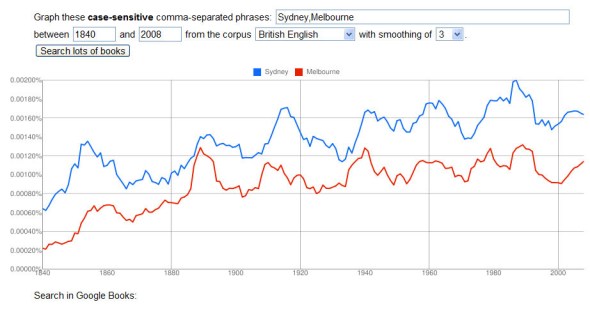
Google Ngram for: ‘Sydney’ vs ‘Melbourne’
Posted: December 19, 2010 Filed under: Miscellaneous | Tags: Melbourne, nGram, Sydney 1 CommentMelbourne almost rivalled Sydney circa 1890 – click to insert your own search terms. More on Ngram here.
Why do bankers make $squillions (and you don’t)?
Posted: December 16, 2010 Filed under: Miscellaneous | Tags: bankers, David Rumsey Maps, GFC, inequality, Kevin Drum, Marginal Revolution, Matt Yglesias, Ross Douthat, Ryan Avent, Tyler Cowen 5 Comments
Road pricing in London in the 18th century
There’s an interesting discussion going on in the blogosphere right now about how Wall St made and lost so much money in the noughties.
It started yesterday our time when George Mason University economist and ‘the world’s most read economics blogger’, Tyler Cowen, announced that he’d written an essay on inequality in The American Interest.
He makes some interesting points – for example, Americans are more likely to be envious of their better paid colleague or their slightly wealthier brother in law than they are of billionaires and financial high rollers. Nevertheless, he focuses on “the pernicious role that big finance plays in modern political economy”.
As I interpret it, his thesis is that the finance sector takes big but self-enriching risks in the good times because it relies on government bailing it out on the odd occasion when real disaster strikes. As Ross Douthat from the New York Times puts it:
The “bust” part of the cycle tends to make taxpayers suffer more than the Wall Street investors themselves, thus incentivizing further recklessness and still worse crack-ups down the road
By this morning (Thursday), the debate has been joined by an army of influential pundits, including Ross Douthat, Ryan Avent from The Economist, Kevin Drum from Mother Jones and political blogger Matthew Yglesias. By the time you read this it is likely there will be many more. Read the rest of this entry »
What’s the angle with Fishermans Bend?
Posted: December 14, 2010 Filed under: Housing, Planning | Tags: city centre, e-Gate, Fishermans Bend, high density housing, Kenneth Davidson, LA Live, Matthew Guy, Melbourne City Council, urban renewal 7 Comments
LA Live entertainment complex
The Minister for Planning, Matthew Guy, is reported as saying that rather than “sprinkle high density housing across Melbourne”, the new Government will give priority to strategic developments on specific sites close to the CBD.
Mr Guy has already moved to water down the former government’s planning laws encouraging higher density residential developments (i.e. over three storeys) along public transport corridors.
He says the focus of urban renewal in future will be on locations like Fishermans Bend, the 20 hectare E-Gate site just off Footscray Road, and the area around Richmond station.
This is surprisingly reminiscent of Kenneth Davidson’s prescription for Melbourne. However unlike the Minister, who is moving to increase land supply in the Growth Areas as well, Mr Davidson sees major urban renewal projects as providing enough land to obviate the need for further fringe development.
Facilitating urban renewal in areas close to the city centre is a good thing. But it’s a big call to put all your higher density eggs in one basket when Melbourne’s population is projected to grow by 1.8 million between 2006 and 2036. According to The Age, Mr Guy doesn’t want higher density development in that part of the city that lies beyond the city centre i.e. virtually all of Melbourne*.
I’m not sure the potential of the brownfields basket is as great as Messrs Guy and Davidson imagine. Here are some constraints that individually might be a mere difficulty but collectively amount to a major impediment. Read the rest of this entry »
Do more fast food restaurants make the locals fat?
Posted: December 13, 2010 Filed under: Education, justice, health | Tags: Anderson and Matsa, calories, fast food, fat tax, obesity, public health, restaurants 9 Comments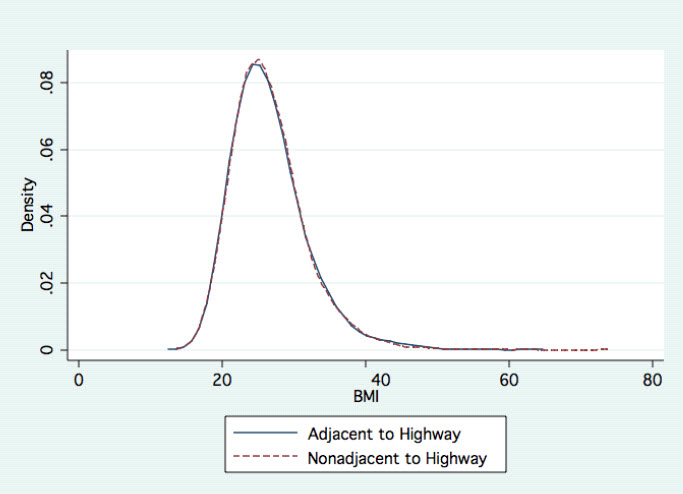
Distribution of BMI for people living in US towns adjacent and non adjacent to interstate highways (note there are 2 curves)
It’s commonly taken for granted that a disproportionately large number of fast food stores in an area is a key reason why the local population often has high rates of obesity.
The California Centre for Public Health Advocacy, for example, argues that “there is growing scientific evidence that what people eat—and their likelihood of being obese—is influenced by the food environment in which they live”.
More people are going to fast food restaurants where the food is high in calories and portions are large. Many respectable studies have shown a clear correlation between average body weight and eating out. According to one, growth in the number of restaurants accounts for as much as 65% of the rise in the percentage of Americans who are obese.
Various policies have been proposed to break the evident connection between fast food restaurants and obesity. These include proposals to limit the number of fast-food restaurants, ‘fat taxes’, limits on fast food advertising and mandatory calorie counts on menus.
But do fast food restaurants really cause obesity? As with many things, appearances may be deceiving. Correlation doesn’t mean causation.
This study, Are Restaurants Really Supersizing America?, by UC Berkeley researchers Michael Anderson and David Matsa, poses this question: “do more restaurants cause obesity or do preferences for greater food consumption lead to an increase in restaurant density?”. Read the rest of this entry »
Will Rowville be a Clayton(s) rail line?
Posted: December 11, 2010 Filed under: Activity centres, Employment, Public transport | Tags: airport, Avalon, CAD, Central Activities Districts, Doncaster, Huntingdale station, Monash Medical Centre, Monash University, rail line, Rowville, Ted Baillieu, Terry Mulder, Waverley Park 9 Comments
Size of Clayton/Monash precinct (jobs) relative to the six designated suburban CADs
Sooner rather than later, the Baillieu Government is going to have to prove its credibility on public transport by making substantial progress on one of the rail lines it has promised. And I have an idea for where it should start.
The easiest candidate is the promised Avalon rail line because its cost is estimated at only $250 million. But as some commentators have pointed out, including me, this would almost inevitably be a jumbo white elephant. It could be a real political liability too.
If good sense prevails, the Federal Government will refuse to contribute to the project and the Government will be off the hook. The private operator might also refuse to contribute to a properly designed financial model.
The other promised rail lines – to Rowville, Doncaster and Melbourne Airport – are all subject to studies. They will all be very costly to build to an acceptable standard but it’s unlikely the electorate will be bothered by the fine print or the cost. It’s likely that as far as they’re concerned, a ‘promise’ is a promise.
I’ve indicated before that none of these lines, on the face of it, seem ready for the green light just yet (here, here and here). Unless new information is introduced or the projects are redefined, it seems to me that any objective study would have to conclude they won’t be ready for funding for some time, probably not until after 2020 (it wouldn’t be politic for any government to come out and say ‘no’ outright).
But I think the Government will have to show serious progress on at least one of these lines by the time of the next election. In my view, the preferred candidate should be the Rowville line, but in an amended form. Read the rest of this entry »
Are there multiple ‘Melbournes’?
Posted: December 9, 2010 Filed under: Cars & traffic, Planning, Public transport | Tags: Brimbank, Cardinia, Casey, home range, municipalities, regions, travel time, trip distance 5 Comments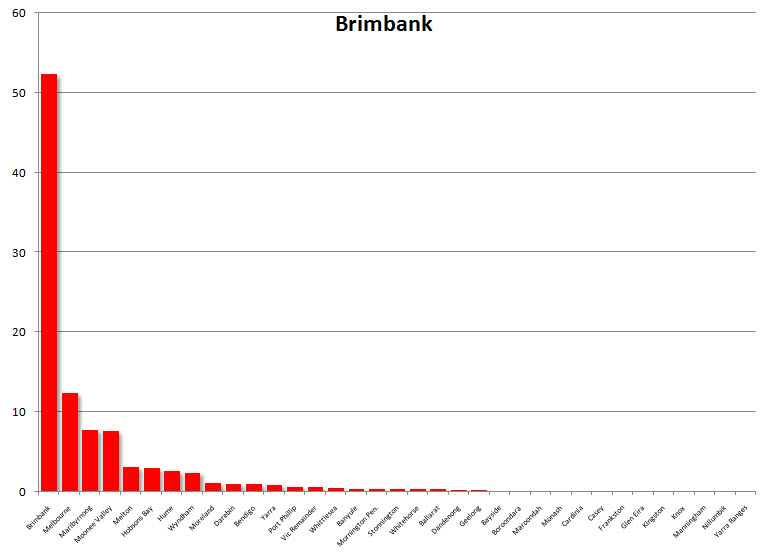
Where residents of Brimbank travel to (%)
The stereotype of people travelling long distances in Australian cities is wrong but persistent. The reality is that most trips are relatively close to home.
For example, the accompanying chart and map show that 52% of all weekday trips (all purposes, all modes) by residents of the middle suburban municipality of Brimbank in Melbourne’s west are made within the municipality. Further, 79% of trips are made either within Brimbank or to contiguous municipalities.
In fact more than 90% of trips by Brimbank residents can be accounted for if just one more destination – the city centre – is added to the list above.
This pattern also holds for the other parts of Melbourne.
More than 80% of trips by residents of Monash, Cardinia and Casey, for example, are likewise made within their home municipality or to neighbouring ones.
While another 8% of trips by Monash residents are to the city centre, the corresponding figure is less for far-flung municipalities – just 4% for Casey and less than 1% for Cardinia (see more charts below).
 It thus makes sense to think of a city like Melbourne as a number of regions rather than as a very big, singular entity. In terms of what people physically do within the urban area, there are multiple ‘Melbournes’.
Each little ‘Melbourne’ or region is centred on a home LGA and has a limited ‘home range’. The median weekday trip distance (all purposes, all modes) for residents of Cardinia is 3.7 km. Monash is 4.9 km and Brimbank is 6.3 km.
For the great bulk of residents, metropolitan Melbourne is more of a construct – an idea – than something that has a real presence in their day-to-day lives. With the exception of the city centre, few people venture much beyond their own region.
This limited ‘home range’ is a product of many forces. In the case of the inner city municipalities – Melbourne, Yarra and Port Phillip – the predominance of professional jobs and social attractions in the city centre is an obvious and powerful factor. The median weekday trip distance for residents of Yarra is 2.8 km.
For the great bulk of the population who live in the suburbs, the factors explaining this limited geography would include the suburbanisation of jobs (more than 80% of jobs in metropolitan Melbourne are outside the CBD), slower travel speeds on roads due to increasing traffic and the desire to live close to family and friends.
It’s natural therefore to emphasise the importance of regions and devise typologies like The Age uses in its real estate pages e.g. inner east, outer east. But that assumes a community of interest at the regional level. And it assumes it can be defined within fixed boundaries. Read the rest of this entry »
What’s wrong with cars?
Posted: December 8, 2010 Filed under: Cars & traffic | Tags: automobile, Bern Grush, Overcoming Global Gridlock, road pricing, Skymeter, tolling, Toronto 4 Comments
One of the key themes of The Melbourne Urbanist is the need to price road space. Cars will be with us in one form or another for a long time yet, whether we like it or not. Autonomous travel provides enormous benefits but cars also have a dark side, so they can’t just be ignored.
I’m therefore pleased that Bern Grush from Skymeter, a Toronto company specialising in road use metering technology, has given me permission to publish the stylishly written Preface from his forthcoming book, (tentatively titled) Overcoming Global Gridlock.
The book is about the need for road pricing and how it can be achieved. Here he lays out the issues and challenges with the car. But a warning – this is not the standard anti-car diatribe you’ve read countless times before. He’s actually pro-car although, as he puts it, in a balanced way. Read on:
Overcoming Global Gridlock – Preface
“We have reached a crisis point with cars and trucks. We face mounting congestion. We need to reduce both emissions and oil consumption pretty much everywhere. In many countries funding for road building and maintenance is becoming ever harder to sustain. All the while, demand for personal mobility and goods movement continues to expand. And there is little to indicate many people are willing to give up the private vehicle.
If the autonomous vehicle has so many problems stacked against it, but demand for it is increasing, you can see that something has to give. This is predicted for the coming decade or two.
Cars are important to us. Judging by their use and abuse, the mile-for-mile preference we have for them over other forms of mobility, the growth in their numbers, the increasing number of vehicle miles travelled each year and a hundred other indicators, it is the car we are addicted to rather than oil. Oil is just one symptom. Most of the sustainability problem as it is now will survive the end of oil.
We can list a lot of bad things about our cars, but there are also a lot of good things. Perhaps the good outweighs the bad – I, for one, think that it does. There are a lot of reasons we have so many cars and there are many solutions offered to deal with their overwhelming ubiquity. We needn’t review those things here. You already have an opinion. You already like or dislike cars. I am probably unable to change your mind. You already have a car (or two) or wish you had one. Or perhaps you have even managed to get rid of yours. Or not yet. Read the rest of this entry »
Is Melbourne 2030 achieving its objectives on housing?
Posted: December 7, 2010 Filed under: Activity centres, Growth Areas, Planning | Tags: Activity centres, AHURI, construction, Housing, Melbourne 2030, RMIT Research Centre, Robin Goodman 8 Comments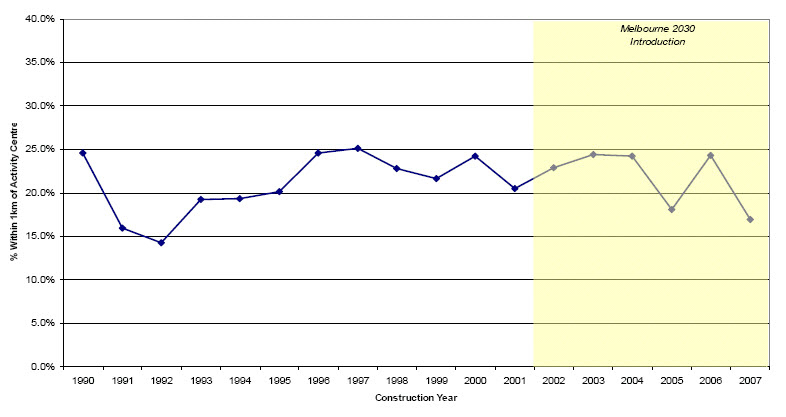
Percentage of new dwelling construction within 1km of a principal or major activity centre
A new research paper suggests that many of Melbourne 2030’s key ambitions in relation to housing have come to nought.
The paper, Planning and the characteristics of housing supply in Melbourne, was written by Dr Robin Goodman and a team of fellow academics from the RMIT Research Centre and published by the Australian Housing and Urban Research Institute (AHURI).
The first part of the project analysed a number of data bases on land transactions over the period from 1990 to 2007.
Contrary to the aspiration of Melbourne 2030, the researchers found that the proportion of new housing located within one kilometre of an activity centre did not increase following the promulgation of the Strategy.
In fact activity centres are not generally a favoured location for new housing. Of the 115 studied, just four account for almost a third of all housing built within one kilometre. Those four are all very close to the city centre – South Melbourne, Melbourne (CBD), Port Melbourne (Bay St) and Carlton (Lygon St). The ten with the highest proportion of new housing were either close to the CBD or in new parts of Growth Areas where developable land was still available close to activity centres.
When the radius is extended to two kilometres, the researchers found that the proportion of new housing actually declined since Melbourne 2030 was released.
They found a similar pattern with rail stations – the proportion of dwellings built within a one kilometre radius of a train station declined after Melbourne 2030 came into effect.
In addition, the delay between acquisition of property by a developer and completion of construction is more protracted on parcels that are closer to activity centres. Read the rest of this entry »
Will Melbourne be like Watts (L.A.) in 1965?
Posted: December 6, 2010 Filed under: Planning | Tags: Activity centres, developers, Kenneth Davidson, urban fringe, Urban Growth Boundary, Watts riots 1965 6 Comments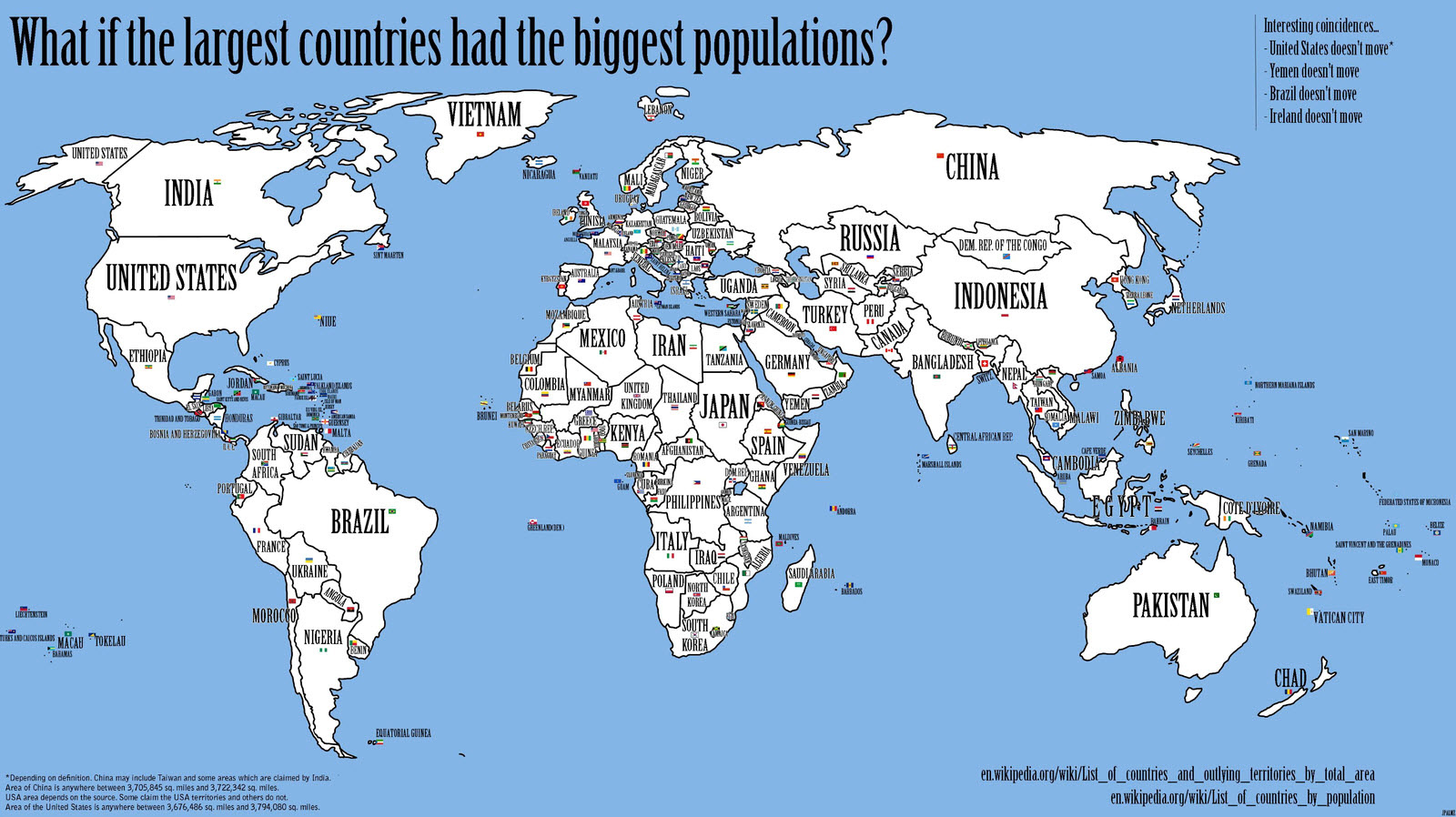
What if the geographically most extensive countries had the biggest populations?
Journalist Kenneth Davidson is often quite sensible so I’m astonished to see him arguing that Melbourne’s planning system is creating a potentially explosive situation like the 1965 riots in Watts, Los Angeles.
In fact there are a number of contentious propositions and assumptions in his column in The Age (6/12/10), Planning must be for people not developers.
He argues that Victoria’s planning system is dominated by developers and is effectively creating two cities in Melbourne – the inner city and the fringe suburbs – with citizens divided by geography as well as class.
Now there’s no doubt there are clear geographical differences by social class across Melbourne – there’s nothing new about that – but invoking the spectre of the Watts riots of 1965 seems a bit excessive. They were a reaction by the black community to racial injustices, including severe police brutality and entrenched job and housing discrimination. More than a thousand people were injured and 34 died. The Watts riots were different by orders of magnitude to Sydney’s 2005 Macquarie Fields riots or the 2004 Redfern riots.
Mr Davidson seems intent on sheeting home almost every planning issue in Melbourne to greedy developers. I accept the argument that speculation and lack of competition are issues in the Growth Areas, but there’s much more to the “two cities” phenomenon than that. Read the rest of this entry »
Did poor public transport give Baillieu the election?
Posted: December 4, 2010 Filed under: Public transport | Tags: Election Victoria 2010, electorates, Frankston line, punctuality, rail, swing, trains Leave a comment
Seats won by Coalition (dark blue)
Now that the dust has settled, there seems to be a solid consensus in many quarters that public transport was the key factor in the demise of the Brumby Government. There’s no doubt it was important, but perhaps it wasn’t as significant as assumed.
The most frequently cited example involves the loss of four seats in particular – Bentleigh, Mordialloc, Carrum and Frankston – which neatly follow the path of the Frankston rail line. See the first chart (dark blue seats were won by the Coalition from Labor).
Frankston is the least punctual line in Melbourne, with only 71.2% of trains running on time (i.e. within 5 minutes of the scheduled time) over the 12 months to September, with a low of 62.6% in May. In fact these appalling statistics gild the lily – conditions on all lines are far worse than the official figures indicate.
As I pointed out back in July, train punctuality is measured over a 24 hour period, whereas the great bulk of passengers travel in the peak. Most delays occur in the peak because the headway between trains is considerably shorter than in the off peak and there is therefore much less margin for error.
Thus the way punctuality is measured does not describe accurately the experience of most passengers because it measures the proportion of trains delayed, not the proportion of passengers delayed. Peak period punctuality on the Frankston line in May must have been truly shocking. It should consequently surprise no one that trains were a serious issue in these electorates.
Yet Labor did not lose any electorates north of the Yarra even though, for example, punctuality averaged only 78.4% on the Werribee line over the last year and fell as low as 70.4% in March. Nor did Labor lose any electorates on the Pakenham line which, with a 12 month on-time average of just 72.5% and a low point of 63% in March, rivals the Frankston line for poor punctuality. Read the rest of this entry »
Is Victoria’s new public transport authority just the beginning?
Posted: December 2, 2010 Filed under: Public transport | Tags: management arrangements, Minister for Public Transport and Roads, Ted Baillieu, Terry Mulder, Victoria, Victorian Public Transport Development Authority 10 CommentsEstablishing the Victorian Public Transport Development Authority before Christmas is a smart move by the new Government. Such early action signals its commitment to tackling the problems with public transport.
But the Premier and the Minister for Public Transport should not get too carried away – as so many others have – with the idea that changing management arrangements is the silver bullet we’ve been waiting for.

Setting up the new authority is neither a sufficient nor even a necessary condition for addressing the problems of public transport. What matters above all else is getting the right leadership, the right policies, the right resources and the right people.
The people aspect is by and large the least problematic area for improvement. Of course there are exceptions, but the great bulk of senior public servants across Australia at both Federal and State level are intelligent, committed, practical and hard working executives.
It should be no surprise to anyone that the weak link in the quality of public administration in Australia isn’t usually the public servants but rather the politicians. As clever as it was, I think the TV series, Yes Minister, did public administration a great disservice by portraying the public service as self interested and manipulative – and politicians as hapless and dim witted.
Why is public transport patronage increasing?
Posted: December 1, 2010 Filed under: Public transport | Tags: Brisbane, patronage, Perth, petrol price, population growth, Public transport, South East Qld, Sydney, traffic congestion 9 Comments
Public transport patronage growth in Australian cities (chart by Chris Loader)
As the accompanying chart shows, public transport patronage has grown sharply in some of Australia’s capitals this past decade but the rate of growth has generally slowed significantly over the last 18 months.
We’re accustomed to thinking that growth in patronage is driven by higher petrol prices but the chart indicates the explanation is probably more complex.
In particular, the considerable differences between cities suggest that one single factor is unlikely to provide a satisfactory explanation. Patronage grew spectacularly in South East Qld, Perth and Melbourne, but was modest in Greater Sydney and unremarkable elsewhere.
It needs to be borne in mind that all of this growth is from a relatively small base. For example, public transport’s share of all motorised travel (weekday and weekend) in Melbourne is even now only around 11%. This is only slightly lower than Sydney’s. Perth is likely to be only around half Melbourne’s level and Brisbane somewhere in between.
The usual suspect when looking at increasing public transport patronage is higher petrol prices. However if that were the key factor we’d expect a more uniform pattern of growth across cities. Canberra has one of the highest levels of car use of all capitals, yet public transport patronage in the nation’s capital barely moved over the period. The same is true of rising traffic congestion. Sydney would have to figure much more prominently if this were the key driver. Read the rest of this entry »
Does being a locavore add up?
Posted: November 30, 2010 Filed under: Education, justice, health, Energy & GHG, Planning | Tags: agriculture, food miles, locavore 7 Comments
"It gets better" - Pixar shows why it would be a great place to work (click)
As I’ve argued before (here) there are a number of reasons why buying food locally is probably the least sustainable basis on which to base your food buying preferences.
First, transport is only a small component of the total carbon emissions from agriculture.
Second, most food can’t be grown locally without resorting to potentially environmentally damaging practices like excessive application of fertiliser, irrigation or artificial heating of greenhouses.
Third, even where the local area is suitable for growing certain foods, it might not be the most environmentally efficient location for a particular food.
Fourth, producers in more distant locations might have superior farming practices to local growers. Fifth, the environmental and economic cost of moving people is higher than the cost of transporting their food.
Now Stephen Budiansky has assembled an array of interesting factoids in this NY Times oped, Math lessons for locavores, to show the folly of being a locavore. He’s a stylish writer so you might want to read the full article; otherwise here are a few key quotes:
- “Whether it’s grown in California or Maine, or whether it’s organic or conventional, about 5,000 calories of energy go into one pound of lettuce. Given how efficient trains and tractor-trailers are, shipping a head of lettuce across the country actually adds next to nothing to the total energy bill. Read the rest of this entry »
Where will the money come from?
Posted: November 30, 2010 Filed under: Infrastructure | Tags: debt, Infrastructure, Lateral Economics, Nicholas Gruen, PPP, Public Private Partnerships 3 Comments
Melbourne & Ballarat trams in the 60s (click)
According to Paul Austin in The Age (29/11/10), there’s little doubt that infrastructure inadequacies weighed heavily on voters’ minds in last Saturday’s election. His list of problems includes overcrowded trains, congested roads, the Myki debacle and long hospital waiting lists.
The pressure to “fix” these problems from voters in the eastern suburbs and sandbelt electorates that fell to the Coalition on Saturday will be immense.
The new Premier, Mr Baillieu, might therefore find it worthwhile to look at this report on public sector borrowing by Dr Nicholas Gruen (summary here).
Dr Gruen contends that governments in Australia have focussed on the cost of debt but have ignored the benefits. They’ve reduced the budget deficit to zero but exchanged it for an infrastructure deficit. Their constituents have saved on debt repayments, but:
they are paying inflated tolls on roads and heavy mortgage repayments that reflect the lack of land release and the loading of infrastructure charges onto the land that has been released. And they are paying with their time as they wait at peak hour in traffic that has slowed to a crawl or crowd into late trains and buses.
Thanks to the culture of strict fiscal rectitude that dominates modern government thinking, new debt has been kept off the government’s balance sheet by funding infrastructure in other ways – partly through asset sell-offs but mostly via Public Private Partnerships (PPPs). Read the rest of this entry »
What is the inner city?
Posted: November 28, 2010 Filed under: Planning | Tags: Brisbane, definition, density, Employment, history, Inner city, Jobs 7 Comments We all use the term “inner city” but I doubt we’re all talking about the same geographical area.
For some people, the inner city means the area where cafe society thrives – probably a 10 km circle around the CBD in cities like Sydney and Melbourne. Or it might mean the extent of medium density historic terrace housing.
Some Brisbanites think of the inner city as the large area covered by the Brisbane City Council (1,367 km2) while some Melburnians think of it as the area serviced by tram lines.
Planners have addressed this problem by adopting simple measures. For example, in Melbourne the inner city is customarily defined as the area covered by the central municipalities of Melbourne, Yarra and Port Phillip (77 km2). Sometimes the Prahran portion (SLA) of the City of Stonnington is also included.
In my work on Melbourne I define the inner city as the area (79 km2) within a 5 km radius of the City Hall . This approximates closely to the three inner municipalities, but I use it because it’s consistent with what’s done elsewhere. US researchers typically use a 3 mile radius to define the inner city – an area approximating the size of the central Counties of the larger metros.
There are a number of problems with this sort of ‘administrative’ approach. A key one is that there is no underlying rationale for where the boundary is drawn – why not 2 km or 10 km? Another is that it doesn’t really connect with people because it has no obvious reference like, say, the tram network. Read the rest of this entry »
Does commuting erode social capital?
Posted: November 25, 2010 Filed under: Social and community | Tags: andrew leigh, commuting time, Disconnected, HILDA 17 Comments
(click) John Faine interviews Pallas (ALP), Mees (Greens) and Mulder (Lib) on 774. 'Spirited' exchange between Faine and Mees at circa 29.00
In his new book, Disconnected, Dr Andrew Leigh argues that social capital, defined as the level of trust and reciprocity between people, has declined in Australia. I’m not convinced, however, that one of the culprits he fingers for this loss is guilty.
Several measures indicate social capital is on the wane – organisational membership, church attendance, political party membership, union membership, sporting participation, cultural attendance and volunteering.
Dr Leigh identifies seven key causes of this decline: long working hours, the feminisation of the workplace, television, ethnic diversity, impersonal technologies, tipping points and car commuting.
I want to look at his argument on car commuting, which I briefly alluded to once before.
He says that time spent commuting is bad for social capital because it is time not spent with family, community and friends:
Commuters are less likely to be active members of sporting clubs or community organisations. And commuting can affect family life: one in five men who works full-time spends more hours commuting than with his children
It is also negative for social capital because most commuting is done alone. Moreover, “being stuck in traffic for 45 minutes a day inevitably means a spate of small annoyances…..taken individually these are minor annoyances but as they add up, driver frustration can lead us to form an increasingly hostile view of our fellow Australians”. Read the rest of this entry »
What costs society more – cars or public transport?
Posted: November 24, 2010 Filed under: Cars & traffic | Tags: emissions, externalities, Garry Glazebrook, parking, Public transport, social cost, transit, transport modes, transport subsidy 9 Comments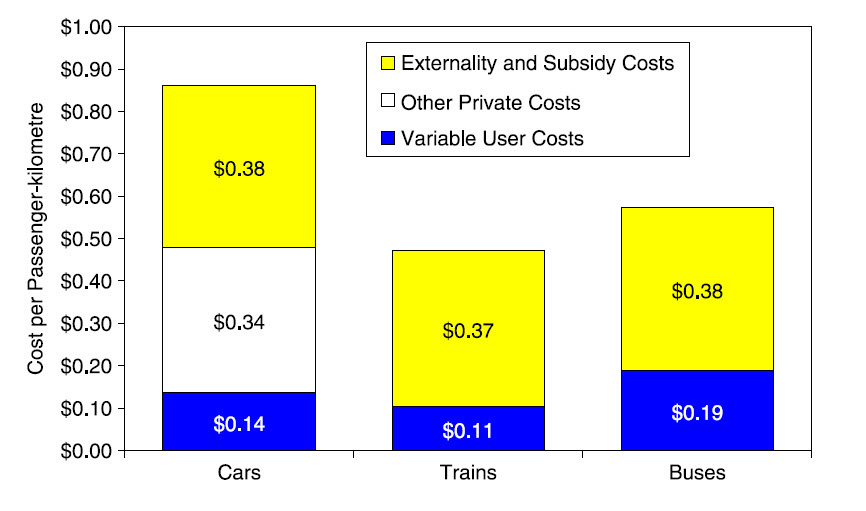
Cost per passenger km by mode in Sydney
This simple but extraordinary chart (see first graphic) is from a paper written last year by one of the country’s leading transport researchers, Dr Garry Glazebrook, of Sydney’s University of Technology.
In the paper, the author estimates the total cost of different transport modes, taking account of both private and social (i.e. external) costs. The costs are based on Sydney.
A number of interesting things about travel are evident from the chart, some of which are familiar and some which may surprise.
First, both private and public transport modes generate significant social costs. These costs are borne generally by society, “either in the form of subsidies (e.g. rail and bus subsidies from government, or hidden parking subsidies for car users) or in the form of externalities (including pollution, congestion, accidents, etc)”.
Second, although their composition is quite different, the social costs of private and public transport are essentially the same, at around 38c per passenger kilometre. One big difference of course is that subsidies for public transport are paid in actual dollars by government whereas the social costs of cars are largely an unpaid burden on others (primarily other road users). Read the rest of this entry »
What’s a new rail line worth?
Posted: November 23, 2010 Filed under: Social and community | Tags: Avalon Airport, Carol Nader, disabilities, election, opportunity cost, rail, Ted Baillieu, Victoria 21 Comments
This is hilarious! (click) Men in Suits choir - Metro Trains Melbourne Regrets...
One way to answer this question is to consider what else the money could be spent on.
One possibility is the 1,235 people with disabilities in Victoria who, according to this article, are registered with the Department of Human Services for supported accommodation.
One of them is David Graham, a 44 year old who is legally blind, has an intellectual disability and suffers from epilepsy. Last month his 70 year old mother died of cancer. She had looked after him all his life since he was born premature at 24 weeks. Now Mr Graham is on the waiting list for supported accommodation.
Mr Graham’s plight illustrates the importance of opportunity cost, something I’ve banged on about here at length. In plain terms, when you spend money it refers to what else you could have spent the money on i.e. the opportunities you’re foregoing.
The writer of the article, Carol Nader, refers specifically to the $50 million that Ted Baillieu promised he would spend in his first term to commence building a rail line from the CBD to Avalon Airport. The full cost would be $250 million.
She implies that $50 million could instead be spent on something else, like supported accommodation for people with disabilities. It costs $1.5 million on average she says to provide a unit for five residents and an average annual cost of $125,000 to support each resident. Read the rest of this entry »
Why did Melbourne 2030 fail?
Posted: November 22, 2010 Filed under: Planning | Tags: Brownfields, Challenge Melbourne, Decentralisation, empty nesters, growth areas, Infrastructure, Melbourne 2030, Oliver Hulme, peri-urban 6 Comments
(click) Heaps of parking in central Paris in 1976!
The Age editorialises (21/11/10) that Melbourne 2030 is effectively dead and I agree. The latest nail in the coffin in The Age’s opinion is the apparently burgeoning growth of housing in townships and hamlets located in the peri urban area outside the Urban Growth Boundary (UGB).
I’ve argued before that this sort of “decentralisation” is poor policy (e.g. here and here). But I also think The Age has tended to ‘catastrophise’ the scale of the problem, especially with its highly misleading contention that Melbourne has “sprawled 50% beyond the official growth boundary, spanning 150 kilometres from east to west”.
However what interests me at the moment is why Melbourne 2030 failed. The key reason in my view is that it blithely assumed that enough affordable dwellings – mostly town houses and apartments – could be provided within the established urban areas to avoid the need for the UGB to be extended.
This objective was never realistic for a number of reasons. Read the rest of this entry »
 The Melbourne Urbanist
Merry Xmas (and some reflections on the blog)
Posted: December 15, 2010 | Author: Alan Davies | Filed under: Miscellaneous | Tags: andrew leigh, blog, blogging, comments, posts, reads, views, Wordpress | 12 CommentsIrish finance expert explains (robustly!) where the Celtic Tiger went wrong
It’s time for The Melbourne Urbanist to start winding down for the holiday season. After this week, posts will flow to a trickle or even peter out while I take a holiday.
The Melbourne Urbanist has now been going for over nine months so it’s timely to pause for a moment and take stock.
The blog now gets around 2,500 ‘views’ each week. WordPress, who provide the blogging platform, say this count excludes automated searches. The busiest month was November, with 10,721 views and the trend continues upwards. That’s not quite up there with the likes of NineMSN, but I think it’s pretty respectable for a blog with a defined topic and relatively narrow geographic ambit.
It compares well with some other blogs – for example, former ANU economics professor (and now Federal MP) Andrew Leigh, who’s been blogging daily since 2004, says he gets similar numbers. It seems many of the topics addressed by The Melbourne Urbanist “travel well” – they have a reasonably broad appeal.
About a third of views are of the home page where visitors presumably scroll down and scan the first part of each post. However I measure the popularity of each individual post by the number of ‘reads’ i.e. the number of readers who click through to “read the rest of this entry”. I interpret this to mean the reader was interested enough to keep going. Read the rest of this entry »