London in the time of cholera
Posted: June 24, 2010 Filed under: Education, justice, health, Infrastructure | Tags: cholera, density, health, John Snow, London, Mathew Kneale, Steven Johnson, Sweet Thames, The Ghost Map 2 CommentsI’ve just read The Ghost Map by Steven Johnson. This extraordinary book, which nominally chronicles the campaign of physician Dr John Snow to persuade Victorian England that cholera was caused by contaminated water rather than noxious odours, also takes the reader on long and fascinating asides into topics like how living at density selected for alcohol-tolerant genes.
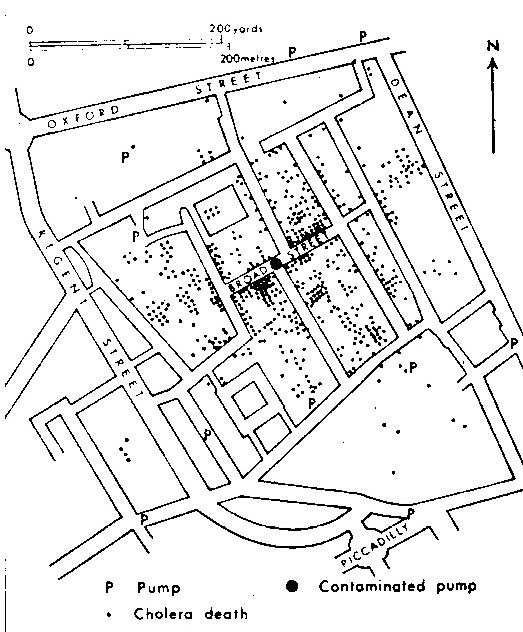
Deaths from cholera, Victorian London
As this article points out, large cities in all parts of the world used to be very dangerous places where the very proximity of humans directly led to disease and death.
I already knew the basics of John Snow’s battle with the established order and his famous map of Broad Street from TV programs and the odd book, like Mathew Kneale’s excellent novel about a Victorian hydraulic engineer, Sweet Thames.
But the particular value of Stevenson’s take on London’s cholera epidemic is the attention it gives to the broader circumstances of the times and the way he burrows deeply into the underlying social, medical and technological issues.
He talks, for example, about how humans living at close quarters historically addressed their vulnerability to polluted water by drinking alcohol instead (notwithstanding it is itself poisonous and addictive). Nothing new about that perhaps, but what is interesting is how the desire to live at higher density gradually selected for genes that could tolerate alcohol: Read the rest of this entry »
The VFT and Green’s preferences
Posted: June 19, 2010 Filed under: HSR High Speed Rail, Infrastructure, Public transport | Tags: election, Gary Johns, High Speed Rail, The Australian, The Greens, very fast train, VFT 3 CommentsThis blog has devoted a fair bit of attention to the proposed Very Fast Train between Sydney-Canberra-Melbourne (here, here and here), wondering what warrant there is to replace one form of public transport with another.

More attention in fact than any of the mainstream papers or denizens of the blogosphere have mustered, as far as I can tell.
So readers might be interested in this article by Gary Johns published in The Australian last week. It’s notable because he conjectures that the VFT might be the price the Government has to pay to secure Green preferences in this year’s Federal election.
Don’t think I agree with his analysis of the Greens mind (this is the former Special Minister of State in the Keating Government, isn’t it?) but I think his sources on the economics of the VFT are impeccable. Here nevertheless is a less-than-complimentary take on Johns. Read the rest of this entry »
Is unused infrastructure capacity in the inner suburbs all used up?
Posted: June 17, 2010 Filed under: Infrastructure, Planning | Tags: ACF, Infrastructure, Inner city, inner suburbs, Justin Madden, Port Melbourne Primary, schools, spare capacity, sprawl, sustainability, The Sunday Age 7 CommentsThere was more evidence in The Sunday Age on the weekend that the spare infrastructure capacity that is widely presumed to be available in the inner city and inner suburbs has in all likelihood already been consumed.
What is unfortunate about this stubborn idea is that there are already sufficient good reasons for increasing housing density in established suburbs without having to resort to unsubstantiated and outdated beliefs.

Proposed 520 unit development, Coburg. How much 'spare' infrastructure capacity will it use?
New research by Professor Kevin O’Conner, Melbourne University, shows that the number of additional students who will be seeking enrolment by 2016 in the inner city and inner suburbs is equivalent to fourteen new schools.
However existing schools are generally at capacity. The principal of Port Melbourne primary is reported as saying “schools in this area don’t have the capacity to cope with more students….looking at my projected enrolments and those of neighbouring schools, and from what I hear about the plans for extra multistorey developments in Southbank and Docklands, we will be full soon”.
He could’ve mentioned that virtually every school within at least 10 km of the CBD already has one or more so-called temporary class rooms including, now, the two story portable, and some are using public parks for play and sport.
Unfortunately there is no credible contemporary analysis of infrastructure capacity and costs in different parts of Melbourne. As I’ve argued before (here and here), there is unlikely to be significant spare infrastructure capacity in the inner established areas. There are a number of reasons for this proposition: Read the rest of this entry »
Has the very fast train run out of steam?
Posted: May 26, 2010 Filed under: HSR High Speed Rail, Infrastructure, Public transport | Tags: Canberra, High Speed Rail, Sydney-Melbourne corridor, very fast train 9 CommentsThe idea of very fast trains on the Sydney-Canberra-Melbourne corridor seems to have run out of steam after an initial flurry earlier this year when the CRC for Rail Innovation and the Greens both called on the Federal Government to fund a major concept study.
There has been very little in the popular media since that opening blast. Hence it was interesting to see author, educator and consultant, John Legge, arguing in The Age on Saturday that the figures on very fast rail add up.

Note the extensive green areas near Canberra
He asserts that: (a) high speed rail works in Europe, China and Japan, (b) the US is now building high speed rail projects, (c) rail is faster, more comfortable and more convenient than flying, and (d) it can be built for a mere $15 billion. Ergo, it will be an unqualified success on the Sydney-Canberra-Melbourne corridor. But he provides little in the way of evidence or argument to support these claims.
Surprisingly, Legge makes no mention of what I think is the best argument for the project – constraints on Sydney Airport’s ability to expand capacity. Even more surprisingly, he doesn’t mention the environmental benefits of rail over air until the very last line and then just in passing. His key argument is that rail would out-compete air simply because a very fast train is a more attractive product.
I don’t want to deal with everything Legge says because I’ve covered most of the arguments for and against high speed rail here and here. But I do want to take issue with a couple of the points he makes.
First, what works in other countries won’t necessarily work in Australia. Most of the routes in Europe and Japan where high speed rail is strong are relatively short e.g. London-Paris is 340 km; London-Brussels is 198 km. London, with a population of 8 million and Paris (10 million) are very big cities compared to Sydney and Melbourne. They are world cities that have huge numbers of business travellers and tourists compared to Australia (London is an ‘Alpha’ world city). Congestion in the air and on the ground makes air less competitive in those cities, particularly for short trips. Read the rest of this entry »
Spare infrastructure capacity – is it a tall story?
Posted: May 10, 2010 Filed under: Architecture & buildings, Education, justice, health, Infrastructure | Tags: Albert Park Primary School, Infrastructure, portable classroom, school, spare capacity, The Age 10 CommentsHere’s more evidence that claims of “spare” infrastructure capacity in inner city and inner suburban areas are a tall story. The Sunday Age reports that Port Melbourne Primary School, Malvern Primary and Middle Park Primary are the first schools to get double storey portable classrooms.
Two storey portables are a natural evolution – practically every State primary school in Melbourne within 10 km of the CBD already has single storey portables. However I’m not concerned with whether portables are better or worse than permanent buildings but rather with what additional classrooms say about spare capacity in schools.
As I argued previously in Why ‘spare infrastructure capacity’ is exaggerated, it is a mistake to think that there is necessarily spare infrastructure capacity just because an area historically had a higher population than it has at present. Read the rest of this entry »
Why did the NYC road pricing proposal fail?
Posted: May 8, 2010 Filed under: Cars & traffic, Infrastructure | Tags: Bruce Schaller, congestion charge, Mayor, Michael Bloomberg, New York, road pricing 2 CommentsThis paper is an object lesson in the pitfalls of attempting to introduce cordon pricing. Written by Bruce Schaller from the New York City Department of Transportation, it analyses Mayor Bloomberg’s failed 2007 congestion pricing proposal (it was ultimately blocked by the State legislature).
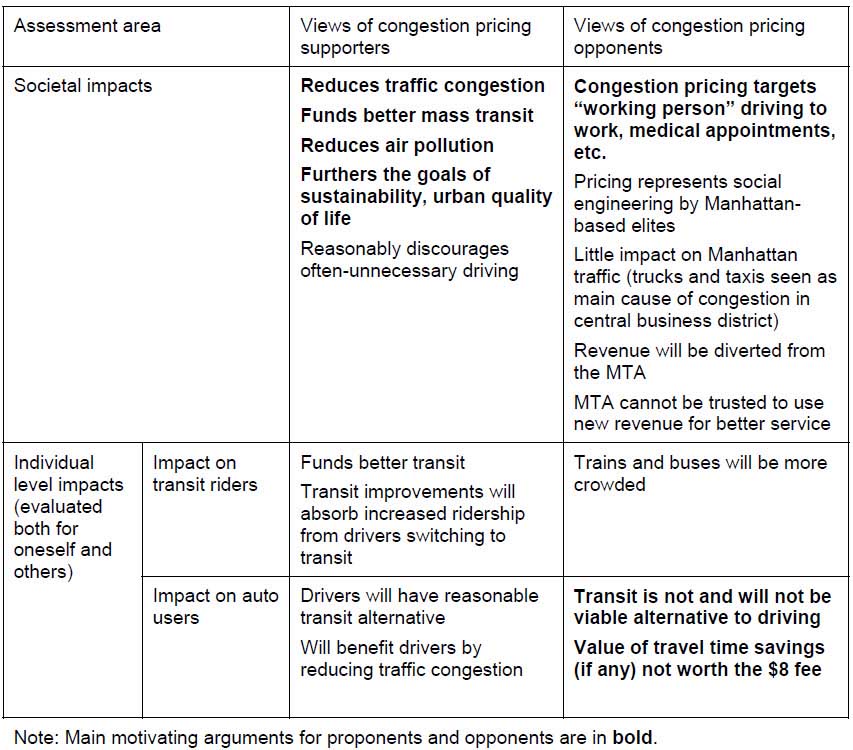
Opposing views on congestion charging (click to enlarge)
The key message is that gaining support for pricing proposals requires more than showing the social benefits – it is necessary to persuade individual motorists they will be better off. The New York experience shows small groups can have great influence – only 5% of workers would have paid the toll.
The author also argues that the best prospects for successfully implementing road pricing lie in initiatives like High Occupancy Toll lanes (see my previous post on this topic in relation to Melbourne) as motorists are less likely to feel they will be disadvantaged.
This table is a neat summary of the key views of proponents and opponents.
Do the numbers support the Very Fast Train?
Posted: May 3, 2010 Filed under: Energy & GHG, HSR High Speed Rail, Infrastructure, Public transport | Tags: GHG, greenhouse gas, High Speed Rail, Melbourne airport, Sydney airport, very fast train 16 CommentsI’ve run some numbers on how a Very Fast Train in the Sydney-Melbourne corridor would stack up against planes in order to flesh out the questions I posed last week (Is the VFT all huff and no puff?). I used a simple “back of the envelope” methodology adapted from that used by Harvard’s Edward Glaeser to evaluate high speed rail projects in the US (here).
I estimate the economic and environmental benefits of carrying all current Sydney-Melbourne air traffic by VFT rather than plane at around $840 million p.a. (although this does not include the cost of GHG emissions from construction of a rail line – this would be large).
Table by Booz Allen
At first glance a VFT looks unpromising, since I estimate the capital cost of constructing and maintaining a VFT line from Sydney to Melbourne at about $1.5 billion per year. This is well in excess of the benefits.
However this assumes Sydney can accommodate passenger growth by using larger planes. It quite possibly can, but if it can’t and a second Sydney airport has to be built, a VFT starts to look viable if the cost of the airport were to come in at around $15 billion.
Let me emphasise that this is a simple analysis. I’ve left out many complications, including Canberra passengers and car traffic on the Hume.
The only environmental issue I’ve included is (operating) GHG. And of course I’ve made assumptions on things like construction costs and future interest rates.
Starting with capital costs, estimates of the cost to acquire land and construct a VFT line range from $14 to $82 million per km in Europe and the US (Japan is much higher because of earthquake risks). I assume a middling cost of $30 million per km, giving a total cost of $27 billion to build a 900 km line (the existing Sydney-Melbourne rail line is 950 km). I’ve assumed an interest rate of 5% p.a. and annual track maintenance cost of $124,000 per km. These assumptions give a total capital cost for the line of $1.5 billion per annum. Read the rest of this entry »
Is the Very Fast Train all huff and no puff?
Posted: April 27, 2010 Filed under: Decentralisation, Energy & GHG, HSR High Speed Rail, Infrastructure, Public transport | Tags: Canberra, CSIRO, Greens, Insiders, Melbourne, Sydney, very fast train, VFT 23 CommentsThe idea of a very fast train (VFT) connecting Sydney, Canberra and Melbourne is gaining momentum (again). The CRC for Rail Innovation launched a pre-feasibility study earlier this year; veteran journalist Brain Toohey expressed his enthusiasm for the idea on Insiders on 11 April; and now the Greens are calling on the Federal Government to fund a $10 million study into a new scheme they are proposing.

The idea of a VFT has a long history in Australia, dating back to the first serious proposal put forward by the CSIRO in 1984. The key drivers of the current proposal are environmental and resource efficiency and support for expanded regional centres.
I don’t have access to whatever technical analysis the Green’s are relying on, but this seems an unlikely idea. The fact no project has yet been shown to be viable should be a warning to tread warily. I have some doubts. Read the rest of this entry »
Are smart meters always a smart idea?
Posted: April 26, 2010 Filed under: Energy & GHG, Infrastructure | Tags: Dora Costa, electricity, energy, Matthew Kahn, NBER, nudges, smart meter 1 CommentYou need to be careful with incentive programs that aim to change behaviour by providing consumers with feedback on, for example, their level of electricity consumption.
Husband and wife academics at UCLA, Matthew Kahn and Dora Costa, gave households information about their own consumption of energy and that of their peers (the paper is here – may be gated for some). They found that providing feedback to green-minded households encourages them to reduce consumption, but it encourages conservative households to increase consumption. They conjecture that when conservatives see that their consumption is less than average, they respond by increasing it in order to be closer to the average.
Ring Road (M80) – an opportunity for road pricing?
Posted: April 8, 2010 Filed under: Cars & traffic, Infrastructure | Tags: congestion charging, equity, HOT lane, M80, Melbourne, ring road, road pricing, toll lane 8 CommentsThe current upgrade of Melbourne’s Ring Road (the M80) provides an unprecedented opportunity to implement a form of peak period congestion charging in Melbourne.
Designation of one lane as a toll lane during congested periods would offer a higher speed for vehicles paying a fee. They would not necessarily enjoy the maximum permitted speed – a time saving of around 15% seems sufficient.
A toll lane would offer clear economic benefits. In particular, it would enable high value trips, which currently suffer the same delays as comparatively low value trips, to be made faster. In the US these sorts of lanes are called High Occupancy Toll (HOT) lanes but I prefer something like High Value Trip (HVT) lanes to emphasise the underlying efficiency rationale. The ‘price’ or toll varies with how many vehicles use the toll lane to ensure it provides an advantage while optimising the level of use. Read the rest of this entry »
Why ‘spare infrastructure capacity’ is exaggerated
Posted: March 23, 2010 Filed under: Housing, Infrastructure | Tags: ACF, Coburg, Infrastructure, inner suburbs, Pascoe Vale, spare capacity, sprawl, sustainability 5 CommentsAre claims of spare infrastructure capacity in the inner suburbs real?
The Age reports that there were almost 30,000 more people living in Coburg and Pascoe Vale in 1976 than there are now (The Outer Limits). The paper quotes the former Mayor of the City of Moreland, who says that increasing the population density in many areas “is simply returning suburbs to previous population levels”.
The editorialist in The Age of 20 March stated that “some ‘traditional’ inner Melbourne suburbs – such as Coburg, Pascoe Vale and Fitzroy – have fewer residents than they did 50 years ago. Current ‘in-fill’ housing is thus regrowth” (emphasis added).
The idea of course is that there is spare capacity in infrastructure and amenities that can accommodate ‘restoration’ of the historic population level. This would be a good thing because any underutilisation of infrastructure is economically wasteful. It might also minimise further ‘sprawl’ at the urban fringe. Read the rest of this entry »
More on rail link to airport
Posted: March 13, 2010 Filed under: Airports & aviation, Infrastructure, Public transport | Tags: ACCC, airport, Melbourne, parking, Public transport, rail, taxi, The Age, traffic congestion 9 CommentsThe Age is continuing its campaign for a new rail line to be built from the city centre to Melbourne Airport (I discussed this previously on March 2 – Possible rail link to Melbourne airport). There are also a couple of follow-up letters this morning supporting the idea of a rail link.
In a story yesterday, Airport ‘exploiting’ public on parking fees, The Age reported on a new analysis by the ACCC of airport performance in Australia, noting that parking charges account for 20% of Melbourne Airport’s revenue but just 8% of Sydney Airport’s.
The Age’s reporter, Ari Sharp, said the figures, “could add to calls for a rail link to Melbourne Airport to help overcome the growing problems – and costs – of getting there by car or bus”.
However contrary to The Ages’s apparent inference, the difference in the Sydney and Melbourne figures does not appear to be caused by a rapacious parking operator ripping off travellers who lack an alternative to driving.
What the story didn’t say was that Sydney Airport’s revenue from charges to airlines is $446 million, compared to Melbourne Airport’s comparatively modest $197 million. Parking revenues are much the same ($88m and $95m respectively), hence it’s not at all surprising that parking makes up a much larger proportion of total revenue in Melbourne than Sydney. Read the rest of this entry »
Melbourne flooding no surprise
Posted: March 8, 2010 Filed under: Infrastructure | Tags: drainage, flood, Melbourne, stormwater 6 CommentsThe scenes in Melbourne over the weekend of extensive flooding, especially in the CBD, didn’t surprise me. Although these were unusual events, I recall reading a report some years ago by the French engineering firm Aegis on the water and sewerage system of Melbourne. Apparently the drainage system in most of inner Melbourne was only designed to accommodate a one in five year storm. In fact some inner areas were designed for a one in two year storm. In contrast, newer areas are designed to cater for a one in one hundred year storm without property damage. They have the space to channel excess stormwater along overland flow paths to parks and creeks whereas in the inner city where the surface is almost entirely impervious the excess tends to flood.
Infrastructure costs on the urban fringe
Posted: March 3, 2010 Filed under: Housing, Infrastructure | Tags: Infrastructure, Inner city, Melbourne, Suburban sprawl, The Age 8 CommentsIt is amazing how quickly supposed facts become accepted wisdom. A feature article in The Age last week, Fringe Benefits, repeated the highly questionable claim that “for every 1,000 dwellings, the cost for infill development (in existing suburbs) is $309 million and the cost of fringe development is $653 million”. Read the rest of this entry »
Possible rail link to Melbourne Airport
Posted: March 2, 2010 Filed under: Airports & aviation, Infrastructure, Public transport | Tags: airport, Melbourne, rail, The Age, traffic congestion 15 CommentsThe Age ran an editorial this week arguing that a rail line should be built from the CBD to Melbourne Airport to deal with growing traffic congestion on the principal radial freeway route. I have a lot of difficulty seeing how this could ever work financially, much less why it should be a priority compared to other potential transport projects. I’ve been on both the new Sydney and the new Brisbane airport rail lines and judging by the low patronage I’m not surprised they’ve both been in deep financial difficulty. Read the rest of this entry »
 The Melbourne Urbanist