Why does Canberra have more social capital?
Posted: October 13, 2010 Filed under: Planning, Social and community | Tags: ACF, andrew leigh, Australian Conservation Foundation, Canberra, commuting, Disconnected, Public transport, regions, social capital, travel time 3 Comments Newly elected Labor member for the seat of Fraser in the ACT, Andrew Leigh, argues that Canberra has the highest level of social capital of any of Australia’s capital cities.
The former ANU economist contends that social capital – essentially the level of trust and reciprocity within communities – has declined in Australia. He points to declines in active membership of associations, in religious participation, and in membership of political parties and unions.
We even have fewer close friends now than in the 80s – we’ve two fewer friends who could keep a confidence and we’ve lost half a friend who’d help us through a hard time.
Andrew concludes that there are several plausible explanations for this decline, including people working longer hours, the feminisation of the workforce and greater ethnic diversity. In addition, more time spent watching television, using a computer and commuting means less time spent face-to-face with others.
Most of these changes also have benefits, so he cautions against trying to return to the past. We need new and innovative ways to build social capital. He argues that the place to look for how we might increase social capital is Canberra. This is where it gets really interesting. Read the rest of this entry »
What’s VECCI’s vision for Melbourne?
Posted: September 16, 2010 Filed under: Planning | Tags: bicycle licensing, Infrastructure, Liveability, VECCI 22 Comments
I've always said street art is rubbish (video)
The Victorian Employer’s Chamber of Commerce and Industry (VECCI) released five policy papers on Monday aimed at guiding the pre-election decision-making of the major parties.
The paper on Infrastructure and Liveability is of particular interest to the Melbourne Urbanist. Apart from a short introduction emphasising the economic importance of infrastructure, it’s essentially a list of actions, some very specific, which looks like it was cobbled together by the proverbial committee.
It includes some current projects such as the planned Melbourne Metro, but there are some other ideas that are very interesting, to say the least. Read the rest of this entry »
Public transport: time for a new paradigm?
Posted: September 12, 2010 Filed under: Cars & traffic, Planning, Public transport | Tags: Cars, energy efficiency, Public transport, sustainability 22 Comments Sorry for the hoary cliché but I really do think it’s time for a new way of thinking about public transport.
Much of the debate on transport in cities is too simplistic. All too frequently it’s reduced to a simple nostrum: “replace all car travel with public transport”. I think it’s more complex than that and, to use another cliché, requires a more nuanced approach.
Let me be clear from the outset that there are compelling reasons why we need to invest more in public transport – for example, to provide mobility for those without access to a car. Another reason is to provide an alternative to roads that are becoming increasingly congested.
But I’m not convinced that the reason most commonly advanced – to overcome the environmental disadvantages of cars – is all that persuasive. Here’s why. Read the rest of this entry »
Can we make living together better?
Posted: September 7, 2010 Filed under: Education, justice, health, Housing, Planning | Tags: election, Liveability, neighbours, noise, NSW, nuisance, Queensland, Victoria 12 Comments OK so now it’s time to turn to State politics.
I have a modest idea for making our major cities more liveable that I’d like to offer to the Premiers and Opposition Leaders of Victoria, NSW and Queensland in the run up to their forthcoming State elections.
The idea could be named something like the Better Neighbours Initiative or it could as easily be titled Considerate Cities or Liveable Cities or something of that ilk. The idea starts with the recognition that living in close proximity within cities imposes stresses on human relations and demands strong remedial action.
Some of the risks associated with cities, like disease, respond to investment in physical infrastructure. But some don’t – they require behavioural approaches.
The main objective is to limit the stress that inconsiderate behaviour, like noise from “hot” cars or audio amplifiers, imposes on residents and neighbours. I’ll focus on noise here, but the ambit of the liveable cities idea could extend to other problems such as taming the speed and behaviour of cars in local streets and activity centres. Read the rest of this entry »
Can our cities get bigger (and remain liveable)?
Posted: August 23, 2010 Filed under: Planning, Population | Tags: city size, Decentralisation, population growth 17 Comments The issue of decentralisation could be back on the table given the elevated significance of the three regionally-based independents*. I’ve previously argued (here and here) that there are big questions about the viability of decentralisation on a large scale, so today I want to look at whether or not our major cities can cope with more growth.
There was quite a bit of interest in the 60s and 70s around the idea of an efficient city size. The assumption that a point was reached where diseconomies of scale set in was part of the rationale for the failed decentralisation push of the Whitlam era.
There’s a better appreciation today that cities make structural adjustments in response to growth and may generate new economic advantages. There’s wide acceptance of the idea that productivity increases (modestly) as city size/density increases.
Australia’s major cities are certainly not bursting at the seams, notwithstanding residents’ concerns about issues like traffic congestion and housing affordability. Sydney is actually only the 80th largest city by population in the world and Melbourne the 87th. Many of the larger cities dwarf ours – Tokyo, for example, has more than nine times as many residents as Sydney. Read the rest of this entry »
Is Docklands a dog?
Posted: August 18, 2010 Filed under: Architecture & buildings, Planning | Tags: Docklands, Gold Coast, Lindsay Tanner, Southbank 15 Comments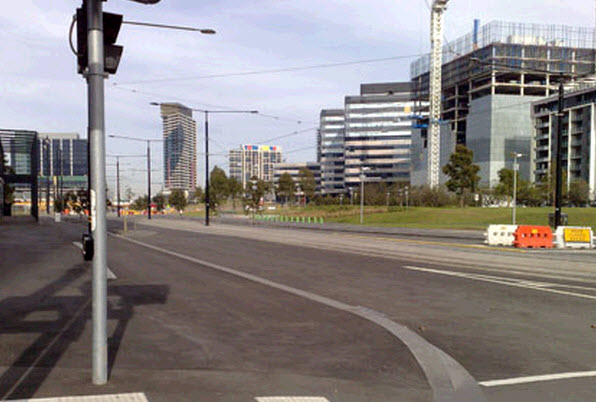
Picture by Ozsoapbox
I like dogs so I’d say Docklands is more like a mangy, flea-bitten hyena. It’s ugly, it’s shrill and it’s very ill-mannered.
As a friend and I cycled down Latrobe Street and over the railway bridge a few Sundays ago, I thought for a moment I was entering one of those anonymous, soulless suburban business parks that abound in the US.
I’ve written recently on how successful Docklands is as a business park so perhaps I shouldn’t have been surprised to see so much banal architecture in one place – not every building, but there’re far too few that aren’t tinted glass boxes.
The residential areas exude the very worst of the Gold Coast, even down to the vulgar attempts to “stand out” from the crowd. They’re as flash as a hyena with a gold tooth. If there’s such a thing as a “Melbourne architectural style” that draws on subtlety, wit, intellect, culture and life in a cold climate, then it’s turned its nose up at Docklands.
This was my first daytime leisure visit to Docklands in a while and it shocked me. I seriously don’t know how I ever imagined that one of Melbourne’s competitive advantages is its high standard of architecture. How could Melbourne produce this generic tripe? Read the rest of this entry »
Is Docklands sinking Melbourne @ 5 Million?
Posted: August 12, 2010 Filed under: Activity centres, Planning | Tags: Central Activities Districts, Docklands, Employment, Melbourne 2030, Melbourne @ 5 Million 4 Comments Docklands has been roundly and rightly criticised for its appalling urban design but it has nevertheless been spectacularly successful in attracting business to locate by the water.
In fact it has been so successful that I wonder what the implications are for office space markets in the rest of Melbourne, not just in the CBD and near-CBD markets, but in particular in the six major suburban activity centres envisaged in Melbourne @ 5 Million i.e. Footscray, Broadmeadows, Box Hill, Ringwood, Dandenong and Frankston.
The recent announcement that the headquarters of the National Broadband Network Company would be located in Docklands merely continues the momentum already established in the area in and around the old docks. Current tenants of this end of town include the National Australia Bank, ANZ, Myer, National Foods, CSC, Fairfax Media, Customs, Channel 7, AFL and the Australian Tax Office.
Other organisations planning to move to the area include Melbourne Water, BP, Channel Nine and Chartis Australia. Even the Demons have been mooted as prospective tenants of a new training park (or stadium) proposed for the precinct. Read the rest of this entry »
Are Australia’s 1960s suburbs really “emptying out”?
Posted: July 27, 2010 Filed under: Planning, Population | Tags: ageing in place, Campbelltown, Club Troppo, empty nesters, Lavartus Prodeo, middle ring suburbs, Sydney 11 Comments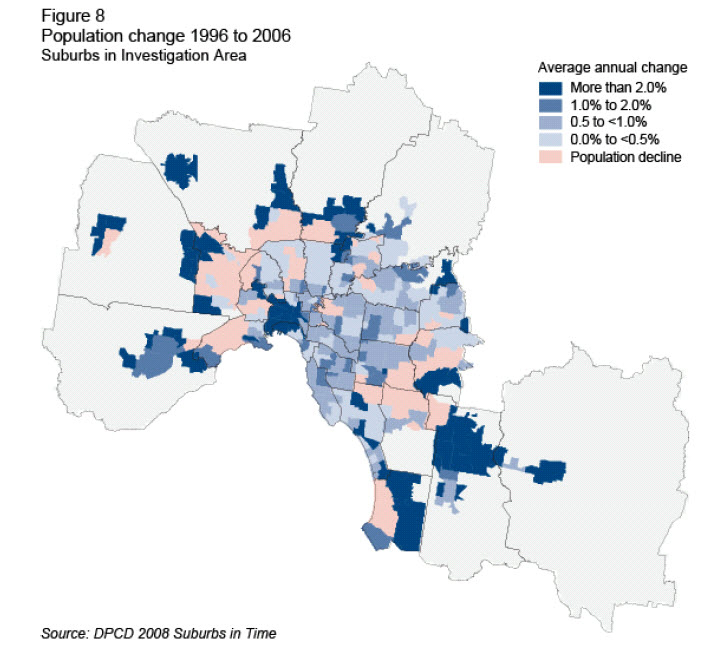 This article at Club Troppo, We’re not full, has generated lots of interest on the net (e.g. here) because the writer argues that, contrary to what population growth opponents contend, Sydney is far from “bursting at the seams”.
The key evidence he offers is that many older suburbs that were settled in the 1960s and 70s, like Campbelltown, are losing population. This is largely because the children of those early settlers have grown up and left home, leaving mum and dad getting older and rattling around in a home with three or more bedrooms.
I completely agree that Sydney is not bursting at the seams, but regular readers of The Melbourne Urbanist will know instinctively that there’s more to this issue than meets the eye. These suburbs are not really “emptying out”. Read the rest of this entry »
Is Melbourne better today than it was in the sixties?
Posted: July 18, 2010 Filed under: Planning, Population | Tags: 1960s, Andrew Mcleod, Brisbane, Committee for Melbourne, Population 3 Comments
Little Collins St traffic 1960 (by FailingMemory)
I’ve previously discussed the argument advanced by the CEO of the Committee for Melbourne, Andrew Mcleod, that Melbourne can get better as it gets bigger.
Mr Mcleod has another interesting contention – he argues that Melbourne is unambiguously better and more liveable today than it was in 1960. Back then Melbourne had a population of around two million but now it has four million.
I have my doubts about the political wisdom of running that line but that’s neither here nor there – my primary interest is whether or not Mr Mcleod’s proposition makes sense.
I’ve no doubt the response of many people would be that housing in Melbourne is now less affordable than it was forty years ago and the roads and public transport are more congested. Some people also think it’s less safe, less equal and has a much larger per capita ecological footprint. For others, the footy lost something really important when the AFL was created.
On the other hand, many would argue that Melbourne is now more tolerant, more diverse and more exciting than it ever was. It’s now a city with a global profile, a better educated population and a vastly more sophisticated lifestyle. You can drive from the west to the south east fringe today entirely on freeway in under an hour in the off peak and you can take a train around the CBD. Read the rest of this entry »
Is local food more sustainable?
Posted: July 11, 2010 Filed under: Energy & GHG, Growth Areas, Planning | Tags: agriculture, food kilometres, food mile, locavore, Melbourne 2030, sprawl 16 CommentsOne argument against suburban sprawl is that it sterilises agricultural land. A particular variation on this contention is that land should be preserved for agriculture so that carbon emissions in transporting food from farm gate to plate – “food kilometres” – can be minimised.
A frequently cited estimate is that food in the US travels on average 2,400 km from where it is produced to where it sold to consumers. We should therefore seek to grow as wide a range of food as possible as close to Melbourne as possible.

From Weber and Mathews, Food Miles and the Relative Climate Impacts of Food Choices in the US
All things being equal that makes sense. But of course it’s never that simple. Here are some pertinent issues to consider.
First, transport is not a major component of the total carbon emissions from agriculture. These researchers estimate that on-farm production accounts for 83% of the average US household’s carbon emissions from food whereas delivery from producer to retail outlets accounts for just 4%.
Second, most food can’t be grown locally without resorting to potentially environmentally damaging practices like excessive application of fertiliser, irrigation or artificial heating of greenhouses. This article cites a British study which found that because British tomatoes are grown in heated greenhouses, they emit 2.4 metric tons of carbon dioxide per ton grown whereas Spanish tomatoes emit 0.6 tons. Further:
Another study found that cold storage of British apples produced more carbon dioxide than shipping New Zealand apples by sea to London. In addition, U.K. dairy farmers use twice as much energy to produce a metric ton of milk solids than do New Zealand farmers. Read the rest of this entry »
Is a bigger Melbourne a better Melbourne?
Posted: June 23, 2010 Filed under: Planning, Population | Tags: Andrew Mcleod, city size, Committee for Melbourne, density, Los Angeles, Manhattan, New York, Shaping Melbourne 6 CommentsThe CEO of the Committee for Melbourne, Andrew Mcleod, advanced an interesting argument about the importance of growth when launching the Committee’s new report, Melbourne Beyond 5 Million, earlier this month.
He contended that Melbourne can get better as it gets bigger. His main argument is that Melbourne in 2010, with 4 million people, is double the size it was in 1960 and is, he says, unambiguously more liveable.

Big city - East Village, Manhattan
So is bigger better? I don’t think I have a definitive answer and I’m not even sure there is one, but I think it’s useful in light of the high population growth projected for Melbourne to canvass some of the issues.
The fear many people have is that a bigger Melbourne will mean housing is less affordable and roads and public transport more congested. Some people also think it would be less safe, less equal and have a much larger per capita ecological footprint.
But there are advantages in getting bigger. Larger cities are usually denser and have a lower ecological footprint than smaller cities. There is also an extensive literature showing that the productivity of cities increases with population.
There are different opinions on the underlying reasons but many observers, like Harvard’s Professor Edward Glaeser, think that big cities enable people to connect and learn from one another. They tend to be more diverse and offer greater specialisation in work, consumption, socialising and ideas.
There are more than thirty cities in the OECD countries alone that have a larger population than Melbourne. They must be doing something right if people want to live in them. For all the complaints made about Los Angeles, many more people seem to want to live there than in Melbourne. Many talented Australians aspire to move to LA to work in specialised industries like entertainment, higher education and technology. Read the rest of this entry »
Will Brumby’s new decentralisation initiative work?
Posted: June 18, 2010 Filed under: Decentralisation, Planning | Tags: Decentralisation, Education, justice, health, Infrastructure, Portland, Ready for Tomorrow, regional centres, sprawl, suburbs 5 CommentsThe Ready for Tomorrow initiative announced by the Premier earlier this week is being sold as a way to relieve growth pressure on Melbourne.
Just why people would move to regional centres on a scale sufficient to ease the demands on Melbourne significantly is not clear, as there’s little in the announcement to suggest the Government has suddenly discovered the secret to growing jobs in the regions.

The track record of policy-driven migration in Australia is poor. The decentralisation schemes of the seventies, based on growing regional centres like Albury-Wodonga and Bathurst-Orange, were conspicuously unsuccessful in lowering growth in the major capital cities.
Decentralisation was supposed to be driven by manufacturing, which at that time was on the march out of the inner city. However rather than moving to regional centres, manufacturing largely moved to the suburbs and offshore. It now offers even less potential for underpinning decentralisation that it did 30 or 40 years ago.
I think the practical impact of Ready for Tomorrow is more likely to lie in enhancing the liveability of the regions than in giving respite to Melbourne. It is really a regional development program. As The Age’s editorial writer points out, even if the annual growth rates of the eight largest regional cities were to double, it would only relieve Melbourne of seven weeks growth.
Nevertheless, I suppose the prospect of cheaper housing and lower congestion in reasonable proximity to Melbourne may be sufficient to attract some new settlers to regional centres, especially if it is hyped as the sensible thing to do by the Government and regional councils. Read the rest of this entry »
Is unused infrastructure capacity in the inner suburbs all used up?
Posted: June 17, 2010 Filed under: Infrastructure, Planning | Tags: ACF, Infrastructure, Inner city, inner suburbs, Justin Madden, Port Melbourne Primary, schools, spare capacity, sprawl, sustainability, The Sunday Age 7 CommentsThere was more evidence in The Sunday Age on the weekend that the spare infrastructure capacity that is widely presumed to be available in the inner city and inner suburbs has in all likelihood already been consumed.
What is unfortunate about this stubborn idea is that there are already sufficient good reasons for increasing housing density in established suburbs without having to resort to unsubstantiated and outdated beliefs.

Proposed 520 unit development, Coburg. How much 'spare' infrastructure capacity will it use?
New research by Professor Kevin O’Conner, Melbourne University, shows that the number of additional students who will be seeking enrolment by 2016 in the inner city and inner suburbs is equivalent to fourteen new schools.
However existing schools are generally at capacity. The principal of Port Melbourne primary is reported as saying “schools in this area don’t have the capacity to cope with more students….looking at my projected enrolments and those of neighbouring schools, and from what I hear about the plans for extra multistorey developments in Southbank and Docklands, we will be full soon”.
He could’ve mentioned that virtually every school within at least 10 km of the CBD already has one or more so-called temporary class rooms including, now, the two story portable, and some are using public parks for play and sport.
Unfortunately there is no credible contemporary analysis of infrastructure capacity and costs in different parts of Melbourne. As I’ve argued before (here and here), there is unlikely to be significant spare infrastructure capacity in the inner established areas. There are a number of reasons for this proposition: Read the rest of this entry »
Is Darwin really Australia’s most sustainable city?
Posted: June 16, 2010 Filed under: Energy & GHG, Planning | Tags: ACF, Australian Conservation Foundation, Darwin, Gold Coast, indicators, Melbourne, Perth, Sunshine Coast, sustainability, Sustainable Cities Index 2 CommentsSo, who knew intuitively that Darwin and the Sunshine Coast are Australia’s most sustainable cities? These startling revelations are from the Australian Conservation Foundation’s newly released Sustainable Cities Index, which examined the country’s 20 largest cities across 15 indicators. Our least sustainable city is Perth, closely followed by Geelong.
And contrary to The Age’s headline that “Melbourne trails in sustainable cities index” and “pales in comparison with Darwin and Brisbane”, Melbourne is the 7th most sustainable of the 20 cities studied (Brisbane is 3rd).
I’ve previously looked at the inappropriateness of the Mercer and Economist indexes as measures of a city’s liveability and I think the ACF’s index is less useful. It seems to be more about publicity than useful research – a feeling reinforced by an absence of technical information on the methodology. It’s actually not an environmental sustainability index per se, but rather a mish-mash of environmental, quality of life and resilience indicators.
It includes indicators like subjective well-being, the rate of volunteering, unemployment levels and the proportion of the population with type 2 diabetes.
I’m sympathetic to the argument that sustainability connects deeply to other facets of life – as the ACF puts it, it’s about learning to live within our environmental means while maintaining social cohesion and liveability. But the fact is most readers of the newspapers that reported on this study (see here and here) think of sustainability as a largely environmental concept. I agree with them – there’s a danger that stretching the term to include liveability measures will ultimately devalue its usefulness and render it virtually meaningless. It would be more sensible to have two or three separate indexes rather than one.
Notwithstanding the confusion about what it’s intended to measure, does the Sustainable Cities Index approach its task in a sensible way? Straight off there are some worrying methodological issues. Read the rest of this entry »
Is obesity really caused by suburban sprawl?
Posted: June 11, 2010 Filed under: Education, justice, health, Planning | Tags: CBD, diet, Inner city, Kelvin Thompson, obesity, Suburban sprawl 11 CommentsSuburban sprawl is often linked with rising obesity – for example, see this submission to last year’s Urban Growth Boundary Review from Kelvin Thompson, Labor Member for the Federal seat of Wills, or this article in the Sydney Morning Herald.
The customary argument is that because the incidence of obesity is lower in the inner city where densities are higher, it follows that low density outer suburban development is the cause, or at least a very significant contributor, to obesity.

At first glance this seems to make some sense. For example, only 1.1% of workers in Melbourne’s outer suburbs walk to work, compared to 12.9% in the inner city.
But for all its faults, is it reasonable to put the blame for obesity on sprawl? No, it isn’t reasonable. We would we better off focusing our energies on the real issues associated with sprawl rather than being distracted by sideshows.
The key reason is that what goes in our mouths is more important than how much we exercise. You have to walk the dog for an hour and a half, or cycle for an hour, to burn off the calories in just one Big Mac.
The inner city has a lower incidence of obesity primarily because the residents eat better. And they don’t eat better because of higher density but because they have higher incomes than residents of the outer suburbs and, importantly, higher levels of education. They are more likely to know about the importance of good eating and they are more likely to be able to afford to eat better food. They also have smaller households on average so it’s easier to cook healthy food at home rather than go out for fast food. Read the rest of this entry »
Should (some) Melbourne golf courses be turned into forest?
Posted: June 10, 2010 Filed under: Energy & GHG, Planning | Tags: Alphington, environment, forest, golf, Green Acres Gold Club, Ivanhoe, Kew Golf Club, Latrobe Golf Club, park, Yarra river 5 CommentsAs I noted yesterday, the Yarra River park system – that ribbon of green that runs north east from the vicinity of inner suburban Kew and Abbotsford to Warrandyte State Park – is one of Melbourne’s great assets. Few other cities have such a vast expanse of relatively undeveloped land threaded through residential areas so close to the city centre.
Like Melbourne’s green wedges it is used for all sorts of purposes, but rather than the sewage works, quarries and airports that sully the good name of the wedges, the Yarra River park system is mostly occupied by real “green” uses – primarily golf courses and sporting fields. At the time these facilities were established, this land was floodplain with few alternative uses.

Just looking at the Melways, I can see 10 golf courses along the Yarra, of which six are clustered at the southern end of the river around Fairfield-Ivanhoe. There’s a nine hole course in Yarra Bend Park, Yarra Bend Public Golf Course at Fairfield, Latrobe Golf Course at Alphington, Green Acres Golf Club at Kew, Kew Golf Club, Ivanhoe Public Golf Course, Freeway Public Golf Course at Bulleen, Yarra Valley Country Club at Bulleen, Rosanna Golf Club and Heidelberg Golf Club at Lower Plenty.
The Yarra River park system is a very special asset, but I’m not sure it’s used as well as it could be. In particular, there’s very little forest in the park. There’s a bushland area around Wilson Reserve in Ivanhoe that’s used by locals for walking, but its small and one of very few within the lower reaches of the park system.
Melbourne could however have one of the largest urban forests of any city in the world. Such an asset would provide enormous environmental, recreational and tourism benefits for the city.
If the three adjoining private golf courses at Alphington and Ivanhoe, say, were returned to native forest, it would produce a centrally located bushland region covering an area of around three square kilometres – more than eight times the area of the Royal Botanic Gardens. Read the rest of this entry »
Where are the special places in Melbourne?
Posted: June 9, 2010 Filed under: Miscellaneous, Planning | Tags: Bicycle path, Liveability, special places, Warrandyte State Park, Westerfolds Park, Yarra Flats, Yarra river 4 Comments When I think of Sydney, where I lived for 10 years, I naturally think of the harbour. Not the familiar expanse around the bridge or opera house, but rather the myriad small inlets in places like Mosman that can only be fully appreciated from the water.
When I think of Brisbane, where I grew up, it’s those wonderful old latticed timber Queenslanders, laced with tropical vines and shaded by white and pink frangipani, stepping up and down the steep slopes of inner city Paddington.
But when I think of Perth, where I lived for four years, nothing truly special comes to mind. There’re plenty of interesting places, like Northbridge, Fremantle, Kings Park, Cottesloe and Rottnest Island, but they don’t seem different enough to really distinguish Perth from other cities.
So what about my favourite city – what are the special places in Melbourne? My rule is that these can’t simply be nice places to go to if you live in Melbourne. They have to be places that are special and not readily found in other cities – they are either unique or done so well they make a lasting impression on visitors. Here’s some I like. Read the rest of this entry »
Will cars destroy Preston Market?
Posted: June 4, 2010 Filed under: Activity centres, Cars & traffic, Planning | Tags: gentrification, parking, Public transport, retail, Victoria Market 4 CommentsThe biggest threat to Preston Market is cars.
I got thinking about this after I had lunch there last Friday. As always, I was taken in by the mad rush and vitality of the place and the sense that much of it is still essentially the same as it was when it started. I was surprised to learn that it’s a relatively young institution, having only been established in 1970 (although Preston proper is considerably older – it was connected to Flinders Street by rail in the 1920s and experienced a major population boom in the 1950s).
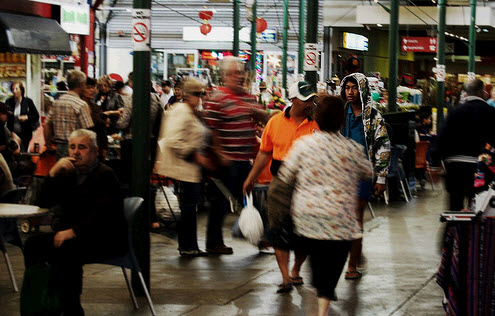
Initially, I was wondering if the Market is vulnerable to the increasing gentrification in the area, but then I realised Victoria Market has withstood demographic changes in the inner city reasonably well. Sure, it’s pretty middle class now but the deli and meat sections at Vic Market are unsurpassed in Melbourne. So while gentrification of Preston Market will undoubtedly diminish its authenticity – and that is the vital ingredient for some customers – it will not necessarily undermine its viability.
Which brings me to the threat to the Market posed by cars – not too many cars, but too few!
I saw a flyer issued by the Market parking manager to stall holders advising of a new parking scheme. I don’t know when it commences, but rather than fine parkers who stay beyond the initial free two hour period (one hour near Aldi), the new arrangement will charge them $1 for each additional hour. How that will work financially for the parking operator is a puzzle (how will they administer it cost-effectively?), but it’s their money. Read the rest of this entry »
Why do inner city residents walk and tram to work?
Posted: June 3, 2010 Filed under: Planning, Public transport | Tags: CBD, Cycling, density, Inner city, new urbanism, Orenco, Public transport, socioeconomic status, sustainable transport, symbolic analyst, traffic congestion, walkability 4 CommentsMore than half of all trips to work by residents of the inner city are made by walking, cycling or public transport. In fact three quarters as many residents walk and cycle as use public transport for their commute.
Why? Is it because of the higher density of the inner city?

Inner city Melbourne (photo by ExTester)
The view that density predicts more sustainable transport use is a common one. While it has some role, it is not the key force at play here. In fact there’s evidence that the population density of some parts of the inner city is not that much higher than that of the suburbs – this is because the average size of households in the inner city is relatively small compared to suburban locations.
There are also examples of higher density developments where use of public transport is quite low, for example edge cities in the US and suburban New Urbanism developments like Orenco in Portland, Oregon.
So if density isn’t the primary force driving more sustainable transport use in the inner city, what is?
Here are four plausible explanations.
The first is proximity. Inner city residents live cheek by jowl with the largest concentration of jobs in the metropolitan area – the inner city has 28% of all metropolitan Melbourne’s jobs and the CBD, despite its diminutive geographical size, has 14.5%. There is no other location in Melbourne that comes within cooee of the job density of the CBD. Read the rest of this entry »
Do firms want to be in suburban centres?
Posted: June 1, 2010 Filed under: Activity centres, Employment, Planning | Tags: activity centre, Edward Glaeser, Employment, Mathew Kahn, Melbourne 2030, Melbourne @ 5 Million, polycentricity, Silicon Valley, suburbs 3 CommentsWe know that most jobs in Melbourne are now in the suburbs. There’s also an increasing understanding that large metropolitan areas are now generally polycentric rather than monocentric in form i.e. there are significant activity centres outside the CBD with large numbers of jobs. The strategic planning update to Melbourne 2030, Melbourne @ 5 Million, released in October 2008, explicitly acknowledged this reality.
It is clear that firms can increasingly obtain the benefits of density, such as face-to-face contact, in both inner city and suburban centres where they don’t have to carry the extra costs in rent and congestion imposed by the very high density of the CBD. The CBD’s share of metropolitan jobs has consequently fallen significantly over the last 30-40 years (it has staged a small revival since 1996, showing significant jobs growth in absolute terms, but its share of metropolitan jobs has not increased).

Tysons Corner - the archetypal edge city
Yet many studies in many countries have found that while the number of suburban and inner city activity centres is increasing, the proportion of jobs located within them is falling. In fact, around a half to two thirds of employment in US cities is scattered across the metropolitan area at relatively low densities. Inter-city and cross-country comparisons are difficult, but the evidence suggests that suburban jobs are even more scattered in Melbourne.
It seems that firms can increasingly achieve the benefits of agglomeration at a larger geographical scale than that of the CBD or suburban activity centres. The advantages of physical proximity have apparently declined to such an extent that the costs of aggregation now exceed the benefits at ever lower levels of density.
But why are firms increasingly spurning density? Read the rest of this entry »
 The Melbourne Urbanist