Is this a sensible comparison of cars and public transport?
Posted: February 23, 2011 Filed under: Cars & traffic, Public transport | Tags: accessibility, auto, Bendigo, car, Employment, Jobs, Melbourne 2030, Public transport, rail, Sunbury Leave a comment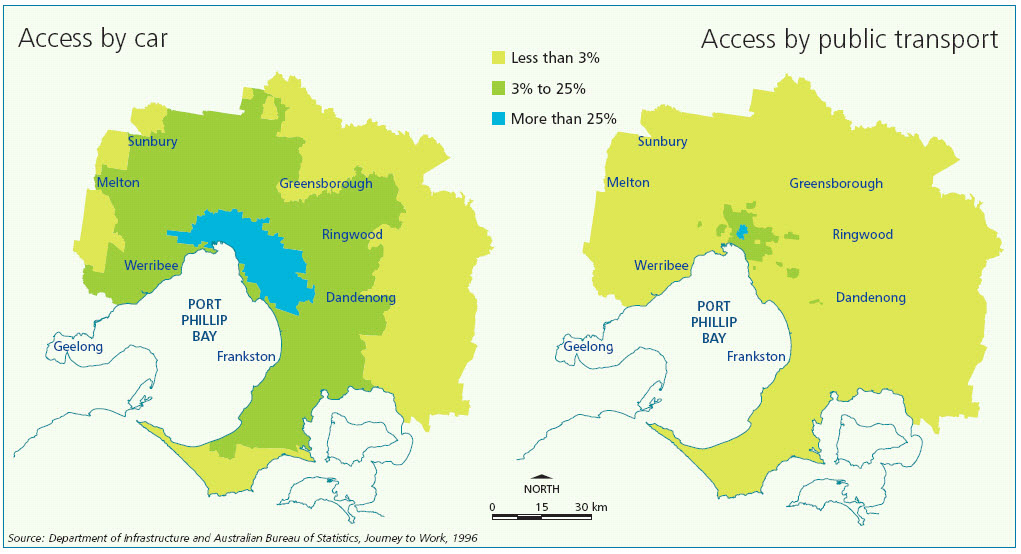
Many readers will have seen this now-ubiquitous chart before – it’s from Melbourne 2030 and has been republished countless times. It shows the proportion of metropolitan jobs accessible within 40 minutes travelling time from different parts of Melbourne by car and by public transport.
I’ve never been happy with this chart because its simplicity is deceptive – I don’t accept the implicit premise that public transport should be judged on the same basis as cars. I’ll come to that shortly, but first there are some technical shortcomings that need to be addressed.
One is that the chart doesn’t say how the data range intervals are determined – are they equal counts? Are they based on a ‘natural break’ in the way the data is distributed? It’s not possible to be confident that they portray the situation with either public transport or cars in as objective a way as possible.
Another shortcoming is that a mere three categories is very limiting. If you live in Sunbury (say), the chart says you can drive to between 3% and 25% of metropolitan jobs within 40 minutes. That’s an enormous range – a factor of more than eight between the lowest and highest values. It’s essentially a useless piece of information. And the maps give a misleading impression of how many Melburnians live in areas with the poorest accessibility. There are very large areas on the fringe that have a tiny population e.g. there is a 9 km wide greenbelt between Melton and Caroline Springs. Much of the outer north east is a catchment area.
Yet even with these technical flaws, there is some intriguing information. For example, the majority of the population can access no more than 2% of metropolitan jobs within 40 minutes travel by public transport. Read the rest of this entry »
What can Sydney teach us about airport rail lines?
Posted: February 16, 2011 Filed under: Airports & aviation, Infrastructure, Public transport | Tags: ACCC, aviation, Melbourne airport, Public transport, rail, Sydney airport, train 30 Comments
Mode share (prepared by ACCC)
There is little doubt that Melbourne Airport needs action to improve land-side access for passengers arriving and departing from the airport.
Many observers argue the solution is a rail line from the CBD to the airport. I think there’s a much bigger picture they’re missing. They would be well advised to look at the Airport Monitoring Report 2009-10, just released by the ACCC (see chart).
It shows that only 39% of trips to Sydney Airport are made by private car (on-airport parking, rentals and kerbside drop-off), compared to 69% for Melbourne Airport. Since Sydney has a train and Melbourne doesn’t, it’s tempting to conclude that a train is the answer to Melbourne’s woes.
However the ACCC’s report says that more people travel to Melbourne Airport by public transport (14% – all by bus) than is the case for Sydney Airport (12% – train and bus).
A key difference between the two airports is that taxis (incl ‘mini buses’) are far more popular in Sydney, where they account for 49% of all airport trips. The comparable figure for Melbourne is just 17%.
Part of the reason for this difference is taxis are more competitive in Sydney against cars and against the train – Kingsford Smith is 8 km from the CBD and hence is relatively central. In contrast, Melbourne is 22 km from the CBD so taxis are not as competitive with either buses or cars (other reasons for the difference include more tourists at Sydney, as well as higher parking charges).
As I discussed last week, Brisbane’s airport – like Melbourne’s – is also located a considerable distance from the city centre. It might be that the location of both airports on the edge of their respective metropolitan areas – well away from the centre of gravity of population in both cities – is a key reason for their high private car use (and low taxi use).
Yet distance can’t be the whole explanation. The Brisbane airport train only captures 5% of trips and all up, public transport carries 8% of airport journeys. That’s considerably less than either Sydney or train-free Melbourne.
Given the experience of Sydney and Brisbane, it cannot simply be assumed that constructing a rail line from the CBD to Melbourne Airport will inevitably lead to a significant increase in public transport use – at the expense of cars – over and above the already substantial mode share enjoyed by buses. Read the rest of this entry »
Is this the way we’ll live next?
Posted: February 15, 2011 Filed under: Infrastructure, Public transport | Tags: aerotropolis, aircraft, airport, freight, Greg Lindsay, Lawrence D Kasarda, logistics, Tullamarine 6 Comments
Wivenhoe Dam, Qld, at 197% capacity, Jan 2011
The centre of the city of the future will be the airport, according to a book by John D Kasarda of the University of Carolina and journalist Greg Lindsay to be published next month.
They say in Aerotropolis (subtitled, to emphasise its inevitability, The Way We’ll Live Next), that “not so long ago, airports were built near cities, and roads connected the one to the other. This pattern—the city in the center, the airport on the periphery— shaped life in the twentieth century, from the central city to exurban sprawl”. But things, they say, have changed:
Today, the ubiquity of jet travel, round-the-clock workdays, overnight shipping, and global business networks has turned the pattern inside out. Soon the airport will be at the center and the city will be built around it, the better to keep workers, suppliers, executives, and goods in touch with the global market.
Soon the airport will be the centre of the city?!!! I am, to put it mildly, sceptical about this view of the future.
Yes, cities have almost always developed around transport infrastructure – first ports and rivers and more recently railheads and freeway nodes. Yes, local concentrations of economic activity have sprung up in various places to provide logistics services in close proximity to major airports, some of which are very large. And of course, as this preview of the book states, the share of high value freight carried by air is increasing at a much faster rate than trade generally.
Now if some marketer wants to start calling Melbourne airport and the surrounding area ‘Tullamarine Aerotropolis’ or something similar (‘Tullatropolis’?) that’s OK by me. It is after all one of the biggest concentrations of jobs in the suburbs of Melbourne and a fair number of those jobs are doubtless related in some way to aviation.
But arguing that the city of the future will “be built around the airport” is silly. Read the rest of this entry »
An animated map of Auckland’s public transport network
Posted: February 14, 2011 Filed under: Public transport | Tags: animation, Auckland, Chris McDowell, Flink Labs, Google Transit Feed McDowell, Public transport 2 Comments
Last year I linked to an animation of Melbourne’s trains system developed by Flink Labs. This one (click on map) shows a day in the life of public transport in Auckland and was developed by Chris McDowell. He says:
The animation begins at 3am on a typical Monday morning. A pair of blue squiggles depict the Airport buses shuttling late night travellers between the Downtown Ferry Terminal and Auckland International. From 5am, a skeleton service of local buses begins making trips from the outer suburbs to the inner city and the first ferry departs for Waiheke Island. Over the next few hours the volume and frequency of vehicles steadily increases until we reach peak morning rush hour. By 8am the city’s major transportation corridors are clearly delineated by a stream of buses filled with commuters. After 9am the volume of vehicles drops a little and stays steady until the schools get out and the evening commute begins. The animation ends at midnight with just a few night buses moving passengers away from the central city. Read the rest of this entry »
Is this story a beat-up?
Posted: February 9, 2011 Filed under: Public transport | Tags: East West Link Needs Assessment, Edward Dotson, Investing in Transport, Kenneth Davidson, Regional Rail Link, Sir Rod Eddington, Tarneit Link 3 Comments
A great song that really is about public transport (click to play)
Kenneth Davidson reckons the Regional Rail Link (RRL) is a “wasteful infrastructure investment” that hopefully will be cancelled in its entirety as a result of the Federal Government’s flood reconstruction cutbacks.
He bases this argument largely on a review prepared for the Government in 2008 by consultant transport planner Edward Dotson, who formerly worked for Melbourne’s public transport authority from 1983 to 1991.
Mr Dotson was commissioned to review four of the recommendations of the East West Link Needs Assessment study undertaken by Sir Rod Eddington. One of those recommendations relates directly to the RRL, a planned new rail line from West Werribee via Tarneit to Southern Cross Station (a.k.a the Tarneit Link).
Referring to Mr Dotson’s report, Mr Davidson says “his report was scathing. He described (the Eddington report) as a ‘pre-feasibility study’ whereas what was required was a full study that included engineering analysis, service planning (including timetabling), costing and public consultation”.
He says Dotson also recommended the examination of alternatives to the RRL, including using the existing Bunbury Street tunnel and running a new set of tracks alongside the existing line to Werribee rather than a new route through Tarneit. He goes on:
The RRL proposal looked as if it was set up to fail in the first place. On the basis of what the transport expert Dotson said, the Eddington report was a pre-feasibility study that hadn’t done the engineering studies in sufficient detail to come with cost estimates in the first place.
I hadn’t heard of the Dotson report so I tracked it down and had a look – you can read it too, here (It would also be a good idea to have a look at the Eddington report, here). There’re three things that struck me about this report. Read the rest of this entry »
Will a rail line stop high airport parking prices?
Posted: February 8, 2011 Filed under: Airports & aviation, Public transport | Tags: ACCC, Airport Monitoring Report, Australian Pacific Airports Corporation, Brisbane Airport, Melbourne airport, parking, Skybus, Skytrain 21 Comments
Passenger mode share for access to Brisbane and Melbourne airports (ACCC)
The ACCC has fingered Melbourne Airport for its monopolistic approach to parking. In its latest Airport Monitoring report, it accuses the operator of imposing excessive levies on private buses and limiting the service offering of off-airport parking establishments:
Excessive access levies could have the effect of shifting demand to on-airport parking and, consequently, allow the airport to increase car parking prices. These factors point to Melbourne Airport earning monopoly profits from its car parking operations.
The comments section of The Age’s story about the report is bubbling over with calls from outraged punters calling for a rail line to be built from the CBD in order to bust the monopoly power of the airport operator, Australia Pacific Airports Corporation.
Irrespective of the overall merits of building an airport rail link, I can’t see that it would have any more than a marginal impact on the airport’s parking policies. It might (or might not) be justified on other grounds, but a train is not really a substitute for parking.
Travellers who park at the airport are by definition residents of Melbourne and have access to a car. A rail line from the CBD is not going to be attractive when most trips made by residents – including business trips – either originate or terminate at home (or both). When you’re catching a 7:00 am flight you don’t usually catch the train into the office first. Likewise if your flight gets you back into town at 7:00 pm or later, most travellers go straight home.
Rail is not going to be an attractive alternative for the great bulk of the 99% of residents who live outside the CBD or the 92% who live outside the inner city. Rather than walk to their local station, take a train and then change onto the airport line, they’ll drive.
In many cases their employer (or the taxpayer!) is in any event paying for their airport parking. Read the rest of this entry »
Will networking make public transport the mode of choice?
Posted: February 1, 2011 Filed under: Employment, Public transport | Tags: auto, car, CBD, density, John Stone, network, Paul Mees, Public transport, road pricing, suburbs, traffic congestion 9 Comments
What's the biggest danger?
According to a report in The Age last month, new research published in the latest issue of Australian Planner shows that higher suburban densities are not a precondition for vastly better public transport. Reporter Andrew West says:
City dwellers have been presented with a false choice – live in apartments and enjoy good public transport or retain the house and land and rely on cars
The research by Dr John Stone and Dr Paul Mees contends that it is not necessary to intensify land-use across the whole city before significant improvement in both patronage and economic efficiency of public transport becomes possible.
They say the contribution made by urban consolidation “to recent public transport patronage growth is modest and makes little impact on the density of the whole urban region”. Most residents of Australian cities will continue to live in houses and suburban subdivisions that are already built so “alternatives to the car will need to be effective at existing urban residential densities”.
They argue instead for a ‘networked’ model of public transport. Improving the way existing public transport resources are managed – especially by providing higher frequencies and improving coordination between services and between modes – will yield significantly higher transit patronage in the suburbs without the need for broadbrush increases in density.
I’ve argued before that increasing residential density, by itself, will not necessarily increase public transport patronage significantly, much less shift travellers out of their cars in large numbers.
I’ve also argued that there are generally better gains to be had from using existing resources more efficiently rather than relying on strategies based around huge new infrastructure investments or massive land use changes.
And I think the idea of networking public transport is absolutely critical. By embracing transfers, networking provides faster travel paths to all parts of the metropolitan area than is possible by radial routing.
However it’s not obvious to me that ‘networked’ public transport, by itself, would have the sort of major impact on mode share in the suburbs implied by The Age’s report. I can see that it would make public transport much better for existing users and I’ve no doubt it would increase patronage, but I’m not persuaded that it would be enough to address the ‘false choice’ that The Age says Melburnites have been presented with. Read the rest of this entry »
Will Rowville be a Clayton(s) rail line?
Posted: December 11, 2010 Filed under: Activity centres, Employment, Public transport | Tags: airport, Avalon, CAD, Central Activities Districts, Doncaster, Huntingdale station, Monash Medical Centre, Monash University, rail line, Rowville, Ted Baillieu, Terry Mulder, Waverley Park 9 Comments
Size of Clayton/Monash precinct (jobs) relative to the six designated suburban CADs
Sooner rather than later, the Baillieu Government is going to have to prove its credibility on public transport by making substantial progress on one of the rail lines it has promised. And I have an idea for where it should start.
The easiest candidate is the promised Avalon rail line because its cost is estimated at only $250 million. But as some commentators have pointed out, including me, this would almost inevitably be a jumbo white elephant. It could be a real political liability too.
If good sense prevails, the Federal Government will refuse to contribute to the project and the Government will be off the hook. The private operator might also refuse to contribute to a properly designed financial model.
The other promised rail lines – to Rowville, Doncaster and Melbourne Airport – are all subject to studies. They will all be very costly to build to an acceptable standard but it’s unlikely the electorate will be bothered by the fine print or the cost. It’s likely that as far as they’re concerned, a ‘promise’ is a promise.
I’ve indicated before that none of these lines, on the face of it, seem ready for the green light just yet (here, here and here). Unless new information is introduced or the projects are redefined, it seems to me that any objective study would have to conclude they won’t be ready for funding for some time, probably not until after 2020 (it wouldn’t be politic for any government to come out and say ‘no’ outright).
But I think the Government will have to show serious progress on at least one of these lines by the time of the next election. In my view, the preferred candidate should be the Rowville line, but in an amended form. Read the rest of this entry »
Are there multiple ‘Melbournes’?
Posted: December 9, 2010 Filed under: Cars & traffic, Planning, Public transport | Tags: Brimbank, Cardinia, Casey, home range, municipalities, regions, travel time, trip distance 5 Comments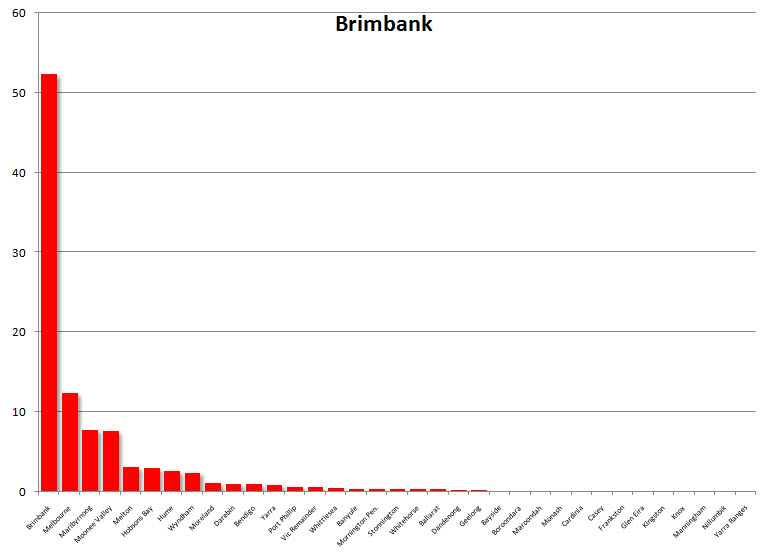
Where residents of Brimbank travel to (%)
The stereotype of people travelling long distances in Australian cities is wrong but persistent. The reality is that most trips are relatively close to home.
For example, the accompanying chart and map show that 52% of all weekday trips (all purposes, all modes) by residents of the middle suburban municipality of Brimbank in Melbourne’s west are made within the municipality. Further, 79% of trips are made either within Brimbank or to contiguous municipalities.
In fact more than 90% of trips by Brimbank residents can be accounted for if just one more destination – the city centre – is added to the list above.
This pattern also holds for the other parts of Melbourne.
More than 80% of trips by residents of Monash, Cardinia and Casey, for example, are likewise made within their home municipality or to neighbouring ones.
While another 8% of trips by Monash residents are to the city centre, the corresponding figure is less for far-flung municipalities – just 4% for Casey and less than 1% for Cardinia (see more charts below).
 It thus makes sense to think of a city like Melbourne as a number of regions rather than as a very big, singular entity. In terms of what people physically do within the urban area, there are multiple ‘Melbournes’.
Each little ‘Melbourne’ or region is centred on a home LGA and has a limited ‘home range’. The median weekday trip distance (all purposes, all modes) for residents of Cardinia is 3.7 km. Monash is 4.9 km and Brimbank is 6.3 km.
For the great bulk of residents, metropolitan Melbourne is more of a construct – an idea – than something that has a real presence in their day-to-day lives. With the exception of the city centre, few people venture much beyond their own region.
This limited ‘home range’ is a product of many forces. In the case of the inner city municipalities – Melbourne, Yarra and Port Phillip – the predominance of professional jobs and social attractions in the city centre is an obvious and powerful factor. The median weekday trip distance for residents of Yarra is 2.8 km.
For the great bulk of the population who live in the suburbs, the factors explaining this limited geography would include the suburbanisation of jobs (more than 80% of jobs in metropolitan Melbourne are outside the CBD), slower travel speeds on roads due to increasing traffic and the desire to live close to family and friends.
It’s natural therefore to emphasise the importance of regions and devise typologies like The Age uses in its real estate pages e.g. inner east, outer east. But that assumes a community of interest at the regional level. And it assumes it can be defined within fixed boundaries. Read the rest of this entry »
Did poor public transport give Baillieu the election?
Posted: December 4, 2010 Filed under: Public transport | Tags: Election Victoria 2010, electorates, Frankston line, punctuality, rail, swing, trains Leave a comment
Seats won by Coalition (dark blue)
Now that the dust has settled, there seems to be a solid consensus in many quarters that public transport was the key factor in the demise of the Brumby Government. There’s no doubt it was important, but perhaps it wasn’t as significant as assumed.
The most frequently cited example involves the loss of four seats in particular – Bentleigh, Mordialloc, Carrum and Frankston – which neatly follow the path of the Frankston rail line. See the first chart (dark blue seats were won by the Coalition from Labor).
Frankston is the least punctual line in Melbourne, with only 71.2% of trains running on time (i.e. within 5 minutes of the scheduled time) over the 12 months to September, with a low of 62.6% in May. In fact these appalling statistics gild the lily – conditions on all lines are far worse than the official figures indicate.
As I pointed out back in July, train punctuality is measured over a 24 hour period, whereas the great bulk of passengers travel in the peak. Most delays occur in the peak because the headway between trains is considerably shorter than in the off peak and there is therefore much less margin for error.
Thus the way punctuality is measured does not describe accurately the experience of most passengers because it measures the proportion of trains delayed, not the proportion of passengers delayed. Peak period punctuality on the Frankston line in May must have been truly shocking. It should consequently surprise no one that trains were a serious issue in these electorates.
Yet Labor did not lose any electorates north of the Yarra even though, for example, punctuality averaged only 78.4% on the Werribee line over the last year and fell as low as 70.4% in March. Nor did Labor lose any electorates on the Pakenham line which, with a 12 month on-time average of just 72.5% and a low point of 63% in March, rivals the Frankston line for poor punctuality. Read the rest of this entry »
Is Victoria’s new public transport authority just the beginning?
Posted: December 2, 2010 Filed under: Public transport | Tags: management arrangements, Minister for Public Transport and Roads, Ted Baillieu, Terry Mulder, Victoria, Victorian Public Transport Development Authority 10 CommentsEstablishing the Victorian Public Transport Development Authority before Christmas is a smart move by the new Government. Such early action signals its commitment to tackling the problems with public transport.
But the Premier and the Minister for Public Transport should not get too carried away – as so many others have – with the idea that changing management arrangements is the silver bullet we’ve been waiting for.

Setting up the new authority is neither a sufficient nor even a necessary condition for addressing the problems of public transport. What matters above all else is getting the right leadership, the right policies, the right resources and the right people.
The people aspect is by and large the least problematic area for improvement. Of course there are exceptions, but the great bulk of senior public servants across Australia at both Federal and State level are intelligent, committed, practical and hard working executives.
It should be no surprise to anyone that the weak link in the quality of public administration in Australia isn’t usually the public servants but rather the politicians. As clever as it was, I think the TV series, Yes Minister, did public administration a great disservice by portraying the public service as self interested and manipulative – and politicians as hapless and dim witted.
Why is public transport patronage increasing?
Posted: December 1, 2010 Filed under: Public transport | Tags: Brisbane, patronage, Perth, petrol price, population growth, Public transport, South East Qld, Sydney, traffic congestion 9 Comments
Public transport patronage growth in Australian cities (chart by Chris Loader)
As the accompanying chart shows, public transport patronage has grown sharply in some of Australia’s capitals this past decade but the rate of growth has generally slowed significantly over the last 18 months.
We’re accustomed to thinking that growth in patronage is driven by higher petrol prices but the chart indicates the explanation is probably more complex.
In particular, the considerable differences between cities suggest that one single factor is unlikely to provide a satisfactory explanation. Patronage grew spectacularly in South East Qld, Perth and Melbourne, but was modest in Greater Sydney and unremarkable elsewhere.
It needs to be borne in mind that all of this growth is from a relatively small base. For example, public transport’s share of all motorised travel (weekday and weekend) in Melbourne is even now only around 11%. This is only slightly lower than Sydney’s. Perth is likely to be only around half Melbourne’s level and Brisbane somewhere in between.
The usual suspect when looking at increasing public transport patronage is higher petrol prices. However if that were the key factor we’d expect a more uniform pattern of growth across cities. Canberra has one of the highest levels of car use of all capitals, yet public transport patronage in the nation’s capital barely moved over the period. The same is true of rising traffic congestion. Sydney would have to figure much more prominently if this were the key driver. Read the rest of this entry »
Are Melburnians mad about trains?
Posted: November 18, 2010 Filed under: Airports & aviation, Public transport | Tags: Avalon Airport, Martin Pakula, promises, rail, Ted Baillieu, Tullamarine, Victoria election 2010 19 Comments
Sir Ken Robinson - animation on changing paradigms in education (click)
Yesterday’s promise by the Victorian Opposition to build a $250 million rail line to Avalon Airport – with an unambiguous commitment to spend $50 million over the first term if elected – confirms how powerful the idea of rail is in this year’s election.
A new line is such a potent idea that Ted Baillieu didn’t even feel the need to lay out the warrant for the line. While the Greens are promising vapourware and the Government is close to mute on transport, the Coalition has put a real rail line on the table.
The Minister for Transport, Martin Pakula, made some lame criticisms of the accuracy of Mr Baillieu’s costing, but there are larger failings with this idea.
The most obvious one is it’s simply not warranted by patronage. Given that the numbers don’t make sense (yet) for a rail line from the CBD to Tullamarine, it’s highly unlikely they’re going to add up for a small operation like Avalon. Geelong’s population of 175,000 offers growth potential for Avalon, but Tullamarine is always going to overshadow it because it’s much closer to the centre of gravity of Melbourne’s 4 million population.
Today’s listed flights (18 November) show only 13 scheduled departures from Avalon between 6.45am and 9.55pm. Avalon’s owner, Linfox, claims 1.5 million passengers use Avalon each year. This compares with 26 million p.a. using Tullamarine. Read the rest of this entry »
Are Melbourne’s trains really dangerous?
Posted: November 16, 2010 Filed under: Public transport | Tags: andrew leigh, Auditor General, police, safety, security, trains 4 Comments
"You are not alone" - discouraging suicide in Belgrade (click)
Personal safety on trains is a big election issue. Both major parties have promised to increase transit police numbers and to return more staff to stations.
This is not a beat up. Fear about personal safety – whether real or imagined – could seriously undermine usage of Melbourne’s trains, especially in off-peak periods. There’s a danger that negative perceptions will reach a ‘tipping point’ and assume epidemic proportions.
If the money proposed to be spent on building and operating a Doncaster rail line were instead devoted to improving security on the entire train system, I’ve little doubt it would give a much bigger pay-off in terms of replacing car trips with train.
But that highlights the other big issue with security – it adds significantly to the cost of running the train system.
The Government has promised an extra 100 transit police and 180 staff to provide a “presence” at all metropolitan stations. The Opposition is promising two armed police protective services officers on every one of Melbourne’s 200 plus stations after 6pm.
The Auditor General says there isn’t really a problem – passengers are apparently over-reacting. The number of crimes on the rail system remained constant over the last five years even though patronage grew 50%. Crime fell from 45 offences per million boardings in 2005-06 to 33 in 2008-09.
Yet in spite of these favourable numbers, perceptions of personal safety on trains and at stations have deteriorated over the same period. The proportion who rated the rail system as safe declined from 55% in 2005-06 to 51% in 2008-09. In contrast, perceptions of personal safety on buses were constant at around 71% over the period.
Train users might be delusional or irrational, but I doubt it. Read the rest of this entry »
Is the Opposition’s promised airport rail line good policy?
Posted: November 15, 2010 Filed under: Airports & aviation, Public transport | Tags: Airtrain, Melbourne airport, rail, Skybus, Tullamarine 13 Comments
What New Yorker's complain about - NOISE!
The Age reported today that the Opposition has promised to start planning immediately for a new rail line from the CBD to the airport if elected. The leader of the Opposition, Mr Ted Baillieu, said tickets would be priced the same as current Zone 2 fares.
I’m not at all surprised. This idea has immense popular support from readers of The Age and, I daresay, from Melburnites generally.
There is little doubt that a time will come, given projected passenger numbers through Tullamarine, when passenger volumes will justify replacing the existing privately-owned Skybus service with rail.
But the available evidence indicates that time hasn’t come. Not yet. I’ve previously outlined the case against constructing an airport rail link at this time (here, here, here, here, here, here and here), but in summary the key objections are: Read the rest of this entry »
Does the Green’s public transport plan cut it?
Posted: November 14, 2010 Filed under: Public transport | Tags: Doncaster rail line, Public Transport Plan for Melbourne's East, The Greens, The People Plan, The Sunday Age 20 Comments
Click to hear accents from world cities
Following my review of the Greens’ Public Transport Plan for Melbourne’s East (here and here) some Green’s supporters have suggested that I should really look at the party’s broader public transport vision for Melbourne.
They’ve suggested I should examine The People Plan, which the Greens bill as their “long term vision of the Melbourne we want to live in”. It’s intended to avoid good long-term policy losing out to short-term politics.
During the week The Sunday Age also asked me about the Greens transport policies, so all in all it seemed timely to visit The People Plan.
So I have. And I’m gobsmacked. There’s barely a space on the map where the Greens aren’t proposing to run a new rail line or a new tram line, build a new station or duplicate, triplicate and quadruplicate rail lines. The scale of this plan is epic. The main components seem to be:
- 10 new rail lines
- Close to 40 new rail stations
- Extension of four rail lines (electrification)
- The aforementioned expansion of track capacity (duplications, etc)
- 30 new trains
- 12 new tram lines
- 12 extended tram lines
- 550 new trams
- Conductors on all trams
All of this, the Greens say, can be bought for a mere $13 billion plus additional operating costs of $333 million per annum.
I applaud the objective of making Melbourne a more liveable, sustainable and equitable city. Melbourne definitely needs better public transport. But whether this Plan is the best way of achieving that objective is doubtful. Here’s why. Read the rest of this entry »
Is management of public transport a mess?
Posted: November 9, 2010 Filed under: Public transport | Tags: coordination, flowchart, Greens, management, PTUA, Public transport, Public Transport Users Association, State Election, Victoria 10 Comments
Who is responsible for public transport? (PTUA)
It seems the way management structures and processes are arranged is still the key public transport solution being advanced in the Victorian election campaign.
The first three points in the Green’s Six Point Transport Plan all relate to governance and management. Now the Public Transport Users Association (PTUA) has released this chaotic flowchart with the charge that “a hundred different organisations are running public transport in Victoria” (see first graphic).
The PTUA says the flowchart illustrates how difficult it is for the average person to work out who to contact with questions and problems. This is a brilliant and no doubt effective piece of politics, building on the glorious history of spaghetti diagrams like Barry Jones’ famous Knowledge Nation vision.
As I’ve argued before, I think management arrangements are a second order issue – there’re more important things to get right first. And I’m by no means arguing that current arrangements are ideal or can’t be improved.
But there are a number of reasons why this flowchart is not a fair and reasonable account of the way transport is managed in Victoria.
First, as pointed out by a commenter (Invincible) over at Skyscrapercity.com, this is a deceptive diagram – flow charts usually flow from top left to bottom right, otherwise they will always look misleadingly complex. Invincible has redrawn the same information in a more logical flow, producing a vastly simpler diagram (see second graphic). Read the rest of this entry »
Is Qantas shirking its corporate responsibilities?
Posted: November 8, 2010 Filed under: Airports & aviation, Public transport | Tags: Airbus A380, Boeing 747, Channel Nine, density, Exxon Valdez, fuel dumping, Gulf of Mexico, Moscow, Qantas Leave a comment
Socialist city - Moscow's density increases the further you get from the centre!!!
There’re a couple of letters in today’s issue of The Age (8/11/2010) related to Qantas’s A380 problems that I think illustrate a tendency to over-egg the corporate responsibility pudding.
A Peter Tregear of Brunswick is surprised that on a recent flight from Hobart to Melbourne, Qantas’s in-flight news service did not cover the serious engine trouble the airline was having at the time with the A380 Airbus.
He wonders if the news provider, Channel Nine, came under pressure from Qantas to excise the story or whether it was self-censorship by the network. Either way, he concludes, it’s not a great moment for either journalism or corporate honesty. He asks if Qantas has something to hide.
I would say the last thing some passengers want to hear about while they’re mid-flight is the vulnerability of flying. A flight from Hobart is likely to have more occasional flyers who might have some fear of flying than (say) flights on the Sydney-Melbourne routes that have many frequent business travellers.
This story dominated the terrestrial news so I don’t think passengers wouldn’t have known about Qantas’s problems before they boarded. And the in-flight news is invariably so out of date so it would be hard to argue passengers were being denied ‘new’ information. Read the rest of this entry »
Will changing management arrangements give us better cities?
Posted: November 7, 2010 Filed under: Management, Planning, Public transport | Tags: Grattan Institute, Hunter District Water Board, John Paterson, management arrangements, MMBW, organisation, Paul Landa, structure, Vicroads, water pricing 7 Comments
Counting votes - Federal election 2010
Almost everybody, it seems, from political parties to academics, think tanks and planning experts, reckons the key priority for improving planning and public transport in Melbourne is to reform the way they’re managed.
The clamour for revised governance arrangements in order to effect reform has been increasing in Melbourne, with groups like the Committee for Melbourne, the Greens, the Public Transport Users Association and the Committee for Economic Development of Australia agitating for change.
It’s therefore sobering to see the Grattan Institute pointing out that reformed governance arrangements are not a silver bullet. The Director of the Institute’s Cities program, Jane-Frances Kelly, makes the point that:
the evidence from successful overseas cities does not support the idea that changing governance structures will help. In the successful cities we examined, no one type of governance was dominant. Unnecessary changes to governance structures can also be a distraction from the things that are vital. In short, changing structures is no cure-all. Read the rest of this entry »
Does the Opposition’s pitch on Doncaster rail stack up?
Posted: November 4, 2010 Filed under: Public transport | Tags: Banyule, City of Melbourne, Doncaster rail line, election, Liberal Party, Maroondah, Ted Baillieu, The Greens, Victoria, Whitehorse 24 Comments
San Francisco bans the Happy Meal!
So now the Victorian Opposition has jumped on the Green’s bandwagon and proposed a new rail line along the Eastern Freeway from Clifton Hill to Doncaster!
Ted Baillieu has made an art form of ‘vagueing’ the details, but this is essentially the same proposal as the Greens put forward last month for linking Doncaster with Victoria Park station.
I dealt with the shortcomings of this idea last week (here and here) so I’ll just look at a claim made in The Age that the City of Manningham has low public transport use.
This is attributed to the absence of both trains and trams in Manningham – the only municipality in Melbourne that doesn’t have at least one of these modes.
The reporter, Clay Lucas, says that only 7% of all trips made by residents of Manningham are by public transport compared to the metropolitan Melbourne average of 9% (actually he said 14% but the VISTA travel survey indicates the correct figure is 9%. Note also that this claim does not appear in the on-line version of The Age).
He is right – public transport does indeed have a lower share of trips in Manningham. In fact VISTA shows its share compares poorly with the neighbouring municipalities of Whitehorse, Banyule and Maroondah, which all have rail lines. In these municipalities, public transport carries 10%, 11% and 7%, respectively, of all trips. Still, there’s not all that much in it – the car dominates in all four.
The journey to work is probably a more pertinent measure of the warrant for a rail line to the CBD as peak period passenger volumes determine the need or otherwise for a mass transit system. Read the rest of this entry »
 The Melbourne Urbanist