Is the Auditor-General on-track with cycling?
Posted: August 20, 2011 Filed under: Cycling | Tags: Cycling, efficiency and effectiveness review, Victorian Auditor-General, Victorian Cycling Strategy 12 Comments
Bikes of San Francisco - I wish someone had thought to do this for Melbourne
It’s a long time since I’ve read an official report as both extraordinary and disappointing as the report released last week by the Victorian Auditor-General, Developing cycling as a safe and appealing mode of transport.
This effectiveness and efficiency review of the former government’s 2009 Victorian Cycling Strategy is extraordinary because it takes the Brumby government to task for its extravagant claim that the Strategy would “grow cycling into a major form of public transport”, but then failed to put in place the steps the Auditor-General believes are necessary to achieve this ambitious goal.
He makes it clear the sorts of actions he thinks are required are those pursued since the 1970s in countries like Denmark, The Netherlands and Germany where bike’s mode share is now as high as 38% of all trips (but also as low as 3% e.g. Wiesbaden). Those actions include education and promotion, but the key ones are segregating cyclists from cars and making cars slower and less convenient.
As I read the Victorian Cycling Strategy – which is only 20 months old – this sounds like a bit of fit up, but since the Department of Transport has signed off on the Auditor-General’s review, I’ll let that lie.
Governments in Victoria might need to be careful. Judging by this report the Auditor-General seems to be in no mood to tolerate the entrenched practice of blithely setting exaggerated and inflated goals with little real commitment or accountability for realising them. On the other hand, the Baillieu government has “discarded” the Strategy, so perhaps that emboldened the Auditor-General in this particular instance.
Either way, I applaud the Auditor General for his evident intolerance of bullshit (I hope he takes the time to compare some of the purple prose written about public transport against what’s actually being done in practice). Governments should and can do much more to promote cycling. So far there’s lots of lip service but not much action.
But having said that, the Auditor General’s report is also disappointing because its not without its own failings. For a study that cost nearly $400,000, it is a surprisingly lightweight document. I have to hope there’s much more to it, but quite frankly it reads like someone merely got the Department of Transport to run some basic data off VISTA and read Pucher and Buhler’s influential paper, Making cycling irresistible. If there were such a thing as an audit of Auditor-General’s reports, I reckon this one would be found wanting.
I was doubtful of the report’s technical quality from the get-go when I read the claim in the first paragraph that “cycling offers benefits over other forms of transport because it reduces traffic congestion…”. No it doesn’t, no more than building freeways or improving public transport do. What cycling can do is increase the number of people who can get to a destination despite traffic congestion – which is a huge positive – but it won’t reduce congestion.
A key criticism the report makes is the Strategy prioritises inner city work journeys over other trips. Since 78% of car journeys up to 4 kilometres long (and 80% of car journeys between 4 and 10 kilometres) are in middle and outer Melbourne, the Auditor-General reckons the Strategy should have addressed this potential more vigorously. This simplistic view is symptomatic of much of the report. What it fails to recognise is the necessity of prioritising scarce resources like money and political capital. The fact is inner city work trips in the Melbourne of today are more amenable to cycling than suburban shopping trips.
Another shortcoming is the presumption that to grow cycling into a major form of transport we can and should do exactly what successful European cities like Copenhagen have done. But is “a major form of public transport” the 37% of all trips that Groningen has achieved, or the 3% of Wiesbaden? This is the Auditor-General and he’s finding fault with government policy – expecting some measure of precision isn’t unreasonable.
The fact that those cities have much higher bicycle use than Australian or US cities is a very important and pertinent piece of information, but it doesn’t automatically follow that if we do what they’ve done we’ll get the same outcome. In fact it doesn’t even follow that it’s practical, realistic or feasible for us to do what they’ve done.
There’s a long history of assuming what works overseas will work here. For example, in common with many other countries, Australian governments and universities have attempted many times over the last 30 or so years to replicate the success of places like Silicon Valley by establishing technology parks close to universities. Yet every analysis I’ve seen has shown these attempts to be unmitigated flops – at best, we’ve ended up with cookie-cutter business parks rather than the anticipated hotbeds of innovation fuelled by university-business interaction. The fact is places like Silicon Valley are the result of a very special set of circumstances that can’t easily be replicated elsewhere. Read the rest of this entry »
A literary map of Melbourne’s railways?!
Posted: August 18, 2011 Filed under: Books, Public transport | Tags: Cloud Atlas, David Mitchell, Ghostwritten, literature, London, Neville Cardus, railways 5 Comments
Amimation: London rail network - pulse of the city (not 'literary' but interesting nevertheless)
The English cricket writer, Neville Cardus, is famous for bringing a literary sensibility to the hitherto prosaic task of reporting on the game. International cricketer John Arlott said, “before him, cricket was reported … with him it was for the first time appreciated, felt, and imaginatively described”.
British novelist David Mitchell may be the Neville Cardus of the railways (not the very talented comedian of Mitchell & Webb fame – this is the David Mitchell who wrote the incomparable Cloud Atlas). I recently read his first novel, Ghostwritten, and was struck by the richness of the way one of the characters in the novel describes the London Tube:
As the fine denizens of London Town know, each tube line has a distinct personality and range of mood swings. The Victoria Line for example, breezy and reliable. The Jubilee line, the young disappointment of the family, branching out to the suburbs, eternally having extensions planned, twisting around to Greenwich, and back under the river out east somewhere. The District and Circle Line, well, even Death would rather fork out for a taxi if he’s in a hurry……
Docklands Light Railway, the nouveau riche neighbour, with its Prince Regent, West India Quay and its Gallions Reach and its Royal Albert. Stentorian Piccadilly wouldn’t approve of such artyfartyness, and nor would his twin uncle, Bakerloo. Central, the middle-aged cousin, matter-of-fact, direct, no forking off or going the long way round…….
Then you have the Oddball lines, like Shakespeare’s Oddball plays. Pericles, Hammersmith and City, East Verona Line, Titus of Waterloo……
London is a language. I guess all places are.
There’s lots more. The Northern Line “is the psycho of the family”. Kennington Tube Station is the sort of place “where best-forgotten films starring British rock stars as working class anti-heroes are set”.
Makes me wonder how, given some literary license, the essence of Melbourne’s public transport system might be captured. I know if my local station were a country, it would be cold war Russia; if it were a language it would be Pidgin English; and if it were a mental state it would be deeply depressed.
I’m already imagining a “literary map” of Melbourne’s rail network where every station is a novel – I’ll start by renaming Dandenong to Brighton Rock; Collingwood to Power without glory; Northcote to The slap; Parliament to Wolf Hall; Ringwood to The satanic verses; Toorak to Bonfire of the vanities; Eaglemont to Middlemarch;……. Read the rest of this entry »
Have buyers abandoned McMansions (forever)?
Posted: August 17, 2011 Filed under: Housing | Tags: CEDA, house size, Housing, Mark Hunter, Mark Quinn, McMansions, Stockland, UDIA 4 Comments It only seems like yesterday we were told Australia had the largest new houses in the world (e.g. see here and here). Now it seems we’ve seen the error of our ways. According to this press report, the head of residential communities at property developer Stockland, Mark Hunter, has no doubt the era of ever-growing McMansions is over – he expects home sizes to shrink as fast as they grew in the first decade of this century. Mr Hunter is reported as saying three-bedroom, two bathroom houses are the new sweet spot in the market:
With power prices increasing, people want more efficient homes and are happy to sacrifice extra bedrooms, rumpus and media rooms and make do with a single open-plan living and dining area opening onto an outdoor area.
Stephen Albin, the chief executive of the Urban Development Institute of Australia, says the trend to shrinking new home sizes is only just beginning:
I think there’s a massive shift going on and we are at the front end of it. People are starting to realise a five-bedroom house has other costs, from the amount of leisure time you lose maintaining it, to heating and cooling, and you are going to start to find we are at the front end of that shift
He sees a permanent change in Australians’ preferences. “The McMansion’s days are numbered”, he asserts, “just look overseas and see what’s happening”.
In a recent address to CEDA, the CEO of Stockland, Mark Quinn, argued that people are choosing less debt over having five bedrooms and a separate dining room they use once a year at Christmas. People are more patient now, he said, and rather than seek instant gratification they “prefer to wait and have less debt”.
Have Australian fringe buyers really lost their taste for big houses virtually overnight? And is this really a permanent change – is it a “paradigm shift”? Only a few months ago we were debating in these pages home buyers’ preference for seemingly ever-larger dwellings!
I’m hard pressed to see it. Sure, electricity prices – which really could drive a permanent shift toward downsizing – look like they’ll keep rising, but as I’ve pointed out before, there have been massive improvements in the operational energy efficiency of new detached houses over the last ten years. The per capita operating energy required by the average new greenfield dwelling in 2008 was about a third lower than it was in 2000. In fact it was lower than it was in 1960, nearly 50 years earlier, notwithstanding the size of the average new greenfield dwelling more than doubled over this period.
The latest edition of Property consultant Oliver Hume’s Survey of purchaser sentiment in Melbourne’s Growth Areas doesn’t suggest buyers tastes have changed. When the company asked land buyers what size house they intended to build, the proportion who said greater than 279 sq m was the same in June 2011 (30%) as it was in December 2010 (Oliver Hume say the actual size buyers end up building is about 50 sq m smaller). Read the rest of this entry »
Should replacing level crossings be given higher priority?
Posted: August 16, 2011 Filed under: Cars & traffic, Public transport | Tags: Brian Negus, bridge, Committee for Melbourne, development rights, grade separation, level crossing, overpass, PTUA, RACV, rail, surplus railway land 14 Comments
Hot wheels metropolis (1200 cars, but no trains)
The Committee for Melbourne has called for a $17.2 billion program to remove all Melbourne’s level crossings over the next 20 years.
The Committee says just two separations of road and rail were constructed by the Kennett government and two by the Bracks/Brumby government. While Melbourne has 172 level crossings, Sydney tackled the issue years ago and now has only eight.
However the Baillieu government has given an undertaking to grade-separate ten crossings at an estimated cost, on average, of around $100 million each. The Committee reckons the private sector could pay a big chunk of the $17.2 billion cost in return for the commercial rights to each site, although the Herald-Sun warns such a move would very likely “be fiercely opposed by anti-development groups”.
There’s a lot to be said for giving a higher priority in the transport capital works program to eliminating level crossings, as they present a number of problems. One is they slow traffic, including buses and trucks. According to the RACV’s public policy manager, Brian Negus, crossings along the Dandenong line are closed for 30-40 minutes an hour during the peak, exacerbating traffic congestion. This is likely to become a bigger problem as the share of public transport trips carried by buses increases. The interaction between crossings and nearby signalled junctions is a major barrier to the efficient performance of the transport network.
Level crossings also impose a limit on the frequency of train services. There are only so many trains that can realistically be sent down a line given each service entails stopping traffic in both directions for well in excess of one minute (in Newcastle, crossings are closed on average for passenger and freight trains for between three and seven minutes!). Some crossings are forecast to carry nearly 40 trains per hour in the peak by 2021. Another issue is traffic queuing across rail lines — as well as the occasional car/train incident — limits the efficiency of the network. Further, level crossings are a safety hazard for pedestrians and give parents a reason to discourage children from walking to school.
While I’ve not seen an analysis for Melbourne, there’s little doubt the benefit-cost ratio of level crossing elimination would be very high. I expect it would be well ahead of some other much larger transport projects, such as the Avalon, Doncaster or Rowville rail proposals.
There are nevertheless a number of issues raised by this proposal. One is the need to prioritise works – some crossings are relatively minor and simply don’t warrant expenditure in the forseeable future. Probably 80% of the benefits will come from grade separating 20% of crossings. Back in 2009, the Public Transport Users Association argued these ten crossing should be given the highest priority, given their impact on road-based public transport:
- Bell Street and Munro Street, Coburg (one project) (Smartbus 903)
- Springvale Road, Springvale (Smartbus 888/889)
- Bell Street, Cramer Street and Murray Road, Preston (one project) (Smartbus 903)
- Glen Huntly Road and Neerim Road, Glenhuntly (one project) (Tram 67, and trains subject to speed restrictions)
- Balcombe Road, Mentone (Smartbus 903)
- Buckley Street, Essendon (Smartbus 903)
- Clayton Road, Clayton (Smartbus 703)
- Burke Road, Gardiner (Tram 72, and trains subject to speed restrictions)
- Camp Road, Campbellfield (crossing elimination and new station) (proposed Smartbus 902)
- Glenferrie Road, Kooyong (Tram 16, and trains subject to speed restrictions)
That’s a particular perspective, yet it matches some of the RACV’s priorities. Last year the RACV said the four worst crossings in Melbourne are in High Street near Reservoir station, on Burke Road near Gardiner station in Glen Iris, on Clayton Road next to Clayton station, and Murrumbeena Road near the station. The Dandenong rail corridor also figures high in the RACV’s priorities.
I’m not sure there is as much value in development rights as the Committee for Melbourne imagines. Many level crossings, perhaps most, may not have enough suitable land available for development after meeting grade separation and operational needs. The most promising opportunities are probably where the rail line rather than the road has been lowered, but this can be expensive. Many of those that do have land available may be in locations considered unsuitable for development by planners. And let’s be clear that development in air space over railway lines is a fantasy – it’s simply too expensive in all but an extremely small number of cases. For practical purposes, development in air space is not an option. Read the rest of this entry »
Is Avalon side-tracking Tullamarine rail?
Posted: August 15, 2011 Filed under: Airports & aviation | Tags: Avalon Airport, aviation, China, Gordon Rich-Phillips, High Speed Rail, investment, Lindsay Fox, Melbourne airport, rail, Robert Doyle, Ted Baillieu 5 Comments
Some famous faces spruiking Avalon Airport to Chinese investors
The Baillieu Government is determined to press on with its election commitment to start construction of the $250 million rail link to Avalon Airport in its first term. The Premier did this nice photo op last week waving-in planes at Avalon.
The Age reporter, Andrew Heasley, took a clever line, asking how the Government could commit to Avalon while spending just $6 million on a feasibility study for a rail line to Melbourne Airport. That produced this bizarre explanation from the State’s Aviation Minister, Gordon Rich-Phillips, who effectively said Avalon is going ahead because it’s easier:
There are challenges around an airport link for Melbourne ……Avalon is a clearer project than Melbourne in terms of the logistics associated with doing it. The reality is.…the lack of development around its [Avalon’s] immediate vicinity makes a lot of those logistics questions at Avalon easier than they are for Melbourne….. We have committed to work at Avalon and we’ve committed to feasibility at Melbourne. We don’t have a project for Melbourne [Airport], we have a feasibility study for Melbourne.
While I admire Mr Rich-Phillip’s unusual and possibly courageous frankness, I can’t see that ease matters more than need. Otherwise we’d build new schools where it’s cheapest rather than where the population is growing. Or the Government would be putting Protective Services Officers in retirement villages rather than on rail stations.
I won’t go into depth about what a silly idea the Avalon rail link is because I discussed it only a few weeks ago (Is the Avalon rail link Baillieu’s folly?). Suffice to say that Melbourne Airport is 22 km from the CBD, is the second busiest airport in the country, and has enormous scope for expansion; Avalon is 55 km away, has just six scheduled flights a day, and has enormous scope for expansion. Even if a rail line were built to Avalon, you’d have to wonder what the frequency, hours of operation and ongoing financial losses would be – it’s got to be sobering that Brisbane Airport’s train stops running at 8pm. I don’t have any problem with Avalon Airport per se, my worry is why taxpayers have to kick in when there are better uses our dollars could be put to.
This fascinating PR video produced to market Avalon to Chinese investors (see exhibit) shows what a cast of famous characters are backing Lindsay Fox’s Avalon venture, from the Prime Minister to the Lord Mayor. I know some gilding of the lily should be expected, but seriously Robert Doyle, how could you say “Avalon is the gateway to Melbourne” with a straight face? And as if, Lindsay Fox, travellers using Avalon could continue to get “on a plane in five minutes” if it really did grow to the size you imagine and hope it will?
What I didn’t know until I viewed the video is the Victorian Government, according to the Premier, has “committed to build a fuel pipeline for jets” to Avalon. This is all on the back of Avalon being “Melbourne’s second international airport”. As I’ve said before, it’s time we were given some explanation for what a second international airport actually means – is it something more than a place for motor racing teams and pop stars to land their cargos once a year? No one is going to seriously believe they’ll transport Ferraris to Albert Park or amplifiers to Rod Laver Arena by rail. What’s the logic behind it? We need a clear explanation – in terms of quantified benefits – of why governments are apparently prepared to spend hundreds of millions on infrastructure for Avalon.
Of course, construction of Avalon rail will have minimal practical effect on the need for a rail link to Melbourne Airport, although it could conceivably have a big effect on whether the Government feels obliged politically to proceed with the latter project. What they both have in common however is that no considered case has yet been made for either one. However The Age’s story – subsequently taken up as fact by these letter writers to the paper – implies that rail to Melbourne Airport is automatically a good idea. It’s certainly an infinitely better idea than rail to Avalon (what wouldn’t be?), but it’s by no means obvious that it’s needed now, as I’ve pointed out a number of times before (see Airports & Aviation in Categories list in the sidepane). Read the rest of this entry »
Book giveaway – ‘1835: The founding of Melbourne’
Posted: August 13, 2011 Filed under: Books | Tags: 1835: The founding of Melbourne and the conquest of Australia, Black Inc., history, James Boyce Leave a comment I’ve got two copies of James Boyce’s new book, 1835: The Founding of Melbourne and the Conquest of Australia (RRP $44.95), to give away to readers of The Melbourne Urbanist thanks to the publisher, Black Inc.
All you have to do is tell me your favourite song that references or evokes Melbourne in some way and you’re in the running. To enter, just follow this link or go to Giveaways in the sidebar under the PAGES menu). Entries close midday, Thursday 25 August.
As usual, the quality of the song you choose doesn’t matter, because the winners will be chosen at random (if you’re stuck, Up There Cazaly will do). Still, it’s nice to show some taste and wit if possible. It would be wonderful to compile a comprehensive anthology of Melbourne-related songs from all eras.
If you’re one of the winners (and the odds are pretty good!), you’ll have to give the publisher, Black Inc., your address and they’ll post your bounty to you direct.
Here’s a summary of the book from the publisher:
In 1835 an illegal squatter camp was established on the banks of the Yarra River. In defiance of authorities in London and Sydney, Tasmanian speculators began sending men and sheep across Bass Strait – and so changed the shape of Australian history. Before the founding of Melbourne, British settlement on the mainland amounted to a few pinpoints on a map. Ten years later, it had become a sea of red.
In 1835 James Boyce brings this pivotal moment to life. He traces the power plays in Hobart, Sydney and London, the key personalities of Melbourne’s early days, and the haunting questions raised by what happened when the land was opened up. He conjures up the Australian frontier – its complexity, its rawness and the way its legacy is still with us today.
Here’s a review by Mark Rubbo from Readings. Here’s an interview with James Boyce that appeared in the Herald Sun and another he did on ABC Radio National’s Late Night Live.
And to whet your appetite, here from the author himself is a dozen things you may not have known about the founding of Melbourne: Read the rest of this entry »
Links for urbanists No. 2
Posted: August 11, 2011 Filed under: Miscellaneous | Tags: links, Sophie Cunningham 1 Comment
Assorted links to some of the useful, the informative, the interesting, and sometimes even the slightly weird sources I stumble across from time-to-time:
- A free copy of Sophie Cunningham’s new book, Melbourne, is up for grabs at The Melbourne Urbanist (hey, that’s here!). Entries close on Saturday,13 August, at midday. Virtually no effort involved, just enter. Damn good odds too!
- 18% of streets in London (2,800 km) have a 20 mph max speed limit. That’s 32 kph. The trend is upwards.
- World parking rates – Sydney and Melbourne are towards the top of the pile.
- The Washington DC Metro Authority is shortening unwieldy station names. They’re also looking at naming stations after landmarks only if they’re within walking distance. At present, some stations are more than an hour’s walk from the destination they’re named after.
- Cyclists can now run red lights legally in Virginia. Maryland is looking at a law which would allow cyclists to occupy a full lane of traffic. Conditions apply.
- Classic bicycle designs of the last century. Love the Eddie Merckx Corsa Extra Special Edition from 1990. Love those thin steel frames – can’t help feeling bike aesthetics have gone downhill since the advent of carbon.
- If we’re talking cycling we’re talking Cadel – Chiara Passerini.
- Mel Campbell praises the virtues of big box and superstore shopping. The chief virtue of Borders was its size and banality – the feeling that nobody is watching you. “I’ve felt scrutinised by staff in smaller bookstores”, she says.
- Kay Hymowitz explains why in the USA the gender pay gap will never go away. Ever. It’s got more to do with being a mother than with being discriminated against, she says.
- Why are uncles weird?
- The amazing architecture of Yemen. And who knew Yemen has over two hundred islands? Judging by these pictures, there might be more islands than trees.
- A history of Melbourne’s Green Wedges, from Peninsula Inc.
- The mathematics of cities, by Geoffrey West.
- Is it time to retire Jane Jacob’s vision of the city? A review of Edward Glaeser’s Triumph of the City.
- Glaeser reviews Anthony Flint’s book, Wrestling with Moses: how Jane Jacobs took on New York’s master builder and transformed the American city. The book is a couple of years old now but this has always been one of the most fascinating stories about cities
- A crash course in the potential of driverless cars.
- The New Urbanist playlist. Songs that evoke the spirit of new urbanism.
- Sprawl’s greatest hits. A history of urban protest songs. There’re a dozen more nominations in the Comments, including Ben Folds, Rockin’ the Suburbs; Storyhill, Paradise Lost; Descendents, Suburban Home; REM, Don’t go back to Rockville; and The Eagles, Last Resort. I’d add WA’s Dave Warner’s from the Suburbs for Just a Suburban Boy.
- What are the best Green Books? Cambridge academics have compiled a list of their top 50 books on sustainability. Embarrassingly, I’ve only read Collapse, Natural Capitalism and An Inconvenient Truth.
What causes urban riots?
Posted: August 10, 2011 Filed under: Social and community | Tags: Brendan O'Neill, Denise DiPasquale, Edward Glaeser, London, Los Angeles, Miami, riots, UK, Watts 29 Comments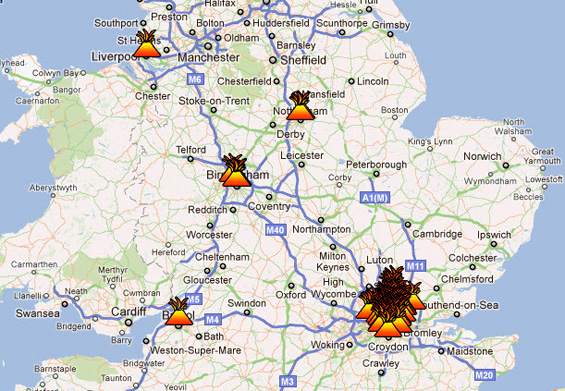
Location of verified riots, up to 6.00am 9 August 2011
British leftie, Brendan O’Neill, takes an unsympathetic view of the UK rioters in this article, London’s burning: a mob made by the welfare state. He dismisses popular explanations like racism, characterising the rioters as “welfare-state mobs” who are destroying their own communities.
Painting these riots as some kind of action replay of historic political streetfights against capitalist bosses or racist cops might allow armchair radicals to get their intellectual rocks off, as they lift their noses from dusty tomes about the Levellers or the Suffragettes and fantasise that a political upheaval of equal worth is now occurring outside their windows. But such shameless projection misses what is new and peculiar and deeply worrying about these riots. The political context is not the cuts agenda or racist policing – it is the welfare state, which, it is now clear, has nurtured a new generation that has absolutely no sense of community spirit or social solidarity.
Harvard economist Edward Glaeser (author of my last book giveaway, Triumph of the City) has a long interest in the causes and consequences of urban violence. In this paper, The Los Angeles riot and the politics of unrest, Professor Glaeser and colleague Denise DiPasquale examined the tragic history of post-war riots in the US (H/T Christian Dimmer, @remmid).
The LA riot of 1992 – sparked by the police beating of Rodney King – lasted three days and resulted in 52 deaths, 2,499 injuries, 6,559 arrests, 377 buildings completely destroyed and 222 seriously damaged. Seventeen people died and 400 were arrested in the two-day Miami riot in 1980. In 1965, a six-day riot in Watts resulted in 34 deaths, 1,032 injuries and 800 buildings damaged or destroyed.
DiPasquale and Glaeser examined the causes of rioting using international data, evidence from the race riots of the 1960s in the US, and Census data on Los Angeles, 1990. Their empirical results suggest high levels of ethnic diversity and unemployment among young black men, combined with the “sheer size” of LA, all help to explain the 1992 riot.
However they found little support for the notion that poverty is a major determinant of which cities riot. Nor did they find a connection between high levels of migration – a proxy for social capital – and rioting. They conclude that rioting is driven to some extent by the probability and size of punishment. An increase in the probability of arrest, they say, lessens the probability of a riot and its size. Individual costs and benefits matter.
We find some support for the notions that the opportunity cost of time and the potential cost of punishment influence the incidence and intensity of riots. Beyond these individual costs and benefits, community structure matters. In our results, ethnic diversity seems a significant determinant of rioting, while we find little evidence that poverty in the community matters.
Brendan O’Neill says the intrusion of the welfare state in the UK over the past 30 years “has pushed aside older ideals of self-reliance and community spirit”. The most striking thing about the rioters, he says, is how little they seem to care for their own communities – the violence is not political, but merely criminal: Read the rest of this entry »
Will the price of jet fuel go stratospheric?
Posted: August 9, 2011 Filed under: HSR High Speed Rail | Tags: Aviation Green Paper, Ben Sandilands, Decentralisation, High Speed Rail, HSR, John Quggin, Robert Merkel 5 Comments
Comparison of air fares and HSR fares used in the patronage demand forecasting modelling (one-way). NOTE: The clue to understanding this graph is the blue curve is business fares and the grey one is non-business fares
Ultimately, the bottom line in discussions about the warrant for High Speed Rail (HSR) always seems to come down to proponents’ certainty that the price of jet fuel will go stratospheric.
HSR won’t save time, won’t reduce fares, won’t increase economic activity, won’t promote decentralisation and is an extraordinarily expensive way to reduce carbon emissions – but if at the end of the day the cost of jet fuel means flying becomes ridiculously expensive, then, the argument goes, HSR is the only way of filling the breach.
There are a number of points to consider about this sort of scenario.
One is that while fuel is a significant part of the cost of flying, it’s not the whole story. At present, fuel comprises around a third of airline operating expenses, up from about 15% ten years ago. So a doubling in fuel costs will have a big impact, but it isn’t going to double fares – that would require fuel to quadruple in price (and other costs to remain constant).
Airlines could respond to higher fuel prices by finding ways to reduce their consumption of jet fuel. Aviation expert Ben Sandilands reckons “by 2036….jet fuel is realistically predicted to be at least 50% derived from algal or biological fuel substitutes….”. Others like Robert Merkel are not as convinced of the prospects for biofuels on the scale required. There’re plenty of “out there” proposals for alternative fuels and technologies (e.g. here and here) but they all look pretty speculative.
I don’t think alternative fuels have much potential at this stage but there’re better prospects in using jet fuel more efficiently. Although commercial jet aircraft speeds haven’t increased a lot over the last 40 years, the Aviation Green Paper says modern aircraft are 70% more fuel-efficient than they were in the late 1960s.
The current average fuel consumption of the world’s jet aircraft fleet is around 5 litres per 100 Revenue Passenger Kilometres (RPK), but this will improve as larger, more modern aircraft come into service. For example, a fully laden A380 consumes 3 litres per RPK and the new Boeing Dreamliner is claimed to be even better. Of course this is a mature technology so it’s unlikely historical efficiency gains can be carried forward at the same rate.
However not all experts expect fuel prices to go sky high. The Federal Government’s new High Speed Rail Study – Phase One report assumes both air and HSR fares will reduce by three per cent in real terms by 2015 and remain constant thereafter. Road vehicle operating costs on the other hand are assumed to increase in real terms by eight per cent to 2036 and by a further four per cent to 2056. None of this suggests the apocalypse is nigh.
There’s very little in the report elaborating on these assumptions but it’s as well to remember that the peak oil hypothesis does not mean an immediate end to oil production. Rather, as John Quiggin says, it means a gradual decline over 100 years or more (international oil production has been stable for the last seven years). Read the rest of this entry »
Are planning regulations making retailing uncompetitive?
Posted: August 8, 2011 Filed under: Activity centres | Tags: City of Darebin, GST, internet shopping, Northland, Productivity Commission, regulation, retail, vsion, zoning 20 Comments
City of Darebin's draft Vision for Northland
I agree with Australia’s retailers and the Productivity Commission that imported internet purchases valued at less than $1,000 should be subject to GST. But I only agree in-principle.
The trouble is, as the Productivity Commission’s report on retailing released last week shows, the administrative effort required to levy the GST would cost more than the tax would raise in revenue.
But the GST is really just a distraction – the underlying malaise of Australia’s retail sector runs far deeper. The Commission says retailers operate under several regulatory regimes that reduce their competitiveness. It nominates three major restrictions which require improvement:
Planning and zoning regulations which are complex, excessively prescriptive and often exclusionary
Trading hours regulations (in some States) which interfere with the industry’s ability to adapt and compete in a more globalised market
Constraints on workplace flexibility such as obstacles to the greater use of enterprise bargaining and the adoption of best practice productivity measures
Retail hasn’t historically been trade-exposed, so it hasn’t had to work hard at being competitive. Up until now, international suppliers have even been able to practice blatant price discrimination. But the internet has changed the game. Consumers can now compare what they’re paying for many products locally with what it costs to import them from overseas markets.
The impact of planning regulations on the viability of domestic retailing is of course of particular interest to The Melbourne Urbanist. The Commission notes that the ability to maintain a competitive and healthy retail sector is vitally dependent on the ability of new retail formats to gain entry to Activity Centres. A number of studies have shown that preventing the development of new retail formats lowers productivity, reduces employment and raises prices to consumers.
The Commission finds a number of barriers to entry, including limits on the size and scope of centres, prescriptive planning requirements and excessive scope for firms to establish local monopolies and maintain them by excluding new entrants, either with the implicit cooperation of planning agencies or through the courts. The Commission recommends that:
Activity Centres should be large enough in terms of total retail floor space and broad enough in terms of allowable uses to facilitate new retail formats locating in existing business zones
Prescriptive planning requirements should be significantly reduced to ensure competition is not needlessly restricted
The impact of new entrants on the viability of existing retail businesses should not be considered at any stage in the rezoning or development assessment process. This issue should only be considered at the strategic planning stage
The focus should shift to “as-of-right” development processes to reduce uncertainty and minimise the scope for gaming of the system by commercial rivals
Courts should be able to award costs against parties who are found to be appealing for non planning reasons
It’s interesting and illuminating to read the Commission’s report and at the same time look at what the City of Darebin is proposing in this report for the future development of Northland, a “hard-top” shopping centre (mall) with nearby “big-box” retail facilities at Preston, about 11 km north of Melbourne’s CBD. The exhibit above shows Council’s proposed vision for the centre and surrounding uses. Read the rest of this entry »
How important are the regions for HSR?
Posted: August 7, 2011 Filed under: HSR High Speed Rail | Tags: AECOM, air services, Anthony Albanese, aviation, High Speed Rail, HSR, regions, SKM, train 8 Comments
HSR - passenger loadings 2036 (from High Speed Rail Study - Phase One Report)
The exhibit above is one of the ‘money’ graphs from the High Speed Rail study – Phase One report released on Thursday by the Minister for Transport, Anthony Albanese. In my last post, I concentrated on doing a broad but quick response to the report and questioned the wisdom of spending mega dollars on a project that doesn’t reduce either travel times or the cost of travel.
Now I want to start exploring some issues the report raises. One of those is that, up to this point, the focus of the HSR discussion has largely been around travel between major cities, especially Sydney-Canberra-Melbourne, with some residual claims for regional development (see Categories in the side pane for previous posts on HSR).
The Phase One report however shows regional trips are a very large component of the travel forecast on the complete Brisbane to Melbourne HSR network in 2036. In fact regional travellers – those who are journeying between regional areas and one of the major cities – comprise an extraordinary 75% of forecast demand in 2036 (see exhibit). These are the sorts of trips that are almost all currently made by car. A significant proportion are also “induced” trips – in the absence of HSR and the greater accessibility it provides, they wouldn’t otherwise be made.
Only a small proportion of regional trips are for business purposes. The vast majority – 85% – are for private or leisure purposes i.e. to visit friends or relatives, holidays, entertainment, sport, shopping, education, personal or health-related purposes. The study assumes leisure passengers will pay a lower fare than business travellers (who are concentrated on the inter-city services, e.g. Sydney-Melbourne, where they account for 50% of passengers).
Regional trips are also shorter on average (they comprise half of all HSR passenger kilometres), so the contribution of regional travellers to total revenue is much lower than their 75% share of patronage. Even so, as with airlines at present, their contribution is vital.
There are a number of issues raised by the high level of forecast regional patronage. One is that leisure travellers are sensitive to the cost of travel. The study assumes HSR fares are pitched a little lower than air fares, but if this assumption proves optimistic the demand for HSR could be much lower. Unfortunately there’s no estimate provided for regional travellers, but for inter-city travel the study says a 10% increase in fares will reduce patronage by 10%, and vice versa.
In estimating demand, the study compares the cost of travel by HSR between the regions and the major cities against the car, but doesn’t allow for the usefulness of having a car when travelling within the big smoke. HSR will certainly suit people going (say) from Seymour to the MCG – they can drive to their nearest HSR station (they’ll be about 100 km apart in the regions), disembark at Southern Cross and take a local train/tram combination to get to the G. If however they’re not going to the city centre – perhaps they’re attending a wedding, a party or staying overnight with one of the 90% of the population who lives more than 5 km from the CBD – they might prefer the convenience of having a car for travel within Melbourne.
The car will be a more attractive option the closer regional residents live to the city, although anyone familiar with Canberra will know of the large numbers of young people who commonly drive to Sydney on weekends. Another thing to note is car occupancy for leisure travel is much higher than it is for commuting (where solo driving predominates). Two people travelling (say) to Sydney from Gosford for a concert would pay $26 each per one-way trip on HSR i.e. a combined total of $104 to get to and from Central station. Once the novelty of HSR has subsided, driving could be a more attractive alternative for many.
The big issue to my mind though is just why we as a society would want to spend so much money to improve the leisure travel options of regional populations living along Australia’s east coast. Doubtless they deserve it and would appreciate it, but they already have pretty reasonable travel choices. Last time I drove the Hume Highway from Sydney to Melbourne (about five years ago) it was divided carriageway practically all the way. Large centres like Wagga Wagga and Albury-Wodonga have pretty good air connections to Sydney and Melbourne. There’s already (an admittedly slowish) train service connecting Brisbane, Sydney and Melbourne. Read the rest of this entry »
What does the new HSR feasibility study say?
Posted: August 4, 2011 Filed under: HSR High Speed Rail | Tags: AECOM, Anthony Albanese, High Speed Rail, HSR 17 Comments
HSR short-listed station sites, Melbourne (DIT/AECOM)
I’ve had an admittedly rushed look at the Executive Summary of the High Speed Rail Study – Phase One, released today by the Minister for Infrastructure and Transport, Anthony Albanese. I’ll have a closer look at the full report shortly, but for now here are a few initial thoughts.
Today’s report is Phase One. It looks at infrastructure costs and forecast patronage. The really important bit – the analysis of the benefits and costs and how the project might be financed – must wait for completion of Phase Two. So for the moment difficult questions like “is HSR a good idea?” are side-stepped.
This study was done partly because The Greens and Independents required it be done. But given how popular the idea of HSR is, it could be up there with the NBN as one of the Government’s smarter moves politically. One way or another the Government’s going to support it and find a way to make it look plausible. After all, it reeks of ‘vision’ and no significant outlays will probably be required for at least two terms. But the risk is it won’t be examined seriously.
Mr Albanese is certainly talking up HSR. He is quoted as saying high-speed rail would be an “attractive alternative” for many, particularly those fed up with airport scanners introduced after the 9/11 attacks. It’s a pity he didn’t see recent reports of Al Qaeda’s interest in trains or recall the Madrid train bombing.
As is now seemingly obligatory, Mr Albanese also cites the success of the AVE system in Spain in support of HSR. ”In Spain, the line between Madrid and Seville is so popular, it carries more people between those cities than cars and airplanes combined”, he says. I’ve pointed out before that AVE is a questionable analogy, at least for routes like Sydney-Melbourne and Sydney-Brisbane – Madrid has a population of 6.5 million and is only 391 km from Sevilla.
The report says the estimated cost for the most likely route between Brisbane and Melbourne is a cool $108 billion – and there’s a 10% chance it could be higher (ignore the lower $61 billion figure published in the media as there’s a 90% chance it’s too low). These estimates don’t include planning and procurement costs – so add another 15% – and nor do they include the cost of buying and operating the rolling stock.
The estimated cost for the Sydney-Canberra-Melbourne leg is a whopping $45-$50 billion, depending on whether it goes via Wollongong. And of course, add procurement and operating costs.
The study is upfront in making it clear the capital cost can’t be recovered from revenue. International experience, it says, “suggests it is unrealistic to expect the capital cost of a HSR network to be recovered”. Of course that’s par for the course with public transport, but in this case we already have a competitive airline system transporting the public between Brisbane, Sydney, Canberra and Melbourne. So the cost to the taxpayer of replacing one form of public transport with another is no idle matter.
One reason the capital cost is so high is because the investigators have concluded an HSR network is only sensible if it provides for speeds as fast as 350 km/hr in non-urban areas and 200 km/hr within cities. They have assumed a dedicated two track right of way, with tunnels from the urban periphery to the CBD in Sydney, Melbourne and Brisbane.
Based on these speeds, they estimate the travel time between Sydney and Melbourne CBDs at around three hours, making it competitive with air for city centre workers. That seems ambitious – I’ve noted before the maximum permitted speed of Spain’s new AVE system is 300 km/hr. China’s extensive HSR system is also limited to a maximum speed of 300 km/hr for reasons of safety.
Although other candidates are being considered, the most likely city centre station in Sydney is Central and in Melbourne Southern Cross (the alternative is North Melbourne). Suburban stations are also being examined e.g. Parramatta. Stations deep underground are ruled out, so it could be a challenge to accommodate new works in the CBD.
It will come as a surprise to many that HSR is not capable of serving either Sydney or Melbourne airports due to differing operational requirements. It’s possible however than a Melbourne Airport train and HSR could share the same infrastructure, e.g. own tracks but same tunnel. One of the most interesting aspects of the report is that a second Sydney Airport doesn’t appear to even be mentioned. Regional stations are assumed to be located at approx 70-100 km intervals. Read the rest of this entry »
What is the key challenge for cycling policy?
Posted: August 3, 2011 Filed under: Cycling | Tags: bicycles, Bojun Björkman-Chiswell, Cycle Chic, Cycling, license, mandatory helmet, pedestrians, registration, safety 26 Comments
Trend in per capita cycling fatalaties, 1981-2010, Australia (data from BITRE)
There’s been a spirited and useful debate in Victoria over the last 12 months about the rights and wrongs of mandatory helmets, but now it’s time to move on to the main game. This column in The Age (and especially the associated comments) by Bojun Björkman-Chiswell, the founder of website Melbourne Cycle Chic, is a reminder that compulsory helmets aren’t the key obstacle to the wider uptake of cycling in Melbourne.
Ms Björkman-Chiswell describes how she was recently hit by a car while cycling in the very city that only days before had been pronounced by Lord Mayor Robert Doyle and Premier Ted Baillieu as a ”bike city”. Melbourne is most definitely not, she avers, a bike city. “It is a city where people who wish to use a fast, free, non-polluting, peaceful and convenient mode of transport are subjected to harassment, culpable driving, injury and death….”.
The shit hit the fan however when she let on, seemingly as an afterthought, that she wasn’t wearing a helmet:
You’ll be pleased to know, Cr Doyle and Mr Baillieu, that despite my accident, my head is fine, but my neck is wrenched, my ankle swollen, my knee strained and my left shoulder, rib cage and thigh bruised, and I don’t wear a helmet.
A string of commenters took her to task for those last five words. As one said: “Great article, but you totally lost all your cred without the helmet. No wonder motorists don’t take you seriously”. And another: “How sad that you won’t protect yourself when you KNOW how idiotic most of the car drivers are”. And this one: “You’re insane if you don’t wear a helmet riding a bike in any Australian city (this isn’t the Netherlands). Plus there is the little matter that it is illegal not to wear a helmet”.
The key issue at the moment for Melburnians interested in cycling isn’t compulsory helmets – that’s a sideshow – it’s safety. While the weight of evidence suggests the exercise disincentive effect of helmets probably outweighs their protective benefits, our starting point is not an ideal world. Melbourne’s streets are dominated by cars. An individual contemplating cycling on the city’s roads has to have very special regard for the dangers of traffic. Cycling might not be as dangerous as people imagine, but it’s the perception of danger that holds prospective cyclists back.
Even if helmets were made discretionary, my feeling is the great bulk of Melbourne’s cyclists would make the rational decision and elect to wear a helmet. Just as importantly, I suspect that the next ‘cohort’ on the verge of taking up cycling (given an appropriate nudge) would also overwhelmingly choose to wear a helmet. Some might prefer not to, but on Melbourne’s roads you need every little advantage you can get.
As Paul Keating might say, compulsory helmets is a second order issue at this time. So let’s move on and give much-needed attention to the current number one issue, improving safety. So far that’s mainly meant providing dedicated infrastructure like bike lanes. More infrastructure is indeed needed – much more – but the task of effectively segregating bicycles and motorised traffic is mammoth.
The reality is cycling can only increase its share of travel significantly in Melbourne if it shares road space with cars, buses, trucks and trams. What’s really needed to make cycling safer is more respect and consideration from drivers.
The core issue is drivers don’t see cyclists as legitimate road users. I don’t think that’s got a lot to do with cyclists not being licensed, bicycles not being registered, riders wearing lycra, or cyclists flouting the road rules. I think its fundamentally because motorists simply see roads as exclusively for their use and cyclists, like pedestrians, don’t belong on them. That’s what drivers have always been told and that’s what they’ve always believed. Read the rest of this entry »
Should Councils sell suburban parks to developers?
Posted: August 2, 2011 Filed under: Planning | Tags: asset management, Brimbank City Council, Frederick Law Olmstead, Jan Gehl, Keilor Downs, open space, parks 13 Comments
5 Ulmara Place Keilor Downs - Brimbank Council proposes to sell this park for housing
The Age reported on 28 July that Brimbank City Council is proposing to sell 14 parks in the municipality to developers. It followed up next day with an editorial, No walk in the park for Brimbank, lambasting the planned sale.
Selling parks?! I’d never heard of this proposal before, but I was aghast. I was amazed that any Council would sell off parkland, especially in the west, which we know from Melbourne 2030 is under-provided with regional parks relative to other parts of Melbourne. It didn’t surprise me to see that Brimbank is run by a Government-appointed administrator who presumably would be more inclined to put counting beans ahead of counting heads.
These must be significant parks, I figured, if The Age had written an editorial so quickly on the subject and published it alongside such weighty matters as its opinion on the carbon tax. I therefore read The Age’s editorial with great interest so I could see the issues laid out objectively and analysed dispassionately. I wanted to know which parks they were and what they’re like. I wanted to know what on earth Council could be thinking.
I have to say I was greatly disappointed. The editorial doesn’t make much effort to explain both sides of the story or lay out the ‘facts’. It notes Council says it will spend the proceeds to buy or improve more appropriate open spaces, yet it condemns Council’s position outright as selling “to developers in an apparent revenue raising exercise”. It’s made up largely of homilies like “public space belongs to the community”, “good quality public spaces are essential to build civic life and neighbourhood resilience”, “parks are part of the social glue of any suburb”, and so on.
The editorial even brings the spirit of Frederick Law Olmstead, the designer of Manhattan’s Central Park, to Keilor Downs. Olmstead, it argues, was “part of a movement in the 19th century that argued for parks and public recreation spaces as a means of overcoming isolation and suspicion”. Danish architect Jan Gehl’s claim that “as societies become more privatised with private homes, cars, computers and offices, the public component of our lives is disappearing” is also cited in support of the case.
This combination of blatant one-sidedness and over-reaching hyperbole put me on my guard. Of course it’s true parks are generally a good thing. And of course residents will generally be passionately opposed to losing something they’ve already got. But disposing of open space isn’t necessarily and automatically a bad thing – it depends on the circumstances. Read the rest of this entry »
Is the Avalon rail link Baillieu’s folly?
Posted: August 1, 2011 Filed under: Airports & aviation | Tags: Avalon Airport, Barbara Tuchman, Freight Futures, rail, Ted Baillieu, The March of Folly, Tiger Airways, transport 7 Comments In her famous book, The march of folly: from Troy to Vietnam, multiple Pulitzer Prize winning author Barbara Tuchman describes how governments sometimes persist, despite overwhelming evidence to the contrary, with policies that are against their own interests.
Ted Baillieu’s folly might be his Government’s unconditional election commitment to build a rail line to Avalon Airport. Handed the perfect opportunity to begin stepping backwards from the project by reports of Tiger Airway’s imminent withdrawal of all services from Avalon in favour of Tullamarine, the Premier was steadfast in his support for the Avalon link.
Although Tiger accounts for half of all Avalon’s airline business, the Premier is reported as saying that he doesn’t think a pull-out by Tiger would have any longer term implications for the airport. In another report, the Premier told The Age planning for the rail line would continue irrespective of what Tiger does:
The rail link is part of the development of Avalon and if you look at the numbers around Melbourne airport, there is going to be a need for a second international airport
No doubt there’ll come a day when Melbourne does need a second major airport, but as I’ve explained before, we’re a long, long way from that now. In fact spare airport capacity is one of the city’s great competitive strengths compared to arch-rival Sydney. If the Federal Government’s current investigations conclude that High Speed Rail between Sydney and Melbourne is viable, the warrant for a second major airport in this city would recede even further into the future. In any event, given the majority of Melbourne’s population lives south of the Yarra and will be for many years yet, it’s not obvious that locating an airport near Geelong would be the most sensible course to pursue.
Now is the time to be planning long-term for a future airport, not to be building the associated infrastructure – yet the Government has committed to starting construction of the Avalon rail link in its first term. Read the rest of this entry »
Is News Ltd bringing discussion about cities to a standstill?
Posted: July 30, 2011 Filed under: Miscellaneous | Tags: congestion tax, Herald Sun, media bias, News Ltd, Tax Forum, The Australian 5 Comments
If the world's 6.9 billion people lived in a single city, how large would it be if it were as dense as.................................... (from Per Square Mile)
One of the more bizarre examples of ‘story manufacturing’ in the media I’ve seen for a while – and we regularly have some doozies – went down in News Ltd papers right across Australia on Friday.
Sydney’s Daily Telegraph ran a front-page story headlined Congestion road tax on drivers is highway robbery. The lead para told us: “workers struggling with a carbon tax are about to be hit with a second wave of Greens-inspired tax pain”. This story was repeated in News Ltd papers across the country. Melbourne’s Herald-Sun was so concerned at this imminent threat it even published an editorial on the matter, No to a new Tax – “Australians do not need another new tax”, it thundered.
And what exactly is this new tax workers are about to be hit with? Well, there’s a clue in the rest of the Herald-Sun’s (short) editorial:
Even the idea of a congestion tax, put forward by the Federal Government yesterday for discussion at the tax forum, will have taxpayers shaking their heads. Fortunately, the Gillard Government will not be able to impose this tax on top of the carbon tax, and all the other taxes Labor has brought in, because it needs the agreement of the states. A congestion tax on cars was suggested by former Treasury secretary Ken Henry to help cut petrol excise, but the taxpayers can take only so much. No, no, no.
“Even the idea”?! The incontrovertible fact is there is no new tax. All this supposed angst is manufactured from a handful of words in the Government’s new 36 page Discussion Paper released on Thursday in advance of October’s Tax Forum. The Forum is one of the conditions the independents set for their support of the Government.
The Discussion Paper canvasses a wide range of tax issues participants at the Forum might wish to discuss. These relate to personal tax, transfer payments, business tax, State taxes, environmental and social taxes, and tax system governance. At page 30, it notes the Henry Review recommended governments consider the introduction of variable congestion pricing and therefore poses the following question as a prompt for discussion:
Is there a case to more closely link road charging to the impact users have on the level of congestion on particular roads?
That’s it. It’s just a question. Moreover it’s one of 34 proposed for discussion. And so it should be – I’d be very upset if the most important prospective policy for improving the way we manage our cities wasn’t at least on the table. Read the rest of this entry »
Links for urbanists No. 1
Posted: July 28, 2011 Filed under: Miscellaneous | Tags: links, xkcd 4 Comments
by xkcd
Assorted links to some of the useful, the informative, the interesting, and sometimes even the slightly weird sources I stumble across from time-to-time. Worth sharing, I think:
- The level of GDP is correlated with human penis length. As xkcd often points out, correlations are easy to find.
- History of a vacant city lot. Sad and neglected now, but this lot in Philadelphia has had some wonderful buildings in its life. This is brilliant – I wish someone would do one of these for Melbourne (note to the delicate – some colourful words).
- A wolf in sheep’s clothing. Lamb is really high in carbon emissions – much worse than beef. The key problem is not enough of the carcass gets eaten.
- Why do women have to queue more at public toilets?
- Reimagining the High Street. Strategies for re-invigorating strip shopping centres decimated by the internet and big retail chains.
- Hackgate: the movie. Didn’t take Hollywood long to get on the job! Brilliant casting for the Murdoch role.
- Urban evolution. Animals in cities are adapting biologically to urban conditions.
- Opinions: most of us make it up on the spot. According to economist Robin Hanson “If you talk a lot, you probably end up expressing many opinions on many topics. But much, perhaps most, of that you just make up on the fly. You won’t give the same opinion later if the subject comes up again, and your opinion probably won’t affect your non-talk decisions”. Let me say that blogging is a discipline which makes one very conscious about being consistent because there’s always someone who’ll catch you out!
- Manhattanisation of Melbourne. Following on from my piece last week about developers using American place names, an American’s view of our cultural cringe.
- Printing with concrete. This technology makes complex shapes out of concrete using a 3D printer.
I’ll try and post more links another time.
Note the competition to win a copy of Triumph of the City closes this weekend, Saturday 30 July at midday. See sidepane for details.
Are wind turbines bad for the countryside?
Posted: July 27, 2011 Filed under: Energy & GHG | Tags: Four Corners, Mark Diesendorf, Mark Lawson, Matt Ridley, turbine, wind energy 14 Comments
Wind turbines attack! by xkcd
Earlier this week I watched the Four Corners story, Against the Wind, on the alleged health impacts of wind turbines and came away wondering just what the point of the program was. Based on what I saw, my clear impression is there’s no issue here – there’s simply no hard evidence of the supposed health dangers of turbines*. The allegations remind me of the scare-mongering around the dangers of winds turbines to birds, which I’ve discussed before.
But I was horrified (no doubt unintentionally) by the vision of rural landscapes blighted by row upon row of giant white robots stretching along the tops of the hills. An occasional turbine is novel, even an object of beauty, but to my sensibilities a massed army of towers is a scar on the countryside.
I know they’re not being erected in pristine bushland, but the sort of sweeping pastoral panoramas in the regions filmed by Four Corners – with green meadows, stands of trees and occasional rustic buildings – are extraordinarily beautiful. It’s a different aesthetic to natural bushland, but no less valuable for that.
As if we haven’t done enough visual damage by permitting ad hoc development on the urban fringe, now we want to make the country look like Texas’s endless oil derricks. We fight tooth and nail to protect the beauty of streetscapes in the cities (admittedly not always successfully), but the defacing of farming landscapes on a grand scale goes on with hardly a murmur of protest.
It’s true we urgently need to reduce carbon emissions but I don’t think it’s obvious we need to pollute the countryside to achieve that goal. That seems a ludicrous price to pay, effectively substituting one form of environmental damage with another.
Wind isn’t the only option we have to address climate change. Wind just happens to be the cheapest form of renewable power – with subsidy – we currently have available. However that calculation doesn’t account for the long-term damage done to scenic landscapes. Just as historically we’ve done with cars, we’re failing to price the negative externalities. Read the rest of this entry »
Are too many houses empty?
Posted: July 26, 2011 Filed under: Housing | Tags: dwellings, Earthsharing Australia, REIV, unoccupied properties, vacancy rate 4 Comments
Earthsharing Australia - Suburbs with highest proportion of properties withheld from rental market (last col)
Earthsharing Australia highlighted this week what could be a major housing supply issue in Australia’s major cities: the number of houses sitting vacant at any one time. Properties will inevitably be vacant from time to time – that’s necessary for an efficient market – but the issue is whether there are structural factors that mean too many are unoccupied for too long.
Earthsharing has attempted to quantify the number of unoccupied dwellings in Melbourne. It claims speculators are the reason why five per cent of the city’s housing stock – or 46,220 dwellings – sit empty and unrented at any time. It says the REIV’s Rental Vacancy rate is commonly referred to in media coverage as the ‘housing vacancy’ rate, but Earthsharing’s own:
Estimated Speculative Vacancy Rate (of 4.9%) is more than twice the REIV’s Rental Vacancy rate for the same period of 1.7%…….Recent increases in house prices have been driven by speculation, not a housing shortage. Property buyers are restricting the supply of housing by holding their properties off the rental market.
The Estimated Vacancy Rate for some suburbs was much higher – in Docklands it was 23% and in East Melbourne, 19% (referred to in the exhibit above as Estimated Genuine Vacancy rate).
Earthsharing’s findings are contained in a report released on the weekend, Speculative Vacancies in Melbourne 2010, which measured the number of houses (excluding the area covered by South East Water) that consumed less than 50 litres of water per day, on average, over a period of six months in 2010. The presumption is dwellings using less than this amount must be unoccupied, given that average daily consumption during the period of the study was 140-160 litres per day. The further assumption is these dwellings have been withheld from the rental market for speculative reasons.
Earthsharing’s Speculative Vacancy rate could be conservative. Unoccupied dwellings with an automatic sprinkler system or a serious leak might consume more than 50 litres per day and hence be under-counted. On the other hand, its methodology could over-count the number of unoccupied dwellings. There’s some evidence consistent with the latter view – of the 46,200 properties identified by Earthsharing as “withheld from the market”, only 15,237 consumed zero litres of water over the six month period, and hence could be regarded as unambiguously vacant.
In fact there are many reasons why a property might be occupied but nevertheless average less than 50 litres per day over six months. Apart from rental dwellings between leases, some properties are unoccupied because they’re being sold by one owner-occupier to another. There are city properties owned by country people who use them regularly but relatively briefly e.g. a weekend every fortnight. Then there are single person households who travel frequently or for extended periods, as well as “couples” where each party has their own home but they favour one.
It might be possible to refer to these sorts of properties as “under-occupied” in the same sense that empty nesters rattling around in four bedroom houses is “inefficient”, but it would be a big stretch to label them with a pejorative like speculative. These aren’t properties that are being withheld from the rental market. In short, Earthsharing’s methodology doesn’t seem very robust.
But having said that, I suspect there are far too many non-rental properties that sit unoccupied for unnecessarily long periods. Let me emphasise that I don’t have any objective data to support this contention, but if it’s right, it would add to pressure in the rental market. Consider that within 500 metres of my place (I live 8 km from the CBD) there are four properties I’m aware of that have sat vacant in recent years for twelve months or more. Read the rest of this entry »
Are neighbourhood bookshops doomed?
Posted: July 25, 2011 Filed under: Activity centres, Books | Tags: Amazon, Book Depository, books, bookshops, Crikey, internet, Readings, Zinio 18 Comments
Relative prices of selected magazines in hardcopy (1st col) vs electronic delivery in the US (2nd col) and Australia (3rd col). Chart by Kwanghui-Lim
There’s a small, independent literary bookshop in my local shopping centre whose days, I fear, are numbered. I can’t see how it will survive the online challenge. Its likely demise will make the shopping centre even more monocultural. This isn’t a big shop like Readings in Carlton, so its scope to live on by “adding value” for customers is limited.
Some people really love their local bookshops. In Friday’s Crikey, Ben Eltham said “many independent bookshops offer…..character, passion and charm”. What they provide, he says, is:
An induction into a vast and exciting secret society, populated by beautiful physical objects containing wisdom, and knowledge, and love.
Not sure I like the “secret society” bit, but as a keen reader I understand the delights of browsing, even though I don’t make a lot of use of my local bookshop. Although Readings is further away, I’m much more likely to browse there because I can combine it with a visit to the movies and dinner. Readings is also bigger with a larger range of specialised books.
However the key reason I don’t spend a lot of time in the local store is because, like most people, I’m actually far more interested in reading than I am in the act of buying. The fact is the internet offers me a vastly superior buying/browsing experience and thereby gives me more time to get down to reading.
It goes without saying that I can get books much cheaper online than I can over the local counter. There’s no way even the big chains are competitive on price with Amazon-Book Depository, so my local indie has no chance. And there’s no way any bricks and mortar bookshop in Australia can compete on stock against the online behemoths, especially when it comes to technical books or out of print volumes. A smaller bookshop can’t afford to carry all the works of even popular literary authors. Its big advantage is immediate over-the-counter delivery, but that only works if it has stock.
Then there’s information. Although I hear a lot of talk about the expertise of dedicated bookshop staff, there’s no way they can have the sort of product knowledge that’s just a click away at Amazon. Maybe bookshops run by owner-managers that specialise in arcane topics do, but chances are it’ll be something I’m not interested in. My local is a more general, literary-oriented bookshop.
Somewhere like Amazon gives you instant reviews from literary sources and other readers across the world. Amazon even tailors recommendations for new books based on your search topics and previous purchases. Even on those occasions when I do buy a book from my local (usually a gift so new releases are preferred) I’ve already done my research and know what I’m after.
If I want a novel in a hurry I’ll go to my local bookstore, but unless it’s reasonably popular or new, chances are the proprietor won’t have it in inventory. I can either get the store to order it in or do it myself at substantially lower cost (as well as avoid another trip to the store). In fact these days I’m much more likely to get an electronic copy instantly and read it on my (Kobo) e-reader. A growing proportion of Australians are doing likewise.
Some argue that if we don’t patronise our local bookshops they won’t be there when we need them. They usually turn out to be people who are in the publishing and media business, like Ben Eltham or this writer. The “use it or lose it” argument is of course rubbish – no commercial operation is likely to survive, much less flourish, on this sort of shaky business model. It would be nice to have a local bookshop but it will hardly be the end of civilisation if mine disappears – I’ve got too many other options. Read the rest of this entry »
 The Melbourne Urbanist