What’s good about the Coalition’s planning policy?
Posted: November 21, 2010 Filed under: Growth Areas, Planning | Tags: code based assessment, election, Melbourne 2030, Melbourne @ 5Million, Metropolitan Liveability Audit, population projection, spare infrastructure capacity, Urban Growth Boundary, Victoria, Victorian Liberals Nationals Coalition Plan for Planning 2 Comments
What Americans think 'family' means
I think some aspects of the Victorian Opposition’s clumsily titled Plan for Planning are doubtful, especially their proposal for ensuring 25 years land supply within Growth Areas and their intention of levying the Growth Areas Infrastructure Charge at the time of development.
But there are also some good ideas that I want to discuss, notably the proposal for a new strategic plan for Melbourne and another for an audit of the infrastructure capacity of the entire metropolitan area.
A new plan for Melbourne would be timely because Melbourne 2030 is misguided, old and tired. It’s been more than ten years since the process of preparing the metropolitan strategy began and eight years since it was published.
A key problem with Melbourne 2030 is that it was misconceived from the get-go. It never worked properly and simply hasn’t delivered on its lofty ambitions.
Its relevance took a serious hit when the projections of future population growth that underpinned its policies were revised upwards. Further, one of its main directions – the primacy of the CBD – was weakened in 2008 when the Government decided to establish six new CBD-type Central Activities Districts in the suburbs.
The objective of locating nearly 70% of all dwelling commencements out to 2030 within the existing suburbs – rising to almost 80% by 2030 – was also abandoned in 2008 and replaced with the much less challenging target of just 53%.
And of course the much vaunted Urban Growth Boundary lasted only a few years before it was breached. The supply of well-located affordable housing that the plan was intended to foster dried up and neither jobs nor housing gravitated to suburban centres on anything like the scale originally envisaged.
The problem with Melbourne 2030 is that it was driven from the outset by ideological posturing rather than logic. Too many of its key directions weren’t supported by data or analysis and the consultation process was largely a sham. Read the rest of this entry »
Are Melburnians mad about trains?
Posted: November 18, 2010 Filed under: Airports & aviation, Public transport | Tags: Avalon Airport, Martin Pakula, promises, rail, Ted Baillieu, Tullamarine, Victoria election 2010 19 Comments
Sir Ken Robinson - animation on changing paradigms in education (click)
Yesterday’s promise by the Victorian Opposition to build a $250 million rail line to Avalon Airport – with an unambiguous commitment to spend $50 million over the first term if elected – confirms how powerful the idea of rail is in this year’s election.
A new line is such a potent idea that Ted Baillieu didn’t even feel the need to lay out the warrant for the line. While the Greens are promising vapourware and the Government is close to mute on transport, the Coalition has put a real rail line on the table.
The Minister for Transport, Martin Pakula, made some lame criticisms of the accuracy of Mr Baillieu’s costing, but there are larger failings with this idea.
The most obvious one is it’s simply not warranted by patronage. Given that the numbers don’t make sense (yet) for a rail line from the CBD to Tullamarine, it’s highly unlikely they’re going to add up for a small operation like Avalon. Geelong’s population of 175,000 offers growth potential for Avalon, but Tullamarine is always going to overshadow it because it’s much closer to the centre of gravity of Melbourne’s 4 million population.
Today’s listed flights (18 November) show only 13 scheduled departures from Avalon between 6.45am and 9.55pm. Avalon’s owner, Linfox, claims 1.5 million passengers use Avalon each year. This compares with 26 million p.a. using Tullamarine. Read the rest of this entry »
How can we improve our schools?
Posted: November 17, 2010 Filed under: Education, justice, health | Tags: class size, Education for Life, Grattan Institute, Investing in our teachers, Labor. election, NSW Teachers Federation, teacher effectiveness, The Greens, VECCI, Victoria schools 6 Comments
High demand: tram or bike? (Fed Square, late morning, Tuesday 9 November, 2010)
The editorial writer in The Age today reckons many teachers and parents will be underwhelmed by the Government’s new $208 $258 million Education for Life promise. The writer bemoans the lost opportunity for the Government to advance some “big ideas”.
I agree that Education for Life won’t rattle the windows of most voters, but the objectives of the program are important and worthwhile. As explained by VECCI, it addresses the disengagement of many young people from the education system. This is a program that, if done well, might help to tackle the sorts of safety and security issues around trains that I discussed yesterday.
It’s a pity, though, that the Premier didn’t use the opportunity of the campaign launch to also pick up on the important message in the new report on teacher effectiveness released this week by Melbourne’s own Grattan Institute, Investing in our teachers, investing in our economy.
In the past I’ve wondered what the purpose of some of the Institute’s reports is, but not this one. Its message is clear and direct – improving teacher effectiveness is the single most important reform that could be put in place to improve educational outcomes.
The report makes three key points. Read the rest of this entry »
Are Melbourne’s trains really dangerous?
Posted: November 16, 2010 Filed under: Public transport | Tags: andrew leigh, Auditor General, police, safety, security, trains 4 Comments
"You are not alone" - discouraging suicide in Belgrade (click)
Personal safety on trains is a big election issue. Both major parties have promised to increase transit police numbers and to return more staff to stations.
This is not a beat up. Fear about personal safety – whether real or imagined – could seriously undermine usage of Melbourne’s trains, especially in off-peak periods. There’s a danger that negative perceptions will reach a ‘tipping point’ and assume epidemic proportions.
If the money proposed to be spent on building and operating a Doncaster rail line were instead devoted to improving security on the entire train system, I’ve little doubt it would give a much bigger pay-off in terms of replacing car trips with train.
But that highlights the other big issue with security – it adds significantly to the cost of running the train system.
The Government has promised an extra 100 transit police and 180 staff to provide a “presence” at all metropolitan stations. The Opposition is promising two armed police protective services officers on every one of Melbourne’s 200 plus stations after 6pm.
The Auditor General says there isn’t really a problem – passengers are apparently over-reacting. The number of crimes on the rail system remained constant over the last five years even though patronage grew 50%. Crime fell from 45 offences per million boardings in 2005-06 to 33 in 2008-09.
Yet in spite of these favourable numbers, perceptions of personal safety on trains and at stations have deteriorated over the same period. The proportion who rated the rail system as safe declined from 55% in 2005-06 to 51% in 2008-09. In contrast, perceptions of personal safety on buses were constant at around 71% over the period.
Train users might be delusional or irrational, but I doubt it. Read the rest of this entry »
Is the Opposition’s promised airport rail line good policy?
Posted: November 15, 2010 Filed under: Airports & aviation, Public transport | Tags: Airtrain, Melbourne airport, rail, Skybus, Tullamarine 13 Comments
What New Yorker's complain about - NOISE!
The Age reported today that the Opposition has promised to start planning immediately for a new rail line from the CBD to the airport if elected. The leader of the Opposition, Mr Ted Baillieu, said tickets would be priced the same as current Zone 2 fares.
I’m not at all surprised. This idea has immense popular support from readers of The Age and, I daresay, from Melburnites generally.
There is little doubt that a time will come, given projected passenger numbers through Tullamarine, when passenger volumes will justify replacing the existing privately-owned Skybus service with rail.
But the available evidence indicates that time hasn’t come. Not yet. I’ve previously outlined the case against constructing an airport rail link at this time (here, here, here, here, here, here and here), but in summary the key objections are: Read the rest of this entry »
Does the Green’s public transport plan cut it?
Posted: November 14, 2010 Filed under: Public transport | Tags: Doncaster rail line, Public Transport Plan for Melbourne's East, The Greens, The People Plan, The Sunday Age 20 Comments
Click to hear accents from world cities
Following my review of the Greens’ Public Transport Plan for Melbourne’s East (here and here) some Green’s supporters have suggested that I should really look at the party’s broader public transport vision for Melbourne.
They’ve suggested I should examine The People Plan, which the Greens bill as their “long term vision of the Melbourne we want to live in”. It’s intended to avoid good long-term policy losing out to short-term politics.
During the week The Sunday Age also asked me about the Greens transport policies, so all in all it seemed timely to visit The People Plan.
So I have. And I’m gobsmacked. There’s barely a space on the map where the Greens aren’t proposing to run a new rail line or a new tram line, build a new station or duplicate, triplicate and quadruplicate rail lines. The scale of this plan is epic. The main components seem to be:
- 10 new rail lines
- Close to 40 new rail stations
- Extension of four rail lines (electrification)
- The aforementioned expansion of track capacity (duplications, etc)
- 30 new trains
- 12 new tram lines
- 12 extended tram lines
- 550 new trams
- Conductors on all trams
All of this, the Greens say, can be bought for a mere $13 billion plus additional operating costs of $333 million per annum.
I applaud the objective of making Melbourne a more liveable, sustainable and equitable city. Melbourne definitely needs better public transport. But whether this Plan is the best way of achieving that objective is doubtful. Here’s why. Read the rest of this entry »
Do fringe dwellers want density?
Posted: November 11, 2010 Filed under: Growth Areas, Housing | Tags: density, Docklands, growth areas, Henley, Housing, mcmansion, Stockland, urban fringe 8 Comments
150 m2 house on 294 m2 lot at Craigieburn
The benefits of residential density are more complex than they appear. The attractions of living cheek by jowl in places like Surfers Paradise or the CBD may not apply everywhere, especially on the fringes of our major cities.
Almost everyone knows, it seems, that density has enormous benefits. It is correlated with lower levels of car ownership, fewer kilometres driven and higher public transport use. It lowers infrastructure costs and is also associated with lower consumption of energy and water. According to some, it’s even connected with higher levels of social capital and lower rates of obesity.
However most of the benefits – both private and social – do not derive from density per se but rather from location. Lots of people want to live in high amenity places like the beachfront or in proximity to the jobs, entertainment opportunities and transport infrastructure of somewhere like the city centre. These sorts of places are in short supply so demand can only be met by increasing density.
Higher density necessarily means less land per dwelling but it doesn’t inevitably mean smaller dwellings. However unless you’re filthy rich, one of the compromises you will have to make to capitalise on a sought-after location is a smaller dwelling. The 350 m2 McMansion on the fringe might at best be a 140 m2 three bedroom unit on the top of Doncaster Hill or an 80 m2 two bedroom unit in Docklands.
The point is that many of the social benefits associated with density – like higher public transport use and lower car ownership – are a function of the location, not the dwelling type. In turn, lower energy and water use is not primarily a direct function of density but rather a result of their smaller size.
This might seem self-evident or even a distinction of no more than academic interest. But as I’ve argued before, the failure to fully understand what density is, can lead to bad policy. It is also a particularly pertinent point in the context of advocating higher densities in places like fringe Growth Areas.
What if the price of petrol doubled?
Posted: November 10, 2010 Filed under: Cars & traffic | Tags: growth, incomes, patronage, petrol price, Public transport, wages 10 Comments One clue to the likely consequence of a major hike in the price of petrol is provided by the recent past. As it happens, the price almost doubled within the last ten years.
The accompanying chart, which is based on ABS data, shows the nominal price increased 100% between March 2000 and September 2008. Fortunately it’s dropped back substantially since then. Even so, the current price is still around 80% higher than it was ten or eleven years ago.
It is therefore instructive to look at how drivers responded to this increase in costs.
In part, travellers adjust to higher petrol prices by driving more carefully, driving less and by buying more fuel-efficient cars. While there have been some improvements in this respect, they’re not spectacular. The average fuel consumption of new light vehicles is now around 8 litres per 100 km. Yet the average consumption of the national fleet is still up at 11 litres per 100 km. Moreover, the potential benefits from more fuel-efficient cars are not being fully realised because of increasing consumer demand for larger, more powerful and more luxurious vehicles.
Some travellers respond to higher petrol prices by switching to public transport. Indeed, there was a significant increase in demand for public transport over this period, especially from around 2004-05. However this was from a small base and public transport still only accounts for around 14% of all weekday trips in Sydney and Melbourne.
Like most things, this increase in patronage is very likely the result of a combination of factors. While there seems little doubt that the higher price of petrol is a factor, it is by no means certain it is the most important one. Read the rest of this entry »
Is management of public transport a mess?
Posted: November 9, 2010 Filed under: Public transport | Tags: coordination, flowchart, Greens, management, PTUA, Public transport, Public Transport Users Association, State Election, Victoria 10 Comments
Who is responsible for public transport? (PTUA)
It seems the way management structures and processes are arranged is still the key public transport solution being advanced in the Victorian election campaign.
The first three points in the Green’s Six Point Transport Plan all relate to governance and management. Now the Public Transport Users Association (PTUA) has released this chaotic flowchart with the charge that “a hundred different organisations are running public transport in Victoria” (see first graphic).
The PTUA says the flowchart illustrates how difficult it is for the average person to work out who to contact with questions and problems. This is a brilliant and no doubt effective piece of politics, building on the glorious history of spaghetti diagrams like Barry Jones’ famous Knowledge Nation vision.
As I’ve argued before, I think management arrangements are a second order issue – there’re more important things to get right first. And I’m by no means arguing that current arrangements are ideal or can’t be improved.
But there are a number of reasons why this flowchart is not a fair and reasonable account of the way transport is managed in Victoria.
First, as pointed out by a commenter (Invincible) over at Skyscrapercity.com, this is a deceptive diagram – flow charts usually flow from top left to bottom right, otherwise they will always look misleadingly complex. Invincible has redrawn the same information in a more logical flow, producing a vastly simpler diagram (see second graphic). Read the rest of this entry »
Is Qantas shirking its corporate responsibilities?
Posted: November 8, 2010 Filed under: Airports & aviation, Public transport | Tags: Airbus A380, Boeing 747, Channel Nine, density, Exxon Valdez, fuel dumping, Gulf of Mexico, Moscow, Qantas Leave a comment
Socialist city - Moscow's density increases the further you get from the centre!!!
There’re a couple of letters in today’s issue of The Age (8/11/2010) related to Qantas’s A380 problems that I think illustrate a tendency to over-egg the corporate responsibility pudding.
A Peter Tregear of Brunswick is surprised that on a recent flight from Hobart to Melbourne, Qantas’s in-flight news service did not cover the serious engine trouble the airline was having at the time with the A380 Airbus.
He wonders if the news provider, Channel Nine, came under pressure from Qantas to excise the story or whether it was self-censorship by the network. Either way, he concludes, it’s not a great moment for either journalism or corporate honesty. He asks if Qantas has something to hide.
I would say the last thing some passengers want to hear about while they’re mid-flight is the vulnerability of flying. A flight from Hobart is likely to have more occasional flyers who might have some fear of flying than (say) flights on the Sydney-Melbourne routes that have many frequent business travellers.
This story dominated the terrestrial news so I don’t think passengers wouldn’t have known about Qantas’s problems before they boarded. And the in-flight news is invariably so out of date so it would be hard to argue passengers were being denied ‘new’ information. Read the rest of this entry »
Will changing management arrangements give us better cities?
Posted: November 7, 2010 Filed under: Management, Planning, Public transport | Tags: Grattan Institute, Hunter District Water Board, John Paterson, management arrangements, MMBW, organisation, Paul Landa, structure, Vicroads, water pricing 7 Comments
Counting votes - Federal election 2010
Almost everybody, it seems, from political parties to academics, think tanks and planning experts, reckons the key priority for improving planning and public transport in Melbourne is to reform the way they’re managed.
The clamour for revised governance arrangements in order to effect reform has been increasing in Melbourne, with groups like the Committee for Melbourne, the Greens, the Public Transport Users Association and the Committee for Economic Development of Australia agitating for change.
It’s therefore sobering to see the Grattan Institute pointing out that reformed governance arrangements are not a silver bullet. The Director of the Institute’s Cities program, Jane-Frances Kelly, makes the point that:
the evidence from successful overseas cities does not support the idea that changing governance structures will help. In the successful cities we examined, no one type of governance was dominant. Unnecessary changes to governance structures can also be a distraction from the things that are vital. In short, changing structures is no cure-all. Read the rest of this entry »
Does the Opposition’s pitch on Doncaster rail stack up?
Posted: November 4, 2010 Filed under: Public transport | Tags: Banyule, City of Melbourne, Doncaster rail line, election, Liberal Party, Maroondah, Ted Baillieu, The Greens, Victoria, Whitehorse 24 Comments
San Francisco bans the Happy Meal!
So now the Victorian Opposition has jumped on the Green’s bandwagon and proposed a new rail line along the Eastern Freeway from Clifton Hill to Doncaster!
Ted Baillieu has made an art form of ‘vagueing’ the details, but this is essentially the same proposal as the Greens put forward last month for linking Doncaster with Victoria Park station.
I dealt with the shortcomings of this idea last week (here and here) so I’ll just look at a claim made in The Age that the City of Manningham has low public transport use.
This is attributed to the absence of both trains and trams in Manningham – the only municipality in Melbourne that doesn’t have at least one of these modes.
The reporter, Clay Lucas, says that only 7% of all trips made by residents of Manningham are by public transport compared to the metropolitan Melbourne average of 9% (actually he said 14% but the VISTA travel survey indicates the correct figure is 9%. Note also that this claim does not appear in the on-line version of The Age).
He is right – public transport does indeed have a lower share of trips in Manningham. In fact VISTA shows its share compares poorly with the neighbouring municipalities of Whitehorse, Banyule and Maroondah, which all have rail lines. In these municipalities, public transport carries 10%, 11% and 7%, respectively, of all trips. Still, there’s not all that much in it – the car dominates in all four.
The journey to work is probably a more pertinent measure of the warrant for a rail line to the CBD as peak period passenger volumes determine the need or otherwise for a mass transit system. Read the rest of this entry »
Is High Speed Rail the new NBN?
Posted: November 3, 2010 Filed under: HSR High Speed Rail, Public transport | Tags: Anthony Albanese, Department of Infrastructure and Transport, High Speed Rail Study, Terms of Reference, very fast train 8 Comments
The National Public Toilet Map - East Melbourne
The Federal Minister for Transport, Anthony Albanese, released the Terms of Reference on the weekend for the High Speed Rail (HSR) study promised during the election campaign.
I’m very disappointed with Mr Albanese’s approach. He says the first phase of the study, which will be completed by July 2011, will:
focus on identifying possible routes, corridor preservation and station options, including city-centre, city-periphery and airport stations. This will provide a basis for route development, indicative transit times and high-level construction costs.
That reads to me like a straight up and down business plan. The key questions it seeks to answer are nothing more than: is there a feasible route? is it affordable? and, where will the money come from?
This is most definitely not a cost-benefit analysis. We already know that HSR will never work without a heap of taxpayer’s money. Yet there’s no suggestion here that it should first be established whether or not it’s a good idea – do we need to do it? Why would we want to do it? What will the consequences be for other industries?
Since when did it become accepted wisdom that HSR is such ‘a good thing’ that it’s not necessary to make a case for it? Read the rest of this entry »
Zombie planning ideas
Posted: November 1, 2010 Filed under: Planning | Tags: ideas, Planning, zombie 15 Comments
Not a real zombie...
This is a day late, but I wouldn’t want to let Halloween pass without joining in the spirit of the walking dead.
So here’s my starter list of urban policy ideas and misconceptions that should be dead but are still staggering, walking or, in most cases, still running full pelt:
- Freeways solve traffic congestion
- Public transport solves traffic congestion
- Drivers would willingly change to public transport if only it were better
- Cars are irredeemably bad – they have no role in making transport more sustainable
- The suburbs are dormitories – most jobs are in the city centre
- There’s heaps of spare infrastructure capacity in the inner city and suburbs
- Buses aren’t real public transport – real transit runs on tracks Read the rest of this entry »
Is a busway right for Mernda?
Posted: October 30, 2010 Filed under: Public transport | Tags: BRT, Brumby, bus, busway, Epping, Mernda, Parkula, Planning Institute Australia, Public Transport Users Association, rail, South Morang, train, transit, Whittlesea 18 Comments If I lived in Mernda I’d be pretty unhappy that the Brumby Government (here and here) is only going to give me a bus service rather than extend the Epping rail line beyond the new station at South Morang.
Sure, it’s Bus Rapid Transit with its own dedicated 7.5 km busway (here and here). And buses will be coordinated with arrivals and departures when trains start operating from the new South Morang station.
But it means I would have to change mode at South Morang. That will inevitably lose me some minutes. Moreover, a bus is simply not as comfortable as a train.
This seems like a politically fraught decision. The President of the Victorian Planning Institute says it’s bad planning and that buses are a “dinky service”. The President of the Public Transport Users Association (PTUA) says buses are “not as good as a train and are certainly not what residents are looking for”.
However I don’t live in Mernda. And I pay taxes, so I’m quite interested in public money being spent efficiently and equitably. I also understand that there are many demands on available funds, not just from other transport projects but from other portfolios like education, health and housing.
So when I stand back and take a look at this initiative I can see some positives. In fact I think this is the right decision. It’s how governments should be approaching this sort of issue. These are my reasons: Read the rest of this entry »
Why are outer suburban houses so damn big?
Posted: October 28, 2010 Filed under: Growth Areas, Housing | Tags: Burbank, dwelling size, floor space, Housing, McMansions 15 Comments
The economics of Seinfeld (click)
Everyone knows that Australians build the largest new houses in the world. According to the Deputy Governor of the Reserve Bank, real expenditure on each new dwelling is now 60% higher than it was 15 years ago.
Just why we need 85 m2 per person, on average, in our new suburban houses is an interesting question, especially given that the average household size in Australia has fallen.
As with most things, it’s the coincidence of a number of factors that provide the most plausible explanation, but in my view the key reason is that Australians increasingly see the purchase of a dwelling as an investment decision.
There was a time when buying a house was solely about consumption – i.e. shelter – but now it’s received wisdom that houses inexorably increase in price. They provide growing equity to borrow against in the future and capital to draw against if the unthinkable should happen.
Recent history has convinced home buyers that residential property is a good, even spectacular, investment. This reflects factors such as its tax-sheltered status, restrictions on supply, low interest rates and Federal and State home buyer assistance schemes.
From the perspective of many home buyers, a bigger house not only provides more consumption value but is seen as a sound long-term investment decision. Unlike a car, which depreciates in value, buyers assume every dollar spent on a house ultimately increases in value. A bigger house might even appreciate in value faster than a smaller house. Read the rest of this entry »
Do higher travel costs make the fringe unaffordable?
Posted: October 27, 2010 Filed under: Cars & traffic, Growth Areas, Housing | Tags: affordability, Cardinia, Casey, fuel economy, growth areas, Monash, transport cost 5 Comments
The new art of Cartosimpsonology
A common argument is that households who settle on the fringe because housing is more affordable end up worse off because of higher transport costs. They are forced to buy a second or third car and they use more petrol because they have to travel further.
Of course there’s an assumption here – that ordinary families actually could find a suitable dwelling, at an affordable price, in an area where transport costs are significantly lower than they would be on the fringe.
Consider the municipalities of Casey and Cardinia, which together comprise the largest Growth Area in Melbourne. At around 45 km and 55 km respectively from the CBD they are also the most distant fringe growth areas.
The median price of an established house and garden in Casey (Narre Warren) is $350,000. Now compare that with the City of Monash, which stretches between 13 km and 24 km from the CBD. The median price for a house in this municipality is $780,000 (although in Clayton it’s $618,000).
A more likely alternative for a settler in Monash who’s primary concern is affordability would be a unit. However the median price for a unit is $464,000 ($401,000 in Clayton).
Thus the Growth Area has a considerable advantage in price and size – it’s much cheaper and offers a three to four bedroom house with a garden compared to a two bedroom unit. Clearly a Monash location would need to offer a considerable saving in transport costs to offset Casey/Cardinia’s advantages. Read the rest of this entry »
Why is road pricing a good idea?
Posted: October 26, 2010 Filed under: Cars & traffic | Tags: Boris Johnson, compact city, congestion pricing, McMansions, road pricing, sprawl 11 Comments
What Americans mean by a 'McMansion'. Click for slideshow.
I’m not aware of anyone who disagrees seriously with the contention that car travel is underpriced. The consequence of this inefficiency is we drive more than we otherwise would and more than is socially optimal.
The idea of road pricing is that drivers should pay the real costs they impose on others through traffic congestion, pollution, noise and carbon emissions.
There’s also another force at play here which exacerbates the problem of excessive driving. There are some costs that drivers actually do pay – standing costs like depreciation, insurance and registration – that are “disconnected” from the perceived cost of travel.
A person deciding whether or not to drive somewhere will tend to take account of the cost of their time plus petrol, but they usually don’t perceive the standing costs. This under-estimation promotes more driving.
There have been various experiments with road pricing, such as the well known Singapore and London central city cordons (giving rise to amusing interpretations such as this one by Boris Johnson). However this is a technologically outdated approach – transponders and/or GIS technology mean it is now feasible to charge motorists in relation both to distance and traffic conditions i.e by location and time.
A driver who paid a price for a litre of petrol that included both external and standing costs would have a strong incentive to drive less. A gauge on the dash showing the total cost ticking over with every kilometre would provide an even more powerful nudge to think long and hard about the wisdom of driving.
Road pricing can be thought of in simple terms as a two-part per kilometre tariff that recovers both external costs and those standing costs that can be disaggregated. One part is a charge reflecting the general cost of using the roads. The other is a variable price reflecting specific costs like congestion in peak periods.
There are potentially some important benefits for the wider community from road pricing: Read the rest of this entry »
A Doncaster rail line – is this really what the Greens stand for?
Posted: October 25, 2010 Filed under: Public transport | Tags: City of Manningham, DART, Doncaster, Greens, rail line, Victoria Park 13 Comments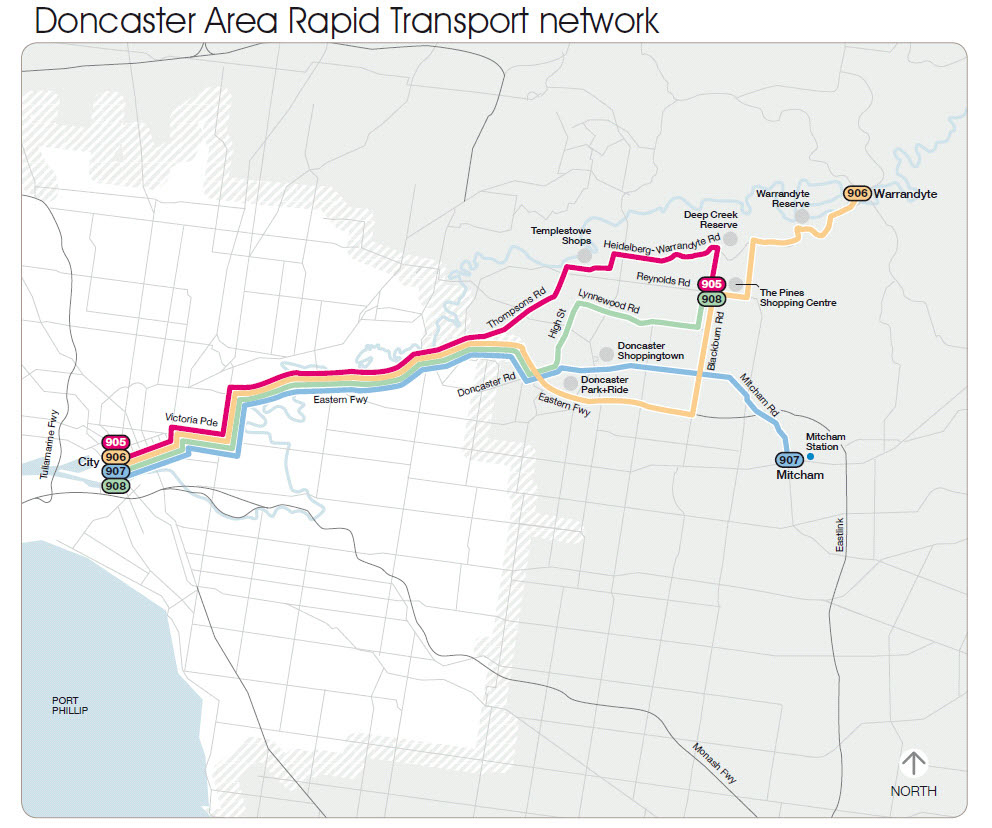 In my last post about the Green’s election manifesto, a Public transport plan for Melbourne’s east, I indicated I would take a closer look at the two new rail lines the party is proposing to finance – a line to Rowville and a line to Doncaster – with its nonexistent $6 billion.
I discussed the shortcomings of the Rowville line a few months ago when the Liberals also came out in favour of it (is there a winnable seat in the vicinity perhaps?), so here I’ll just concern myself with the proposed Doncaster line.
The Greens say a line is needed because Manningham is the only municipality in Melbourne without either a train line or a tram line. And they say a rail line was promised before – plans were drawn up in 1969 but never acted on.
I’m not impressed by this logic. Do we spend billions of dollars on infrastructure because some area is “entitled” to a track even if it’s not the best solution? Should we get the 1969 freeway plan because it’s a “broken” promise too?
I’d be more impressed if the Greens had provided some justification, but they haven’t. There’s no attempt to measure expected patronage and no indication of the possible economic benefits compared to other potential investments. Nor is there any indication of the annual operating cost and the ongoing subsidy that the line would require.
The proposal is that the line would run from the CBD via a tunnel under Carlton and Fitzroy to Victoria Park station on the Hurstbridge-Epping line. It would then run along the median of the Eastern Freeway (which was designed from the outset to take a rail line) until 1.5 km east of Bulleen Rd. At that point it would run underground to a new station at Doncaster.
There are some very serious questions that need to be asked about this proposal. Read the rest of this entry »
Victorian election – why have the Greens dug a black hole?
Posted: October 24, 2010 Filed under: Public transport | Tags: City of Knox, Doncaster, election, North East Link, Public Transport Plan for Melbourne's East, rail, Rowville, The Greens, Victoria, Victoria Transport Plan 22 Comments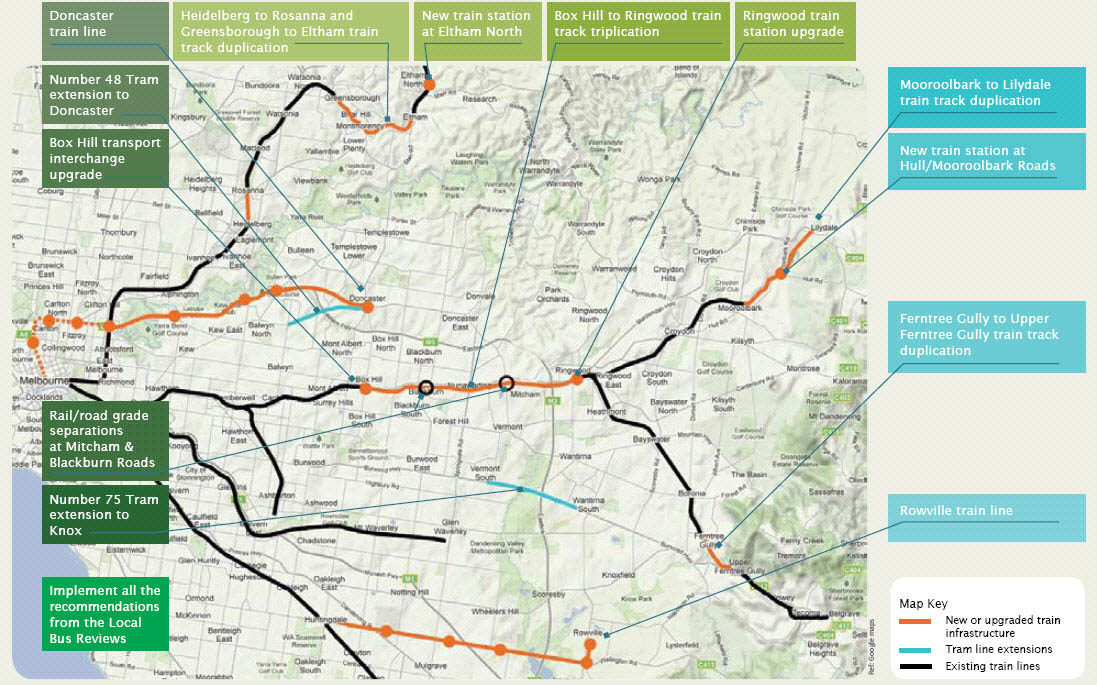
The Green's transport plan for Melbourne's east
If you think the Greens provide a real alternative to the tired, cynical politics of Labor and the Liberals, then you might be very disappointed in the transport initiative the Green’s are promoting for the forthcoming Victorian election.
The Green’s Public transport plan for Melbourne’s east proposes a massive $6 billion program of public transport works, including a new rail line to Rowville and another along the Eastern Freeway to Doncaster. It also proposes rail duplications and triplications, new train stations, level crossing upgrades, tram line extensions, transport interchange upgrades and improvements to bus services.
The Greens clearly and loudly proclaim that the $6 billion will be found by scrapping the Government’s proposed North East Link, the so-called ‘missing link’ between the metropolitan ring road at Greensborough and the Eastern Freeway at Bulleen.
It almost sounds too good to be true. No additional funding, no new freeway and heaps of new public transport infrastructure! Trouble is, as the Greens well know, it isn’t true – there is no $6 billion to reallocate. Read the rest of this entry »
 The Melbourne Urbanist