Do we want cars in the city centre?
Posted: May 9, 2011 Filed under: Cars & traffic, Public transport | Tags: congestion, cordon, Harry Clarke, Melbourne on Transit, parking, patronage, road pricing, trains, trams 24 Comments
Possible road pricing cordon boundary, inner Melbourne - Clarke and Hawkins, 2006
I’ve noted before that only 30% of commuters who work within the Hoddle Grid – i.e. the area bounded by Spring, Flinders, Spencer and La Trobe streets – drive to work. However only a block or two beyond the city rail loop, the share of work trips taken by car increases steeply to 50-60%, and above.
Peter Parker at Melbourne on Transit offers an explanation. Using Metlink, he found a journey from Laverton station to Melbourne Town Hall in the morning peak takes 33 minutes. However if the Laverton traveller is bound for nearby Docklands (Waterfront City), the trip takes an extraordinary 54 minutes. Anyone travelling from Greensborough station to the same two destinations would have to allow an additional 29 minutes to get to Docklands and if travelling from Cheltenham station an extra 30 minutes.
In other words, once a traveller gets off the rail system in the CBD, further travel to near-CBD destinations is very slow. This is in part because the rail loop was not designed primarily to move people around the CBD and in part because trams are slow. Peter explains:
We have trams but unlike some compact European cities we don’t have a dense metro in the job-dense 2-5km core that allows for fast local travel. Instead for the ‘last mile’ we rely on slow surface modes, notably trams and buses, often without their own right of way.
Public transport’s mode share in the vicinity of Waterfront City is just 22%. This is despite the area having a frequent tram service. Given the huge investment in public transport in the city centre, any mode share below 50% is very disappointing, but the figure for Waterfront City is appalling.
I suspect there are two key reasons for the low mode share of near-CBD areas. The first is simply that the cost of driving and parking in these areas is still reasonably low – so workers drive because they can. Perhaps there’s a high proportion of workers in the CBD fringe whose status attracts a “company car”. Perhaps also there are more institutions like hospitals with shift workers who drive off-peak. The second reason is that movement within the city centre by public transport is too slow. That’s partly because the rail loop is not configured well for intra CBD trips and partly because trams are slowed by cars, particularly at intersections.
The CBD is one of those places where I think it’s very hard to justify commuting by car, given the enormous investment in public transport infrastructure and the extremely high accessibility it provides to the rest of the metropolitan area. It’s such a vital asset to the city as a whole and to the State that its amenity should not be despoiled by the noise, fumes and danger of too many cars.
The Melbourne City Council has proposed some worthwhile improvements, such as a maximum speed limit of 40 km/hr in the CBD (although I’d prefer 30 km/hr) and a plan to eliminate cars, taxis and vans from Swanston Street (although I fear the potential for pedestrian/cyclist conflict has not been fully resolved). Read the rest of this entry »
– What causes traffic jams?
Posted: May 5, 2011 Filed under: Cars & traffic | Tags: congestion, Japan, New Scientist, traffic jam 2 Comments The Japanese Mathematical Society of Traffic Flow set up this unique experiment to figure out why traffic jams appear for no apparent reason (see video). New Scientist explains:
Traffic that grinds to a halt and then restarts for no apparent reason is one of the biggest causes of frustration for drivers. Now a team of Japanese researchers has recreated the phenomenon on a test-track for the first time. The mathematical theory behind these so-called “shockwave” jams was developed more than 15 years ago using models that show jams appear from nowhere on roads carrying their maximum capacity of free-flowing traffic – typically triggered by a single driver slowing down.
After that first vehicle brakes, the driver behind must also slow, and a shockwave jam of bunching cars appears, travelling backwards through the traffic. The theory has frequently been modelled in computer simulations, and seems to fit with observations of real traffic, but has never been recreated experimentally until now.
There’s more explanation at the New Scientist web site. Read the rest of this entry »
Does the Grand Prix have to be so effin’ loud?
Posted: March 26, 2011 Filed under: Cars & traffic, Miscellaneous | Tags: Albert Park, Auditor General Victoria, Bernie Eccelstone, cost benefit, F1, Federation Internationale de l’Automobile, FIA, Formula One, Melbourne Grand Prix, noise 4 Comments There’s an important debate going on about the net economic benefits of the Australian Grand Prix, but what I can’t get over is the noise.
The nearest point of Albert Park is 9 km as the crow flies from my house yet today I can hear it inside. It’s not loud enough to be annoying – just part of the background hum really – but I’m astounded that I hear it at all.
That makes me wonder why F1 has to be so extremely, incredibly loud. According to the cost benefit analysis published by the Victorian Auditor General on the 2005 race, the estimated peak noise level trackside reaches 125 dB(A) and 105 dB(A) at 100 metres. The report says above 70 db (A) is annoying and 115 dB (A) can cause hearing damage, although this depends on the duration and the vulnerability of the listener.
I’ve only visited Albert Park once but that was enough – I found the noise excruciating. Ditto the Gold Coast Indycar. Even with foam ear pads plus a set of those external headphone-type sound dampeners it was still plenty loud enough. At some events the organisers also send an air force jet over at low altitude, presumably to show what real noise is!
The Auditor General reckons the impact of noise from the 2005 event ‘cost’ 12,500 neighbouring households a combined $415,000 (not that they were actually compensated!). Households within the 70 dB (A) contour suffered an estimated disamenity of $50 per week and those within the 80 dB (A) contour – where the noise level is generally regarded as intolerable – suffered $100 per week.
I’d debate the methodology but there’s some relief coming in the 2013 season when a new ‘green’ four cylinder turbo charged engine has been mandated by the Federation Internationale de l’Automobile (FIA). It will be significantly quieter than the current eight cylinder engine but it seems noise is in the DNA of the sport. F1 boss Bernie Eccelstone is at loggerheads with the FIA over the change. This week he said:
I meet people worldwide in all different walks of life – sponsors, promoters and journalists – and I think there are two things that are really important for Formula One. One is Ferrari, and second is the noise. People get excited about the noise. People who have never been to a Formula One race, when they leave you ask them what they liked, and they say ‘the noise.’ It’s incredible, it really gets to you.
With serious questions being raised about the viability of the Grand Prix in Melbourne, it’s time for Bernie to embrace this change. The Auditor General found that the costs of the event exceed the economic benefits, let alone the cash outlay. Reducing the impact on residents affected by the noise footprint might help fans retain the race. In fact the sport should go further to embrace ‘green’ thinking as I argued this time last year.
-24 hours of LA traffic (animation)
Posted: March 24, 2011 Filed under: Cars & traffic | Tags: animation, LA, Los Angeles, traffic congestion, Waze Leave a comment
Animation - 24 hours of Los Angeles traffic
This is a recently released animation of 24 hours of traffic in Los Angeles. It’s constructed from reports sent from the smartphones of Waze users. Waze is a “social mobile application providing free turn-by-turn navigation based on the live conditions on the road and driven by users”.
It starts at 4pm but really goes beserk the next day in the AM peak. As far as I can work out, red dots are concentrations of high congestion and green dots are hazards reported by Waze users.
Why is transit’s share low at Latrobe Uni?
Posted: March 16, 2011 Filed under: Cars & traffic, Education, justice, health, Public transport | Tags: Census, Chadstone, City of Darebin, commuting, Cycling, journey to work, Latrobe University, Melbourne University, Monash University, transit 12 Comments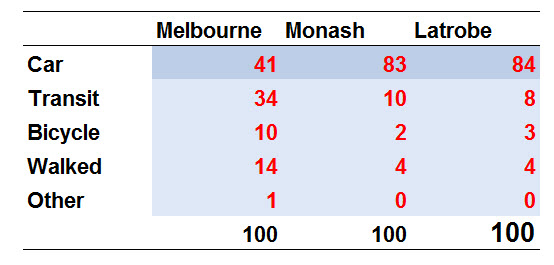
Mode shares (%), 2006 Census
Workers who commute to Melbourne University at Parkville are much more inclined to use public transport than their colleagues who work at suburban Monash or Latrobe universities. The chart shows that at the 2006 Census, 41% of Melbourne University workers reported they drove to work compared to 83% at Monash and 84% at Latrobe universities. Many more staff at Melbourne also walked and cycled – 24% compared to 6-7% at the other two institutions.
Melbourne University’s lower car use is explained by a few key factors. The main one is that it is located on the edge of the CBD where car use is limited by high levels of traffic congestion and expensive all-day parking charges. For many staff, driving would take too long, generate too much angst and be too expensive. If the value of driving is marginal, the decision to choose an alternative will be tipped by the high quality of public transport service available to Parkville workers. Although it’s not served directly by rail (none of these universities are), Melbourne University has easy access by multiple tram lines to the CBD and thence to the many radial train and tram lines linking to the larger metropolitan area. For many Melbourne University workers public transport would be a no-brainer.
Melbourne University’s high level of walking can largely be attributed to the relatively high residential densities in the nearby CBD and inner city environs. If transport is expensive in outlays and time, it makes sense for workers to live close to the university. In this case, living close to the university also means living close to the many activities and opportunities offered by the inner city.
The suburban setting of Monash and Latrobe provides a very different environment. Although these universities are not without their challenges, they generally experience less traffic congestion and enjoy cheaper parking than Melbourne University. Low suburban residential densities and large open space and industrial uses mean fewer staff can live within walking distance. The level of public transport service is actually pretty reasonable by prevailing standards (for example, see here) but obviously not as good as Melbourne University, which benefits greatly from its proximity to the CBD. Read the rest of this entry »
Is time on transit more productive than driving?
Posted: March 15, 2011 Filed under: Cars & traffic, Public transport | Tags: auto, car, in-vehicle time, phone, Public transport 13 Comments
MTR Hong Kong - SRO (photo by M Wong)
I regularly hear the argument that time spent travelling on public transport is more enjoyable and more productive than time spent in the driver’s seat of a car. The public transport passenger can read, study, write, listen to music, play games, talk to others and even think without distraction. The driver, on the other hand, must devote most of his or her attention to the road or else get fined (or worse).
I think this line of argument is ultimately pointless. Both modes have their upsides and downsides in terms of how fruitfully in-vehicle travel time can be spent. Travellers make their choice on criteria that are far more critical than this one. Still, it’s an argument that’s often made so it’s worth looking briefly at the issues.
You can listen to music, podcasts and radio just as well while driving as you can on transit, so let’s scotch that one from the get-go. In fact some people prefer listening over speakers because ear phones can cause fatigue. And far too few smartphones and mp3 players come with AM radio, so if listening to 621 or 774 on the train is your thing then your options are limited. I’d score this one even.
What you can’t do in a car however is use a notebook computer, send text messages, play games or read reports and books, at least not if you’re driving. Actually notebooks aren’t widely used on public transport in my experience, even on the sharp end of planes, but reading, texting and playing games are certainly a common way to while away the time. It’s neither legal nor practical to do those activities in any meaningful way if you’re driving.
But they’re much harder to do on public transport if you don’t have a seat. On Melbourne’s public transport system that’s by no means guaranteed in rush hour. In places like Hong Kong, Singapore and Japan where public transport is the dominant mode, you don’t necessarily even get a choice (see picture – the priority there is to move lots of people quickly).
But there’s one area where the car has an offsetting advantage – (hands free) phone calls. Drivers can make personal and business calls without sacrificing privacy and without imposing on others. That means they can make more important, nuanced and meaningful calls than they would on a train or a bus. They can communicate more effectively without feeling self-conscious because strangers are listening in. Apart from the odd loudmouth, phone calls on public transport are like text messages – suitable mainly for communicating simple or straightforward information. Read the rest of this entry »
Does driving cost less than transit?
Posted: March 13, 2011 Filed under: Cars & traffic, Public transport | Tags: auto, Camry, car, Driving Your Dollar, Metlink, Public transport, RACV, Yaris 16 Comments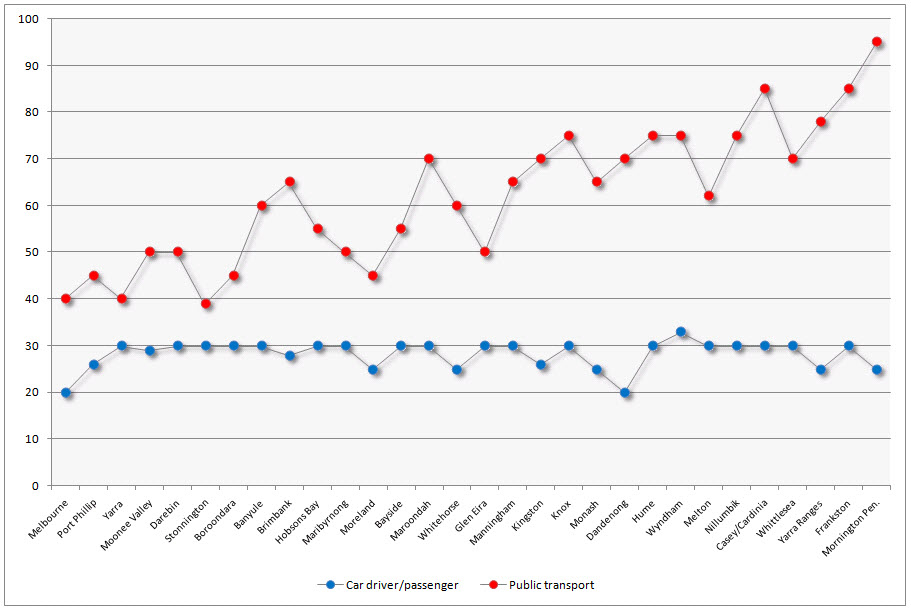
Median journey to work time in Melbourne, by mode, ordered by approx distance of home municipality from CBD (VISTA)
With petrol prices spiking upwards, it’s a good time to examine the relative cost of driving versus public transport. You can save a lot of cash if you’re prepared to live without a car, but you’ll pay in other ways.
According to the RACV’s 2010 Driving Your Dollar survey, it costs $10,668 p.a. on average to run a medium sized car like a Toyota Camry Altise. The cost could be as low as $6,759 p.a. for something small such as a Toyota Yaris or as much as $19,234 p.a. for a behemoth like a Toyota Landcruiser GXL. On the other hand, a zones 1and 2 Yearly Metcard costs $1,859 p.a. for unlimited travel. However ticket outlays need to be adjusted for household size. In my case, my wife would also require a yearly pass and our two children would need travel concession passes. That brings the total cost up to $4,562 p.a., but that’s still considerably less than the Camry’s $10,668 p.a.
Of course many children already have a school travel concession pass. And adults who know they have a limited travel range could probably get by with either a zone 1 ($1,202) or zone 2 ($799) ticket and buy extra daily tickets on those (presumably infrequent) occasions they travel cross-zone. Travellers who use public transport exclusively will in all likelihood spend more on taxis and occasional light truck rental, as well as sacrifice some spontaneity in trip planning, but in cash terms they should still come out well ahead of car owners.
Whatever the overall saving is, it isn’t going to be realised by households who keep their car and simply use it less. The bulk of outlays associated with a car are standing costs like depreciation, insurance and registration. In order to be significantly better off in cash terms, a household either has to lose a second car or decide they can get along without any car at all.
But this simple accounting doesn’t provide a fair comparison. There’s one big difference that has to be taken into account – travel by car is much faster on average than by public transport. The latter is most attractive for work travel, but even then the median journey time in Melbourne is almost double that by car (see accompanying chart). Those longer trip times in part reflect commuters who catch trains from distant places to the city centre. But the main reason is that passengers have to expend time on tasks like walking to the stop, waiting for the service and in some cases transferring between services. Read the rest of this entry »
Does higher density mean lower car use?
Posted: March 5, 2011 Filed under: Cars & traffic, Planning, Public transport | Tags: Centre for Transportation Studies, cities, Gary Barnes, land use, Public transport, transit, University of Minnesota, urban areas, weighted density Leave a comment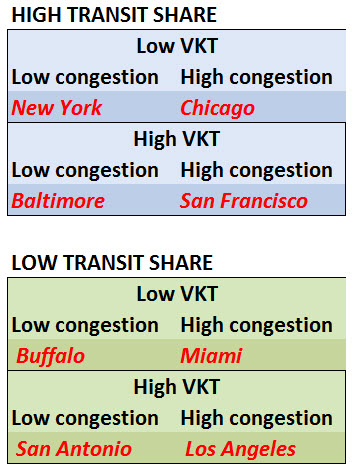
Travel outcomes (Barnes)
Not necessarily – in fact in the US, not even usually!
It’s a truism that denser, more concentrated cities tend to have higher public transport use. Various studies have confirmed this intuition but what is usually left unexamined is the implicit assumption that such cities consequently have lower car use.
This study of 31 of the largest cities in the US found that assumption is not correct. Higher public transport mode share does not translate on average to lower kilometres of travel by car, shorter commutes by car, or lower levels of traffic congestion.
The primary finding “is that land use, at least at the aggregate level studied here, is not a major leverage point in the determination of overall population travel choices”.
Undertaken by Gary Barnes from the Centre for Transportation Studies at the University of Minnesota, the research found that, if anything, “the higher densities that increase transit share tend to increase commute times and congestion levels”.
The main objective of the project was to identify the effect of land use on travel behaviour. Most studies concentrate on the effect of average density on one or two variables, usually transit share and sometimes total kilometres of car travel.
Barnes’ approach was much more extensive. For each urbanised area, he defined 15 descriptors of travel behaviour, 11 of land use and 15 other, mainly demographic, factors. Moreover, he employed the concept of ‘weighted density’ (he calls it ‘perceived density’) to more accurately describe the distribution of both population and employment in each city.
Barnes confirms that residential concentration increases transit’s share of travel, but he notes the effect is not large. Contrary to the underlying assumptions of much urban policy:
Even very large changes in land use have very little impact on travel behaviour, in good ways or in bad. Apparently the larger effects sometimes observed in neighborhood-scale studies are just that: neighbourhood-scale effects that do not extend their benefits to the larger urbanized area.
His analysis implies that increasing residential density by 100% would increase transit share by only 5-6%. To get a 1% increase in walking and cycling’s combined mode share would require an increase in residential density of 5,000 persons/mile2 (1,931/km2). Similarly, a 14% increase in density would only yield a 0.5% decrease in in-car travel time per person. Read the rest of this entry »
Why are we driving less?
Posted: February 26, 2011 Filed under: Cars & traffic | Tags: Adam Millard-Bell, David Metz, distance driven, Gen Y, Lee Schipper, peak travel, saturation 6 Comments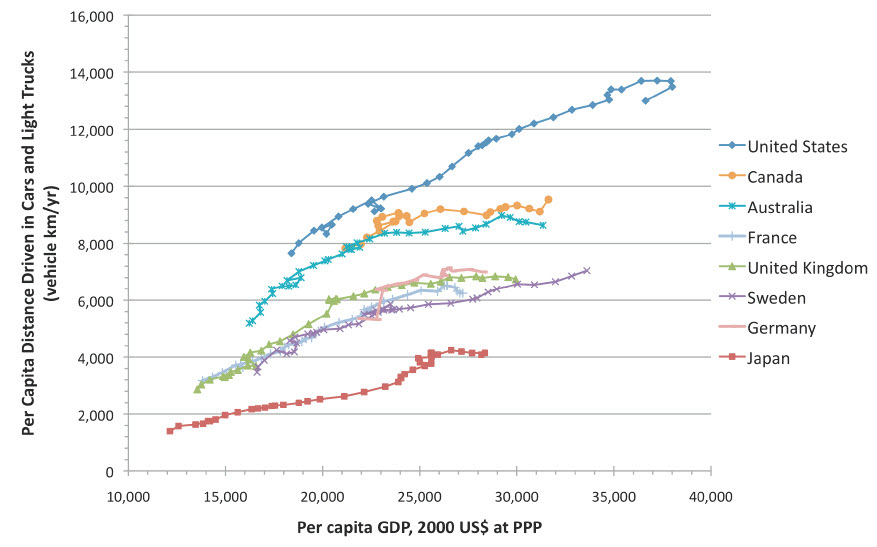
Per capita distance driven in cars and light trucks, 1970-2007/08 (click to enlarge)
I’ve mentioned before how travellers in developed countries like the United States, Britain and Australia are driving less.
The accompanying chart, from a new paper, Are we reaching peak travel? By Adam Millard-Ball and Lee Schipper of Stanford University, shows the change in per capita distance driven over the period from 1970 to 2007/08 (before the GFC in September 2008) in eight developed countries, including Australia.
It can be seen that the rate of growth in per capita car travel has been slowing for some time in Australia and has actually declined in recent years. As we’ve gotten richer we’ve driven less.
What explains this phenomenon? As with most things, it probably doesn’t come down to one dominant explanation. It’s more likely the coincidence of a number of factors (although some will be more important than others).
Higher petrol prices are one likely explanation because they started rising at a higher rate than the CPI about 10 years ago. However as I’ve discussed here, they didn’t rise any faster than average earnings over this period. Further, the flattening in car travel preceded the very large increase in the price of petrol from 2008.
Another likely explanation is increasing traffic congestion and greater restrictions on parking. Travellers may still drive for much the same time per day on average but lower speeds mean they can’t travel as far. Higher parking charges discourage car use and encourage use of alternative modes, at least for those like CBD workers who don’t have much choice about where they work.
While the declining rate of freeway construction in many cities contributes to traffic congestion, the converse is that greater investment in public transport has made it a more attractive alternative to driving for some types of trip.
This would be the case in the CBD where public transport is most competitive against cars. The rapid (absolute) growth in jobs in many central cities over the last 15 years would have helped shift more commuters onto public transport. Growth in population in the inner city could also have contributed somewhat to this phenomenon.
Vastly cheaper air travel has virtually wiped out the long distance drive. Thanks to Tiger Airways and their kind, there is now a generation of students that haven’t experienced the dubious delights of driving the Hume Highway. An increasing proportion of people don’t drive as much for the simple reason they spend a couple of weeks each year out of the country, either holidaying or on business. Their place is taken by incoming tourists who have a higher propensity to use public transport.
Also implicated in the decline is a range of what can loosely be termed ‘demographic’ factors. Read the rest of this entry »
Is this a sensible comparison of cars and public transport?
Posted: February 23, 2011 Filed under: Cars & traffic, Public transport | Tags: accessibility, auto, Bendigo, car, Employment, Jobs, Melbourne 2030, Public transport, rail, Sunbury Leave a comment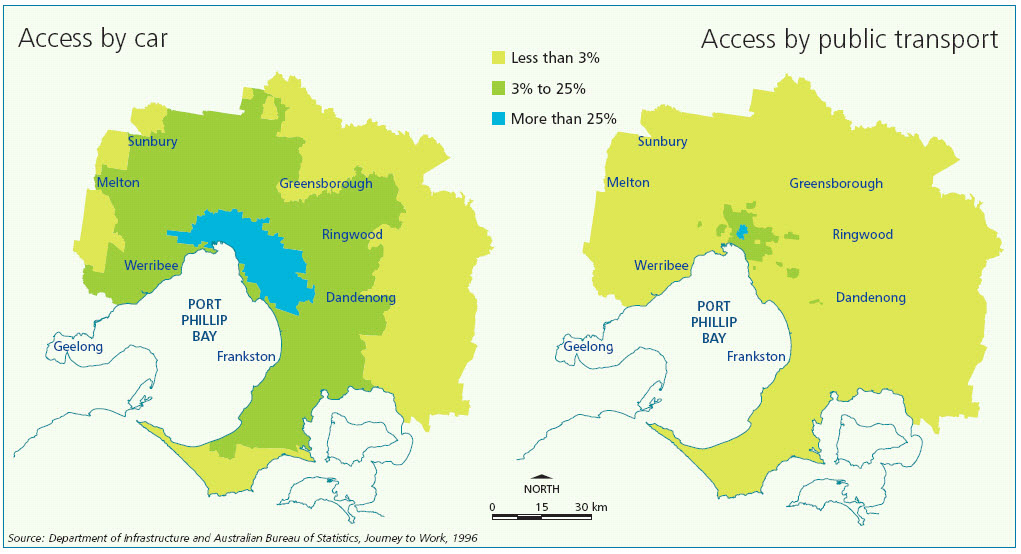
Many readers will have seen this now-ubiquitous chart before – it’s from Melbourne 2030 and has been republished countless times. It shows the proportion of metropolitan jobs accessible within 40 minutes travelling time from different parts of Melbourne by car and by public transport.
I’ve never been happy with this chart because its simplicity is deceptive – I don’t accept the implicit premise that public transport should be judged on the same basis as cars. I’ll come to that shortly, but first there are some technical shortcomings that need to be addressed.
One is that the chart doesn’t say how the data range intervals are determined – are they equal counts? Are they based on a ‘natural break’ in the way the data is distributed? It’s not possible to be confident that they portray the situation with either public transport or cars in as objective a way as possible.
Another shortcoming is that a mere three categories is very limiting. If you live in Sunbury (say), the chart says you can drive to between 3% and 25% of metropolitan jobs within 40 minutes. That’s an enormous range – a factor of more than eight between the lowest and highest values. It’s essentially a useless piece of information. And the maps give a misleading impression of how many Melburnians live in areas with the poorest accessibility. There are very large areas on the fringe that have a tiny population e.g. there is a 9 km wide greenbelt between Melton and Caroline Springs. Much of the outer north east is a catchment area.
Yet even with these technical flaws, there is some intriguing information. For example, the majority of the population can access no more than 2% of metropolitan jobs within 40 minutes travel by public transport. Read the rest of this entry »
Are there multiple ‘Melbournes’?
Posted: December 9, 2010 Filed under: Cars & traffic, Planning, Public transport | Tags: Brimbank, Cardinia, Casey, home range, municipalities, regions, travel time, trip distance 5 Comments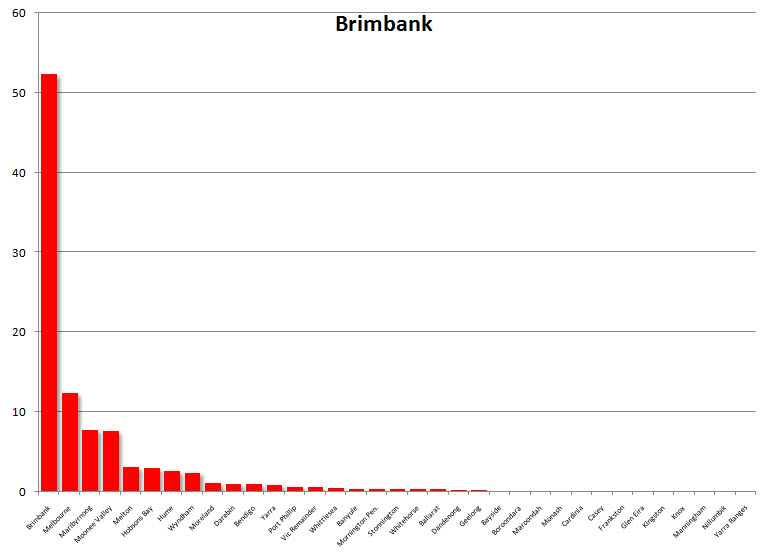
Where residents of Brimbank travel to (%)
The stereotype of people travelling long distances in Australian cities is wrong but persistent. The reality is that most trips are relatively close to home.
For example, the accompanying chart and map show that 52% of all weekday trips (all purposes, all modes) by residents of the middle suburban municipality of Brimbank in Melbourne’s west are made within the municipality. Further, 79% of trips are made either within Brimbank or to contiguous municipalities.
In fact more than 90% of trips by Brimbank residents can be accounted for if just one more destination – the city centre – is added to the list above.
This pattern also holds for the other parts of Melbourne.
More than 80% of trips by residents of Monash, Cardinia and Casey, for example, are likewise made within their home municipality or to neighbouring ones.
While another 8% of trips by Monash residents are to the city centre, the corresponding figure is less for far-flung municipalities – just 4% for Casey and less than 1% for Cardinia (see more charts below).
 It thus makes sense to think of a city like Melbourne as a number of regions rather than as a very big, singular entity. In terms of what people physically do within the urban area, there are multiple ‘Melbournes’.
Each little ‘Melbourne’ or region is centred on a home LGA and has a limited ‘home range’. The median weekday trip distance (all purposes, all modes) for residents of Cardinia is 3.7 km. Monash is 4.9 km and Brimbank is 6.3 km.
For the great bulk of residents, metropolitan Melbourne is more of a construct – an idea – than something that has a real presence in their day-to-day lives. With the exception of the city centre, few people venture much beyond their own region.
This limited ‘home range’ is a product of many forces. In the case of the inner city municipalities – Melbourne, Yarra and Port Phillip – the predominance of professional jobs and social attractions in the city centre is an obvious and powerful factor. The median weekday trip distance for residents of Yarra is 2.8 km.
For the great bulk of the population who live in the suburbs, the factors explaining this limited geography would include the suburbanisation of jobs (more than 80% of jobs in metropolitan Melbourne are outside the CBD), slower travel speeds on roads due to increasing traffic and the desire to live close to family and friends.
It’s natural therefore to emphasise the importance of regions and devise typologies like The Age uses in its real estate pages e.g. inner east, outer east. But that assumes a community of interest at the regional level. And it assumes it can be defined within fixed boundaries. Read the rest of this entry »
What’s wrong with cars?
Posted: December 8, 2010 Filed under: Cars & traffic | Tags: automobile, Bern Grush, Overcoming Global Gridlock, road pricing, Skymeter, tolling, Toronto 4 Comments
One of the key themes of The Melbourne Urbanist is the need to price road space. Cars will be with us in one form or another for a long time yet, whether we like it or not. Autonomous travel provides enormous benefits but cars also have a dark side, so they can’t just be ignored.
I’m therefore pleased that Bern Grush from Skymeter, a Toronto company specialising in road use metering technology, has given me permission to publish the stylishly written Preface from his forthcoming book, (tentatively titled) Overcoming Global Gridlock.
The book is about the need for road pricing and how it can be achieved. Here he lays out the issues and challenges with the car. But a warning – this is not the standard anti-car diatribe you’ve read countless times before. He’s actually pro-car although, as he puts it, in a balanced way. Read on:
Overcoming Global Gridlock – Preface
“We have reached a crisis point with cars and trucks. We face mounting congestion. We need to reduce both emissions and oil consumption pretty much everywhere. In many countries funding for road building and maintenance is becoming ever harder to sustain. All the while, demand for personal mobility and goods movement continues to expand. And there is little to indicate many people are willing to give up the private vehicle.
If the autonomous vehicle has so many problems stacked against it, but demand for it is increasing, you can see that something has to give. This is predicted for the coming decade or two.
Cars are important to us. Judging by their use and abuse, the mile-for-mile preference we have for them over other forms of mobility, the growth in their numbers, the increasing number of vehicle miles travelled each year and a hundred other indicators, it is the car we are addicted to rather than oil. Oil is just one symptom. Most of the sustainability problem as it is now will survive the end of oil.
We can list a lot of bad things about our cars, but there are also a lot of good things. Perhaps the good outweighs the bad – I, for one, think that it does. There are a lot of reasons we have so many cars and there are many solutions offered to deal with their overwhelming ubiquity. We needn’t review those things here. You already have an opinion. You already like or dislike cars. I am probably unable to change your mind. You already have a car (or two) or wish you had one. Or perhaps you have even managed to get rid of yours. Or not yet. Read the rest of this entry »
What costs society more – cars or public transport?
Posted: November 24, 2010 Filed under: Cars & traffic | Tags: emissions, externalities, Garry Glazebrook, parking, Public transport, social cost, transit, transport modes, transport subsidy 9 Comments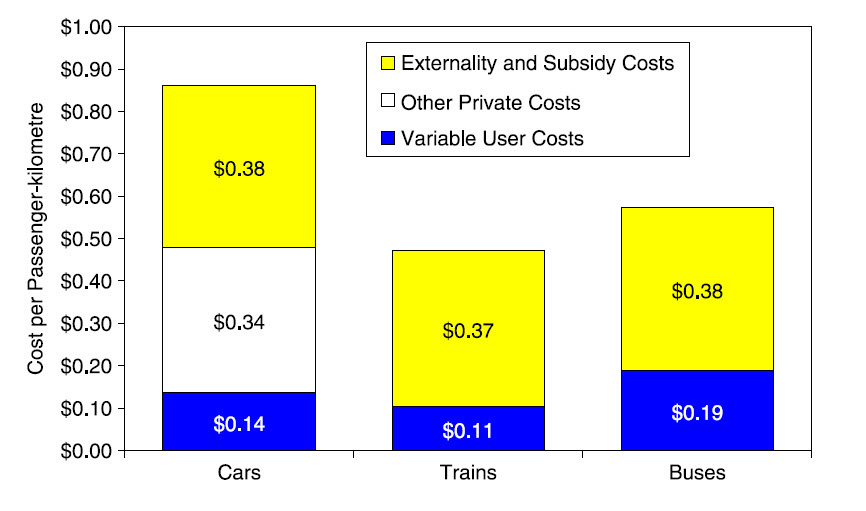
Cost per passenger km by mode in Sydney
This simple but extraordinary chart (see first graphic) is from a paper written last year by one of the country’s leading transport researchers, Dr Garry Glazebrook, of Sydney’s University of Technology.
In the paper, the author estimates the total cost of different transport modes, taking account of both private and social (i.e. external) costs. The costs are based on Sydney.
A number of interesting things about travel are evident from the chart, some of which are familiar and some which may surprise.
First, both private and public transport modes generate significant social costs. These costs are borne generally by society, “either in the form of subsidies (e.g. rail and bus subsidies from government, or hidden parking subsidies for car users) or in the form of externalities (including pollution, congestion, accidents, etc)”.
Second, although their composition is quite different, the social costs of private and public transport are essentially the same, at around 38c per passenger kilometre. One big difference of course is that subsidies for public transport are paid in actual dollars by government whereas the social costs of cars are largely an unpaid burden on others (primarily other road users). Read the rest of this entry »
What if the price of petrol doubled?
Posted: November 10, 2010 Filed under: Cars & traffic | Tags: growth, incomes, patronage, petrol price, Public transport, wages 10 Comments One clue to the likely consequence of a major hike in the price of petrol is provided by the recent past. As it happens, the price almost doubled within the last ten years.
The accompanying chart, which is based on ABS data, shows the nominal price increased 100% between March 2000 and September 2008. Fortunately it’s dropped back substantially since then. Even so, the current price is still around 80% higher than it was ten or eleven years ago.
It is therefore instructive to look at how drivers responded to this increase in costs.
In part, travellers adjust to higher petrol prices by driving more carefully, driving less and by buying more fuel-efficient cars. While there have been some improvements in this respect, they’re not spectacular. The average fuel consumption of new light vehicles is now around 8 litres per 100 km. Yet the average consumption of the national fleet is still up at 11 litres per 100 km. Moreover, the potential benefits from more fuel-efficient cars are not being fully realised because of increasing consumer demand for larger, more powerful and more luxurious vehicles.
Some travellers respond to higher petrol prices by switching to public transport. Indeed, there was a significant increase in demand for public transport over this period, especially from around 2004-05. However this was from a small base and public transport still only accounts for around 14% of all weekday trips in Sydney and Melbourne.
Like most things, this increase in patronage is very likely the result of a combination of factors. While there seems little doubt that the higher price of petrol is a factor, it is by no means certain it is the most important one. Read the rest of this entry »
Do higher travel costs make the fringe unaffordable?
Posted: October 27, 2010 Filed under: Cars & traffic, Growth Areas, Housing | Tags: affordability, Cardinia, Casey, fuel economy, growth areas, Monash, transport cost 5 Comments
The new art of Cartosimpsonology
A common argument is that households who settle on the fringe because housing is more affordable end up worse off because of higher transport costs. They are forced to buy a second or third car and they use more petrol because they have to travel further.
Of course there’s an assumption here – that ordinary families actually could find a suitable dwelling, at an affordable price, in an area where transport costs are significantly lower than they would be on the fringe.
Consider the municipalities of Casey and Cardinia, which together comprise the largest Growth Area in Melbourne. At around 45 km and 55 km respectively from the CBD they are also the most distant fringe growth areas.
The median price of an established house and garden in Casey (Narre Warren) is $350,000. Now compare that with the City of Monash, which stretches between 13 km and 24 km from the CBD. The median price for a house in this municipality is $780,000 (although in Clayton it’s $618,000).
A more likely alternative for a settler in Monash who’s primary concern is affordability would be a unit. However the median price for a unit is $464,000 ($401,000 in Clayton).
Thus the Growth Area has a considerable advantage in price and size – it’s much cheaper and offers a three to four bedroom house with a garden compared to a two bedroom unit. Clearly a Monash location would need to offer a considerable saving in transport costs to offset Casey/Cardinia’s advantages. Read the rest of this entry »
Why is road pricing a good idea?
Posted: October 26, 2010 Filed under: Cars & traffic | Tags: Boris Johnson, compact city, congestion pricing, McMansions, road pricing, sprawl 11 Comments
What Americans mean by a 'McMansion'. Click for slideshow.
I’m not aware of anyone who disagrees seriously with the contention that car travel is underpriced. The consequence of this inefficiency is we drive more than we otherwise would and more than is socially optimal.
The idea of road pricing is that drivers should pay the real costs they impose on others through traffic congestion, pollution, noise and carbon emissions.
There’s also another force at play here which exacerbates the problem of excessive driving. There are some costs that drivers actually do pay – standing costs like depreciation, insurance and registration – that are “disconnected” from the perceived cost of travel.
A person deciding whether or not to drive somewhere will tend to take account of the cost of their time plus petrol, but they usually don’t perceive the standing costs. This under-estimation promotes more driving.
There have been various experiments with road pricing, such as the well known Singapore and London central city cordons (giving rise to amusing interpretations such as this one by Boris Johnson). However this is a technologically outdated approach – transponders and/or GIS technology mean it is now feasible to charge motorists in relation both to distance and traffic conditions i.e by location and time.
A driver who paid a price for a litre of petrol that included both external and standing costs would have a strong incentive to drive less. A gauge on the dash showing the total cost ticking over with every kilometre would provide an even more powerful nudge to think long and hard about the wisdom of driving.
Road pricing can be thought of in simple terms as a two-part per kilometre tariff that recovers both external costs and those standing costs that can be disaggregated. One part is a charge reflecting the general cost of using the roads. The other is a variable price reflecting specific costs like congestion in peak periods.
There are potentially some important benefits for the wider community from road pricing: Read the rest of this entry »
Is the car industry’s “Cash for Clunkers” plan better?
Posted: October 16, 2010 Filed under: Cars & traffic, Energy & GHG | Tags: carbon, Cars, Cash for Clunkers, CO2, FCAI, Federal Chamber of Automotive Industries, green, guzzler, rebate 2 Comments
Econcartography: Phillips curve, 1980-2005 Guess which country?
The car industry has proposed a revamp of the Gillard Government’s “cash for clunkers” program. They say it will reduce the cost from $400 million to $200 million while still meeting the Government’s target of saving one million tonnes of CO2.
The nub of the proposal is that the rebate on new cars should be increased from $2,000 to $5,000 but targeted strictly at ultra efficient cars like the hybrid Toyota Prius and a number of very small diesel and petrol cars that offer similar levels of efficiency.
This would address a perceived failing of the Gillard Government proposal, which provides the rebate to medium and large cars, including some variants of the new Commodore and Falcon.
Whereas the Government’s proposal would cost a ridiculous $400/tonne of CO2 saved, the industry proposal costs a merely expensive $200 per tonne.
The industry scheme seems like an advance on the original poorly thought-through idea. “Cash for clunkers” was evidently hatched at short notice and released in the heat of the election campaign.
But the modified approach still has drawbacks. It rewards, at taxpayer expense, buyers who would’ve bought ultra-small cars anyway. It’s also likely to increase the price of cheap, old cars and make life a bit harder for drivers confined to this end of the second hand market (although as it only takes 50,000 clunkers off the road it won’t have as big an impact as the Gillard scheme, which eliminates 200,000). And it doesn’t provide an incentive to make all those other small, medium and large cars that most buyers will continue to buy any more efficient. Read the rest of this entry »
Is there a case for freeways?
Posted: October 12, 2010 Filed under: Cars & traffic | Tags: congestion pricing, freeways, roads 2 Comments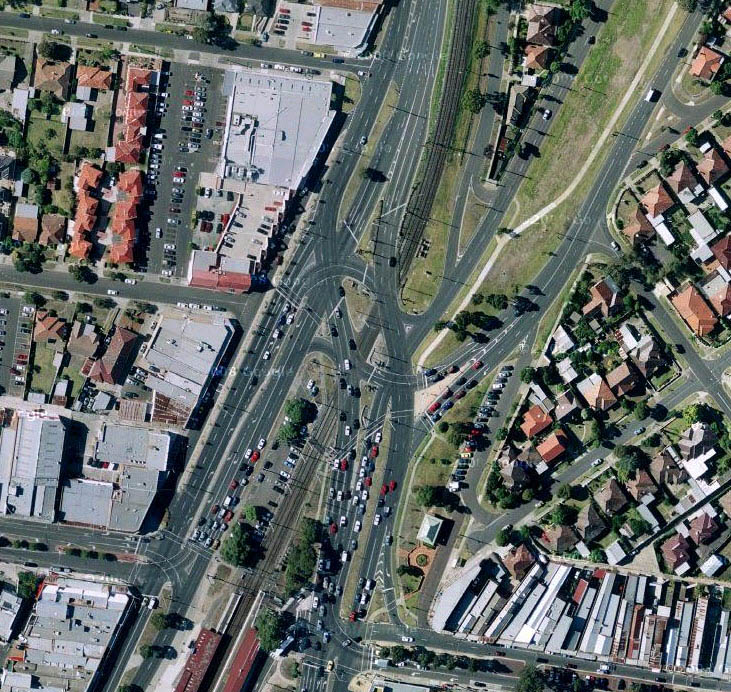
High St Reservoir - where road meets rail!
I’ve concluded before that the most plausible scenario in the forseeable future is that cars will continue to be used for the majority of trips in Australian cities. Increasingly, these cars will tend to be powered by clean energy sources and will be slower and more civilised than today’s vehicles.
I expect growth in public transport and cycling will be much faster but the absolute number of cars will very probably still increase. It is therefore inevitable that there will be continuing pressure for new freeways.
So is there any sort of case for freeways or should all new infrastructure funding be reserved exclusively for public transport, as proposed by the Independent Inquiry into Sydney’s long-term transport needs?
The key criticisms of freeways, most of which are pretty familiar by now, are that they:
- generate more car travel and higher speeds, which in turn produces more emissions and pollution and consumes more oil
- promote a sprawled, car-dependent urban form – the higher speeds provided by freeways mean people tend to live further away from activities
- undermine the viability of public transport where they compete directly
- impact on neighbouring uses – the amenity of adjoining land uses is diminished by noise and pollution
- crowd out investment in transit – governments prioritise funding to roads and investment in public transport is neglected
- sever social linkages and networks when they’re superimposed on existing communities
- cannot deliver very large numbers of people to concentrated locations, like CBDs, without becoming congested relatively quickly
In fairness, it should be acknowledged that efforts have been made to ameliorate some of these issues. Much of the investment in freeways over the last twenty years has been by the private sector. Governments have built sound barriers along new and existing freeways and the almost mandatory use of tunnels in built up areas means severance is no longer the issue it once was. Read the rest of this entry »
Does the RACV truly think long term?
Posted: October 11, 2010 Filed under: Cars & traffic | Tags: freeways, RACV, roads, Vicroads 4 Comments
Click for detailed map (slow to download)
The Age published details on Monday of what it says is a leaked Vicroads “plan for hundreds of kilometres of new freeways”.
The “plan” is actually just a map showing how Melbourne’s road network might look in 2040. Vicroads isn’t conceding that it prepared the map but it isn’t denying it either. Most of the projects are already shown on the Melway or are well known – only the outer, outer ring road and two Geelong roads seem genuinely new.
There is a heap of negative comment on The Age site. The most interesting comment however is a quote in The Age from an RACV spokesperson who says the map represents the sort of ”truly long-term thinking” needed if the city’s road system is to cope with predictions that Melbourne’s population will grow to 7 million by 2049.
I have no issue with the need to think about road transport well into the future. As I’ve pointed out before, even the most optimistic long term public transport plans envisage that the majority of travel will still be by car. While the car’s mode share is likely to decline, the absolute level of car travel – in green cars – is nevertheless highly like to increase.
But I beg to differ with an RACV spokesperson who is quoted as saying that this road plan constitutes “truly long term thinking” about the road system. I don’t see how the efficiency, sustainability and capacity of the road system as depicted in this wish-list can be assessed without having information on a host of other variables that will affect the use of road space in the future. Read the rest of this entry »
How to charge for the Big Day Out?
Posted: October 10, 2010 Filed under: Cars & traffic, Miscellaneous | Tags: Big Day Out, congestion pricing, equity, Flemington, tickets 2 Comments
World's tallest buildings in 1884
The issue of how to deal with excess demand is a common one in cities, whether it’s concerts, road congestion or the (until recently unfamiliar) problem of public transport congestion.
As I went through the stressful process of buying tickets for the Big Day Out for my son (successfully as it turns out), I got wondering if ‘first-in, first served’ is really the ideal way to go about selling tickets for such a high-demand event. The organisers appear to think it isn’t.
They made a decision on Friday, apparently on the fly, to hold back 3,000 tickets for the Melbourne event. These will now be made available via a randomly drawn online ballot conducted once a week for ten weeks. Prices will be the same as they were for the original sale.
The organisers quite clearly could charge more than $164 per ticket (including booking fee), so why don’t they? It could be that they’re simply not very good at estimating people’s willingness to pay for a particular set of bands, or perhaps it’s such a black art that they’re not prepared to take too many risks. Or it might be that they’re in it for the long haul and don’t want to alienate concert-goers from returning in future years – they might want to protect the “brand”. Read the rest of this entry »
 The Melbourne Urbanist