Is there a case for rail to Avalon Airport?
Posted: April 30, 2011 Filed under: Airports & aviation, Public transport | Tags: Avalon Airport, Melbourne airport, rail, Sita Coaches, Skybus, train 12 Comments
A bum rap
One of the great mysteries of 2010 is why the then Opposition promised to spend taxpayers funds to provide a rail service from the CBD to Avalon Airport. This wasn’t a promise to conduct a study, as was the case with the Doncaster, Rowville and Melbourne Airport rail lines, but a firm commitment to take action, with a minimum of $50 million to be spent in the first term of a Baillieu Government.
I’ve been scratching my head to come up with a rationale for this rail line, which Mr Baillieu says will cost $250 million. As I understand it, the Government will contribute the first $50 million and share the remaining $200 million with the Commonwealth and Lindsay Fox (although the size of each party’s contribution has not been revealed).
It’s hard to believe, with the range of other transport problems confronting Melbourne and a tight budgetary outlook, how this could even be on the table, much less be the Government’s highest priority.
The customary rationale for building a high capacity transport system is that current arrangements are approaching or exceed capacity. When I discussed this proposal during the election campaign last year, I noted there were only around 13 scheduled departures from Avalon on a weekday and that just 1.5 million passengers use the airport annually. This compares with 26 million using Tullamarine.These Airservices Australia figures indicate Melbourne Airport handles over twenty times as many aircraft movements as Avalon. I went on to say:
If an Avalon train service performed at a level comparable with Brisbane’s Airtrain and captured 9% of current passengers, it would only carry 135,000 persons per year (an average of 370 per day). Skybus carries around 2 million passengers per annum.
Sita Coaches currently carries fewer than 200 passengers per day between Avalon and the CBD for $20 each. So on the face of it, it’s hard to see why public funds should be prioritised to an Avalon rail line for any reason whatsoever, much less ahead of Melbourne Airport (which is itself a long way from needing rail at this time).
One argument I’ve heard is that Avalon needs a rail line to expand its air cargo capacity. This sounds particularly unlikely to me. Just why customers would pay a large premium to send high value, low weight, high priority articles by air from interstate and overseas, only to then have them transported from Avalon to the CBD and beyond by rail, is a mystery. Couriers were invented to provide speed, flexibility and demand-responsiveness for just this sort of task. The owner of Avalon might want a rail line, but it’s not apparent that its purpose would primarily be to service air traffic. In any event, I’m not sure it would be a good idea for the taxpayer to fund rail for an airport operated by a company that has its own logistics operation.
Another possible argument for an Avalon rail line might be that Melbourne Airport has capacity constraints. This is probably the least convincing of any rationale. Melbourne Airport’s great advantage, especially compared to its key rival in Sydney, is that it has enormous potential for expansion and no curfew. It has a primary north-south runway and a secondary east-west runway with the potential to accommodate two further runways as well as additional operational areas, terminals, aviation support and commercial facilities. Read the rest of this entry »
– What can history teach us about rail?
Posted: April 26, 2011 Filed under: Public transport | Tags: history, land boom, Michael Cannon, Outer Circle Railway, rail, The Land Boomers 3 Comments
What happens when you have real data on transport
Back on April 5th I noted that the suburban rail network we have in Melbourne today was substantially in place by the end of the nineteenth century.
I asked why, with the threat of climate change and peak oil hanging over us, we can’t replicate the achievements of the nineteenth century and massively expand Melbourne’s rail network. If our forebears of four or five generations ago could do it, why can’t we, with our superior technology, do even better?
I pointed out – quite accurately as it turned out – that I couldn’t bring an historian’s eye to the subject. I proposed six hypotheses to explain why it would be much harder to build the suburban network today. One of my reasons was that back then the railways covered their operating costs. A reader, Russ, pointed out that the experience in Victoria was quite different:
After the 1880s the government stepped in, and via the combination of rampant corruption and misplaced optimism in the largest real estate bubble in Australian history built 90% of the existing network – most of it completely wasted expenditure.
On his recommendation, I’ve been flipping through The Land Boomers by Michael Cannon. According to Cannon, transport was so vital to Melbourne’s growth that the story of Victorian politics in the 1880s was largely the story of the building of railways:
Hundreds of miles of track, some of it quite useless, pushed out from the egocentric city to the rampant suburbs and the far countryside. Hardly a member of Parliament whose vote could be bought went without his bribe in the form of a new railway, a spur line, or advance information on governmental plans to enable him to buy choice land in advance – the value of which was enormously enhanced when the line went through. It was a dispiriting chapter in Victorian political morality. Read the rest of this entry »
Melbourne ‘fantasy rail map’
Posted: April 25, 2011 Filed under: Public transport | Tags: fantasy map, future, rail, Railpage, train 5 Comments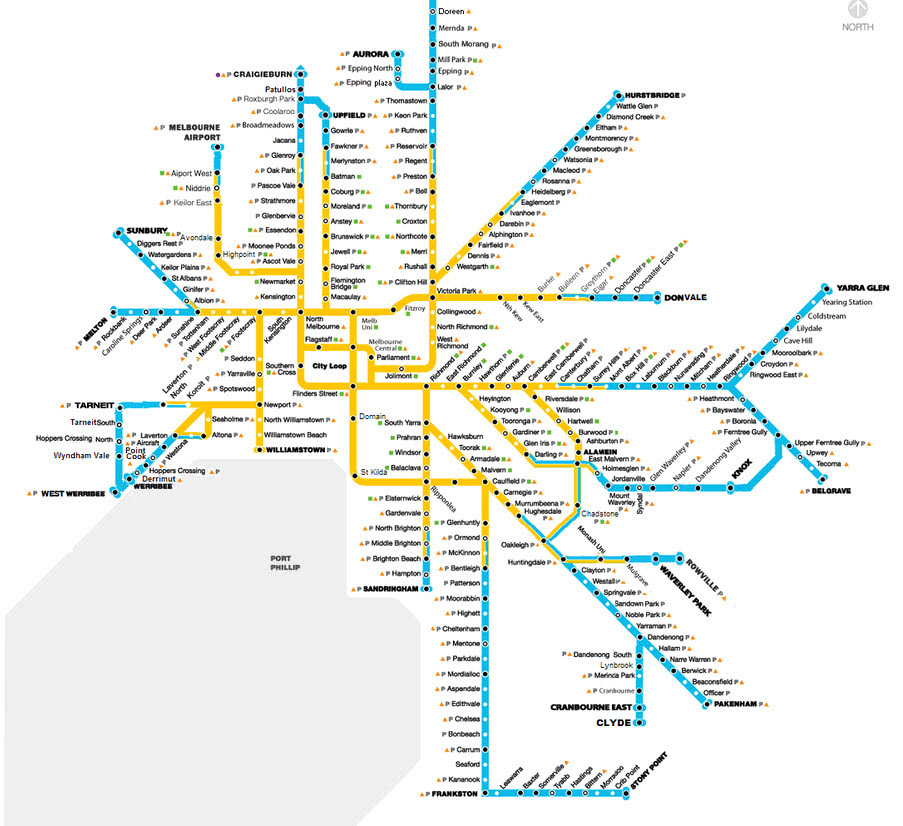
Map by cwer
As it’s the holidays I thought I’d show this 2009 map I stumbled across at Railpage. This is an example of the growing genre of ‘fantasy maps’, fed no doubt by easy access to GIS. It’s one person’s vision of what Melbourne’s rail system could look like at some point in the future at an unspecified financial and political cost. What distinguishes this one from the flotsam is the way the author has used the same graphic style as the current Metlink map, which you can see here.
It doesn’t have the new line to Avalon Airport the Government has committed itself to, perhaps because no one ever conceived in 2009 that it could ever be a priority. But it does have the now well known new lines to Melbourne Airport, Rowville and Doncaster, the latter extended to Donvale in the east, and via Fitzroy in the west to connect to the Melbourne Metro link from the west at Parkville. The Metro carries on via Swanston St to the Domain and St Kilda and connects to the Sandringham line at Ripponlea and the Dandenong line at Caulfield.
The map shows the Regional Rail Link as well as a branch line to Aurora and extensions of existing lines to Whittlesea, Yarra Glen and Clyde. The Glen Waverley line is extended via Knox to connect to the Belgrave line. The Alamein line is extended to connect with the Glen Waverley line and onto the Dandenong line via Chadstone. The Upfield line connects to the Craigieburn line at Roxburgh Park. All lines appear to be fully electrified and the number of tracks is increased to expand capacity on a number of existing lines.
The curmudgeons at Railpage have picked up on a few oddities (Rushall a Premium Station!?), but what I find amusing is that Doncaster is shown in Zone 2! I’m not expecting to see that in any of the PR material associated with the Government’s feasiblity study. Also, a traveller can get as far as Airport West on a Zone 1 ticket, but the Airport is Zone 2. And to go from the Airport to Keilor West is a Zone 1-2!
These are mere details in a ‘fantasy map’ but they illustrate some of the anomalies with Melbourne’s zonal fare system that I discussed last week.
Is the proposed airport train off the rails?
Posted: April 19, 2011 Filed under: Airports & aviation, Public transport | Tags: High Speed Rail, Melbourne airport, RACV, Skybus, The Age, train 10 Comments
Royal wedding preview
The idea of a high-speed Melbourne Airport-to-CBD rail line is in the news yet again, this time advocated by the RACV.
You’ve got to give the Royal Automobile Club of Victoria its due. While simultaneously calling for roadworks to reduce congestion and improvements to traffic flow in Hoddle Street, it’s morphing into a general transport lobby group that “advocates improved transport services for all its members, including those who use public transport”.
This story on the RACV’s call for an airport train has attracted over 100 comments, most of them favouring a rail line. There’re the same themes that come up every time The Age runs pro-airport rail stories – it’s embarrassing that Melbourne doesn’t have a dedicated rail line; car parking prices at the airport are extortionary; Skybus fares cost an arm and a leg; the contract with Citylink won’t allow competition; and the airport and taxi industry won’t let anyone kill their golden goose.
Even while they approvingly cite the example of Sydney’s and Brisbane’s airport trains, commenters nevertheless generally assume an airport train would be high speed, would solve congestion on Melbourne’s freeways and would cost no more than a Zone 1-2 fare.
I’ve explained before why an airport rail line is unlikely to make sense for a while yet, but it’s a good idea to take another more considered view of its prospects than those advanced by unabashed boosters. Here’re twelve reasons why a rail line to Melbourne Airport is unlikely to make sense for a while yet.
First, Skybus already provides a dedicated public transport service from the airport to the CBD with higher frequencies and longer span of hours than any train service in Melbourne. Most times trips to Southern Cross station take 20 minutes. While they blow out to over 40 minutes in peak hour, that could be addressed for a fraction of the cost of a new rail line by extending the existing dedicated on-road lane to other sections of the route that are prone to congestion.
Second, there’s little to be gained from spending more than a billion dollars to replace a high quality public transport service (Skybus) with another one (train), when the money could be spent on providing better public transport to areas that don’t currently have adequate service.
Third, every study undertaken to date has concluded that a rail service isn’t warranted. It might be in the future but not yet. In the meantime, there is considerable potential to increase the capacity and speed of Skybus. As pointed out here, Brisbane’s south-east busway already carries 15,000 passengers per hour. Read the rest of this entry »
Does the media neglect policy?
Posted: April 18, 2011 Filed under: Public transport | Tags: ABC, Barrie Cassidy, Jon Faine, media, Minister for Transport, Radio 774, Regional Rail Link, Terry Mulder 7 Comments
BRT - Backpacker Rapid Transit (H/T #Bustration)
In this short clip, Jon Faine from ABC 774 takes Victoria’s Transport Minister, Terry Mulder, to task for point-scoring over the Regional Rail Link (RRL). Despite criticising the proposed new $4.2 billion rail line while in opposition, the Baillieu Government has finally announced that the project will nevertheless go ahead.
You’ve got to admire Jon Faine’s persistence in hammering away at the theme of hypocrisy. The Minister is shamelessly milking the “blame it on the last lot” mantra well beyond its ‘use by’ date and Faine accordingly seems determined to make him pay for his back-flip. Straight up, Faine asks: “You criticised (the RRL) in opposition and now you’re rubber-stamping it and the price goes up, how come?”. Then towards the end of the interview Faine sums up the situation:
So in other words the bottom line is you opposed a program in opposition that you now endorse in government; you said it wasn’t needed and now it is; it was gonna cost $4 billion, it’s now gonna cost a bit more because you’re including the cost of the trains when before you weren’t and two underpasses which hadn’t been factored in; other than that it doesn’t sound as if it was that far off target at all
That’s all well and good. However the trouble is it’s the only issue Faine addresses. He doesn’t address the substance of the RRL. He’s not interested in the main benefits – more peak hour train services in the west – the Minister says the project will deliver. He doesn’t ask if it will be money well spent or whether there might be better projects the money could be spent on. He doesn’t pursue the claim made by some that the same objectives could be achieved at substantially lower cost, or that Geelong commuters will have to travel further, or that neither of the two new stations will have electrified services.
Of course it’s very important that the media calls politicians to account on matters like hypocrisy, but there’s also a question of balance. The appetite of the media for issues of behaviour – by which I mean proprieties and manners, ethics, honesty and dishonesty, hypocrisy, corruption, law breaking, broken promises and such like – crowds out consideration of the substance of policy. Once a hot story about bad behaviour takes flight, there’s not much space for anything else to get off the ground. Read the rest of this entry »
Should fare zones be rationalised?
Posted: April 16, 2011 Filed under: Public transport | Tags: buses, fares, Public transport, rail, trains, transit, zones 18 Comments I like the principle underlying Melbourne’s two zone public transport fares system – if you travel further, you pay more. Travel within roughly 11 km of Flinders St Station is a Zone 1 fare and travel within the area beyond that is a Zone 2 fare. Those who travel between zones pay a Zone 1-2 fare. Sensibly, there’s a three station ‘grace’ overlap between zones.
The logic of the tariff is premised on the idea that trips are to the CBD. If you live in Epping (say), you are 19 km from the CBD and in Zone 2, whereas someone living near Bell station in Preston is only 9 km out and is in Zone 1. The standard Two Hour Zone 1 fare is $3.80 and the Zone 2 fare is $2.90. If you cross zones, the fare for the longer distances expected with Zone 1-2 trips is $6.00.
That all sounds good, but inevitably there are anomalies. For example, a traveller boarding a train on the Epping line at Reservoir station can travel through 15 stations to Flinders St for a Zone 1 fare. However anyone boarding at the next station out, Ruthven, must pay a Zone 1-2 fare to travel to Flinders St.
Residents who live near the overlap stations and make short trips face a very high marginal cost. For example, someone boarding at Bell station on the Epping line can only travel 3 stations away from the CBD before incurring a Zone 1-2 fare. Similarly the four station inbound trip from Ruthven station to Bell is a Zone 1-2 fare. The same pattern happens on other lines.
Another anomaly is the cost of Zone 1-2 fares compared to Zone 1 and Zone 2 fares. With so much of the cost of operating a rail service tied up in capital items, it’s hard to see why a Zone 1-2 fare costs 60% more than a Zone 1 fare and over 100% more than a Zone 2 fare. That might possibly make sense for buses but seems a real stretch for trains.
These sorts of anomalies could be seen as unfortunate but inevitable compromises – after all, most travellers are bound for the city centre. However as discussed here, the great bulk of jobs are now in the suburbs, not the CBD. Moreover, most Melburnians live relatively close to their key travel destinations, usually in the same or a contiguous municipality.
We should expect that public transport travellers will increasingly be seeking to make intra-suburban trips via a grid of well coordinated train and bus services. Indeed, many advocate such an approach. A two-part tariff based on distance from the CBD makes less sense in that situation. While the CBD will remain the main market for trains for a considerable time yet, they nevertheless are likely to have a growing role in intra-suburban travel. Policy-makers should be thinking about how to make them work harder in this role. Read the rest of this entry »
– How should transit proposals be evaluated?
Posted: April 13, 2011 Filed under: Public transport | Tags: benefit-cost analysis, Lisa Schweitzer, Peter Gordon, Public Works Management and Policy, Robert Cervero, University of Southern California, Urban rail transit 6 Comments
How your parents raised you had almost nil effect on you, according to Bryan Caplan, Professor of Economics at George Mason University. A fascinating presentation!
There’s an interesting debate in the latest issue of one of the academic journals about the application of benefit-cost analysis to urban rail transit projects in the US. The principal players are all from various campuses of the University of Southern California – Peter Gordon, Robert Cervero and Lisa Schweitzer. The journal is Public Works Management and Policy (PWMP), a “peer-reviewed journal for academics and practitioners in public works and the public and private infrastructure industries”. The editor summarises the positions of the protagonists:
Peter Gordon and Paige Kolesar have written A Note on Rail Transit Cost-Benefit Analysis: Do Nonuser Benefits Make a Difference? which examines the rather poor performance of modern rail transit projects when measured in traditional benefit-cost terms. In counterpoint, Robert Cervero and Erick Guerra offer To t or not to t: A Ballpark Assessment of the Costs and Benefits of Urban Rail Transportation where they argue that the benefits of urban rail accumulate over long time horizons and to many who will never use the system. This is a new version of an old conversation and Lisa Schweitzer serves as a referee of sorts with Benefit-Cost Analysis of Rail Projects: A Commentary.
The full articles are gated but the links above provide the abstracts for the Gordon and the Cervero articles. There’s no abstract for Schweitzer’s commentary, however because it’s quite short (2½ pages in the journal), can be read independently and is very good, I’ve posted her piece here complete. She’s a smart, independent and sensible observer of transport issues and I agree with most of her comments in this paper. Like us, the US has some good transit projects, but there are also some that are highly questionable.
The debate in this issue of PWMP reflects a hardy perennial in the transportation community. With some consistency, rail transit fails to meet benefit–cost criteria or ridership forecasts. Planners and transit advocates—often these are the same—respond that benefit-cost analysis is only a partial measure of a project’s worthiness. How, they ask, do you monetize the benefits of something like a trolley that reinvigorates a slumping downtown? Some of the things we could never imagine living without—like the Brooklyn Bridge—would probably have failed a benefit–cost test back in 1866when the New York legislature authorized it. And now the bridge is an architectural icon in a region whose economic health has come to rely at least in part on the aesthetics of investments made more than a century ago. Read the rest of this entry »
Why do we dislike buses?
Posted: April 11, 2011 Filed under: Public transport | Tags: bus, DART, Doncaster, Melbourne airport, Public transport, transit 18 Comments
Houston, we have a problem...
Melburnian’s seem to love trains and dislike buses. Melbourne Airport and Doncaster are both served by high-frequency bus services with a wide span of operating hours, yet large numbers of people want to spend billions replacing them with trains.
The list of criticisms of buses – relative to trains – is long. Right at the top is slowness. Buses operate in traffic, follow circuitous routes, stop frequently and idle while passengers dig out spare change to pay the driver. They’re uncomfortable too. Shelters are perfunctory, the ride is jerky and difficult if standing, seats are jammed too close together and too many drivers don’t seem to actually like passengers. And buses are unreliable. They’re invariably late and if you miss one the wait for the next one will seem interminable. If it’s night or a weekend there’s a good chance that was the last bus for the day.
Then there are systemic criticisms. Buses aren’t ‘legible’ — prospective passengers can’t see where the route goes. Sometimes routes vary over the course of a day. Buses are also impermanent. Developers are less inclined to risk investing along a route if it can be changed overnight or even removed. And there’re hard-nosed criticisms, too. Buses don’t carry many passengers. Operating costs are high because each vehicles requires a driver. Per capita GHG emissions and energy consumption are no better than cars. Engines are noisy and polluting.
As things stand, buses look pretty bad compared to trains, even given the unreliability and crowding that characterises peak hour train services in many Australian cities. Buses have a serious image problem, not just here but in many western cities.
But it’s an unfair comparison*. The key reason buses are perceived so poorly relative to rail is they are mostly assigned to marginal routes with low patronage. Operators follow indirect routes and stop frequently to maximise revenue; they reduce frequency and hours of operation to minimise costs. They can do that because their customers aren’t usually sophisticated CBD workers but travellers who are mostly “captive” to public transport. In other words buses mostly operate in a different market to trains. But it’s given them a bad reputation.
Most of the criticisms can be fully addressed, or at least softened, when the comparison is like-for-like i.e. when buses operate the sorts of long-haul commuter services that urban rail is customarily used for in Australia. Bus Rapid Transit (BRT) systems typically have high patronage and operate in their own right of way (just like trains) or in dedicated on-road bus lanes. Stops are major interchanges spaced kilometres apart and tickets are bought before entry.
BRT vehicles can be made with the internal look and ‘feel’ of (light) rail and the jerky ride can be minimised with electric engines. Articulated buses carry large numbers of passengers and can provide better leg room. According to Corinne Mulley, Chair in Public Transport at Sydney University, Brisbane’s South East Busway carries 15,000 passengers per hour and in Bogota buses carry 45,000 per hour. She says “US evidence points to infrastructure costs for dedicated buses being approximately one third of light rail costs”. As a point of reference, Eddington forecast that a Doncaster rail line would carry up to 12,250 one-way trips per day. Read the rest of this entry »
Why are we still so focussed on CBD rail?
Posted: April 10, 2011 Filed under: Public transport | Tags: Doncaster, Melbourne airport, Public transport, rail, Rowville, trains 19 Comments
Bike lanes - Hitler hates them!!
It’s bizarre, but much of the contemporary debate about expanding public transport in Melbourne is focussed on building more rail lines to the CBD even though the great bulk of jobs are now in the suburbs. It seems we’re locked in an old way of thinking when the world long ago moved on to doing things in a very different way.
The proposed Rowville, Doncaster and Melbourne Airport rail lines are evidence of our preoccupation with radial train lines. They were key issues during last year’s election campaign and the Government promised to study the feasibility of all three. They all connect to the CBD. No one refers to any of them as, for example, the proposed “Rowville to CBD” rail line – the debate is so CBD-centric that’s taken for granted.
Yet the city centre now has only a fraction of all jobs in the metropolitan area. The traditional CBD – that area bounded by Spring, Flinders, Spencer and La Trobe streets – has just 10% of all jobs in Melbourne, as mentioned here. Even the entire City of Melbourne municipality has only 19% of metropolitan jobs.
But it’s not just jobs (although they’re very important because that’s where rail does best). The vast bulk of travel by Melburnians for non-work purposes – which involves considerably more trips than the journey to work – is also not directed at the city centre. It’s local and over relatively short distances.
One consequence of this ‘radial thinking’ mindset is the popular sentiment that ‘black holes’ in the network, like Doncaster, have to be ‘filled in’ with new rail lines to the CBD. This is despite the likelihood that the justification for a Doncaster-CBD line borders on the farcical. For example, Eddington estimated that only 8,500 workers living in the municipality of Manningham commute to the City of Melbourne, of whom 3,150 already take public transport (and this was before the new DART bus rapid transit system started!).
With 72% of jobs located more than 5 km from the CBD and 50% more than 13 km, it’s surprising that the focus of public transport expansion isn’t on improving services for cross-suburban travel. Why, for example, isn’t there more emphasis on improving suburban orbital services and feeder services to major suburban destinations?
The fact is Melbourne’s radial train system was never intended to deliver workers to suburban jobs. The existing rail lines are the ‘spokes’ in a radial system that’s designed for the high peak loadings generated by the CBD. In contrast, economic activity in Melbourne’s suburbs is quite dispersed – no more than 20% of suburban jobs are in the largest 31 activity centres – so something far more flexible than commuter heavy rail is likely to be required. Read the rest of this entry »
How do world transit systems compare?
Posted: April 7, 2011 Filed under: Public transport | Tags: maps, Public transport, subways, transit 12 Comments
This is an eye-opener. First thing you need to do is go here where artist and urban planner Neil Freeman has prepared maps of many more cities at the same scale (none from Australia unfortunately). What these maps show is the enormous variation in the scale and density of different systems. No doubt the artist has had to make assumptions about what to include and exclude*, but this is nevertheless very important information to bear in mind when comparing the performance of Australian rail networks with systems elsewhere.
I think Melbourne’s rail system is a leviathan compared to some of these e.g. the networks in Toronto, Vancouver, Amsterdam, Budapest and Brussels. Note the scale (5 km) beside the map of Toronto above. As a point of reference, it’s about 5 km as the crow flies from Flinders St station to Merri station on the Epping line, Hawthorne station on the Lilydale line and Newmarket station on the Broadmeadows line. Five kilometres is the boundary of the inner city. Read the rest of this entry »
– Are cars the key challenge?
Posted: April 6, 2011 Filed under: Public transport | Tags: Cars, journey to work, mode split, Public transport, transit 17 Comments
Share of journeys to work by car, 2006 (click). Map from Charting Transport
The accompanying map from Charting Transport shows the proportion of journeys to work in Melbourne’s inner city undertaken by car in 2006 — the rest were by public transport, walking and cycling (note that green denotes a low share for cars and red a high share*).
There is a clearly defined area — the ‘golden mile’, bounded by Spring, Flinders, Spencer and La Trobe — where cars capture less than 30% of all journeys. Around Swanston Street the share of journeys taken by car is as low as 24% (click to enlarge map).
But the really striking thing to my mind is the steep increase in car’s mode share as soon as you move beyond walking distance of the rail loop. You only have to go as far as the northern side of Victoria Parade and that share jumps to 50– 60%. Go toward the Hoddle Street end and it’s more than 70%. Once you get into the suburbs, most employment concentrations have a mode split that is 80% – 90% car.
One interpretation of the data is that sustainable modes are doing pretty well in the golden mile. Another is that they’re not doing well enough – maybe no more than 10% of journeys should be considered the ‘natural’ share of the car in this sort of key business area – and hence there’s an opportunity for public transport to increase its share.
I incline to the latter view, but I think there’s another interpretation of this data that’s arguably more significant. Consider what it takes, in terms of density and transit supply, to get the share of journeys to work by car down below 30%.
The ‘golden mile’ is just 2 km2 out of a built up area of around 2,500 km2 (the entire MSD is over 7,500 km2). That little area is the largest single concentration of jobs, by far, in the metropolitan area. It accounts for 10% of all metropolitan employment and is denser by an order of magnitude than any other activity centre in Melbourne, as exemplified by the number of very tall buildings it contains. And despite its diminutive size, it’s the focus of the entire metropolitan train and tram systems. It’s the ‘hub’ where all the ‘spokes’ meet – a giant transport interchange – and is accordingly, again by an order of magnitude, the most accessible place in Melbourne by public transport.
Yet for all the astonishing advantages of job density and public transport quality, a quarter to a third of all those who work in this tiny area still drive to work. Further, literally within one or two blocks of the rail loop, the car’s share of journeys to work rises to 50% and more, notwithstanding that these near-CBD areas themselves have a job density and level of public transport service that is far higher than the rest of the metropolitan area. And this is the journey to work – the trip most likely to be taken by public transport! Read the rest of this entry »
Why can’t we have more train lines?
Posted: April 5, 2011 Filed under: Public transport | Tags: 1890, history, railways, trains 11 Comments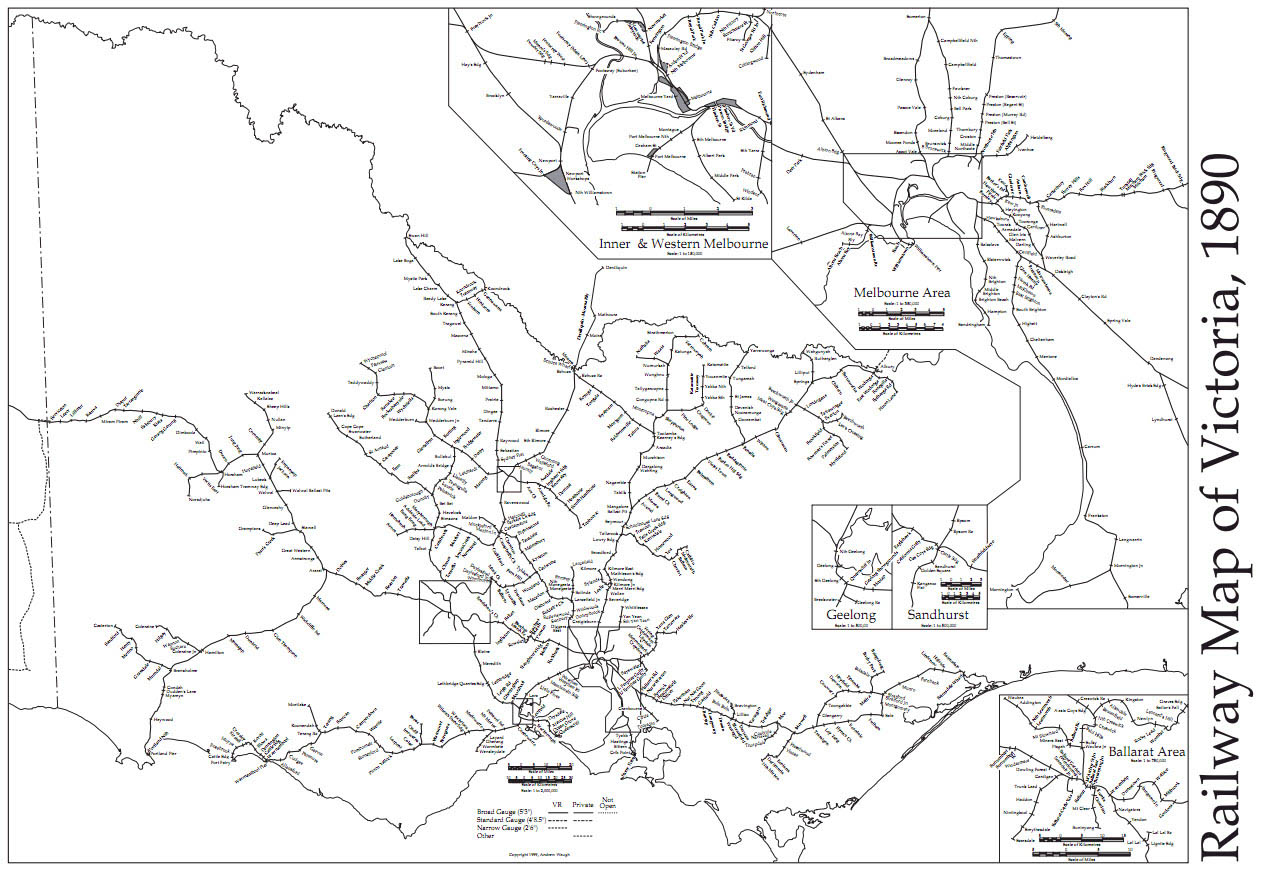
Rail system 1890, Melbourne and Victoria
By the time of the economic depression in 1891, Melbourne and Victoria already had an impressive network of railway lines. The last significant addition to the metropolitan rail system – the Glen Waverley line – was built in 1930, just before the Great Depression.
It’s reasonable to ask why, with the threat of climate change and peak oil hanging over us, we can’t replicate the achievements of the nineteenth and early twentieth centuries and massively expand Melbourne’s rail network. If our forebears of four or five generations ago could do it, why can’t we — with our superior technology — do even better?
I think the answer is that circumstances were vastly different then and much more sympathetic to constructing a network of rail lines. I can’t bring an historian’s eye to this topic but here are some of the broad ways – consider them as hypotheses – in which I think the great rail-building era differed from today.
First, train patronage was very high in that era. Virtually everyone relied on trains to travel any sort of distance. The proportion of the metropolitan population that lived and/or worked in the inner city where rail access was best was much larger than today. Hence there was a real will to build rail lines.
Second, the railways covered their operating costs. All of the first lines built in the 1850s from Melbourne to the suburbs were financed by private money. I don’t know when it happened in Australian cities, but US railways weren’t subsidised directly until after the second world war. If lines are profitable – or at least cover their operating costs – getting funding for expansion of networks and services is much easier.
Third, competition was limited. Investors in rail, whether private or public, had to compete with horses and in some localities with trams, but they had nothing like the competition that contemporary rail lines get from cars. The widespread market penetration of cars, especially after world war two, strangled the demand for train travel in Melbourne, reducing it’s share of motorised travel to around 10%.
Fourth, many Melbourne train lines also extended beyond the metropolitan boundary to country areas and interstate. They did double duty, carrying not only suburban commuters but also country freight and passengers. As this was an era when a much higher proportion of the nation’s population lived in the country, it would have made the case for building new lines right into the heart of Melbourne considerably stronger. Of course, country trains didn’t have to compete against trucks or planes, either. Read the rest of this entry »
-Why don’t Melbourne’s buses use LPG?
Posted: March 21, 2011 Filed under: Public transport | Tags: bus, contracts, LPG, pollution, Siddhartha Mukherjee, The Emperor of all Maladies 7 Comments
The rail line that never was.....
I have a heightened consciousness about diesel buses and 4WDs belching carcinogens because I’ve just finished reading Siddhartha Mukherjee’s excellent book, The Emperor of all Maladies: a Biography of Cancer.
Melbourne’s fleet of 1700 buses is powered almost entirely by diesel engines. Each year they collectively travel around 80 million kilometres, each bus consuming 90 litres of diesel per 100 km. That’s more than 70 million litres p.a. in aggregate.
Melbourne’s taxi fleet, on the other hand, is comprised mainly of LPG powered vehicles. LPG offers a small saving in CO2 emissions compared to diesel (about 10%) but its main advantage is much lower pollution. Compared to ultra-low sulphur diesel, LPG produces less than a fifth as many particles and less than 1% as many ultra-fine particles. It also produces less than one tenth as much oxides of nitrogen (NOx).
One company estimates the cost of converting the engines in the existing bus fleet to LPG at around $55,000 per vehicle. The company says buses that use LPG consume about 100L/100km (about 10% more than diesel buses) but there’s a significant saving in the cost of fuel.
The price of LPG is currently less than half the price of diesel. A bus that covers (say) 100,000 km p.a. would cost $130,500 p.a. in diesel (at today’s price of $1.45 per litre) but only $60,000 p.a. in LPG (at $0.60 per litre). That means the cost of conversion could be recouped within a very short period. This difference depends on factors like distance driven and fluctuations in relative prices. For example, a new excise on LPG of 2.5c a litre comes into effect from July this year, rising to 12.5c over the next four years. On the other hand, the current troubles in the Middle East have increased oil prices.
This highlights another singular advantage of LPG over diesel – it’s less dependent on international price fluctuations. Australia has immense reserves of natural gas from which the propane and butane in LPG are derived. Proponents of LPG also argue that it extends engine life, reduces maintenance and makes buses less noisy.
There appear to be many good reasons for bus operators to shift to LPG so why hasn’t this happened? Read the rest of this entry »
What should we do about the Airport?
Posted: March 19, 2011 Filed under: Airports & aviation, Public transport | Tags: Bus Rapid Transit, freeway, interchange, Melbourne airport, rail, ring road, Skybus 24 Comments
Proposal for an orbital Bus Rapid Transit service
The key transport challenge at Melbourne Airport isn’t to build a rail line to the CBD. Rather, it’s how to move growing numbers of travellers from dispersed suburban locations to the airport and back again. Here’s a (speculative) idea about how that might be done.
This is a pressing issue because passenger movements through the airport are projected to increase from 26 million in 2009/10 to between 44 and 55 million by 2027/28. That’s potentially a doubling of demand within twenty years. On current settings, with 69% of trips to the airport made by private car and 17% by taxi, the outcome could either be gridlock or massive expansion of the freeway network.
Providing a high capacity connection between the airport and CBD is an important part of the answer but it won’t work for all those travellers whose journey starts or ends in homes and workplaces in the suburbs. Theoretically, they could take a train to Southern Cross and transfer there to the airport service, but they’d be unlikely to do that for a number of reasons.
First, the journey would take too long – travellers would have to walk, drive or bus to their nearest station, transfer to a train or tram, and transfer again at Southern Cross station. Second, parking is inadequate – many would seek to drive to their nearest station, but there’re severe constraints on expanding parking in built-up areas. Limited economies of scale mean it would also be hard to provide an acceptable level of security for cars parked overnight at Melbourne’s 200+ rail stations. In addition, baggage would be problematic on peak hour public transport, which wasn’t designed with this purpose in mind. There would be delays in loading and unloading trains, trams and buses at rush hour and suitcases in aisles would reduce capacity.
Trying to leverage the existing suburban rail system would, in short, be too hard. Most Melburnians would simply continue to drive to the airport, leading to worse congestion. They would apply intense political pressure to have the freeway network expanded.
I’d like to offer a different solution. I think two key actions will be needed over the next twenty or so years. The first is to restrict access by car to the airport – unless there is a positive disincentive to driving (something less damaging than congestion!), alternative modes will not be viable. The second is to move the effective entry to the airport to multiple locations in the suburbs. Here’s a broad schematic of how I think it might work:
- Set charges that are high enough to discourage the great bulk of motorists from entering the airport or using the short term and long term car parks
- Provide an orbital transit service running from the airport to the west and to the south east along (mostly) existing freeways – see map
- Construct a small number of car parks with transit stations along this route, near freeway interchanges
- Aim to operate at a frequency and span of hours at least comparable to that currently provided by Skybus.
Under this scenario, Melburnians could drive to the ring road, park in a secure facility, and board the airport transit service. It would be little different from using the current long term car park and shuttle bus – the only real difference is the car leg would be shorter and the transit leg longer (although the overall time should be faster!). I also envision that ‘farewellers and greeters’ and taxi users would mostly go no further than the nearest transit station. The idea is the stations would be the effective ‘entry’ to the airport. Read the rest of this entry »
Why is transit’s share low at Latrobe Uni?
Posted: March 16, 2011 Filed under: Cars & traffic, Education, justice, health, Public transport | Tags: Census, Chadstone, City of Darebin, commuting, Cycling, journey to work, Latrobe University, Melbourne University, Monash University, transit 12 Comments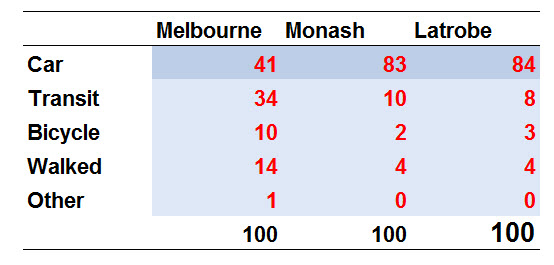
Mode shares (%), 2006 Census
Workers who commute to Melbourne University at Parkville are much more inclined to use public transport than their colleagues who work at suburban Monash or Latrobe universities. The chart shows that at the 2006 Census, 41% of Melbourne University workers reported they drove to work compared to 83% at Monash and 84% at Latrobe universities. Many more staff at Melbourne also walked and cycled – 24% compared to 6-7% at the other two institutions.
Melbourne University’s lower car use is explained by a few key factors. The main one is that it is located on the edge of the CBD where car use is limited by high levels of traffic congestion and expensive all-day parking charges. For many staff, driving would take too long, generate too much angst and be too expensive. If the value of driving is marginal, the decision to choose an alternative will be tipped by the high quality of public transport service available to Parkville workers. Although it’s not served directly by rail (none of these universities are), Melbourne University has easy access by multiple tram lines to the CBD and thence to the many radial train and tram lines linking to the larger metropolitan area. For many Melbourne University workers public transport would be a no-brainer.
Melbourne University’s high level of walking can largely be attributed to the relatively high residential densities in the nearby CBD and inner city environs. If transport is expensive in outlays and time, it makes sense for workers to live close to the university. In this case, living close to the university also means living close to the many activities and opportunities offered by the inner city.
The suburban setting of Monash and Latrobe provides a very different environment. Although these universities are not without their challenges, they generally experience less traffic congestion and enjoy cheaper parking than Melbourne University. Low suburban residential densities and large open space and industrial uses mean fewer staff can live within walking distance. The level of public transport service is actually pretty reasonable by prevailing standards (for example, see here) but obviously not as good as Melbourne University, which benefits greatly from its proximity to the CBD. Read the rest of this entry »
Is time on transit more productive than driving?
Posted: March 15, 2011 Filed under: Cars & traffic, Public transport | Tags: auto, car, in-vehicle time, phone, Public transport 13 Comments
MTR Hong Kong - SRO (photo by M Wong)
I regularly hear the argument that time spent travelling on public transport is more enjoyable and more productive than time spent in the driver’s seat of a car. The public transport passenger can read, study, write, listen to music, play games, talk to others and even think without distraction. The driver, on the other hand, must devote most of his or her attention to the road or else get fined (or worse).
I think this line of argument is ultimately pointless. Both modes have their upsides and downsides in terms of how fruitfully in-vehicle travel time can be spent. Travellers make their choice on criteria that are far more critical than this one. Still, it’s an argument that’s often made so it’s worth looking briefly at the issues.
You can listen to music, podcasts and radio just as well while driving as you can on transit, so let’s scotch that one from the get-go. In fact some people prefer listening over speakers because ear phones can cause fatigue. And far too few smartphones and mp3 players come with AM radio, so if listening to 621 or 774 on the train is your thing then your options are limited. I’d score this one even.
What you can’t do in a car however is use a notebook computer, send text messages, play games or read reports and books, at least not if you’re driving. Actually notebooks aren’t widely used on public transport in my experience, even on the sharp end of planes, but reading, texting and playing games are certainly a common way to while away the time. It’s neither legal nor practical to do those activities in any meaningful way if you’re driving.
But they’re much harder to do on public transport if you don’t have a seat. On Melbourne’s public transport system that’s by no means guaranteed in rush hour. In places like Hong Kong, Singapore and Japan where public transport is the dominant mode, you don’t necessarily even get a choice (see picture – the priority there is to move lots of people quickly).
But there’s one area where the car has an offsetting advantage – (hands free) phone calls. Drivers can make personal and business calls without sacrificing privacy and without imposing on others. That means they can make more important, nuanced and meaningful calls than they would on a train or a bus. They can communicate more effectively without feeling self-conscious because strangers are listening in. Apart from the odd loudmouth, phone calls on public transport are like text messages – suitable mainly for communicating simple or straightforward information. Read the rest of this entry »
Does driving cost less than transit?
Posted: March 13, 2011 Filed under: Cars & traffic, Public transport | Tags: auto, Camry, car, Driving Your Dollar, Metlink, Public transport, RACV, Yaris 16 Comments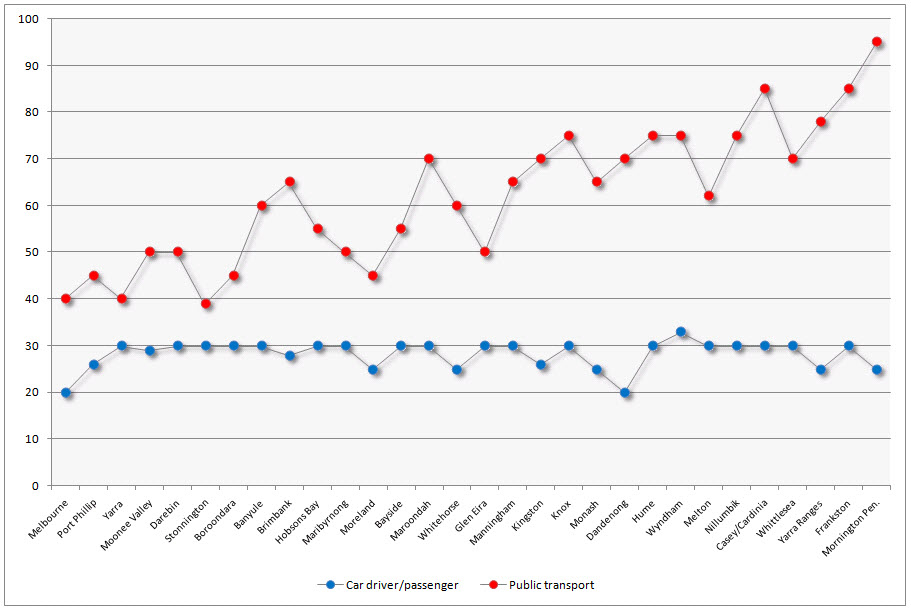
Median journey to work time in Melbourne, by mode, ordered by approx distance of home municipality from CBD (VISTA)
With petrol prices spiking upwards, it’s a good time to examine the relative cost of driving versus public transport. You can save a lot of cash if you’re prepared to live without a car, but you’ll pay in other ways.
According to the RACV’s 2010 Driving Your Dollar survey, it costs $10,668 p.a. on average to run a medium sized car like a Toyota Camry Altise. The cost could be as low as $6,759 p.a. for something small such as a Toyota Yaris or as much as $19,234 p.a. for a behemoth like a Toyota Landcruiser GXL. On the other hand, a zones 1and 2 Yearly Metcard costs $1,859 p.a. for unlimited travel. However ticket outlays need to be adjusted for household size. In my case, my wife would also require a yearly pass and our two children would need travel concession passes. That brings the total cost up to $4,562 p.a., but that’s still considerably less than the Camry’s $10,668 p.a.
Of course many children already have a school travel concession pass. And adults who know they have a limited travel range could probably get by with either a zone 1 ($1,202) or zone 2 ($799) ticket and buy extra daily tickets on those (presumably infrequent) occasions they travel cross-zone. Travellers who use public transport exclusively will in all likelihood spend more on taxis and occasional light truck rental, as well as sacrifice some spontaneity in trip planning, but in cash terms they should still come out well ahead of car owners.
Whatever the overall saving is, it isn’t going to be realised by households who keep their car and simply use it less. The bulk of outlays associated with a car are standing costs like depreciation, insurance and registration. In order to be significantly better off in cash terms, a household either has to lose a second car or decide they can get along without any car at all.
But this simple accounting doesn’t provide a fair comparison. There’s one big difference that has to be taken into account – travel by car is much faster on average than by public transport. The latter is most attractive for work travel, but even then the median journey time in Melbourne is almost double that by car (see accompanying chart). Those longer trip times in part reflect commuters who catch trains from distant places to the city centre. But the main reason is that passengers have to expend time on tasks like walking to the stop, waiting for the service and in some cases transferring between services. Read the rest of this entry »
Does higher density mean lower car use?
Posted: March 5, 2011 Filed under: Cars & traffic, Planning, Public transport | Tags: Centre for Transportation Studies, cities, Gary Barnes, land use, Public transport, transit, University of Minnesota, urban areas, weighted density Leave a comment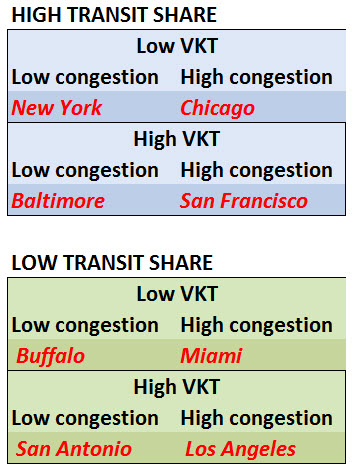
Travel outcomes (Barnes)
Not necessarily – in fact in the US, not even usually!
It’s a truism that denser, more concentrated cities tend to have higher public transport use. Various studies have confirmed this intuition but what is usually left unexamined is the implicit assumption that such cities consequently have lower car use.
This study of 31 of the largest cities in the US found that assumption is not correct. Higher public transport mode share does not translate on average to lower kilometres of travel by car, shorter commutes by car, or lower levels of traffic congestion.
The primary finding “is that land use, at least at the aggregate level studied here, is not a major leverage point in the determination of overall population travel choices”.
Undertaken by Gary Barnes from the Centre for Transportation Studies at the University of Minnesota, the research found that, if anything, “the higher densities that increase transit share tend to increase commute times and congestion levels”.
The main objective of the project was to identify the effect of land use on travel behaviour. Most studies concentrate on the effect of average density on one or two variables, usually transit share and sometimes total kilometres of car travel.
Barnes’ approach was much more extensive. For each urbanised area, he defined 15 descriptors of travel behaviour, 11 of land use and 15 other, mainly demographic, factors. Moreover, he employed the concept of ‘weighted density’ (he calls it ‘perceived density’) to more accurately describe the distribution of both population and employment in each city.
Barnes confirms that residential concentration increases transit’s share of travel, but he notes the effect is not large. Contrary to the underlying assumptions of much urban policy:
Even very large changes in land use have very little impact on travel behaviour, in good ways or in bad. Apparently the larger effects sometimes observed in neighborhood-scale studies are just that: neighbourhood-scale effects that do not extend their benefits to the larger urbanized area.
His analysis implies that increasing residential density by 100% would increase transit share by only 5-6%. To get a 1% increase in walking and cycling’s combined mode share would require an increase in residential density of 5,000 persons/mile2 (1,931/km2). Similarly, a 14% increase in density would only yield a 0.5% decrease in in-car travel time per person. Read the rest of this entry »
-Sydney buses from the air
Posted: March 4, 2011 Filed under: Public transport | Tags: animation, bus, Flink Labs, GPS, Public transport, real time, Sydney 1 Comment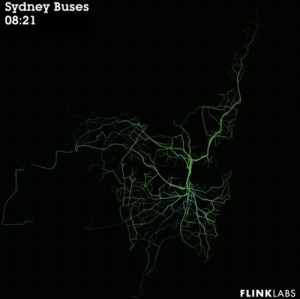 Melbourne data visualisation company, Flink Labs, has produced another excellent transport animation – this time it’s 24 hours in the life of Sydney buses. Flink Labs prepared it as part of the apps4nsw program.
There’s also an associated real time bus map which uses GPS to show the location of Sydney’s many buses. It’s updated every minute.
Unfortunately it might not work with Internet Explorer (hmmm, Flink Labs must have a very interesting business model – maybe it’s intended solely for smartphones?).
Sure are a lot of buses in Sydney!
Readers might recall Flink Lab’s superb animation of Melbourne’s trains which appeared on these pages in July.
See also these animations of transport in Auckland and Lisbon.
Is public transport ‘CBD dependent’?
Posted: February 28, 2011 Filed under: Public transport | Tags: 2006 Census, Frank Milthorpe, journey to work, mode split, Public transport, Sydney, transit, Xu Blake 9 Comments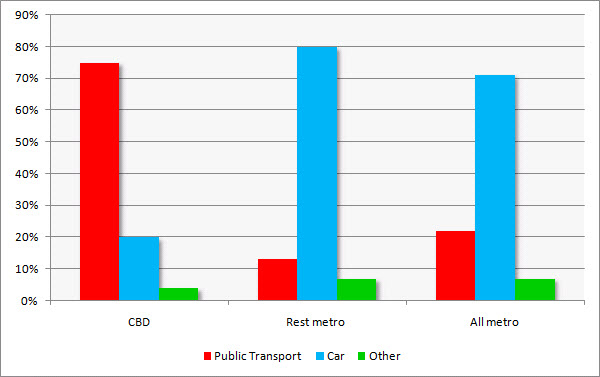
Journey to work mode share, Sydney
A recent paper on travel in Sydney illustrates how dependent the CBD is on public transport and, in turn, how dependent public transport is on CBD commuting.
The paper analyses the journey to work in Sydney using data from the 2006 Census. It was undertaken by Blake Xu and Frank Milthorpe of the NSW Bureau of Transport Statistics.
Although the great majority of travel in Australia’s capitals is now undertaken for non-work purposes and is dominated by the car, the journey to work nevertheless remains an important travel purpose.
This is partly because it generates the largest peak in demand and partly because it is the one travel purpose where public transport’s mode share still remains relatively high.
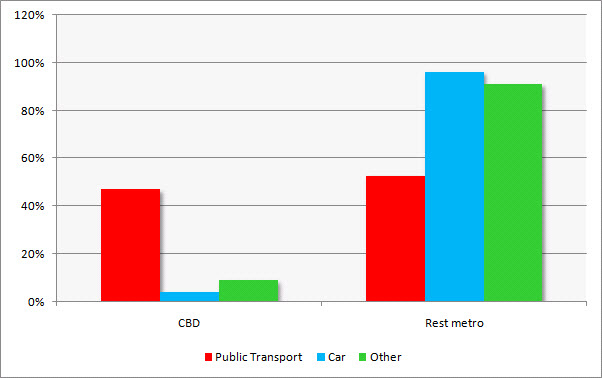
The first chart shows that, as is the case with other capitals, public transport dominates commutes to the CBD in Sydney. It captures 75% of all journeys by Sydney CBD workers, whereas the car only gets 20%. That’s a bit higher than the other capitals but it’s an expected result.
Journey to work, market share by mode, Sydney
However what might surprise is that outside the CBD, public transport’s share is quite small. Only 13% of people who work elsewhere in metropolitan Sydney use public transport to get to work, while 80% drive.
When the CBD and the rest of the metropolitan area are taken together, the mode split for commuting for all of Sydney is 22% for public transport and 71% for car. Despite its high public transport share, the CBD has a small effect on the Sydney-wide average because it only has a small proportion of all jobs in Sydney – it accounts for just 14% of total work journeys.
Public transport patronage grew strongly in Sydney in absolute terms over 1981-06, but car use grew even faster. Transit’s share of work journeys fell from 25% to 22% over the period.
These numbers tell us that public transport is extremely important for the functioning of the CBD. Delivering large numbers of workers to the Sydney CBD in peak hour simply wouldn’t be possible without it. Read the rest of this entry »
 The Melbourne Urbanist