How punctual are our city trains?
Posted: July 28, 2010 Filed under: Public transport | Tags: commuters, Jarrett Walker, Metro Trains, New York City, New York Times, on time running, punctuality, trains 7 Comments
Waitin' on a train
Actually they’re probably much less punctual than you think, no matter which major city you live in.
Consider the performance of Metro Trains, the new private operator of Melbourne’s metropolitan trains. Back in May, only 82.7% of services operated by Metro Trains ran on time.
This is well below the contracted 88% monthly punctuality target below which Metro is obliged to pay compensation. And it’s positively woeful compared to the 96% punctuality achieved by New York City’s commuter rail system last year.
The circumstances in May were probably unusual, but the standard 88% is hardly a high hurdle. Yet from a commuter’s perspective, it’s actually worse than this figure suggests. Read the rest of this entry »
Melbourne’s trains from the air
Posted: July 8, 2010 Filed under: Public transport | Tags: App My State, data visualisation, Flink Labs 4 Comments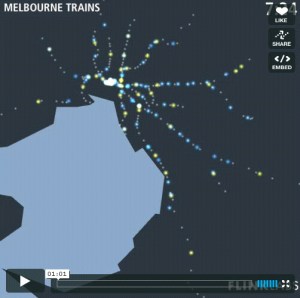
Click to play video
This outstanding satellite-like view of Melbourne’s trains running over the course of a day was developed about twelve months ago by Flink Labs, a new Melbourne data visualisation firm. In their words:
“Inspired by the foraging of ants and their pheromone trails, this visualisation provides the viewer with a satellite-like view of the entire train network over an accelerated timeframe. The visualisation exposes the ebbs and flows of the system along with a surprising level of complexity, not obvious to the viewer at a single point in time or at the scale of an individual train.
The day starts and the train network awakens, slowly at first, then increases to peak hour levels around 9am. A steady active state continues through the day, then increases again as school students, then workers, commute home from the city. Finally, the system quietens as the last trains depart at the end of the day. Read the rest of this entry »
Will an airport rail link reduce GHGs?
Posted: July 5, 2010 Filed under: Airports & aviation, Energy & GHG, Public transport | Tags: Australian Greenhouse Office, Epping South Morang rail line, GHG, Melbourne airport, Public Transport Users Association, Skybus, Tullamarine freeway 7 CommentsGiven the evident public interest in the idea of a rail link from the CBD to the airport, I thought I’d look more closely at some of the key rationales for this project, starting with the claim that it would reduce greenhouse gas emissions.
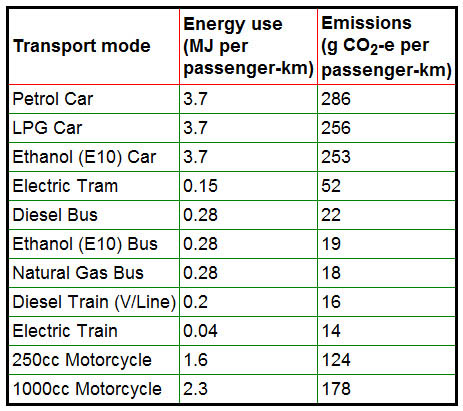
Energy use and emissions (PTUA)
I’ve looked at this issue and, on my admittedly simple calculations, I conclude that the value of greenhouse gas (GHG) savings from a rail line is likely to be minor compared to the probable cost. There are far cheaper ways to offset equivalent emissions than building a rail line.
I looked at this by making the following simplifying assumptions.
First, I assume that a new rail line captures 20% of airport passenger traffic or five million of the current 25 million annual passenger movements at Melbourne Airport. This is double the share captured at either Sydney or Brisbane (around 10%), and almost three times the 7% estimated in feasibility studies.
Second, I assume that all of the current two million passengers using Skybus transfer to the new train (i.e. Skybus ceases to operate) and three million passengers transfer from cars, including taxis.
Third, I assume an average distance of 22 km from the CBD to the airport for bus and train. I assume that the combined average distance travelled to the airport by the cars and taxis that are replaced by train is 35 km. Read the rest of this entry »
Forecasting patronage: it’s easy, isn’t it?
Posted: July 4, 2010 Filed under: HSR High Speed Rail, Infrastructure, Public transport | Tags: Clem 7 Brisbane, Cross City Tunnel Sydney, High Speed Rail, very fast train 2 CommentsWe’ve seen some high profile examples in recent years of how hard it is to forecast patronage on new transport infrastructure.
The Cross City tunnel in Sydney and the Clem 7 in Brisbane, for example, have both performed well below forecasts. Even when it was free, the Cross City tunnel did not approach the forecast volumes of 90,000 vehicles per day. Traffic volumes on the cross-river tunnel in Brisbane fell from almost 60,000 during the free period to around 20,000 in the first week of tolling.

Click to enlarge interactive map
California’s planned $42 billion High Speed Rail (HSR) project provides another example of the difficulties of forecasting demand. Although there are important differences between the design of the California HSR system and proposals for a Very Fast Train (VFT) between Sydney-Canberra-Melbourne, the former nevertheless has important lessons for us. I have previously discussed the VFT here, here, here and here.
A new analysis by the Institute of Transportation Studies, University of California Berkeley, found significant problems with the demand modelling and analysis undertaken for the California project by Cambridge Systematics (CS) “that render the key demand forecasting models unreliable for policy analysis”. Read the rest of this entry »
More on Melbourne Airport rail link
Posted: July 2, 2010 Filed under: Airports & aviation, Infrastructure, Public transport | Tags: Melbourne airport, rail link, Skybus, Tullarmarine freeway 19 CommentsThere’s been a strong reaction, predominantly negative, to my oped in The Age this morning where I argue that there are higher priorities for scarce transport funding at this time than the CBD-Airport rail link championed by the Lord Mayor and The Age.
I expected a hot reaction because The Age’s online poll is currently running 97% in favour of a rail link. Also, there were 208 comments, almost all strongly in favour of a rail link, on this piece run by The Age last Monday.
Some commenters seem to think my brief must be to defend the Minister for Transport and the Government. Others think I must be in the pocket of Skybus, the taxi industry, the Government, or all three. Someone’s even accused me of being anti public transport and of lamenting the decline in driving in my earlier post Why is Gen Y driving less? Lukas, who says he works in DPCD, reckons the consensus “around here” is we do need the link and the reason it’s not happening is “so many industries …have their hands in Brumby’s pockets”. Phew!!
Now that the flood of invective is slowing, let me say that not one of these personal insinuations is true. It is possible to raise serious questions about the desirability of this or any other transport project without being corrupt, incompetent or worse. No project, rail or otherwise, is automatically a “no brainer”.
My point remains that on the information publicly available, it does not seem to me that a rail link from the CBD to the airport is as high a priority at this time as some other pressing transport needs, such as improving outer suburban public transport services. Airport users generally have much better, if imperfect, options at present than those who live in the vast reaches of suburbia. Read the rest of this entry »
Why is Gen Y driving less?
Posted: June 28, 2010 Filed under: Cars & traffic, Public transport | Tags: baby boomers, driving less, Gen Y, internet, Public transport 9 CommentsAfter growing consistently for many decades, car use is falling in developed countries (e.g. USA, Australia, Britain). A notable aspect of this decline is the fall-off in driving by young people.
New data from the US Federal Highway Administration (see here and here) shows that although they increased their share of the US population slightly over the period, those aged 21-30 accounted for only 14% of all miles driven in 2009, compared to 21% in 1995. Another study reports that in 2008 only 49% of 17 years olds had driver’s licenses compared to 75% in 1978.

There is now a sharp difference between Gen Y and baby boomers. A typical 58 year old in the US last year drove 11,607 miles, while the average 28 year old drove just 7,011 miles.
Neither the GFC nor the recent escalation of petrol prices fully account for these changes because the decline in driving preceded these events. So what is driving Gen Y to abandon what has traditionally been one of the great rewards of coming-of-age?
The explanation usually advanced is that the internet has enabled electronic communication to substitute for face-to-face contact. As I’ve pointed out before, however, reputable researchers conclude the exact opposite – electronic communication increases the demand for face-to-face contact more than it substitutes for it. Read the rest of this entry »
Does a rail line to Melbourne airport make sense?
Posted: June 28, 2010 Filed under: Airports & aviation, Infrastructure, Public transport | Tags: Booz Allen Hamilton, IMIS, Melbourne airport, rail link, Skybus, The Age, Tullamarine freeway 10 CommentsThe Age ran a front page story on Saturday (Train derailed by buck-passing and vested interests) on the need for a rail link from the airport to the CBD. I say story, but as the headline and this quote indicate, it was more advocacy than news:
“But thanks to decades of buck-passing and pandering to vested interests by successive state and federal governments, Melbourne – unlike so many other cities of its size and wealth – does not have a railway line to its airport”.
So having pressed the civic pride button, it’s a pity The Age didn’t also push the rationality pedal and ask: is there a case for constructing a new public transport system (rail) to compete with the existing one (bus)?
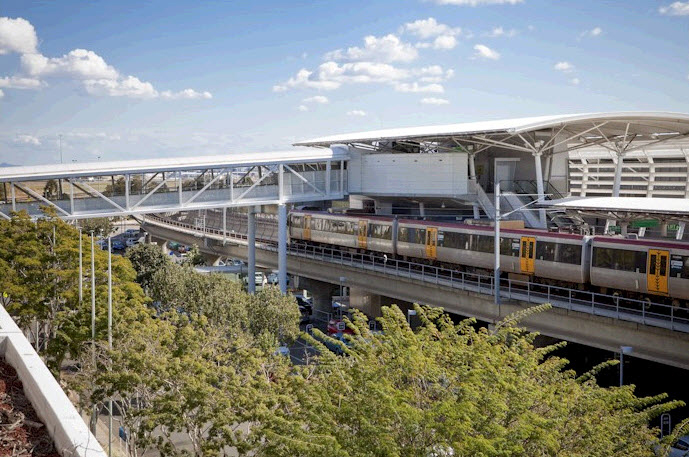
Airtrain terminal Qld international airport
I would quite like to have a rail line from the CBD to the airport, but as I’ve indicated before (here and here), only if it makes sense. Let’s look at some pertinent issues.
First, the feasibility studies undertaken by the Government conclude that the numbers for rail don’t stack up (yet). The most recent evaluations, undertaken in 2001 by BAH and in 2009 by IMIS, both concluded there is not a strong enough case to build a new rail line to the airport.
The Department of Transport projected rail would capture only 9% of all airport trips and would require a subsidy of $350-450 million over 10 years (in 2001 dollars).
Second, in 2003 the Government upgraded the Skybus service so it could deal better with congested conditions around the CBD and on the Tullamarine Freeway. According to the Transport Department, new roadworks enabled Skybus to bypass traffic delays at the Tullamarine/Calder Freeway interchange and at the city fringe. The package included lane widening as well as line marking changes to create an emergency lane wide enough for buses. Read the rest of this entry »
Winners of ‘App My State’ have an urban focus
Posted: June 22, 2010 Filed under: Miscellaneous, Public transport | Tags: App My State, application, iPhone app, mashup, Transportle, Which Bin? 5 Comments
Transportle: it's a long trip (purple line) from Preston to Ivanhoe station by public transport at 10.30 pm
The winners of the Victorian App My State competition announced last night by the Premier have a distinctly urban orientation. The objective of the competition is to inspire Victorians to create web and mobile applications for Victorians. Entrants compete for $100,000 in prizes.
First prize was won by Jason Smale for his iPhone app, Which Bin?, which helps people understand what items are able to be recycled. He says:
I’ve often seen my mother struggle to read which number is in the tiny recycling triangle on the bottom of yoghurt containers. After about 5 minutes she resorts to using a magnifying glass and finally the often undecipherable number defeats her.
The judging criteria are usefulness, design and development, innovation, useability and this delightful example of bureacratic cool, “The vibe” or overall appeal. Read the rest of this entry »
Should rail commuters pay a congestion toll?
Posted: June 21, 2010 Filed under: Activity centres, Public transport | Tags: Activity centres, CBD, congestion charge, Melbourne @ 5 Million, toll, train, Washington Metro 8 CommentsMelbourne’s peak train services are overcrowded and have been for quite a few years. Given the high costs that peak period commuters impose on the rail system, wouldn’t it be more efficient and more equitable if they paid more for their tickets?
After all, the capacity of the system is determined by peak demand – all those trains and the associated infrastructure and personnel required to handle the peaks are under-utilised or sit idle for the rest of the day and on weekends.
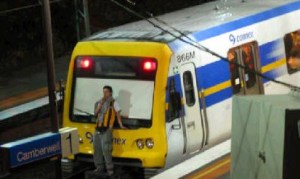
Too crowded to get a seat?
As would be the case with congestion charging on roads, a charge on peak hour train travellers should reduce over-crowding (congestion) by suppressing travel, moving lower value trips to off-peak periods and encouraging shifts to other modes. Passengers who continued travelling in the peak would make a larger contribution towards what it actually costs to get them to work.
I’m prompted to think about this issue by a proposal to levy a $0.50 per trip surcharge on customers of Washington D.C.’s Metro system who use or pass through the network’s busiest stations during the busiest period of the peak. If approved, the congestion toll would apply from next month. Read the rest of this entry »
The VFT and Green’s preferences
Posted: June 19, 2010 Filed under: HSR High Speed Rail, Infrastructure, Public transport | Tags: election, Gary Johns, High Speed Rail, The Australian, The Greens, very fast train, VFT 3 CommentsThis blog has devoted a fair bit of attention to the proposed Very Fast Train between Sydney-Canberra-Melbourne (here, here and here), wondering what warrant there is to replace one form of public transport with another.

More attention in fact than any of the mainstream papers or denizens of the blogosphere have mustered, as far as I can tell.
So readers might be interested in this article by Gary Johns published in The Australian last week. It’s notable because he conjectures that the VFT might be the price the Government has to pay to secure Green preferences in this year’s Federal election.
Don’t think I agree with his analysis of the Greens mind (this is the former Special Minister of State in the Keating Government, isn’t it?) but I think his sources on the economics of the VFT are impeccable. Here nevertheless is a less-than-complimentary take on Johns. Read the rest of this entry »
Melbourne Bike Share – how can the Government save face?
Posted: June 8, 2010 Filed under: Cycling, Public transport | Tags: Bixi, helmet, Melbourne Bicycle Share, RACV, tourism 10 CommentsThere is a near universal consensus that Melbourne Bicycle Share is misconceived and almost certain to fail. Most attention has focussed on the compulsory helmet requirement but as I noted last week, this is a program that addresses a need that doesn’t exist and is designed in a way that will almost guarantee failure.
But no one wants a fiasco. The Government wants to save face, the RACV wants to keep its management contract and no one wants to see Melbourne’s reputation damaged by the failure of the blue Bixis.

So, I propose some radical surgery for Melbourne Bicycle Share.
First, forget about targeting the scheme at CBD workers running short errands. Reposition it instead as a service to promote tourism. The tariff should be turned around completely to support longer hire periods. For example, something more tourist-friendly, like $20 for the first two hours and $5/hr thereafter – hence $30 for 4 hours – would be close to the mark, although the tariff should be set with the goal of operating on a commercial basis.
Second, the Government should change the law to give anyone who can produce a valid out-of-State ID the right to ride a blue bike without a helmet. The exemption would not apply to any other bicycles and would be justified on the basis of supporting tourism. Tourism has been used to support Sunday trading in the dark and distant past when shopping on the Sabbath was a sin, so it’s an old and much used workhorse. Read the rest of this entry »
Free download!!: transport model of NYC
Posted: June 5, 2010 Filed under: Cars & traffic, Public transport | Tags: Balanced Transport Analyzer, Charles Komanoff, New York 1 Comment According to the New York Time’s Freakonomics Blog, the Balanced Transport Analyser “is a spreadsheet that models in intricate detail the daily flow of all transit – public, private, wheeled and bipedal – in New York City”. According to Wired, “over the course of about 50 worksheets, the BTA breaks down every aspect of New York City transportation—subway revenues, traffic jams, noise pollution—in an attempt to discover which mix of tolls and surcharges would create the greatest benefit for the largest number of people”.
It calculates “how new fees and changes to existing tolls affect traffic at different times of day and calculates which costs are borne by city dwellers and which by suburbanites. It calculates how long it takes passengers to dig for change and board buses. And it allows any user to adjust dozens of different variables—from taxi surcharges to truck tolls—and measure their impact. The result is a kind of statistical SimCity, an opportunity to play God and devise the perfect traffic policy”.
The Balanced Transport Analyzer was created by Charles Komanoff. The complete model can be downloaded here.
Why do inner city residents walk and tram to work?
Posted: June 3, 2010 Filed under: Planning, Public transport | Tags: CBD, Cycling, density, Inner city, new urbanism, Orenco, Public transport, socioeconomic status, sustainable transport, symbolic analyst, traffic congestion, walkability 4 CommentsMore than half of all trips to work by residents of the inner city are made by walking, cycling or public transport. In fact three quarters as many residents walk and cycle as use public transport for their commute.
Why? Is it because of the higher density of the inner city?

Inner city Melbourne (photo by ExTester)
The view that density predicts more sustainable transport use is a common one. While it has some role, it is not the key force at play here. In fact there’s evidence that the population density of some parts of the inner city is not that much higher than that of the suburbs – this is because the average size of households in the inner city is relatively small compared to suburban locations.
There are also examples of higher density developments where use of public transport is quite low, for example edge cities in the US and suburban New Urbanism developments like Orenco in Portland, Oregon.
So if density isn’t the primary force driving more sustainable transport use in the inner city, what is?
Here are four plausible explanations.
The first is proximity. Inner city residents live cheek by jowl with the largest concentration of jobs in the metropolitan area – the inner city has 28% of all metropolitan Melbourne’s jobs and the CBD, despite its diminutive geographical size, has 14.5%. There is no other location in Melbourne that comes within cooee of the job density of the CBD. Read the rest of this entry »
Is Melbourne Bicycle Share all spin?
Posted: June 2, 2010 Filed under: Cycling, Public transport | Tags: fares, Melbourne, Melbourne Bicycle Share, RACV, taxis, tourism, trains, trams 21 CommentsI hope I’m proven wrong but I can’t help feeling Melbourne Bicycle Share is much more about political spin than about transport.
The PR material indicates the scheme is pitched at short-distance and short-duration travellers “running an errand at lunch or going across town for a meeting or lecture”. It extends “your public transport options and makes the CBD more accessible than ever before”.

The big question to my mind is what exactly is the need that this scheme is filling? Or more precisely, what is the justification for the Government subsidy it requires?
The very idea of a CBD is that it is walkable and if the trip’s too far then travellers take public transport. In fact public transport in Melbourne’s CBD, where we have the choice of the city rail loop and a dense tram system, is pretty good by world standards. Quite simply, the CBD doesn’t need share bicycles for transport.
I can’t see a lot of sense, either, in spending public money to take off-peak passengers away from public transport – that’s the very time when the system has spare capacity and should earn extra revenue with minimal extra cost. And why subsidise walkers to ride instead?
I’m not in any event confident that Melbourne Bicycle Share is even going to work. Read the rest of this entry »
Why I don’t warm to public art
Posted: May 29, 2010 Filed under: Public transport | Tags: community art, Dostoevsky, public art, Rail station, Russia 4 Comments I love Russian railway stations. The TimesOnline reports “the opening of a Moscow Metro station named after Fyodor Dostoevsky has been postponed after complaints that murals decorating the platform walls are too depressing. The images, drawn from the 19th-century novelist’s works, could prompt depressed commuters to kill themselves, critics say.
“One scene, right, depicts a man preparing to hit a woman with an axe while another lays dying at his feet — inspired by Rodion Raskolnikov in Crime and Punishment”.
I’ve never been very keen on public art and this reinforces my prejudice.
Hat tip to Tyler Cowen.
What if you were the Premier?
Posted: May 27, 2010 Filed under: Cars & traffic, Education, justice, health, Public transport | Tags: Alcohol, Cars, Melbourne, Premier, prohibition, Public transport, road pricing, Victoria 3 CommentsImagine you’ve just been elected Premier. You carried the electorate on a simple but radical two-promise platform: (1) to prohibit alcohol and (2) to shift all travel out of cars and onto public transport.
The Party is solidly behind you. Members agree that both alcohol and cars are bad for the individual and bad for society. You’re lauded as a reformer.

But you’ve not long been in office before you discover just how entrenched car use is in your largest city. Just 10% of trips are made by public transport and 90% of households have at least one car. Less driving would make the community better off but you quickly discover how much people like doing things that are bad for them and bad for others. You have a stiff drink.
For all their talk about sustainability, your predecessors knew the electorate loved cars. The former Premier talked-the-talk about public transport and even threw a few paltry dollars its way, but at the end of the day she didn’t do anything that would come between voters and their cars.
Eager to get started, you begin your quest to reduce car use by investing massively in public transport. You mortgage the State budget for the next 50 years in an endeavour to provide high quality, metro-style public transport across the entire city. Travellers without access to a car, like school children and tourists, think you’re God. CBD workers think you’re Gary Ablett. But you fail to notice that most of them either don’t vote or don’t live in marginal electorates. Read the rest of this entry »
Has the very fast train run out of steam?
Posted: May 26, 2010 Filed under: HSR High Speed Rail, Infrastructure, Public transport | Tags: Canberra, High Speed Rail, Sydney-Melbourne corridor, very fast train 9 CommentsThe idea of very fast trains on the Sydney-Canberra-Melbourne corridor seems to have run out of steam after an initial flurry earlier this year when the CRC for Rail Innovation and the Greens both called on the Federal Government to fund a major concept study.
There has been very little in the popular media since that opening blast. Hence it was interesting to see author, educator and consultant, John Legge, arguing in The Age on Saturday that the figures on very fast rail add up.

Note the extensive green areas near Canberra
He asserts that: (a) high speed rail works in Europe, China and Japan, (b) the US is now building high speed rail projects, (c) rail is faster, more comfortable and more convenient than flying, and (d) it can be built for a mere $15 billion. Ergo, it will be an unqualified success on the Sydney-Canberra-Melbourne corridor. But he provides little in the way of evidence or argument to support these claims.
Surprisingly, Legge makes no mention of what I think is the best argument for the project – constraints on Sydney Airport’s ability to expand capacity. Even more surprisingly, he doesn’t mention the environmental benefits of rail over air until the very last line and then just in passing. His key argument is that rail would out-compete air simply because a very fast train is a more attractive product.
I don’t want to deal with everything Legge says because I’ve covered most of the arguments for and against high speed rail here and here. But I do want to take issue with a couple of the points he makes.
First, what works in other countries won’t necessarily work in Australia. Most of the routes in Europe and Japan where high speed rail is strong are relatively short e.g. London-Paris is 340 km; London-Brussels is 198 km. London, with a population of 8 million and Paris (10 million) are very big cities compared to Sydney and Melbourne. They are world cities that have huge numbers of business travellers and tourists compared to Australia (London is an ‘Alpha’ world city). Congestion in the air and on the ground makes air less competitive in those cities, particularly for short trips. Read the rest of this entry »
Do the numbers support the Very Fast Train?
Posted: May 3, 2010 Filed under: Energy & GHG, HSR High Speed Rail, Infrastructure, Public transport | Tags: GHG, greenhouse gas, High Speed Rail, Melbourne airport, Sydney airport, very fast train 16 CommentsI’ve run some numbers on how a Very Fast Train in the Sydney-Melbourne corridor would stack up against planes in order to flesh out the questions I posed last week (Is the VFT all huff and no puff?). I used a simple “back of the envelope” methodology adapted from that used by Harvard’s Edward Glaeser to evaluate high speed rail projects in the US (here).
I estimate the economic and environmental benefits of carrying all current Sydney-Melbourne air traffic by VFT rather than plane at around $840 million p.a. (although this does not include the cost of GHG emissions from construction of a rail line – this would be large).
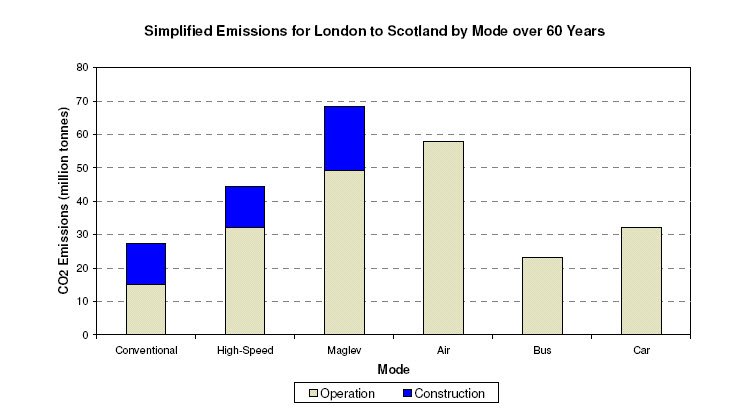
Table by Booz Allen
At first glance a VFT looks unpromising, since I estimate the capital cost of constructing and maintaining a VFT line from Sydney to Melbourne at about $1.5 billion per year. This is well in excess of the benefits.
However this assumes Sydney can accommodate passenger growth by using larger planes. It quite possibly can, but if it can’t and a second Sydney airport has to be built, a VFT starts to look viable if the cost of the airport were to come in at around $15 billion.
Let me emphasise that this is a simple analysis. I’ve left out many complications, including Canberra passengers and car traffic on the Hume.
The only environmental issue I’ve included is (operating) GHG. And of course I’ve made assumptions on things like construction costs and future interest rates.
Starting with capital costs, estimates of the cost to acquire land and construct a VFT line range from $14 to $82 million per km in Europe and the US (Japan is much higher because of earthquake risks). I assume a middling cost of $30 million per km, giving a total cost of $27 billion to build a 900 km line (the existing Sydney-Melbourne rail line is 950 km). I’ve assumed an interest rate of 5% p.a. and annual track maintenance cost of $124,000 per km. These assumptions give a total capital cost for the line of $1.5 billion per annum. Read the rest of this entry »
Is medium density housing on tram routes sustainable?
Posted: April 29, 2010 Filed under: Cars & traffic, Planning, Public transport | Tags: apartments, Melbourne City Council, Residential intensification in tram corridors, Rob Adams, SGS, tram routes 20 CommentsI like Melbourne City Council’s proposal for higher dwelling densities along tram lines but I think the claim that it would increase sustainability is exaggerated. There’s a whole ‘second half’ missing from this proposal.
The idea, which seems to be largely the brainchild of Council’s Rob Adams, is essentially that multi unit developments of up to 8 storeys should be encouraged along tram routes, leaving the suburban “hinterland” undeveloped (Rob refers to it as a new green wedge). This would reduce the need for fringe development and increase the mode share of public transport.
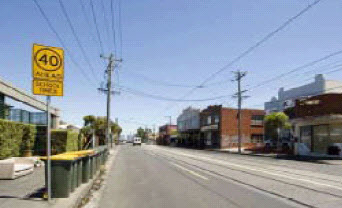
Nicholson Street - before
The major opportunities appear to be on tram routes in the inner suburbs, around 5-10 km from the CBD. While I think the assertion that 4-8 storey buildings can substitute for fringe development is fanciful and is based on a misinterpretation of other research, I accept that the proposal has the potential to increase the supply of dwellings of the type that are sought after by smaller households, especially those without dependents.
The key problem however is that nothing has been proposed to deal with car use by households occupying these new apartments. Without that, it won’t deliver. It just assumes that if households live cheek by jowl with good public transport they will necessarily use it. Read the rest of this entry »
Is the Very Fast Train all huff and no puff?
Posted: April 27, 2010 Filed under: Decentralisation, Energy & GHG, HSR High Speed Rail, Infrastructure, Public transport | Tags: Canberra, CSIRO, Greens, Insiders, Melbourne, Sydney, very fast train, VFT 23 CommentsThe idea of a very fast train (VFT) connecting Sydney, Canberra and Melbourne is gaining momentum (again). The CRC for Rail Innovation launched a pre-feasibility study earlier this year; veteran journalist Brain Toohey expressed his enthusiasm for the idea on Insiders on 11 April; and now the Greens are calling on the Federal Government to fund a $10 million study into a new scheme they are proposing.

The idea of a VFT has a long history in Australia, dating back to the first serious proposal put forward by the CSIRO in 1984. The key drivers of the current proposal are environmental and resource efficiency and support for expanded regional centres.
I don’t have access to whatever technical analysis the Green’s are relying on, but this seems an unlikely idea. The fact no project has yet been shown to be viable should be a warning to tread warily. I have some doubts. Read the rest of this entry »
 The Melbourne Urbanist