Why is public transport patronage increasing?
Posted: December 1, 2010 Filed under: Public transport | Tags: Brisbane, patronage, Perth, petrol price, population growth, Public transport, South East Qld, Sydney, traffic congestion 9 Comments
Public transport patronage growth in Australian cities (chart by Chris Loader)
As the accompanying chart shows, public transport patronage has grown sharply in some of Australia’s capitals this past decade but the rate of growth has generally slowed significantly over the last 18 months.
We’re accustomed to thinking that growth in patronage is driven by higher petrol prices but the chart indicates the explanation is probably more complex.
In particular, the considerable differences between cities suggest that one single factor is unlikely to provide a satisfactory explanation. Patronage grew spectacularly in South East Qld, Perth and Melbourne, but was modest in Greater Sydney and unremarkable elsewhere.
It needs to be borne in mind that all of this growth is from a relatively small base. For example, public transport’s share of all motorised travel (weekday and weekend) in Melbourne is even now only around 11%. This is only slightly lower than Sydney’s. Perth is likely to be only around half Melbourne’s level and Brisbane somewhere in between.
The usual suspect when looking at increasing public transport patronage is higher petrol prices. However if that were the key factor we’d expect a more uniform pattern of growth across cities. Canberra has one of the highest levels of car use of all capitals, yet public transport patronage in the nation’s capital barely moved over the period. The same is true of rising traffic congestion. Sydney would have to figure much more prominently if this were the key driver. Read the rest of this entry »
What costs society more – cars or public transport?
Posted: November 24, 2010 Filed under: Cars & traffic | Tags: emissions, externalities, Garry Glazebrook, parking, Public transport, social cost, transit, transport modes, transport subsidy 9 Comments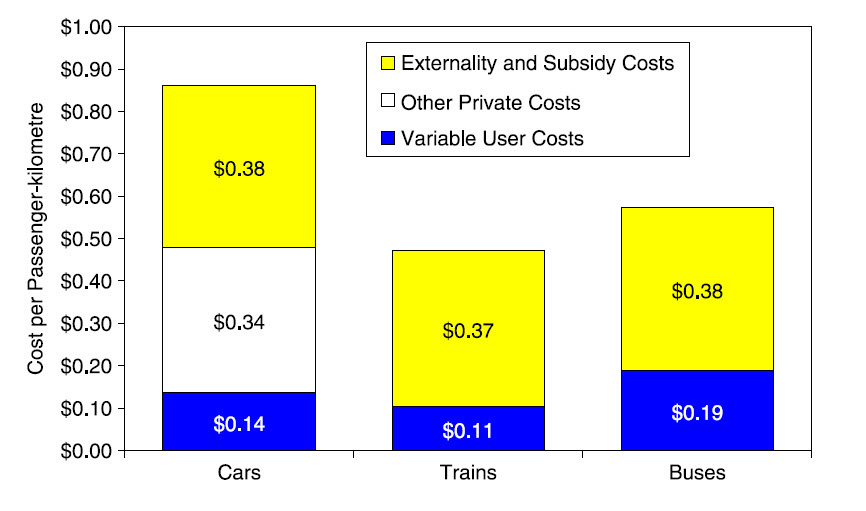
Cost per passenger km by mode in Sydney
This simple but extraordinary chart (see first graphic) is from a paper written last year by one of the country’s leading transport researchers, Dr Garry Glazebrook, of Sydney’s University of Technology.
In the paper, the author estimates the total cost of different transport modes, taking account of both private and social (i.e. external) costs. The costs are based on Sydney.
A number of interesting things about travel are evident from the chart, some of which are familiar and some which may surprise.
First, both private and public transport modes generate significant social costs. These costs are borne generally by society, “either in the form of subsidies (e.g. rail and bus subsidies from government, or hidden parking subsidies for car users) or in the form of externalities (including pollution, congestion, accidents, etc)”.
Second, although their composition is quite different, the social costs of private and public transport are essentially the same, at around 38c per passenger kilometre. One big difference of course is that subsidies for public transport are paid in actual dollars by government whereas the social costs of cars are largely an unpaid burden on others (primarily other road users). Read the rest of this entry »
What if the price of petrol doubled?
Posted: November 10, 2010 Filed under: Cars & traffic | Tags: growth, incomes, patronage, petrol price, Public transport, wages 10 Comments One clue to the likely consequence of a major hike in the price of petrol is provided by the recent past. As it happens, the price almost doubled within the last ten years.
The accompanying chart, which is based on ABS data, shows the nominal price increased 100% between March 2000 and September 2008. Fortunately it’s dropped back substantially since then. Even so, the current price is still around 80% higher than it was ten or eleven years ago.
It is therefore instructive to look at how drivers responded to this increase in costs.
In part, travellers adjust to higher petrol prices by driving more carefully, driving less and by buying more fuel-efficient cars. While there have been some improvements in this respect, they’re not spectacular. The average fuel consumption of new light vehicles is now around 8 litres per 100 km. Yet the average consumption of the national fleet is still up at 11 litres per 100 km. Moreover, the potential benefits from more fuel-efficient cars are not being fully realised because of increasing consumer demand for larger, more powerful and more luxurious vehicles.
Some travellers respond to higher petrol prices by switching to public transport. Indeed, there was a significant increase in demand for public transport over this period, especially from around 2004-05. However this was from a small base and public transport still only accounts for around 14% of all weekday trips in Sydney and Melbourne.
Like most things, this increase in patronage is very likely the result of a combination of factors. While there seems little doubt that the higher price of petrol is a factor, it is by no means certain it is the most important one. Read the rest of this entry »
Is management of public transport a mess?
Posted: November 9, 2010 Filed under: Public transport | Tags: coordination, flowchart, Greens, management, PTUA, Public transport, Public Transport Users Association, State Election, Victoria 10 Comments
Who is responsible for public transport? (PTUA)
It seems the way management structures and processes are arranged is still the key public transport solution being advanced in the Victorian election campaign.
The first three points in the Green’s Six Point Transport Plan all relate to governance and management. Now the Public Transport Users Association (PTUA) has released this chaotic flowchart with the charge that “a hundred different organisations are running public transport in Victoria” (see first graphic).
The PTUA says the flowchart illustrates how difficult it is for the average person to work out who to contact with questions and problems. This is a brilliant and no doubt effective piece of politics, building on the glorious history of spaghetti diagrams like Barry Jones’ famous Knowledge Nation vision.
As I’ve argued before, I think management arrangements are a second order issue – there’re more important things to get right first. And I’m by no means arguing that current arrangements are ideal or can’t be improved.
But there are a number of reasons why this flowchart is not a fair and reasonable account of the way transport is managed in Victoria.
First, as pointed out by a commenter (Invincible) over at Skyscrapercity.com, this is a deceptive diagram – flow charts usually flow from top left to bottom right, otherwise they will always look misleadingly complex. Invincible has redrawn the same information in a more logical flow, producing a vastly simpler diagram (see second graphic). Read the rest of this entry »
Why does Canberra have more social capital?
Posted: October 13, 2010 Filed under: Planning, Social and community | Tags: ACF, andrew leigh, Australian Conservation Foundation, Canberra, commuting, Disconnected, Public transport, regions, social capital, travel time 3 Comments Newly elected Labor member for the seat of Fraser in the ACT, Andrew Leigh, argues that Canberra has the highest level of social capital of any of Australia’s capital cities.
The former ANU economist contends that social capital – essentially the level of trust and reciprocity within communities – has declined in Australia. He points to declines in active membership of associations, in religious participation, and in membership of political parties and unions.
We even have fewer close friends now than in the 80s – we’ve two fewer friends who could keep a confidence and we’ve lost half a friend who’d help us through a hard time.
Andrew concludes that there are several plausible explanations for this decline, including people working longer hours, the feminisation of the workforce and greater ethnic diversity. In addition, more time spent watching television, using a computer and commuting means less time spent face-to-face with others.
Most of these changes also have benefits, so he cautions against trying to return to the past. We need new and innovative ways to build social capital. He argues that the place to look for how we might increase social capital is Canberra. This is where it gets really interesting. Read the rest of this entry »
Should public transport users pay their way?
Posted: September 27, 2010 Filed under: Public transport | Tags: congestion pricing, cost recovery, fares, Funding, LEK, Meeting the Funding Challenges of Public Transport, Public transport, Tourism & Transport Forum, transit 9 Comments
The peak industry body, Tourism and Transport Forum Australia, got itself into hot water with the media last week. The Forum suggested in a new report, Meeting the funding challenges of public transport, that eligibility for concession fares should be drastically restricted.
The brouhaha was unfortunate because the Forum’s underlying contention – that public transport in Australia should be operated on a full cost-recovery basis – is worthy of closer examination. Closer examination, that is, provided we’re talking about recovering full costs from those who can afford it!
At present, fares only account for approximately 36% of public transport operating costs across Australia’s five largest cities according to the Forum’s consultant’s, LEK. They say the rest comes from Government subsidies and is low compared to an international average of 60%.
The challenge facing governments in Australia is simple enough. Public transport capacity has to increase enormously to deal with expected higher demand driven by issues like peak oil, climate change and unprecedented population growth. For example, patronage has already grown 5% p.a. over the past five years in Brisbane and Melbourne. Read the rest of this entry »
Public transport: time for a new paradigm?
Posted: September 12, 2010 Filed under: Cars & traffic, Planning, Public transport | Tags: Cars, energy efficiency, Public transport, sustainability 22 Comments Sorry for the hoary cliché but I really do think it’s time for a new way of thinking about public transport.
Much of the debate on transport in cities is too simplistic. All too frequently it’s reduced to a simple nostrum: “replace all car travel with public transport”. I think it’s more complex than that and, to use another cliché, requires a more nuanced approach.
Let me be clear from the outset that there are compelling reasons why we need to invest more in public transport – for example, to provide mobility for those without access to a car. Another reason is to provide an alternative to roads that are becoming increasingly congested.
But I’m not convinced that the reason most commonly advanced – to overcome the environmental disadvantages of cars – is all that persuasive. Here’s why. Read the rest of this entry »
Will providing better transit be enough to cope with city growth?
Posted: September 6, 2010 Filed under: Cars & traffic, Public transport | Tags: congestion pricing, private transport, Public transport, road pricing, transit 9 Comments
Policies on Public Transport and Private Transport - you can't have one without the other
It might seem counter-intuitive, but you can’t increase public transport’s share of travel significantly unless you simultaneously do something about cars. Yet this simple relationship is usually ignored by governments and lobbyists alike.
Back on 23 August I looked at the question of how our cities could grow larger but still be liveable. Public transport has a vital role in meeting this challenge, but the task is daunting. Notwithstanding current overcrowding on the train system, public transport’s share of all motorised travel is only around 11% in Melbourne and a little higher in Sydney.
The standard recipe for increasing transit’s share of travel is to offer a better product. This is popularly thought of as more trains and more light rail (only occasionally more buses).
It usually involves providing some combination of greater route coverage, higher frequencies, longer operating hours, faster speeds, better connections, more information and higher levels of comfort and security.
Improving quality seems a self-evident solution. After all, the area of the city with the best public transport offering – the CBD – is also the area where public transport scores best against the car. For example, 43% of all motorised work trips to the inner city in Melbourne are made by public transport and this study suggests the figure for the CBD is probably upwards of 65%.
This strategy works – but only up to a point. Consider, for example, the Melbourne inner city municipality of Yarra. It has a pretty high standard of train and tram services, yet 86% of all motorised weekday travel by residents of Yarra is still made by car (or 74% when walking and cycling are also included). Read the rest of this entry »
Why do major infrastructure projects fail?
Posted: September 2, 2010 Filed under: Cars & traffic, Infrastructure, Public transport | Tags: Clem 7, Clem Jones Tunnel, infrastructure failures, Infrastructure financing, Matt O'Sullivan, Midtown Tunnel, Peninsula Link, Public transport, Rivercity Motorway, roads 15 Comments
Selected road and rail infrastructure projects (data from The Australian)
It was reported this week that the new Clem Jones Tunnel in Brisbane (known as the Clem7) is in diabolical financial trouble due to traffic levels that are well below those forecast.
Fewer than 30,000 vehicles a day are using the tunnel even though tolls were halved from 1 July (now $2 for a car). This compares with a forecast of 60,000 on opening, rising to 100,000 after 18 months. The operator of the tunnel, Rivercity Motorway, posted a $1.67 billion loss for the year to 30th June.
Clem7 joins a growing list of infrastructure projects funded on the basis of overly optimistic forecasts of initial usage. These include Sydney’s Lane Cove and Cross City tunnels, the Brisbane and Sydney airport trains, Melbourne’s Eastlink, and the 2,250 km Freightlink rail line connecting Adelaide and Darwin.
The Age’s Matt O’Sullivan is gob-smacked that Clem7’s transport consultants could have forecast traffic levels higher than those on New Yorks Midtown Tunnel, given that Brisbane’s population is a quarter of the City of New York’s:
“Yet traffic forecasters predicted that thousands more motorists would use the new Clem7 tunnel under the Brisbane River every day than another four-lane artery in New York linking Queens with central Manhattan.
“Running under the East River, the two-kilometre Midtown Tunnel has had about 80,000 vehicles passing through it each day. And it has been that way for much of the 70-year-old tunnel’s life. Half a world away in the Sunshine State, well-paid traffic forecasters had predicted that 91,000 vehicles daily would use the Clem7 by now and, by late next year, more than 100,000”.
What strikes me immediately is that this is not a sensible comparison. It’s highly likely the Midtown Tunnel is at capacity and probably has been for a very long time. Read the rest of this entry »
How to pay for public transport?
Posted: September 1, 2010 Filed under: Public transport | Tags: congestion pricing, Funding, Independent Public Inquiry into a Long Term Public Transport Plan for Sydney, Public transport, rail, Regional Rail Link, road pricing 8 Comments
Additional revenue from fare increase, Sydney - three scenarios (Independent Inquiry)
I was pleased to see the call earlier this week by The Age’s city editor, Jason Dowling, for tolling of roads to be introduced in Melbourne (Losing our way on roads).
He sees it as a way to reduce congestion and generate revenue for public transport improvements. Road pricing is something I’ve advocated on a number of occasions (here and here), but what particularly caught my eye in Mr Dowling’s article was his opening line:
“Everyone pays for public transport, first through taxes and then through fares, and it is time everyone had access to it, just as they do to roads”.
Few would disagree that Melbourne would be a more attractive place if it were as easy to access a train, tram or bus as it is a car. Somewhere along the line, however, the issue of cost has to be considered. Transport projects are very expensive. The State Government is spending about $2.5 billion on increasing the capacity of Victoria’s rail and road systems this year.
At that rate it will take many decades to improve the capacity of Melbourne’s public transport system. Just one project, the Regional Rail Link, is costing $4.3 billion in total and is only proceeding because the Federal Government is contributing $3.2 billion. Read the rest of this entry »
Should public transport fares to the airport be subsidised?
Posted: August 10, 2010 Filed under: Airports & aviation, Public transport | Tags: Every 10 Minutes to Everywhere, Melbourne airport, Metlink, Public transport, Public Transport Users Association, rail link, Skybus, Smartbus 13 Comments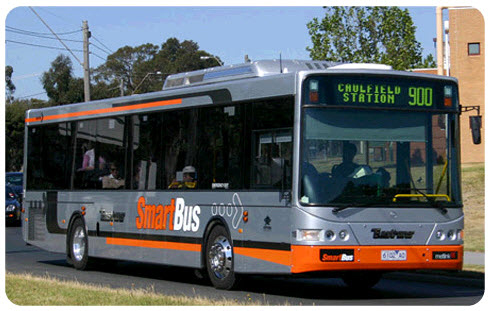 Yesterday’s discussion of an airport-CBD rail link prompts me to look further at the idea that airport users have a “right” to public transport priced at the standard Metlink tariff.
My first reaction is that the idea makes sense. After all, everywhere else in Melbourne is provided with public transport subsidised by the Government (no matter how inadequate it might be). Melbourne Airport is also one of the largest suburban activity centres in the metropolitan area, with around 12,000 workers.
If travel to and from the Airport were charged in accordance with the Metlink tariff, the fare to the CBD would be the standard Zone 1-2 fare of $5.80 one-way. But while it might be the equitable solution it doesn’t follow that it’s the sensible one, the necessary one, or the one that’s in the best interests of all Melburnians. Read the rest of this entry »
What should be done about cars?
Posted: July 21, 2010 Filed under: Cars & traffic, Energy & GHG | Tags: Cars, congestion, Julia Gillard, Public transport, road pricing, Tony Abbot, traffic 12 Comments I’d like to see one of our political leaders steal a march in this election campaign by promising to do something about the environmental and ‘quality of life’ issues associated with car use.
Almost everyone recognises the weakness of our current car fleet in the face of climate change and peak oil, but no one seems to want to do much about it. Most of the focus is on expanding public transport and increasing urban density – at first glance this sounds good, but even on the most optimistic view cars are going to be the dominant mode in Melbourne for a long time yet.
For example, the Victorian Government set a target in Melbourne 2030 to increase public transport’s share of motorised trips to 20% by 2020 (it’s currently around 11%). The report of the Independent Public Inquiry into a Long-Term Public Transport Plan for Sydney, which was released earlier this year, aims to increase public transport’s share of all travel in Sydney to 25% over the next 30 years (currently around 16%) and walking and cycling’s to 10% (page 152)*.
Even if petrol prices suddenly went stratospheric, it would take decades to expand public transport ‘s capacity to a level where it could handle the majority of trips. And it would still have to compete for funding with other areas of serious need like health, education and social housing. This would be more complicated if dramatically higher petrol prices were accompanied by a severe contraction in economic activity. Read the rest of this entry »
Why is Gen Y driving less?
Posted: June 28, 2010 Filed under: Cars & traffic, Public transport | Tags: baby boomers, driving less, Gen Y, internet, Public transport 9 CommentsAfter growing consistently for many decades, car use is falling in developed countries (e.g. USA, Australia, Britain). A notable aspect of this decline is the fall-off in driving by young people.
New data from the US Federal Highway Administration (see here and here) shows that although they increased their share of the US population slightly over the period, those aged 21-30 accounted for only 14% of all miles driven in 2009, compared to 21% in 1995. Another study reports that in 2008 only 49% of 17 years olds had driver’s licenses compared to 75% in 1978.

There is now a sharp difference between Gen Y and baby boomers. A typical 58 year old in the US last year drove 11,607 miles, while the average 28 year old drove just 7,011 miles.
Neither the GFC nor the recent escalation of petrol prices fully account for these changes because the decline in driving preceded these events. So what is driving Gen Y to abandon what has traditionally been one of the great rewards of coming-of-age?
The explanation usually advanced is that the internet has enabled electronic communication to substitute for face-to-face contact. As I’ve pointed out before, however, reputable researchers conclude the exact opposite – electronic communication increases the demand for face-to-face contact more than it substitutes for it. Read the rest of this entry »
Will cars destroy Preston Market?
Posted: June 4, 2010 Filed under: Activity centres, Cars & traffic, Planning | Tags: gentrification, parking, Public transport, retail, Victoria Market 4 CommentsThe biggest threat to Preston Market is cars.
I got thinking about this after I had lunch there last Friday. As always, I was taken in by the mad rush and vitality of the place and the sense that much of it is still essentially the same as it was when it started. I was surprised to learn that it’s a relatively young institution, having only been established in 1970 (although Preston proper is considerably older – it was connected to Flinders Street by rail in the 1920s and experienced a major population boom in the 1950s).
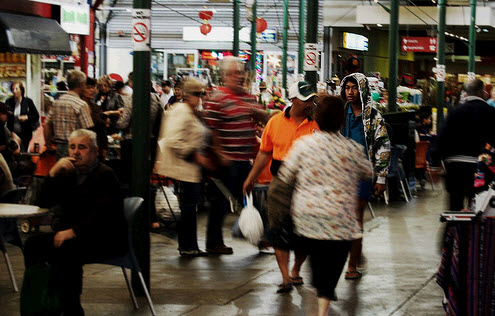
Initially, I was wondering if the Market is vulnerable to the increasing gentrification in the area, but then I realised Victoria Market has withstood demographic changes in the inner city reasonably well. Sure, it’s pretty middle class now but the deli and meat sections at Vic Market are unsurpassed in Melbourne. So while gentrification of Preston Market will undoubtedly diminish its authenticity – and that is the vital ingredient for some customers – it will not necessarily undermine its viability.
Which brings me to the threat to the Market posed by cars – not too many cars, but too few!
I saw a flyer issued by the Market parking manager to stall holders advising of a new parking scheme. I don’t know when it commences, but rather than fine parkers who stay beyond the initial free two hour period (one hour near Aldi), the new arrangement will charge them $1 for each additional hour. How that will work financially for the parking operator is a puzzle (how will they administer it cost-effectively?), but it’s their money. Read the rest of this entry »
Why do inner city residents walk and tram to work?
Posted: June 3, 2010 Filed under: Planning, Public transport | Tags: CBD, Cycling, density, Inner city, new urbanism, Orenco, Public transport, socioeconomic status, sustainable transport, symbolic analyst, traffic congestion, walkability 4 CommentsMore than half of all trips to work by residents of the inner city are made by walking, cycling or public transport. In fact three quarters as many residents walk and cycle as use public transport for their commute.
Why? Is it because of the higher density of the inner city?

Inner city Melbourne (photo by ExTester)
The view that density predicts more sustainable transport use is a common one. While it has some role, it is not the key force at play here. In fact there’s evidence that the population density of some parts of the inner city is not that much higher than that of the suburbs – this is because the average size of households in the inner city is relatively small compared to suburban locations.
There are also examples of higher density developments where use of public transport is quite low, for example edge cities in the US and suburban New Urbanism developments like Orenco in Portland, Oregon.
So if density isn’t the primary force driving more sustainable transport use in the inner city, what is?
Here are four plausible explanations.
The first is proximity. Inner city residents live cheek by jowl with the largest concentration of jobs in the metropolitan area – the inner city has 28% of all metropolitan Melbourne’s jobs and the CBD, despite its diminutive geographical size, has 14.5%. There is no other location in Melbourne that comes within cooee of the job density of the CBD. Read the rest of this entry »
What if you were the Premier?
Posted: May 27, 2010 Filed under: Cars & traffic, Education, justice, health, Public transport | Tags: Alcohol, Cars, Melbourne, Premier, prohibition, Public transport, road pricing, Victoria 3 CommentsImagine you’ve just been elected Premier. You carried the electorate on a simple but radical two-promise platform: (1) to prohibit alcohol and (2) to shift all travel out of cars and onto public transport.
The Party is solidly behind you. Members agree that both alcohol and cars are bad for the individual and bad for society. You’re lauded as a reformer.

But you’ve not long been in office before you discover just how entrenched car use is in your largest city. Just 10% of trips are made by public transport and 90% of households have at least one car. Less driving would make the community better off but you quickly discover how much people like doing things that are bad for them and bad for others. You have a stiff drink.
For all their talk about sustainability, your predecessors knew the electorate loved cars. The former Premier talked-the-talk about public transport and even threw a few paltry dollars its way, but at the end of the day she didn’t do anything that would come between voters and their cars.
Eager to get started, you begin your quest to reduce car use by investing massively in public transport. You mortgage the State budget for the next 50 years in an endeavour to provide high quality, metro-style public transport across the entire city. Travellers without access to a car, like school children and tourists, think you’re God. CBD workers think you’re Gary Ablett. But you fail to notice that most of them either don’t vote or don’t live in marginal electorates. Read the rest of this entry »
More on rail link to airport
Posted: March 13, 2010 Filed under: Airports & aviation, Infrastructure, Public transport | Tags: ACCC, airport, Melbourne, parking, Public transport, rail, taxi, The Age, traffic congestion 9 CommentsThe Age is continuing its campaign for a new rail line to be built from the city centre to Melbourne Airport (I discussed this previously on March 2 – Possible rail link to Melbourne airport). There are also a couple of follow-up letters this morning supporting the idea of a rail link.
In a story yesterday, Airport ‘exploiting’ public on parking fees, The Age reported on a new analysis by the ACCC of airport performance in Australia, noting that parking charges account for 20% of Melbourne Airport’s revenue but just 8% of Sydney Airport’s.
The Age’s reporter, Ari Sharp, said the figures, “could add to calls for a rail link to Melbourne Airport to help overcome the growing problems – and costs – of getting there by car or bus”.
However contrary to The Ages’s apparent inference, the difference in the Sydney and Melbourne figures does not appear to be caused by a rapacious parking operator ripping off travellers who lack an alternative to driving.
What the story didn’t say was that Sydney Airport’s revenue from charges to airlines is $446 million, compared to Melbourne Airport’s comparatively modest $197 million. Parking revenues are much the same ($88m and $95m respectively), hence it’s not at all surprising that parking makes up a much larger proportion of total revenue in Melbourne than Sydney. Read the rest of this entry »
What role for commuting by bicycle in Melbourne?
Posted: March 11, 2010 Filed under: Cycling | Tags: bicycle, commuting, Melbourne, Public transport, road pricing, sprawl, suburbs 2 CommentsIn response to my post last Tuesday, Melbourne will be a car city for a long time yet, a reader asked for my views on the role of cycling in Melbourne.
I have a particular interest in cycling, not least because I’m a keen recreational cyclist and commuted religiously by bike for a number of years. I think cycling has a small but significant role to play in meeting Melbourne’s transport needs but my ideas are a little different to the conventional view.
Despite record sales over the last ten years, bicycles account for just 0.9% of all weekday kilometres travelled in Melbourne, so their present contribution to saving fuel and reducing carbon emissions isn’t large. That figure includes recreational cycling too, so we don’t know how many of these kilometres actually replaced car travel.
Bicycles are more competitive for commuting, where they are used for 2.9% of work trips. The journey to work, however, only accounts for around one fifth of all trips in Melbourne, so again we’re not talking big numbers. Read the rest of this entry »
Melbourne will be a car city for a long time yet
Posted: March 9, 2010 Filed under: Cars & traffic | Tags: compressed natural gas, electric car, environment, Melbourne, Public transport, sprawl, suburbs 14 CommentsIt seems likely that many more Melbourne travellers will drive cars in the foreseeable future than take public transport.
This is not necessarily the disaster that it might at first appear – improvements to the environmental and fuel efficiency of cars will make them much more environmentally friendly and offer a fair trade-off for their many advantages. Read the rest of this entry »
 The Melbourne Urbanist