Cycling and walking on the rise in US
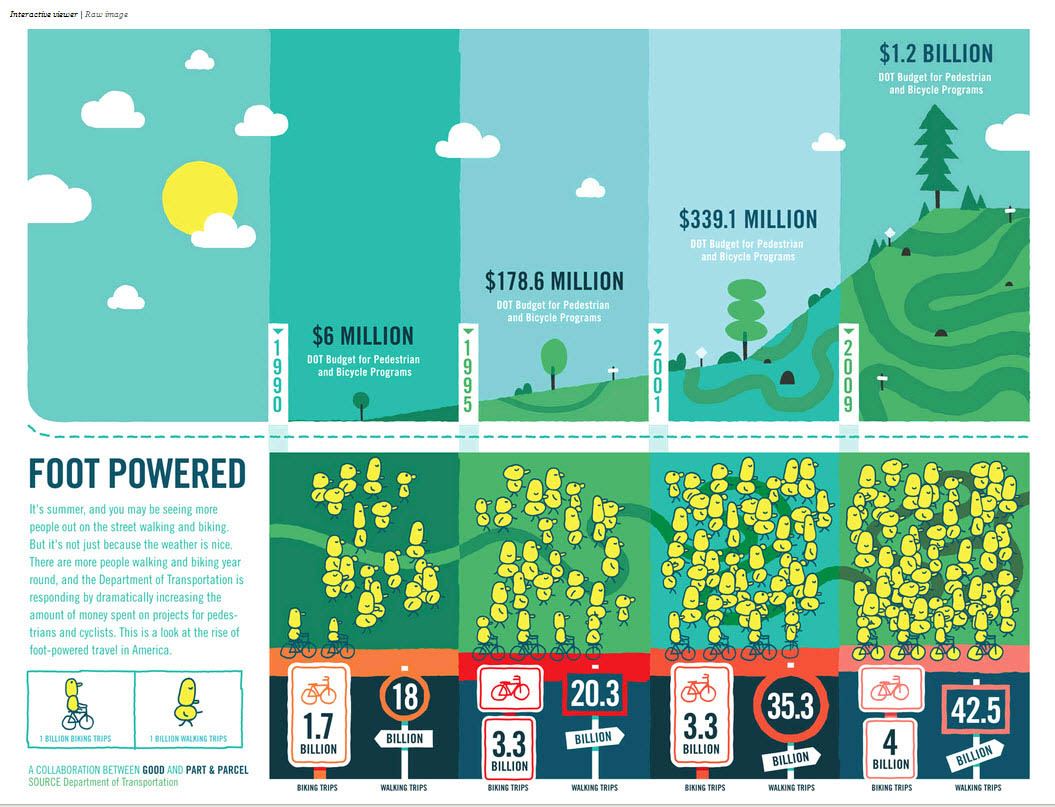
Posted: July 4, 2010 Filed under: Cycling | Tags: biking, Cycling, GOOD, Ray LaHood, US Department of Transportation, walking Leave a commentThis graphic is from GOOD and is titled The Rise of Walking and Biking (click to enlarge). The supporting text says “You may be seeing more people out on the street walking and biking. But it’s not just because the weather is nice. There are more people walking and biking year round, and the Department of Transportation is responding by dramatically increasing the amount of money spent on projects for pedestrians and cyclists”.
The increase in walking and cycling has comfortably out-paced population growth. Nevertheless, the ‘headline’ message is the increase in expenditure by the US Department of Transportation on sustainable forms of travel – it has risen much faster than either walking or cycling (from $6 million in 1990 to $1.2 billion in 2009), particularly since President Obama appointed former Republican House of Reps Member, Ray LaHood, to the position of Secretary of Transportation.
$1.2 billion looks good, but bear in mind that President Obama’s budget request for FY 2010 is over $3.5 trillion.
More on Melbourne Airport rail link
Posted: July 2, 2010 Filed under: Airports & aviation, Infrastructure, Public transport | Tags: Melbourne airport, rail link, Skybus, Tullarmarine freeway 19 CommentsThere’s been a strong reaction, predominantly negative, to my oped in The Age this morning where I argue that there are higher priorities for scarce transport funding at this time than the CBD-Airport rail link championed by the Lord Mayor and The Age.
I expected a hot reaction because The Age’s online poll is currently running 97% in favour of a rail link. Also, there were 208 comments, almost all strongly in favour of a rail link, on this piece run by The Age last Monday.
Some commenters seem to think my brief must be to defend the Minister for Transport and the Government. Others think I must be in the pocket of Skybus, the taxi industry, the Government, or all three. Someone’s even accused me of being anti public transport and of lamenting the decline in driving in my earlier post Why is Gen Y driving less? Lukas, who says he works in DPCD, reckons the consensus “around here” is we do need the link and the reason it’s not happening is “so many industries …have their hands in Brumby’s pockets”. Phew!!
Now that the flood of invective is slowing, let me say that not one of these personal insinuations is true. It is possible to raise serious questions about the desirability of this or any other transport project without being corrupt, incompetent or worse. No project, rail or otherwise, is automatically a “no brainer”.
My point remains that on the information publicly available, it does not seem to me that a rail link from the CBD to the airport is as high a priority at this time as some other pressing transport needs, such as improving outer suburban public transport services. Airport users generally have much better, if imperfect, options at present than those who live in the vast reaches of suburbia. Read the rest of this entry »
What makes you happy?
Posted: July 1, 2010 Filed under: Miscellaneous | Tags: Danny Dorling, Dimitri Ballas, happiness 2 CommentsThis question is important to everyone, including those most concerned with urban policy (believe it or not). One answer, which emphasises the dynamic over the static, is in this paper by Dimitri Ballas and Danny Dorling, Measuring the impact of major life events upon happiness, International Journal of Epidemiology, 2007, 36(6) 1244-1252. Here’s the authors’ summary:

Background
In recent years there have been numerous attempts to define and measure happiness in various contexts and pertaining to a wide range of disciplines, ranging from neuroscience and psychology to philosophy, economics and social policy. This article builds on recent work by economists who attempt to estimate happiness regressions using large random samples of individuals in order to calculate monetary ‘compensating amounts’ for different life ‘events’. We estimate happiness regressions using the ‘major life event’ and ‘happiness’data from the British Household Panel Survey.
Results
The data and methods used in this article suggest that in contrast to living states such as ‘being married’, it is more events such as ‘starting a new relationship’ that have the highest positive effect on happiness. This is closely followed by ‘employment-related gains’ (in contrast to employment status). Also, women who become pregnant on average report higher than average levels of subjective happiness (in contrast to ‘being a parent’). Other events that appear to be associated with happiness according to our analysis include ‘personal education-related events’ (e.g. starting a new course, graduating from University, passing exams) and ‘finance/house related events’ (e.g. buying a new house). On the other hand, the event that has the highest negative impact upon happiness according to our analysis is ‘the end of my relationship’ closely followed by ‘death of a parent’. Adverse health events pertaining to the parents of the respondents also have a high negative coefficient and so does an employment-related loss. Read the rest of this entry »
Minister for Sustainable Population: What’s in a name?
Posted: June 30, 2010 Filed under: Energy & GHG, Population | Tags: externalities, Julia Gillard, Minister for Sustainable Population, Prime Minister, Tony Burke Leave a commentThe new Prime Minister’s minor renaming of the Population portfolio to Sustainable Population suggests there’s a political agenda in play and a new way of thinking about “big Australia”. The terms sustainability and population have been conflated so the Government can walk a new path through the “big Australia” and “boat people” minefields.
But what it’s also saying is that you can’t have one without the other – population growth and environmental sustainability have to be traded off. The two concepts are necessarily in conflict, always and forever.

Population distribution, Australia (www.worldmapper.org)
While that’s perhaps true in a narrow sense, it doesn’t follow that Geelong is necessarily more environmentally sustainable than Melbourne (according to the ACF it isn’t!) or that both have a lower environmental “footprint” than New York.
In fact despite its considerably larger size, New York is substantially more environmentally sustainable than Melbourne. Large concentrations of people provide economies of scale in, for example, the consumption of energy by favouring travel by public transport and smaller, attached dwellings. Bigger is often more environmentally sustainable.
Of course bigger cities also tend to produce larger negative externalities. But the main reason that size is often accompanied by problems like traffic congestion and unaffordable housing is the failure of political and policy systems. Read the rest of this entry »
Are new outer suburban homes getting smaller?
Posted: June 29, 2010 Filed under: Growth Areas, Housing | Tags: floor area, growth areas, home size, Housing, lot size, Oliver Hume, sprawl 3 CommentsThere was a flurry of almost salacious excitement in the media at the end of last year when an ABS study found that Australians have the largest homes in the world. Worse, it found Victorians have the biggest homes in the country.
The Age reported that houses and apartments in Australia are bigger than those in the United States, which has traditionally had the most spacious homes:
“While Australian home sizes have risen 10 per cent over the past decade, research shows sizes of new American homes have fallen from a peak of 212 square metres to 201.5 square metres”.
 Now property group Oliver Hume has thrown some new light on home sizes in Melbourne. They say that excluding Melbourne’s west, the median size of homes in the other five growth areas actually fell slightly over the last three years.
The largest absolute fall was in Cardinia, where the median home size fell from 267 sq m to 209 sq m, or by 57 sq m. Home sizes also fell in Casey, Hume and Whittlesea but increased in Wyndham and Melton. This does not, however, indicate an across-the-board change in preferences toward smaller houses.
According to Oliver Hume’s research manager, Mr Andrew Perkins, much of the drop in house size can be attributed to the increase in the number of first home buyers in the 2007-2008 period, when they accounted for an unprecedented 70% of all sales across the growth areas. Read the rest of this entry »
Why is Gen Y driving less?
Posted: June 28, 2010 Filed under: Cars & traffic, Public transport | Tags: baby boomers, driving less, Gen Y, internet, Public transport 9 CommentsAfter growing consistently for many decades, car use is falling in developed countries (e.g. USA, Australia, Britain). A notable aspect of this decline is the fall-off in driving by young people.
New data from the US Federal Highway Administration (see here and here) shows that although they increased their share of the US population slightly over the period, those aged 21-30 accounted for only 14% of all miles driven in 2009, compared to 21% in 1995. Another study reports that in 2008 only 49% of 17 years olds had driver’s licenses compared to 75% in 1978.

There is now a sharp difference between Gen Y and baby boomers. A typical 58 year old in the US last year drove 11,607 miles, while the average 28 year old drove just 7,011 miles.
Neither the GFC nor the recent escalation of petrol prices fully account for these changes because the decline in driving preceded these events. So what is driving Gen Y to abandon what has traditionally been one of the great rewards of coming-of-age?
The explanation usually advanced is that the internet has enabled electronic communication to substitute for face-to-face contact. As I’ve pointed out before, however, reputable researchers conclude the exact opposite – electronic communication increases the demand for face-to-face contact more than it substitutes for it. Read the rest of this entry »
Does a rail line to Melbourne airport make sense?
Posted: June 28, 2010 Filed under: Airports & aviation, Infrastructure, Public transport | Tags: Booz Allen Hamilton, IMIS, Melbourne airport, rail link, Skybus, The Age, Tullamarine freeway 10 CommentsThe Age ran a front page story on Saturday (Train derailed by buck-passing and vested interests) on the need for a rail link from the airport to the CBD. I say story, but as the headline and this quote indicate, it was more advocacy than news:
“But thanks to decades of buck-passing and pandering to vested interests by successive state and federal governments, Melbourne – unlike so many other cities of its size and wealth – does not have a railway line to its airport”.
So having pressed the civic pride button, it’s a pity The Age didn’t also push the rationality pedal and ask: is there a case for constructing a new public transport system (rail) to compete with the existing one (bus)?
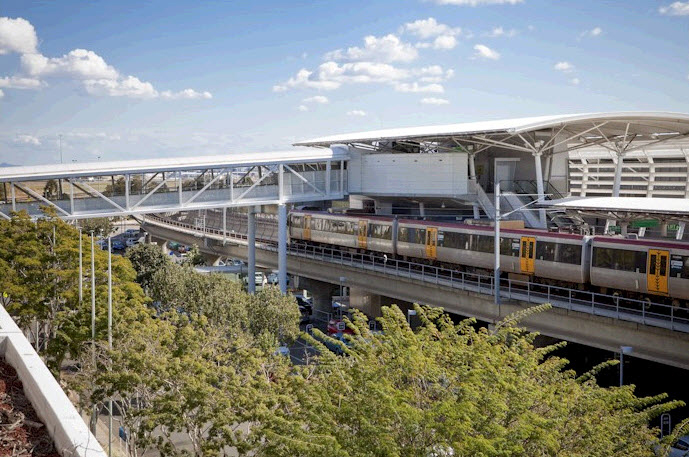
Airtrain terminal Qld international airport
I would quite like to have a rail line from the CBD to the airport, but as I’ve indicated before (here and here), only if it makes sense. Let’s look at some pertinent issues.
First, the feasibility studies undertaken by the Government conclude that the numbers for rail don’t stack up (yet). The most recent evaluations, undertaken in 2001 by BAH and in 2009 by IMIS, both concluded there is not a strong enough case to build a new rail line to the airport.
The Department of Transport projected rail would capture only 9% of all airport trips and would require a subsidy of $350-450 million over 10 years (in 2001 dollars).
Second, in 2003 the Government upgraded the Skybus service so it could deal better with congested conditions around the CBD and on the Tullamarine Freeway. According to the Transport Department, new roadworks enabled Skybus to bypass traffic delays at the Tullamarine/Calder Freeway interchange and at the city fringe. The package included lane widening as well as line marking changes to create an emergency lane wide enough for buses. Read the rest of this entry »
Simple but great piece on climate change
Posted: June 26, 2010 Filed under: Energy & GHG | Tags: Ian mcewan, Michael Beard, solar 1 CommentHere’s a simple but stylishly written and persuasive piece on climate change. It’s a short speech delivered to an audience of big business and investors in London in 2005 by Nobel Laureate and physicist, Professor Michael Beard, famous for devising the Beard-Einstein Conflation.

I can’t locate an on-line copy of the transcript of the entire speech so I’ve typed up just the first few paras:
“The planet is sick. Curing the patient is a matter of urgency and is going to be expensive – perhaps as much as two per cent of global GDP, and far more if we delay the treatment. I am convinced and I have come here to tell you, that anyone who wishes to help with the therapy, to be a part of the process and invest in it is going to make very large sums of money, staggering sums.
“What’s at issue is the creation of another industrial revolution. Here is your opportunity. Coal and then oil have made our civilisation, they have been superb resources, lifting hundreds of millions of us out of the mental prison of rural subsistence.
“Liberation from the daily grind coupled with our innate curiosity has produced in a mere two hundred years an exponential growth of our knowledge base. The process began in Europe and the United States, has spread in our lifetime to parts of Asia, and now to India and China and South America, with Africa yet to come. All our other problems and conflicts conceal this obvious fact: we barely understand how successful we have been. Read the rest of this entry »
London in the time of cholera
Posted: June 24, 2010 Filed under: Education, justice, health, Infrastructure | Tags: cholera, density, health, John Snow, London, Mathew Kneale, Steven Johnson, Sweet Thames, The Ghost Map 2 CommentsI’ve just read The Ghost Map by Steven Johnson. This extraordinary book, which nominally chronicles the campaign of physician Dr John Snow to persuade Victorian England that cholera was caused by contaminated water rather than noxious odours, also takes the reader on long and fascinating asides into topics like how living at density selected for alcohol-tolerant genes.
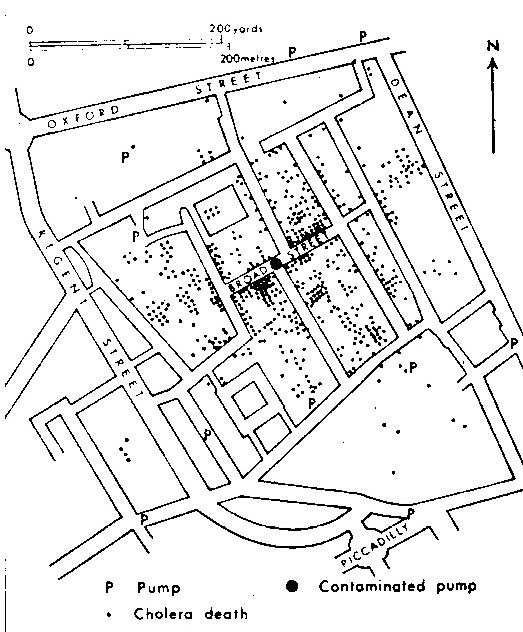
Deaths from cholera, Victorian London
As this article points out, large cities in all parts of the world used to be very dangerous places where the very proximity of humans directly led to disease and death.
I already knew the basics of John Snow’s battle with the established order and his famous map of Broad Street from TV programs and the odd book, like Mathew Kneale’s excellent novel about a Victorian hydraulic engineer, Sweet Thames.
But the particular value of Stevenson’s take on London’s cholera epidemic is the attention it gives to the broader circumstances of the times and the way he burrows deeply into the underlying social, medical and technological issues.
He talks, for example, about how humans living at close quarters historically addressed their vulnerability to polluted water by drinking alcohol instead (notwithstanding it is itself poisonous and addictive). Nothing new about that perhaps, but what is interesting is how the desire to live at higher density gradually selected for genes that could tolerate alcohol: Read the rest of this entry »
Is a bigger Melbourne a better Melbourne?
Posted: June 23, 2010 Filed under: Planning, Population | Tags: Andrew Mcleod, city size, Committee for Melbourne, density, Los Angeles, Manhattan, New York, Shaping Melbourne 6 CommentsThe CEO of the Committee for Melbourne, Andrew Mcleod, advanced an interesting argument about the importance of growth when launching the Committee’s new report, Melbourne Beyond 5 Million, earlier this month.
He contended that Melbourne can get better as it gets bigger. His main argument is that Melbourne in 2010, with 4 million people, is double the size it was in 1960 and is, he says, unambiguously more liveable.

Big city - East Village, Manhattan
So is bigger better? I don’t think I have a definitive answer and I’m not even sure there is one, but I think it’s useful in light of the high population growth projected for Melbourne to canvass some of the issues.
The fear many people have is that a bigger Melbourne will mean housing is less affordable and roads and public transport more congested. Some people also think it would be less safe, less equal and have a much larger per capita ecological footprint.
But there are advantages in getting bigger. Larger cities are usually denser and have a lower ecological footprint than smaller cities. There is also an extensive literature showing that the productivity of cities increases with population.
There are different opinions on the underlying reasons but many observers, like Harvard’s Professor Edward Glaeser, think that big cities enable people to connect and learn from one another. They tend to be more diverse and offer greater specialisation in work, consumption, socialising and ideas.
There are more than thirty cities in the OECD countries alone that have a larger population than Melbourne. They must be doing something right if people want to live in them. For all the complaints made about Los Angeles, many more people seem to want to live there than in Melbourne. Many talented Australians aspire to move to LA to work in specialised industries like entertainment, higher education and technology. Read the rest of this entry »
Winners of ‘App My State’ have an urban focus
Posted: June 22, 2010 Filed under: Miscellaneous, Public transport | Tags: App My State, application, iPhone app, mashup, Transportle, Which Bin? 5 Comments
Transportle: it's a long trip (purple line) from Preston to Ivanhoe station by public transport at 10.30 pm
The winners of the Victorian App My State competition announced last night by the Premier have a distinctly urban orientation. The objective of the competition is to inspire Victorians to create web and mobile applications for Victorians. Entrants compete for $100,000 in prizes.
First prize was won by Jason Smale for his iPhone app, Which Bin?, which helps people understand what items are able to be recycled. He says:
I’ve often seen my mother struggle to read which number is in the tiny recycling triangle on the bottom of yoghurt containers. After about 5 minutes she resorts to using a magnifying glass and finally the often undecipherable number defeats her.
The judging criteria are usefulness, design and development, innovation, useability and this delightful example of bureacratic cool, “The vibe” or overall appeal. Read the rest of this entry »
Should rail commuters pay a congestion toll?
Posted: June 21, 2010 Filed under: Activity centres, Public transport | Tags: Activity centres, CBD, congestion charge, Melbourne @ 5 Million, toll, train, Washington Metro 8 CommentsMelbourne’s peak train services are overcrowded and have been for quite a few years. Given the high costs that peak period commuters impose on the rail system, wouldn’t it be more efficient and more equitable if they paid more for their tickets?
After all, the capacity of the system is determined by peak demand – all those trains and the associated infrastructure and personnel required to handle the peaks are under-utilised or sit idle for the rest of the day and on weekends.

Too crowded to get a seat?
As would be the case with congestion charging on roads, a charge on peak hour train travellers should reduce over-crowding (congestion) by suppressing travel, moving lower value trips to off-peak periods and encouraging shifts to other modes. Passengers who continued travelling in the peak would make a larger contribution towards what it actually costs to get them to work.
I’m prompted to think about this issue by a proposal to levy a $0.50 per trip surcharge on customers of Washington D.C.’s Metro system who use or pass through the network’s busiest stations during the busiest period of the peak. If approved, the congestion toll would apply from next month. Read the rest of this entry »
Is 13 storeys right for Coburg?
Posted: June 20, 2010 Filed under: Architecture & buildings, Cars & traffic, Population | Tags: activity centre, Bell St, Coburg, Coburg High School, Hampton JV (Coburg), Housing Commission, National Rental Affordability Scheme, NRAS, Panel, public art, social housing 5 CommentsWhether you like the look of this building or not, I think the Panel has done a good job in recommending the rezoning and permit pretty much as proposed by the proponent. This is the kind of development Melbourne needs in order to increase densities in established areas (click image below; and here’s another one).
The proposal is for a mixed use development on the old Coburg High School site in Bell St near the intersection with Sydney Rd. It’s a large landmark site of around 1.2 hectares, fronting Bell St in the north, Bridges Reserve in the west and established housing on the other frontages.

It is within the Coburg Principal Activity Centre and will provide 520 residential units spread over 8-13 storeys along the non-residential frontages, stepping down to three storeys where it faces existing housing. It also includes some commercial uses on the Bell St frontage.
The units are very small and therefore relatively affordable (although that’s not the same as value for money!). Around three quarters are proposed to be studios and one bedroom apartments, with a minimum internal floor area of 40 sq m and 44 sq m respectively. The remainder are two bedroom units (minimum 65 sq m). These tiny sizes are around the average for inner suburban apartments – see here.
The project must provide at least 20% of the units for social housing under the planning scheme. However the proponent proposes around half of the units will be allocated to a recognised social housing provider under the National Rental Affordability Scheme.
The Panel’s reasons for supporting the project can be read here. While I endorse their overall direction, I have misgivings about some of their conclusions. Read the rest of this entry »
The VFT and Green’s preferences
Posted: June 19, 2010 Filed under: HSR High Speed Rail, Infrastructure, Public transport | Tags: election, Gary Johns, High Speed Rail, The Australian, The Greens, very fast train, VFT 3 CommentsThis blog has devoted a fair bit of attention to the proposed Very Fast Train between Sydney-Canberra-Melbourne (here, here and here), wondering what warrant there is to replace one form of public transport with another.

More attention in fact than any of the mainstream papers or denizens of the blogosphere have mustered, as far as I can tell.
So readers might be interested in this article by Gary Johns published in The Australian last week. It’s notable because he conjectures that the VFT might be the price the Government has to pay to secure Green preferences in this year’s Federal election.
Don’t think I agree with his analysis of the Greens mind (this is the former Special Minister of State in the Keating Government, isn’t it?) but I think his sources on the economics of the VFT are impeccable. Here nevertheless is a less-than-complimentary take on Johns. Read the rest of this entry »
Will Brumby’s new decentralisation initiative work?
Posted: June 18, 2010 Filed under: Decentralisation, Planning | Tags: Decentralisation, Education, justice, health, Infrastructure, Portland, Ready for Tomorrow, regional centres, sprawl, suburbs 5 CommentsThe Ready for Tomorrow initiative announced by the Premier earlier this week is being sold as a way to relieve growth pressure on Melbourne.
Just why people would move to regional centres on a scale sufficient to ease the demands on Melbourne significantly is not clear, as there’s little in the announcement to suggest the Government has suddenly discovered the secret to growing jobs in the regions.

The track record of policy-driven migration in Australia is poor. The decentralisation schemes of the seventies, based on growing regional centres like Albury-Wodonga and Bathurst-Orange, were conspicuously unsuccessful in lowering growth in the major capital cities.
Decentralisation was supposed to be driven by manufacturing, which at that time was on the march out of the inner city. However rather than moving to regional centres, manufacturing largely moved to the suburbs and offshore. It now offers even less potential for underpinning decentralisation that it did 30 or 40 years ago.
I think the practical impact of Ready for Tomorrow is more likely to lie in enhancing the liveability of the regions than in giving respite to Melbourne. It is really a regional development program. As The Age’s editorial writer points out, even if the annual growth rates of the eight largest regional cities were to double, it would only relieve Melbourne of seven weeks growth.
Nevertheless, I suppose the prospect of cheaper housing and lower congestion in reasonable proximity to Melbourne may be sufficient to attract some new settlers to regional centres, especially if it is hyped as the sensible thing to do by the Government and regional councils. Read the rest of this entry »
Is unused infrastructure capacity in the inner suburbs all used up?
Posted: June 17, 2010 Filed under: Infrastructure, Planning | Tags: ACF, Infrastructure, Inner city, inner suburbs, Justin Madden, Port Melbourne Primary, schools, spare capacity, sprawl, sustainability, The Sunday Age 7 CommentsThere was more evidence in The Sunday Age on the weekend that the spare infrastructure capacity that is widely presumed to be available in the inner city and inner suburbs has in all likelihood already been consumed.
What is unfortunate about this stubborn idea is that there are already sufficient good reasons for increasing housing density in established suburbs without having to resort to unsubstantiated and outdated beliefs.

Proposed 520 unit development, Coburg. How much 'spare' infrastructure capacity will it use?
New research by Professor Kevin O’Conner, Melbourne University, shows that the number of additional students who will be seeking enrolment by 2016 in the inner city and inner suburbs is equivalent to fourteen new schools.
However existing schools are generally at capacity. The principal of Port Melbourne primary is reported as saying “schools in this area don’t have the capacity to cope with more students….looking at my projected enrolments and those of neighbouring schools, and from what I hear about the plans for extra multistorey developments in Southbank and Docklands, we will be full soon”.
He could’ve mentioned that virtually every school within at least 10 km of the CBD already has one or more so-called temporary class rooms including, now, the two story portable, and some are using public parks for play and sport.
Unfortunately there is no credible contemporary analysis of infrastructure capacity and costs in different parts of Melbourne. As I’ve argued before (here and here), there is unlikely to be significant spare infrastructure capacity in the inner established areas. There are a number of reasons for this proposition: Read the rest of this entry »
Is Darwin really Australia’s most sustainable city?
Posted: June 16, 2010 Filed under: Energy & GHG, Planning | Tags: ACF, Australian Conservation Foundation, Darwin, Gold Coast, indicators, Melbourne, Perth, Sunshine Coast, sustainability, Sustainable Cities Index 2 CommentsSo, who knew intuitively that Darwin and the Sunshine Coast are Australia’s most sustainable cities? These startling revelations are from the Australian Conservation Foundation’s newly released Sustainable Cities Index, which examined the country’s 20 largest cities across 15 indicators. Our least sustainable city is Perth, closely followed by Geelong.
And contrary to The Age’s headline that “Melbourne trails in sustainable cities index” and “pales in comparison with Darwin and Brisbane”, Melbourne is the 7th most sustainable of the 20 cities studied (Brisbane is 3rd).
I’ve previously looked at the inappropriateness of the Mercer and Economist indexes as measures of a city’s liveability and I think the ACF’s index is less useful. It seems to be more about publicity than useful research – a feeling reinforced by an absence of technical information on the methodology. It’s actually not an environmental sustainability index per se, but rather a mish-mash of environmental, quality of life and resilience indicators.
It includes indicators like subjective well-being, the rate of volunteering, unemployment levels and the proportion of the population with type 2 diabetes.
I’m sympathetic to the argument that sustainability connects deeply to other facets of life – as the ACF puts it, it’s about learning to live within our environmental means while maintaining social cohesion and liveability. But the fact is most readers of the newspapers that reported on this study (see here and here) think of sustainability as a largely environmental concept. I agree with them – there’s a danger that stretching the term to include liveability measures will ultimately devalue its usefulness and render it virtually meaningless. It would be more sensible to have two or three separate indexes rather than one.
Notwithstanding the confusion about what it’s intended to measure, does the Sustainable Cities Index approach its task in a sensible way? Straight off there are some worrying methodological issues. Read the rest of this entry »
Is the online version of The Age still a paper?
Posted: June 15, 2010 Filed under: Miscellaneous | Tags: Committee for Melbourne, e-commerce, Fairfax, Financial Review, internet, online, review, Sydney Morning Herald, The Age, theage.com.au 4 CommentsI value having The Age delivered to my door each morning, but I’m disappointed with the online version, theage.com.au. I refer to it often, but my experience with the site suggests I’d have to think long and hard before I’d be prepared to pay to access it online.
Charging is of course Fairfax’s ultimate goal (the online version of The Financial Review, which is also Fairfax owned, is pay for use) and seen as a way of making up for the declining popularity of newspapers – sales of the Monday to Friday edition of The Age fell 4% in the March Quarter, 2010. Sales of the Saturday edition fell 5%.

Those video advertisements that automatically start when you click on the site are a real turn-off but I have some sympathy for Fairfax’s search for a financially viable online model (although since I pay for the hard copy, why should I have to endure such intrusive advertising?). No, my disappointment relates to management issues.
A key reason for my dissatisfaction is basic – it’s hard to find stuff on the site. I imagine that many people want to track down an article they recall seeing in yesterday’s paper or last week’s, yet you can’t search by date of publication. You have to know the title or author. That seems like a terribly basic omission to me. Why can’t I look up a simple table of contents for each day, showing the name and author of articles with the ability to jump straight to what I want? Read the rest of this entry »
BP – bringing oil to American shores
Posted: June 12, 2010 Filed under: Energy & GHG, Miscellaneous | Tags: advertisement, BP, Gulf, oil 5 CommentsA sadly prophetic advertisement (not) run by BP in the US in nineties.

Is obesity really caused by suburban sprawl?
Posted: June 11, 2010 Filed under: Education, justice, health, Planning | Tags: CBD, diet, Inner city, Kelvin Thompson, obesity, Suburban sprawl 11 CommentsSuburban sprawl is often linked with rising obesity – for example, see this submission to last year’s Urban Growth Boundary Review from Kelvin Thompson, Labor Member for the Federal seat of Wills, or this article in the Sydney Morning Herald.
The customary argument is that because the incidence of obesity is lower in the inner city where densities are higher, it follows that low density outer suburban development is the cause, or at least a very significant contributor, to obesity.

At first glance this seems to make some sense. For example, only 1.1% of workers in Melbourne’s outer suburbs walk to work, compared to 12.9% in the inner city.
But for all its faults, is it reasonable to put the blame for obesity on sprawl? No, it isn’t reasonable. We would we better off focusing our energies on the real issues associated with sprawl rather than being distracted by sideshows.
The key reason is that what goes in our mouths is more important than how much we exercise. You have to walk the dog for an hour and a half, or cycle for an hour, to burn off the calories in just one Big Mac.
The inner city has a lower incidence of obesity primarily because the residents eat better. And they don’t eat better because of higher density but because they have higher incomes than residents of the outer suburbs and, importantly, higher levels of education. They are more likely to know about the importance of good eating and they are more likely to be able to afford to eat better food. They also have smaller households on average so it’s easier to cook healthy food at home rather than go out for fast food. Read the rest of this entry »
 The Melbourne Urbanist